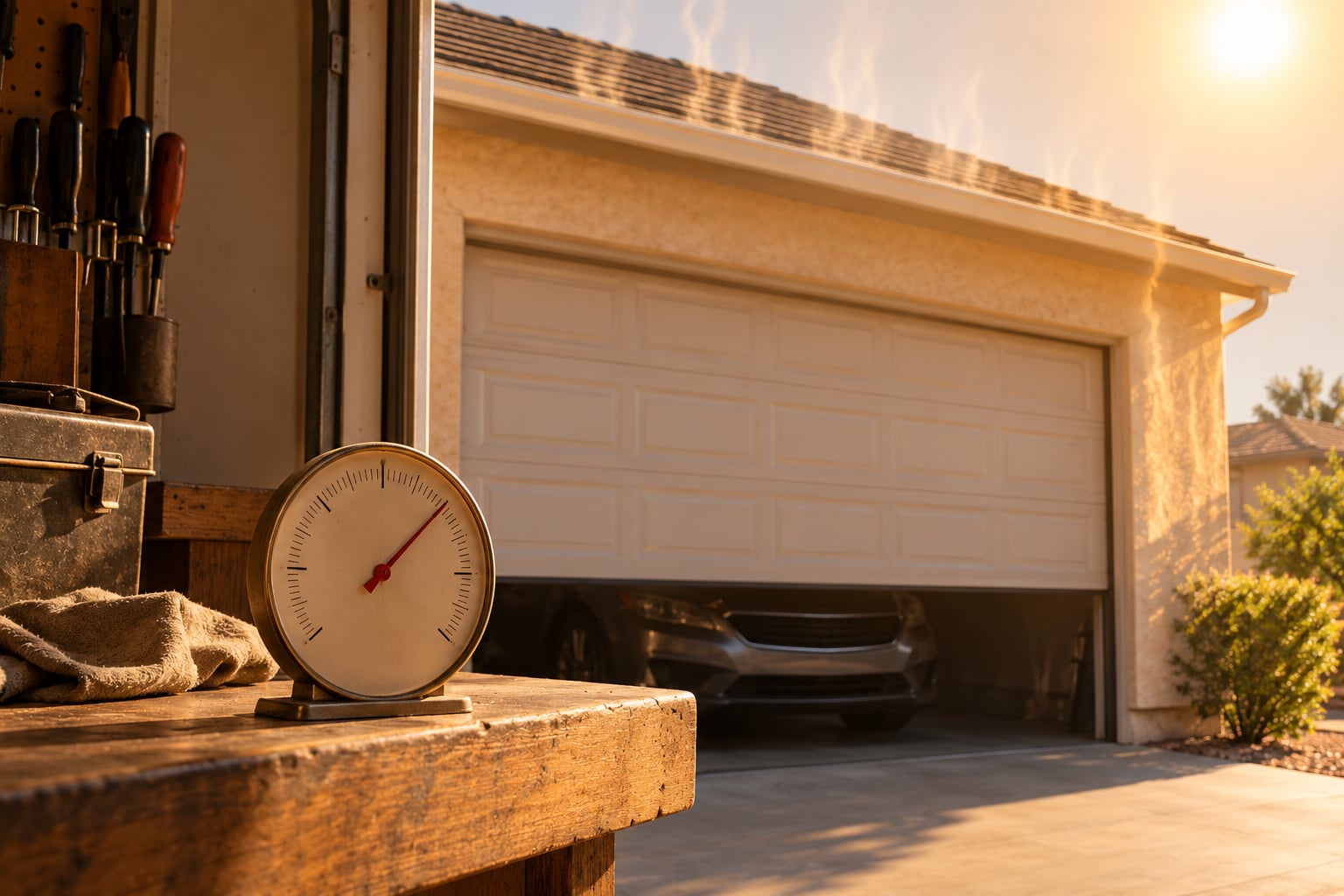
If you are searching for why does my garage get so hot in summer, the short answer is heat gain with no way out. An uninsulated metal door and roof deck absorb direct sun, the bare concrete slab stores that energy and releases it for hours, and a space with no windows and no working vent cannot exhaust any of it. The result is routinely 20 to 40 degrees hotter than the air outside on a sunny afternoon.
That is not a malfunction. A garage built as a parking space for a car is designed to keep rain and snow out, not heat. Once you want to work in it, sleep above it, or store anything heat-sensitive, you are asking a shed to do a conditioned-space job.
Table of Contents
- Why Does My Garage Get So Hot in Summer?
- What Makes a Garage Trap Heat?
- What Should Be Making Your Garage So Hot?
- How Do You Measure Garage Heat and Confirm the Problem?
- How Can You Cool a Hot Garage Safely?
- Do Garage Fans and Air Conditioners Work?
- Can Garage Heat Damage Vehicles, Belongings, or the Building?
- When Should You Call a Professional?
- Frequently Asked Questions
- What To Do First
Why Does My Garage Get So Hot in Summer?
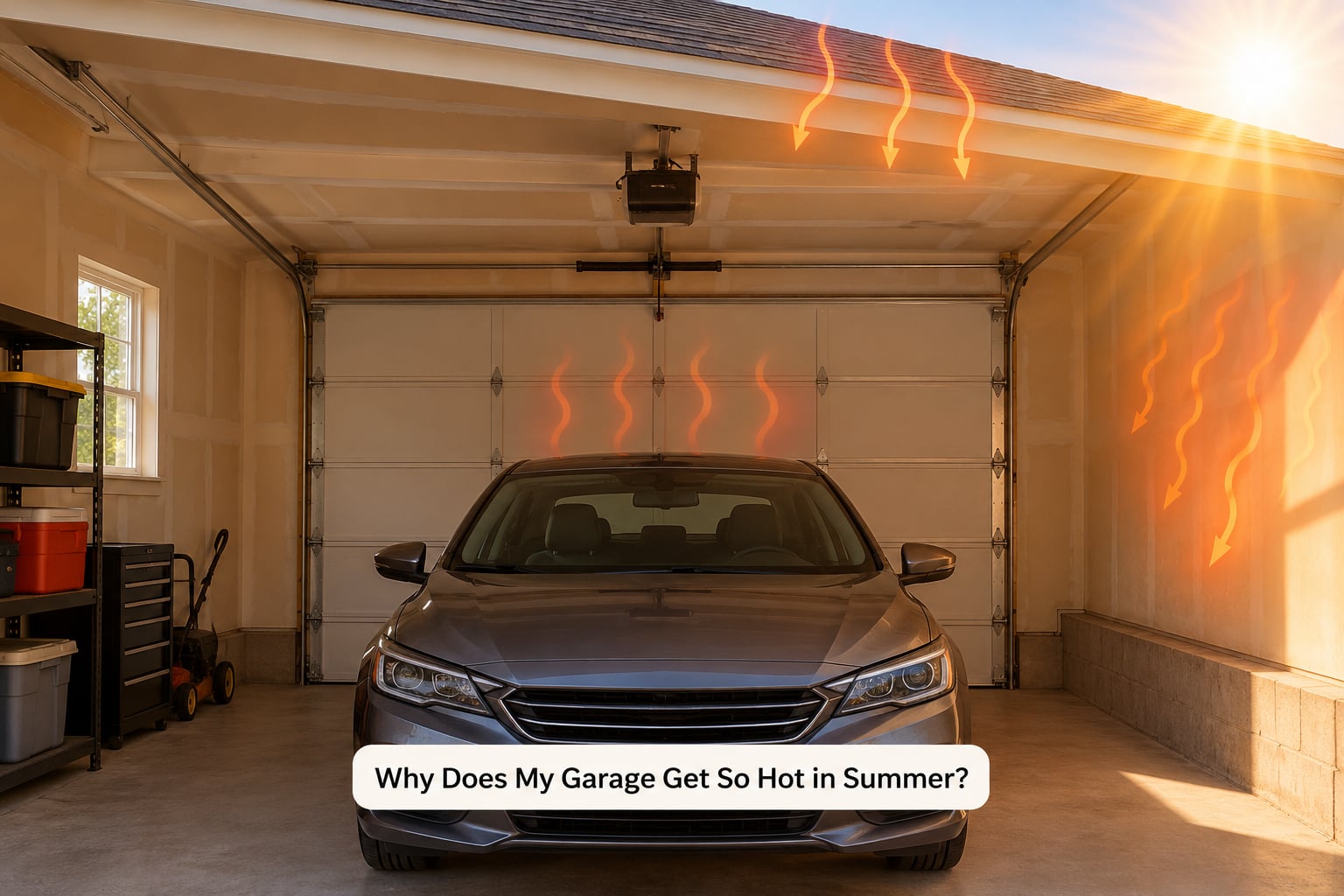
Sunlight lands on the two biggest surfaces of the building, the door and the roof, and converts to heat. That heat conducts through thin steel and uninsulated framing into the interior air. Then the concrete slab, which is several thousand pounds of dense material, absorbs more heat during the hottest hours and re-radiates it long after sunset. The garage stays warm all night because the slab is still giving back what it absorbed all day.
Attached and detached garages behave differently. An attached garage shares walls, a ceiling and often an attic with the house, so heat moves into the rooms above and adds to your whole-home cooling load. A detached garage is a standalone box, which usually runs cooler, but the sun-facing side is often fully exposed and a metal door with no shade heats the entire interior like a convection oven.
Some heat is normal. On a mild 80-degree day, an uninsulated garage with the door shut might sit 10 to 15 degrees above ambient. What is not normal is a space reaching into the 120s on a 95-degree day, or one that never cools below the outdoor temperature overnight. That pattern usually points to a mechanical fault or a vent that has failed rather than simple solar gain.
What Makes a Garage Trap Heat?
Four heat transfer mechanisms do most of the work. Understanding which one you are dealing with tells you which fix will actually help.
Greenhouse effect
Short-wavelength sunlight passes through the door glass and any gaps and warms the floor and objects inside. Those objects then emit long-wave infrared radiation that cannot pass back out the same way, so the space heats until it can radiate to the sky. Opening the door briefly at midday is not enough to clear the stored heat.
Conduction through sun-facing surfaces
Metal and thin panels conduct heat readily. A steel door in full afternoon sun can reach surface temperatures high enough to feel painful to touch, and that energy moves straight inward. The same is true of an uninsulated roof deck where the attic above has little or no insulation above it.
Thermal mass in the slab
Concrete has high thermal mass. It soaks up heat when the air is already hot, which means the slab surface reads cooler than the air at midday, then becomes the dominant heat source in the evening as the stored energy bleeds out. Evening garage temperatures are driven mostly by the floor, not the air outside.
Convection and air leakage
Hot air rises and collects at the ceiling. Any gap at the top of the door, around a window, or at a framing penetration lets that air out, but in a closed garage it simply recirculates. Gaps at the bottom of the door do the opposite and pull cool outdoor air in, adding heat load while never replacing enough air to matter.
| Garage feature | What it does in summer | Typical effect on interior heat |
|---|---|---|
| Uninsulated steel door, west-facing | Absorbs direct afternoon sun across a large surface | Largest single source of heat gain |
| Uninsulated roof deck | Passes roof solar gain straight into the ceiling joists | Rises sharply above outdoor temperature |
| Bare concrete slab | Stores heat by day, radiates it overnight | Keeps the space warm long after sunset |
| Unsealed wall and ceiling joints | Moves air in and out of wall cavities | Uninsulated areas act as heat channels |
| Gaps under and around the door | Leaks conditioned or outdoor air both directions | Works against every other fix |
| Parked vehicle with a hot cabin | Radiates stored heat for hours after arrival | Noticeable local temperature rise |
What Should Be Making Your Garage So Hot?
Start with the causes that show up most often, then work down the list. Each one leaves a different fingerprint.
Direct sun on the door and roof
The single most common driver. Orientation matters more than most people expect: a west-facing door sits in afternoon sun when outdoor temperatures are near their peak, while an east-facing door gets the mild morning sun instead. Check which side of the house your door faces before spending money on anything else.
Missing or thin ceiling insulation
For most attached garages, the ceiling is the highest-value surface to insulate. Homeowners routinely insulate the walls, which are mostly shaded, and leave the ceiling open to an unconditioned attic. Forum builders consistently recommend a ceiling of at least R-35 for a space used in summer, and higher for workshop or living use.
Vehicles and heat-producing equipment
A car parked in the sun all day holds a large amount of stored heat in its cabin and body, and gives it off slowly after you pull in. Add a water heater, a dryer, a compressor, or a battery charger cycling in the space and you have an internal heat source that no amount of insulation addresses.
A closed door and no working ventilation
Users often report the garage being hotter than outdoors and assume they have a sealed envelope. Usually the door is simply shut with no exhaust path. If an exhaust fan or a roof vent exists and does nothing when switched on, the fan motor, the breaker, or a closed damper is the problem.
Evaporative moisture and mechanical faults
In humid climates the slab and walls carry moisture that raises the heat index long before it raises the dry-bulb temperature. Separately, a failed door closer, a sticking track roller, or a leaking water line can change how the space behaves, and a leaking or poorly draining slab creates standing water that adds humidity.
How Do You Measure Garage Heat and Confirm the Problem?
You do not need anything beyond a basic thermometer. The trick is comparing the same reading at several points, because a single sensor tells you very little.
Put one thermometer near the closed garage door at standing height, one near the ceiling at the back wall, and one on the workbench or a shelf a couple of feet off the slab. Take readings in the morning, mid-afternoon, and an hour or two after sunset. If you have a second thermometer, leave it in the shade outdoors and subtract the difference.
| What you see | Likely explanation | Next check |
|---|---|---|
| Hotter than outdoors in late afternoon, cooler overnight | Normal solar gain and slab heat soak | Note peak time and which surface is hottest |
| Hottest at the ceiling, cooler at the floor | Stratified air, no working exhaust | Test the exhaust fan and any roof vent |
| Warm patch behind a specific wall | Missing insulation in that bay | Compare wall temperatures along their length |
| Spikes only after someone drives in | Vehicle heat and exhaust | Read the space before and after arrival |
| Warm near the ceiling only after rain or watering | Moisture entering and evaporating | Check slab drainage and grading around the door |
| Runs hotter every day regardless of sun | Equipment running in the space | Switch off suspected loads and re-measure |
| Temperature keeps climbing past sunset | Vent blocked or a failing fan motor | Inspect vent covers, damper and breaker |
Take heat exposure seriously. Hot garages cause heat exhaustion and heat stroke, particularly for anyone over 60, and garage air can carry carbon monoxide, solvent vapors, and fuel fumes. Do not run a gas engine in a closed garage, even with the door open, and stop working if you feel dizzy, nauseated or confused. Leave immediately and cool down if symptoms appear.
How Can You Cool a Hot Garage Safely?
Fixes are worth doing in order of effort, because the cheap ones often recover more than the expensive ones.
Work on the sun-facing surfaces
A reflective coating or a radiant barrier on an exterior door reduces how much solar energy the steel absorbs in the first place. A shade structure or an extended overhang over a west-facing door works similarly. This addresses the cause rather than treating the symptom.
Seal the air leaks
Before adding insulation, find and close the gaps. Common ones sit where the drywall meets the framing, around the ceiling joists, along the header above the door, and at service penetrations. Insulating open wall cavities without sealing them first moves air through the insulation and delivers less benefit than the R-value on the bag suggests.
Replace the door gasket and bottom weatherstrip
This is the cheapest high-impact fix and the most frequently recommended one in homeowner discussions. Run your hand along the bottom of the closed door; daylight, a draft or a visible gap means the seal has failed. A new bottom seal and jamb weatherstriping take an afternoon and no specialist tools, and they also stop conditioned air escaping from the house in winter.
Insulate the ceiling first, then the door
Insulating a metal door slows heat moving through it, but it is a finishing touch compared with the ceiling. Insulation inside the door does nothing about the roof or the slab. If your walls are already finished and you do not want to open them, add-on rigid panels or foam-board overlays from the interior are slower to install but avoid drywall removal, which is the main reason people stall on the project.
Vent on a schedule, not on reflex
Open the door or run an exhaust fan during the cool morning and evening hours, and close it before the outdoor temperature climbs. Opening up at peak heat makes the problem worse because you are inviting in air that is already hot, and the slab and stored contents do not cool quickly enough to repay it.
Move the heat sources out
Where practical, park a sun-exposed vehicle outside under shade, and relocate water heaters, compressors and chargers to a shaded wall or a utility area. Removing internal heat sources is the only fix whose effect shows up the same afternoon you do it.
Use fans carefully
A shop fan set near the ceiling and pushing air out through a vent helps move accumulated heat out, provided there is a working intake path. Never run a fan that pushes air into a sealed space without exhausting it, since pressure builds and no cooling occurs. Clean the fan blades and grille first: a dusty garage in summer is a poor environment for any motor you install.
Do Garage Fans and Air Conditioners Work?
They work, but only in the right order and with the right expectations. Ventilation moves heat out. Cooling equipment adds heat to another space to remove it from yours.
Exhaust and intake fans
A vent fan sized to the floor area moves air at a known rate and pairs with an intake opening, often a low-level or door-under intake, to complete the path. They help most when the indoor temperature is genuinely higher than outdoors, which is most of the evening and night. In humid weather they remove heat but no moisture, so relative humidity climbs and the space can feel worse even as the temperature falls.
Evaporative coolers
These work by evaporating water into the intake stream, so they lower temperature and raise humidity at the same time. In a dry climate that trade can be worthwhile. In a humid one, an evaporative cooler can add to the discomfort, and it consumes a meaningful amount of water during operation.
Portable and window air conditioners
A portable unit exhausts hot air and condensate through a hose to the outside. It works well in a closed space, which is the entire point: if you leave the garage door open, the unit creates negative pressure and pulls additional hot outdoor air into the garage, so it can cool the room while adding heat to the building. Never run a combustion heater or vehicle engine nearby to compensate.
Whole-garage air conditioning
A ductless mini-split gives the most consistent control and handles humidity properly, but it is a real installation with electrical work, a line set and a refrigerant charge, so a licensed HVAC contractor should handle it. Unit sizing matters: an oversized unit short-cycles, runs constantly and leaves the space clammy. The manual J load calculation that a contractor runs is what tells you the right capacity, and in an attached garage you will want a load that accounts for the ceiling and shared walls rather than just the floor square footage.
Extending your existing house ductwork
This one deserves caution. Mechanical code restricts connecting an attached garage to a home’s combustion HVAC system because of backdrafting risk, and many jurisdictions prohibit it outright. In every case, running a whole-house system in an uninsulated garage means conditioning the whole volume while the door is open. Seal and insulate first, and talk to a licensed HVAC contractor before assuming it is a simple extension job.
Can Garage Heat Damage Vehicles, Belongings, or the Building?
Yes, and most of the damage is gradual rather than dramatic. Tire pressure rises as air heats, so check tires cold rather than after a hot drive, and inflate to the door-jamb value rather than to whatever the sidewall maximum says. Batteries, whether in a vehicle, a charger, or stored power tools, age faster when kept warm, and owners of electric vehicles in hot climates have raised concerns about summer storage in a sun-exposed garage.
Interior plastics, glue joints in dashboards and door panels, adhesives on trim, and vinyl and leather surfaces fade and warp with repeated heat cycling. Aerosol cans, solvent containers, pool chemicals, and most paint products have storage limits tied to temperature, and a garage that regularly exceeds those limits is shortening the life of what you stored there. Foam, cardboard, and paper goods can pick up moisture as well as heat.
Watch for a cabin that is dangerously hot for people and pets. A closed vehicle heats up fast in sun, and children, older adults and animals cannot be left in one even briefly. If you notice an odd smell when the garage heats up, staining below a stored container, cracking sealant, or a door or frame that no longer closes square, that is a reason to look closer rather than cool the space harder.
When Should You Call a Professional?
Some symptoms sit outside ordinary heat gain and should not be handled with a fan.
Bring in an electrician if breakers trip when the garage door or a cooling unit runs, if outlets or switches feel warm, or if you see scorch marks or a burning smell. Call a gas technician for any gas odour in the space, and treat a suspected carbon monoxide source as urgent: a malfunctioning water heater or a vehicle left running can make a closed garage dangerous. Refrigerant leaks from a split system need a licensed HVAC technician, both for the repair and because an improperly handled system can damage the line set.
Plumbers handle recurring slab drainage problems, and a foundation or structural engineer should look at cracks that have widened, a door that has started binding, or framing that has visibly moved. Where heat gain remains extreme despite sealing, insulating and venting, an energy auditor can measure where it is actually entering and stop you from insulating the wrong surface, which is the most common expensive mistake in this project.
Frequently Asked Questions
How hot should a garage get in summer?
On a hot sunny afternoon, an uninsulated single garage commonly runs 20 to 40 degrees above the outdoor temperature, and well-insulated ones may run 10 to 20 degrees above. A west-facing door adds to that. Readings above 120 degrees in ordinary summer weather are normal for an unconditioned garage, but a space that never cools below the outdoor temperature overnight points to a vent or equipment problem rather than solar gain.
Why does my garage stay hot overnight after a hot day?
The concrete slab stores solar heat all day because concrete has high thermal mass. It releases that energy slowly after sunset, which is why an uninsulated garage often stays warmer through the night than the outdoor air, and why the floor feels warm long after the air feels cooler. Insulating the walls and door does almost nothing about this. Cooling or evening ventilation is what shortens the release, or a surface on the slab that reflects rather than absorbs.
Is an attached garage usually hotter than a detached garage?
It depends on orientation more than on the attachment itself. A detached garage with a west-facing metal door in full sun can run hotter than an attached garage with a shaded door and insulated walls. What the attachment adds is coupling: heat moves through the shared wall and ceiling into the house, so a room above the garage heats up and the whole-home cooling load rises. Measure your own space before assuming either is the cooler option.
Can I install an exhaust fan in my garage door?
It is possible, but a door-mounted fan needs a section of the door removed and cut, and it stops working when the door opens. Most installers prefer mounting the fan in a gable end wall or high on a side wall, paired with a low-level intake so air has a path to enter. Any penetrations through the weatherproof envelope need sealing, and any new wiring needs to meet local electrical code, so use a licensed electrician for the electrical work.
What garage temperature is unsafe for starting a vehicle?
Anywhere above about 100 degrees is uncomfortable to work in for long, and heat exhaustion risk climbs with the temperature and humidity. Beyond roughly 105 degrees, limit time inside, work in short stretches and hydrate. Do not idle a vehicle in a closed garage at all, since carbon monoxide can build up without any obvious smell. If you feel dizzy, nauseated or confused, get outside immediately and cool down rather than pushing through it.
What To Do First
If you only do one thing this week, measure. That is the honest answer to why does my garage get so hot in summer, and the answer changes per house. Put a thermometer near the closed door, one at the back of the ceiling and one off the slab, then check them in the morning, mid-afternoon and after sunset. Those three sets of numbers tell you more than any amount of guessing.
Then work in this order: note the hottest time of day and which surface reads hottest, switch off or relocate the vehicle and any equipment that is adding heat, run down the door gasket and weatherstrip to check for daylight at the bottom, and look up at the ceiling to see whether it is insulated at all. Fix the first thing you find, re-measure the next afternoon, and only move to shading, added insulation or cooling equipment once you know which surface is actually responsible.