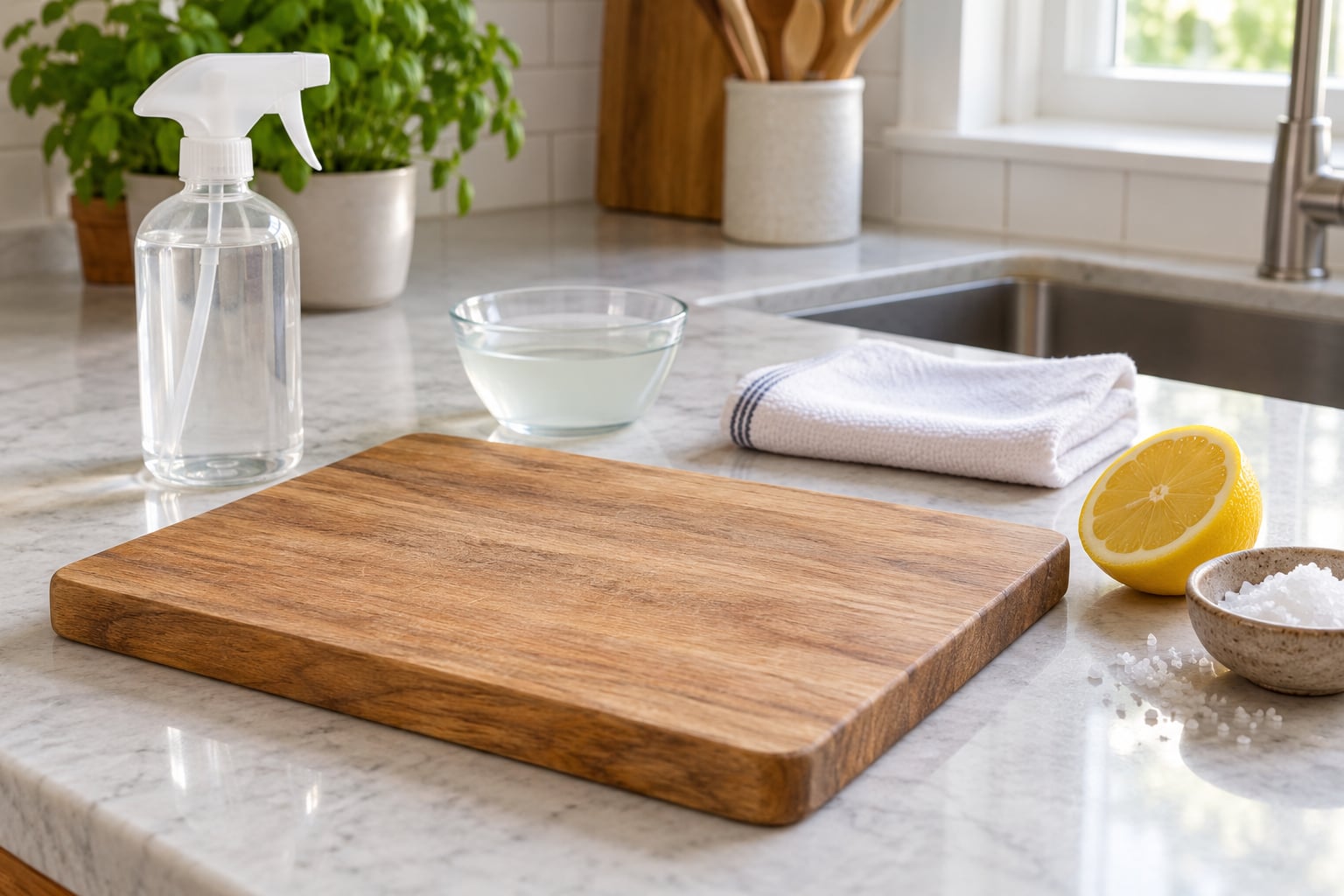
To clean a wooden cutting board without warping it, scrape off the scraps, wash both sides with hot water and mild dish soap, rinse, and set the board upright to air-dry right away. The whole daily routine takes about a minute, and the board lasts years instead of months.
Wood is porous and it drinks water unevenly. A board that sits in a puddle, or one side that stays wet while the other dries, swells on one side and cups. That is the whole reason for the rules below.
A note on where people get stuck: cleaning a board and killing bacteria on a board are two different jobs. Soap and water remove food and grease. Something else, applied correctly and for long enough, handles raw meat. Mixing those up is how boards end up smelling clean and still being treated wrong.
Table of Contents
- What You Need
- How to Clean a Wooden Cutting Board: Step-by-Step
- Common Mistakes
- Frequently Asked Questions
- Can you put a wooden cutting board in the dishwasher?
- How do you remove deep knife marks from a wooden cutting board?
- What is the safest way to disinfect a wooden cutting board?
- How often should a wooden cutting board be replaced?
- How do you get rid of a garlic or onion odor from a cutting board?
- Should a wooden cutting board be oiled after cleaning?
- Conclusion
What You Need
For the daily wash you need very little, and all of it is probably already in your sink.
- A bench scraper or the back of a knife to push food particles into the bin instead of down the drain, where they can lodge in a wooden drainer or clog a disposal.
- Mild unscented dish soap. Unscented matters more than most people expect; heavily perfumed soaps leave a film you can taste in food cut on the board months later.
- A sponge or nylon brush for the grain and the knife grooves.
- A clean dish towel and an open spot on the counter or in a rack for drying.
For odors, stains and periodic deep cleaning, add these.
- Coarse salt (kosher or rock) for the lemon scrub.
- Baking soda for a mild paste and for deodorizing.
- Distilled white vinegar, diluted, for odors and light grease films.
- A food-surface sanitizer if you cut raw poultry, meat or seafood regularly. Follow the label; that is not optional advice.
- Food-grade mineral oil and, if you like, a beeswax board cream for conditioning.
- Sandpaper in a grit progression, 120 through 220, for a surface that has gone rough or deeply scarred.
Two situations are not cleaning problems. A crack running all the way through the board, or black spotting spread across the grain rather than sitting in a groove, usually means replacement. Scrubbing a split board just gets water deeper into it.
How to Clean a Wooden Cutting Board: Step-by-Step
Wash the Board Immediately After Use
Scrape, wash, rinse, dry. That is the whole daily method, and doing it every time is what keeps a board sanitary without any harsher chemistry.
Stand the board in the sink and scrape the surface with a bench scraper, working across the grain so you catch what a knife edge misses. Turn it over and do the other side.
Run hot water over both sides and work a drop of dish soap across each face with a sponge. Scrub the knife grooves, where blood and onion bits hide. Give the edges and the end grain a pass too; end grain absorbs more than face grain and is the first place odor starts.
Rinse with running water and move straight to drying. Do not leave the board sitting in a sink with water collecting around it, even for a few minutes. That soak is the single most common cause of the cupped, split boards people bring back from the trash.
You know the wash worked when the wood is uniformly damp, not slick, and no soap film remains when you run a fingertip across it.
How to Clean a Wooden Cutting Board After Raw Meat
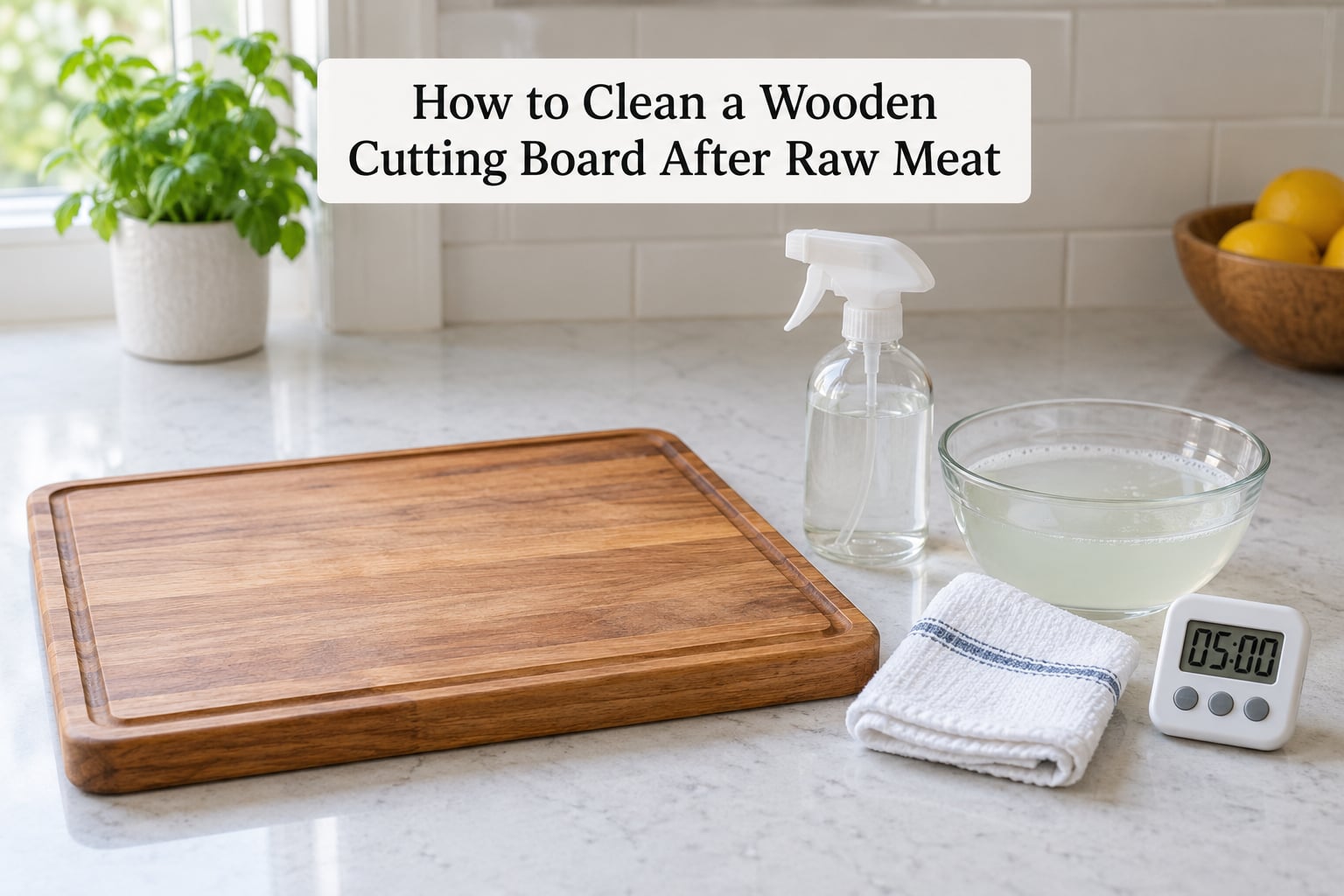
After raw chicken, beef, pork or fish, wash and sanitize as two separate steps.
- Complete the wash above first. Sanitizing a board that still carries grease is wasted effort, because the sanitizer reaches the surface faster.
- Apply a food-contact sanitizer at the dilution printed on its label. Common reference points that show up in kitchen guidance: roughly 1 teaspoon of unscented liquid bleach per 1 quart of water for a bleach solution, or 1 part distilled white vinegar to 4 parts water for a vinegar solution.
- Keep the surface visibly wet for the contact time on the label, which is commonly 1 minute for a diluted bleach solution. Set a timer. A minute of partial drying is a minute of missed contact.
- Rinse if the label directs you to, then dry the board immediately and completely.
Two honest caveats. A diluted bleach solution works on wood in short bursts, but repeated use dries the surface out and bleaches it, so use it on the rare occasion you truly need it rather than as a nightly habit. And vinegar is a cleaner, not a registered disinfectant; it strips odors well but should not be sold to yourself as a sanitizer.
Home cooks on cooking forums say the same thing from both ends: soap and water every single time, and something stronger reserved for meat days. They also note that everyday spray cleaners leave a film on wood, which is another good reason to skip them.
Dry the Board Completely
Drying is not the boring part of this job. It is the part that prevents the warping everyone asks about.
Set the board on edge in a dish rack or leaning against a backsplash, with air moving around every face. If you towel it first, pat both sides dry rather than scrubbing one dry while the other stays wet. The asymmetry is what does the damage.
Before you put it away, touch the middle of the board with the back of your hand. If it feels cool at all, it is still damp. Cool means moisture; room temperature means dry. Boards stored flat in a closed cupboard while even slightly damp come out musty, and that musty smell is mold starting.
Store boards upright or on small feet rather than stacked flat under a pile of pans. Crowding traps humidity against the underside.
Remove Stains and Lingering Odors
Work up the list, gentlest first, and stop as soon as the stain or smell goes.
- Baking soda paste. Mix roughly 3 parts baking soda with 1 part water, spread it over the stained area, scrub gently with a sponge, then rinse and dry. Good for turmeric, beets, red wine and light grease films.
- Coarse salt and lemon. Wet the surface, scatter coarse salt over it, then cut a lemon in half and scrub the cut face in circles. Leave it about 5 minutes, scrape the pulp and salt away, rinse, and dry. This is the method restaurant kitchens still reach for, and it works well on garlic and onion odor.
- Diluted vinegar. Mix 1 part distilled white vinegar with 4 parts water, apply with a cloth, let it sit a few minutes, rinse, dry. Better than either of the above for fish smell and for a greasy film.
Do not combine vinegar and bleach, and do not mix baking soda with vinegar expecting a stronger clean. The first pairing releases chlorine gas, which is genuinely dangerous; the second just neutralizes into salt water and wastes both products.
Never pour a cleaning solution across the whole board and leave it to soak. Spot-treat, then wash the whole board with soap and water as usual so nothing is left sitting in the grain.
Restore a Rough or Stained Surface
A board gets rough when the oil in the wood is gone and the fibers are standing up. The fix is sanding, but only within limits.
Sand with a progression rather than jumping to a fine grit: 120 to smooth the raised fibers, then 180, then 220 for an even, closed surface. Sand with the grain and keep the board flat on a stable surface so you do not round one edge. Wipe off the dust with a damp cloth and let the board dry fully, ideally overnight.
Once it is bone dry, rub in food-grade mineral oil or a board cream until the surface stops absorbing it, then wipe off the excess. The board will drink oil faster than you expect for the first two or three coats, and that is normal.
Sanding is worth doing for a roughened surface, for shallow knife marks, and for stains that soap and lemon have not moved. It is not worth doing when grooves run deeper than a couple of millimetres, when a crack goes through the board, or when you are dealing with a butcher block countertop, where taking a sander to one spot means redoing the whole thing.
Should You Oil It Every Time?
No. Oil the board when it looks dry or pale, when water stops beading on the surface and starts soaking in, and when you have just finished sanding. A board you use daily usually wants conditioning every few weeks; one that sits mostly idle wants it a few times a year.
Use food-grade mineral oil or a beeswax board cream. Olive oil, vegetable oil and coconut oil are not interchangeable: they are cooking oils, and they go rancid on a board that holds moisture, which is exactly the smell you were trying to remove.
Common Mistakes
Soaking the board in the sink. Wood swells when submerged and shrinks as it dries. If one face dries faster than the other, you get a cup that no amount of oiling will fix. Fix: wash under running water and move it to dry within a minute.
Running the dishwasher. The heat, the standing water and the harsh detergent cycle are the fastest way to split a board, and the glue seams on an end-grain board give up first. Fix: hand-wash only, always.
Using bleach as a routine cleaner. It works as a sanitizer but strips the oil out of the wood, leaving it lighter and more absorbent over time. Fix: save it for the rare raw-meat occasion and condition the board afterwards.
Believing vinegar disinfects. It is an effective odor remover and degreaser. Treat it as a cleaning step, not a sanitizing step.
Spraying daily kitchen cleaner on the surface. People on cooking forums keep reporting the same residue and film. Fix: soap and water, and a rinse, every time.
Storing the board flat and damp. A closed cupboard holds humidity against the underside, and the next thing you smell is mildew. Fix: upright storage, or feet under the board, and make sure it is dry first.
Stacking wet boards together. Two damp surfaces pressed together dry slowly and unevenly. Fix: one board at a time, in a rack with air on all sides.
One habit covers most of the rest: weekly conditioning with mineral oil is the thing that keeps boards from warping, and boards that get skipped at the oiling stage are the ones that come back cracked.
Frequently Asked Questions
Can you put a wooden cutting board in the dishwasher?
No. The heat, the standing water and the harsh detergent will split the wood, soften glue seams on an end-grain board, and strip the oil out of the surface. Hand-washing with hot water and mild dish soap is the only safe method. If the board is small enough to sit under a tap, wash it there, rinse, and set it upright to dry immediately.
How do you remove deep knife marks from a wooden cutting board?
Deep grooves cannot be cleaned out, because they are missing wood. Light scoring can be improved by sanding the surface in a grit progression of 120, then 180, then 220, keeping the board flat and working with the grain. Wipe, let the board dry completely overnight, then condition it with food-grade mineral oil. Grooves you can still catch a fingernail in are a sign to replace the board.
What is the safest way to disinfect a wooden cutting board?
Wash with hot soapy water first, then apply a food-contact sanitizer at its labeled dilution and keep the surface wet for the labeled contact time, usually about one minute. Rinse if the label says to, then dry the board immediately. A dilute bleach solution works, but repeated use dries wood out. Vinegar is a good cleaner and deodorizer but is not a registered disinfectant.
How often should a wooden cutting board be replaced?
Replace it when a crack runs through the board, when black spotting is spread across the grain rather than sitting in one groove, or when deep knife marks cannot be sanded flat. Boards used for raw meat daily are the ones that wear fastest. Signs of ordinary wear, a rough surface or a few shallow marks, are a cue to sand and re-oil, not to throw away.
How do you get rid of a garlic or onion odor from a cutting board?
Wet the surface, scatter coarse salt over it, and scrub with the cut face of a lemon in circles. Let it sit about five minutes, scrape away the pulp and salt, rinse, and dry upright. For a smell that survives that, dilute white vinegar 1 part to 4 parts water, leave it a few minutes, then wash the whole board again with soap and water.
Should a wooden cutting board be oiled after cleaning?
Only when it needs it, which is every few weeks for a daily-use board and a few times a year for one that sits idle. Signs include a pale, dry look and water soaking in rather than beading on the surface. Use food-grade mineral oil or a beeswax board cream, never olive or vegetable oil, which go rancid in damp wood and leave the board smelling off.
Conclusion
Start tonight, right after you finish cutting: scrape, wash both sides with hot soapy water, rinse, and stand the board upright until it feels room temperature at the center. Sanitize only on days you handled raw meat, using the label dilution and the full contact time. Deodorize with salt and lemon or diluted vinegar when you need to, and condition with food-grade mineral oil when the wood looks dry.
Skip the soak, skip the dishwasher, and skip the daily spray cleaner. Those three habits are the reason most boards crack within a year.