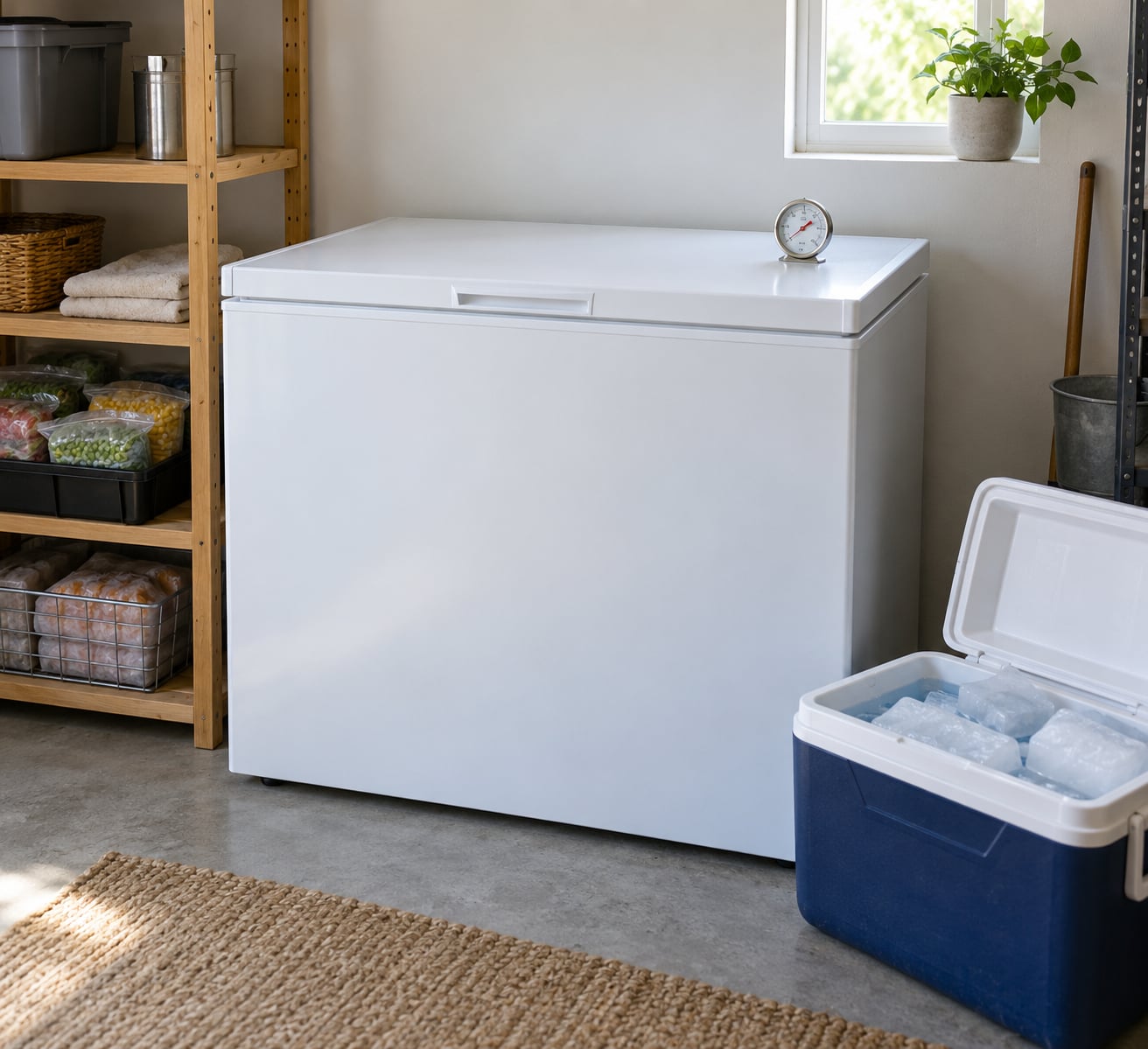
Straight answer to how long does food last in a freezer during a power outage: a closed full freezer keeps food safely frozen for about 48 hours, and a half-full freezer holds a safe temperature for about 24 hours. Those numbers come from FoodSafety.gov, and they only apply if the door stays closed the whole time.
Everything after that number depends on your freezer, your room, how often you open the door, and the kind of food you’re trying to save. A block of frozen meat and a tub of ice cream thaw on very different schedules, and so do a chest freezer in a cool basement and an upright freezer in a hot upstairs kitchen.
This guide walks through the timelines, the temperature thresholds, and the actual steps that buy you extra hours — so you can make the call on your food without guessing in a dark kitchen.
Table of Contents
- How Long Does Food Last in a Freezer During a Power Outage?
- What Determines How Long Frozen Food Stays Safe?
- How to Tell Whether Food Is Still Safe
- What Food Is Safest to Eat First After an Outage?
- How to Protect Food During a Power Outage
- How Long Food Lasts After the Power Returns
- Frequently Asked Questions
- How long can a full freezer keep food frozen during a power outage?
- How long does a refrigerator keep food safe during an outage?
- Can I refreeze food after the power comes back on?
- Is food with ice crystals still safe after thawing?
- How can I tell if frozen food is bad after an outage?
- Should I use dry ice during a long freezer outage?
- Conclusion
How Long Does Food Last in a Freezer During a Power Outage?
A full freezer holds a safe temperature for approximately 48 hours. A half-full freezer manages about 24 hours. A closed refrigerator keeps food cold for roughly 4 hours, and an unopened half-full refrigerator for about 2 hours.
There’s a version of this advice that quotes 24 hours for a full freezer, and it’s the source of most of the confusion. Both numbers appear on government fact sheets, and both are correct for different assumptions. The 48-hour figure assumes a well-insulated freezer packed with frozen food, which is what most households actually have. The 24-hour figure assumes less mass, a warmer room, or more door openings, and it’s the more cautious number to plan around if you’re unsure.
Here’s the reference table. Use it as a starting point, then adjust with the conditions in the next section.
| Appliance state | Food stays safe for | Condition |
|---|---|---|
| Full freezer, door closed | About 48 hours | Food still frozen or at 0°F |
| Half-full freezer, door closed | About 24 hours | Food at 0°F or still solid |
| Full refrigerator, door closed | About 4 hours | Food at 40°F or below |
| Half-full refrigerator, door closed | About 2 hours | Food at 40°F or below |
| Freezer door opened repeatedly | Can drop to a few hours | Each opening warms the whole cabinet |
The key point: those durations aren’t a countdown to spoilage. They’re the window during which the food is likely to still be at or below 0°F. Once the freezer climbs above 40°F, you’re on a different clock, and that clock is short.
What Determines How Long Frozen Food Stays Safe?
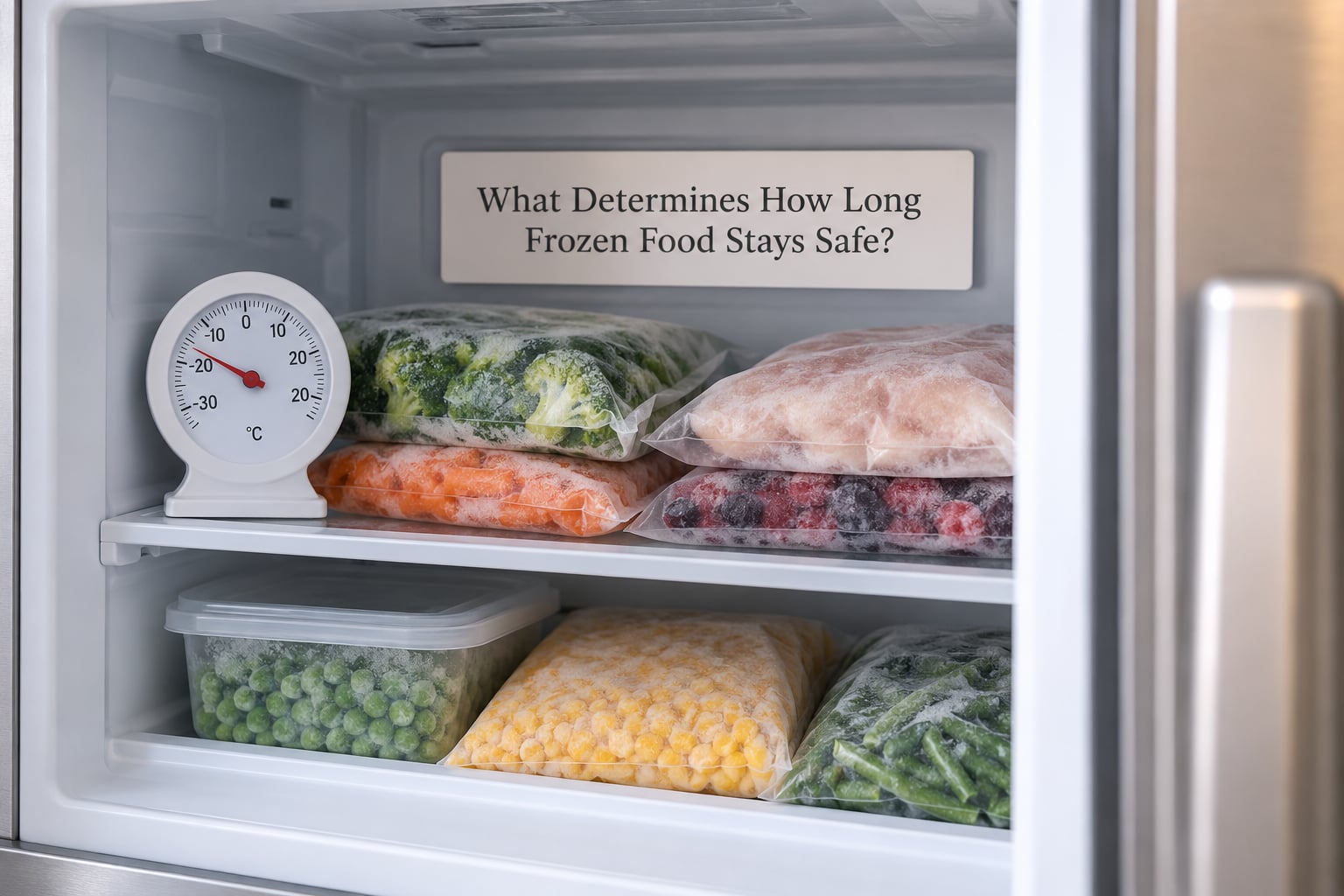
The big one is how full the freezer is. Frozen food is the insulation. A freezer packed solid has far more thermal mass to absorb the heat leaking in through the walls and the door seal, so it climbs in temperature far more slowly than an empty one.
Freezer type changes the picture too, and most guides skip this entirely.
| Freezer type | Typical hold time, door closed | Why |
|---|---|---|
| Chest freezer, full | About 48 to 72 hours | Little or no cold air spills out when opened, and the whole box is at 0°F |
| Upright frost-free, full | About 48 hours | Fan circulates cold air, so the food stays evenly cold |
| Upright manual defrost, full | About 48 hours | Cold settles toward the bottom, so lower shelves run colder |
| Any freezer, half full | About 24 hours | Less frozen mass, more air volume to warm |
| Garage-ready unit | Less than the numbers above | Aim it at an unheated space; warm ambient air strips insulation fast |
A few more factors push the timeline shorter or longer:
- Starting temperature. A freezer at 0°F has more margin than one already at 10°F. FoodSafety.gov recommends keeping it at 0°F so it stays frozen solid and refreezes properly later.
- Room temperature. An upstairs freezer in a house heating up during a winter outage will lose cold faster than a garage unit in a cool space.
- Freezer age and condition. Worn door seals, a gasket that no longer grabs, or a compressor that was already struggling before the outage all shorten the clock.
- How often you open the door. Every opening lets in room air. A few quick grabs are fine; browsing for twenty minutes is not.
- Quantity of food. Less food means more air, and air is what warms up.
- Whether you have a thermometer in there. An appliance thermometer gives you a number instead of a guess, which is the difference between eating dinner and dumping it.
One real-world data point worth keeping in mind: on r/preppers, a user who lost power for more than 36 hours reported cold food spoiled within the first 4 hours and freezer food by 12. Homes vary more than the numbers suggest, which is another argument for a thermometer.
How to Tell Whether Food Is Still Safe
Temperature and time decide it. Smell, color and texture do not. Bacteria that cause foodborne illness can multiply in food that looks, smells and tastes completely normal, and the FDA is explicit that you should never taste food to judge whether it’s safe.
Start with a thermometer, because that’s the only real evidence. If you don’t have one, use this decision guide.
| What you observe | What it means | What to do |
|---|---|---|
| Food is frozen solid, thermometer reads 0°F | Never entered the danger zone | Keep it frozen or refreeze as needed |
| Food is soft but still has ice crystals, or reads 40°F or below | Thawed but stayed safe | Safe to refreeze, though quality may suffer |
| Food reads above 40°F but at or below 45°F | Safe, but eat it first | Cook thoroughly and eat before anything else |
| Food read above 40°F for more than 2 hours (4 hours for items you want to eat raw) | Time in the danger zone | Discard it |
| Package is swollen, leaking or split | Contamination risk, regardless of temperature | Discard it |
| Food looks and smells fine but you have no temperature data | Unknown | When in doubt, throw it out |
That last row is the hard one, and it’s where most of the anxiety lives. On r/isthissafetoeat, someone seven hours into an outage reported a fridge reading of 46°F and was agonizing over groceries bought the day before. Reasonable question, genuinely unanswerable without the number. If you have no thermometer and no certainty, discard is the correct call.
Without a thermometer, two cues help. Ice crystals mean the food never fully thawed. A frozen block that is still hard in the center is safe to refreeze. Neither tells you about a sealed container that has no visible crystals, though — that one is a guess.
What Food Is Safest to Eat First After an Outage?
Eat the food that is closest to thawing, not the food that cost the most. Order matters more than value here.
- Meat, poultry and seafood. These are the highest-risk items and they thaw fast. Cook them first, and never refreeze raw meat that went above 40°F for more than two hours.
- Prepared meals and leftovers. Already cooked, already handled, and the easiest to lose to a power outage.
- Ice cream, frozen custard and sorbet. Ice cream is a poor candidate for refreezing — it loses its texture and can pick up bacteria through repeated handling. If it’s melted, plan on eating it, not saving it.
- Refrigerator perishables you moved into the freezer, like milk, soft cheese and cut fruit.
- Frozen vegetables, bread and butter. These hold up longest and are the last things likely to be in trouble.
Meat and poultry need to reach 165°F (74°C) internally, ground meat 160°F (71°C), and whole cuts of meat and fish 145°F (63°C). Food sitting in the 40°F to 45°F band should be cooked and eaten before anything below it, not after.
One more thing: a refrigerator thermometer is the cheapest tool in this whole situation. Put one in the fridge and one in the freezer now, and you’re never guessing again. A bag of ice on the top shelf, which is what some people improvise mid-outage, doesn’t tell you much — it cools the air near it while the back of the cabinet keeps climbing.
How to Protect Food During a Power Outage
- Keep the freezer and refrigerator doors closed. This is the single most effective thing you can do. A closed door holds the cold; an open door turns the cabinet into a room-temperature box.
- Group the food together and fill empty space. Push everything into one corner or one drawer, then fill the gaps with frozen water bottles. Those bottles act as thermal mass exactly like frozen food does, and they’re free.
- Move the most valuable food into a cooler. A cooler with block ice or gel packs buys you a controlled, portable cold space for what you’ll actually eat during the outage. Skip bags of ice alone — they melt into water and drain away the cold faster than people expect.
- Don’t move everything into the refrigerator. A full fridge reaches safe temperatures in about 4 hours, not 48. A freezer that is holding 24 hours beats a fridge that is holding 2.
- Use dry ice if you know what you’re doing. The common reference is 50 pounds of dry ice to keep an 18 cubic foot full freezer cold for about two days. Handle it with insulated gloves in a ventilated space, never in an airtight container, and keep it away from kids and pets. Skip this if you have never handled it before.
- Run backup power only per its manual. A generator belongs outdoors, away from windows and doors. A portable power station or a car battery inverter is a different category of risk and has its own instructions. Follow the manufacturer’s guidance, and never run anything that produces fumes indoors.
Here is the hour-by-hour version, for when you have no thermometer and just want to know where you stand.
| Time elapsed | Likely state, full freezer | Do this |
|---|---|---|
| 0 to 6 hours | Still frozen solid | Do nothing. Leave the door shut |
| 6 to 12 hours | Still frozen, edges softening | Still nothing. This is the easy part |
| 12 to 24 hours | Ice cream and small items softening | Open once, take out what you’ll eat first, close it again |
| 24 to 36 hours | Half-full freezers now above 40°F; full freezers marginal | Move everything to a cooler with ice; check with a thermometer |
| 36 to 48 hours | Most food thawed; full freezers near the end of the window | Start sorting: refreeze what has ice crystals, discard what doesn’t |
| Beyond 48 hours | Assume food is thawed | Keep only what you can verify is at 40°F or below |
On r/foodsafety, someone who rode out a 12 to 13 hour outage with the door shut reported everything still frozen, frozen chocolate included. A user in r/kitchener posted about a 4-hour fridge loss and the community spent the thread sorting what to keep. Both match the table above.
How Long Food Lasts After the Power Returns
Refreezing is about temperature at the moment power comes back, not about how long the freezer was off.
If the food still has ice crystals or is at 40°F or below, it can generally be refrozen, though quality may suffer. Refrozen food often gets a change in texture and can lose moisture, and that is a quality issue rather than a safety one.
If food has thawed and stayed above 40°F for more than two hours, discard it. That two-hour window is the rule; during a heat wave with room temperatures above 90°F, it drops to one hour.
Food by food, once the power is on:
- Ice cream — safe if it never went above 40°F, but the texture suffers badly once it melts. Discard if it got warm or stayed above 40°F for over two hours.
- Meat, poultry and seafood — refreeze only if ice crystals remain. Otherwise discard. Cook to 165°F (74°C) for poultry, 160°F (71°C) for ground meat, 145°F (63°C) for whole cuts and fish.
- Frozen vegetables — usually fine to refreeze if still cold or slushy, since blanched produce is handled well. Discard anything that has fully thawed and warmed.
- Bread and pastries — safe to refreeze, but they’ll lose structure. Stale is fine; warm and moldy is not.
- Leftovers and prepared meals — same rules as refrigerator food. Above 40°F for more than two hours means discard.
- Butter and other high-fat frozen items — the last things to warm and usually still fine.
How long the freezer takes to get cold again is a separate question. A full freezer usually needs around 24 hours to return to 0°F; an empty one can take 48 hours or more. Keep an eye on the thermometer rather than the clock, and don’t load a freshly thawed freezer with new groceries until it’s back down to 0°F. Until then, keep a cooler going for anything you buy.
One more note: food safety in a house without power also applies to the medicine fridge. Talk to your pharmacist about which medications can tolerate a night above 40°F, and keep them with you rather than in the kitchen appliance.
Frequently Asked Questions
How long can a full freezer keep food frozen during a power outage?
About 48 hours, according to FoodSafety.gov, provided the door stays closed the whole time. A half-full freezer manages roughly 24 hours. Frozen food is the insulation, so a packed freezer climbs in temperature far more slowly than an empty one. If you have an appliance thermometer in the freezer, check it rather than trusting the clock alone.
How long does a refrigerator keep food safe during an outage?
An unopened refrigerator keeps food cold for about 4 hours. A half-full refrigerator manages about 2 hours. Food measured at 40°F or below is still safe; anything above 40°F for more than 2 hours should be discarded, or more than 1 hour if your kitchen is above 90°F. Don’t count on the fridge for long-term holding, though — it can’t match a freezer.
Can I refreeze food after the power comes back on?
Yes, if the food still contains ice crystals or is at 40°F or below. Expect quality to suffer, with changes in texture and moisture, but it is not a safety problem. If the food thawed and stayed above 40°F for more than 2 hours, it should be discarded instead of refrozen. Ice cream is the common exception, since it does not refreeze well.
Is food with ice crystals still safe after thawing?
Yes. Ice crystals are the clearest sign that the food never fully thawed, so it never spent meaningful time in the 40°F to 140°F danger zone. You can refreeze it or cook it. The exception is a package that is swollen, leaking or split, which can be contaminated regardless of temperature, and any food you know sat above 40°F for more than 2 hours.
How can I tell if frozen food is bad after an outage?
Use a thermometer, not your nose. Smell, taste and appearance are not reliable safety tests, because bacteria can multiply without changing any of them. Food at 0°F is fine, food with ice crystals is fine, and food at 40°F to 45°F is safe but should be cooked and eaten first. If you have no temperature data at all, discard it — when in doubt, throw it out.
Should I use dry ice during a long freezer outage?
For outages of more than a couple of days, it is the most effective option. The common reference is 50 pounds of dry ice to keep an 18 cubic foot full freezer cold for about two days. Handle it with insulated gloves in a ventilated area, never seal it in an airtight container, and keep it away from children and pets. If you have not handled dry ice before, bags of block ice are safer and simpler.
Conclusion
Keep the freezer shut. That single habit is worth more than any other step on this page, and it is the condition attached to the 48-hour figure everyone quotes.
When the power returns, check the temperature and look for ice crystals before you decide anything. Eat what is closest to thawing first, refreeze what is still at 40°F or below, and discard anything that sat above 40°F for more than two hours without evidence that it stayed cold. A thawed-looking package is not automatically spoiled, and a normal-looking one is not automatically safe.
Put an appliance thermometer in your freezer before the next storm. It turns every one of these decisions into a number instead of a coin flip.