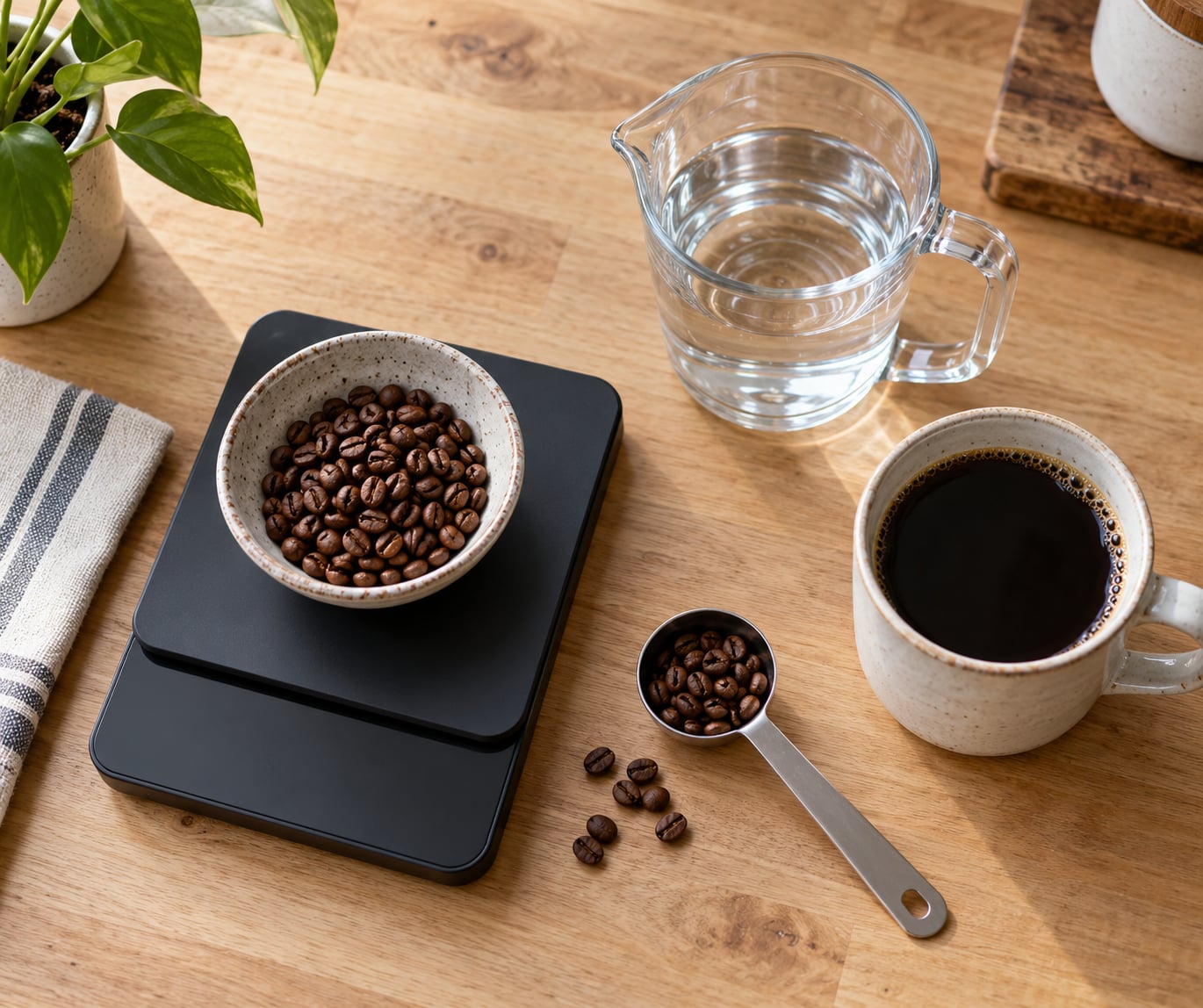
Use about 2 level tablespoons of ground coffee, roughly 10 to 12 grams, for every 6 ounces of water. That is the standard starting point for most home brewers, and it matches the widely used 1:16 coffee-to-water ratio by weight. Treat it as a starting point, not a law of physics.
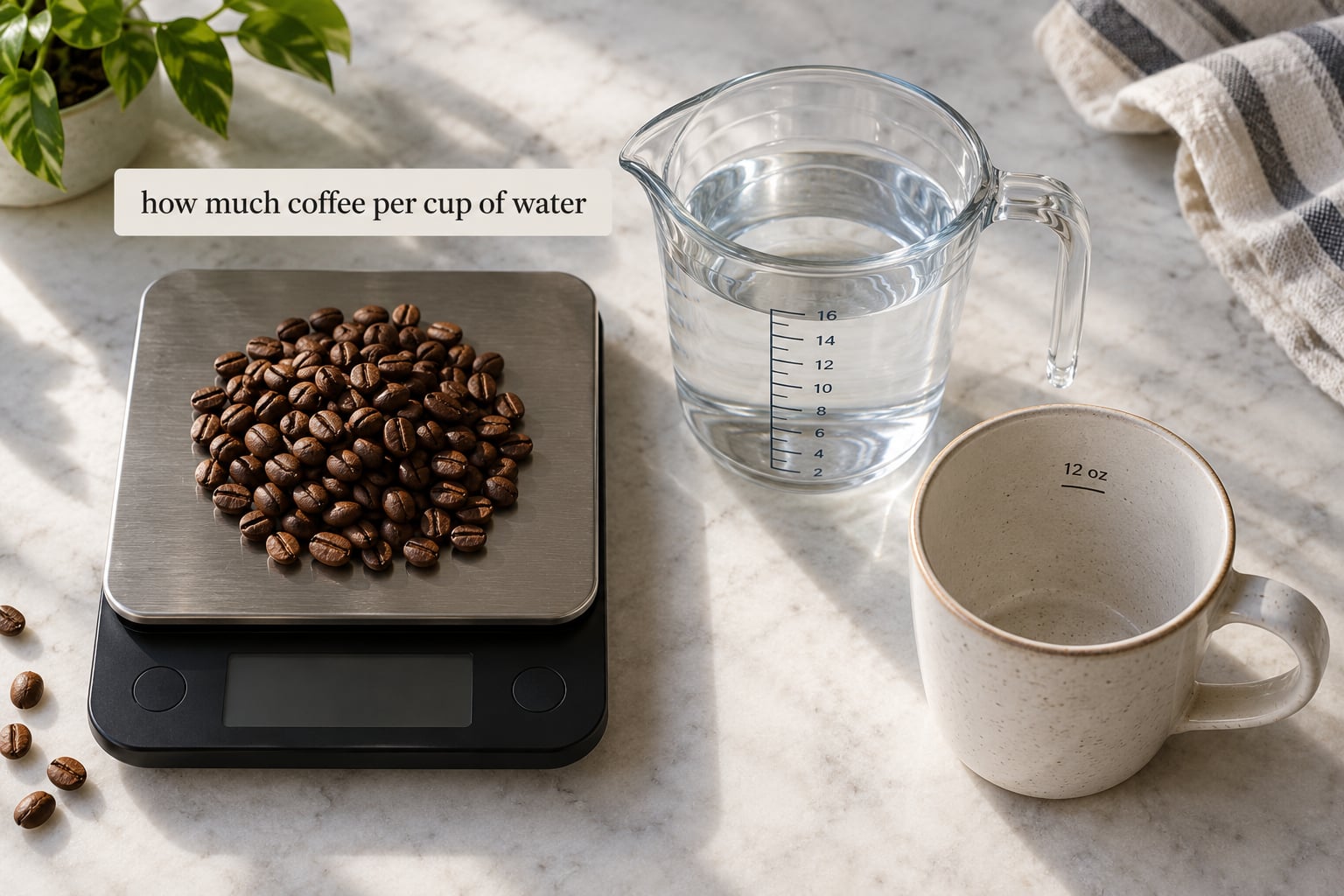
The reason that number comes up so often is that a spoon is what most kitchens have. But a spoon is a volume measure, and coffee grounds pack differently depending on how fine they are ground and how dark the roast is.
Here is the short version before the details: 2 tablespoons per 6 ounces of water for drip and pour-over, roughly 1:15 for a French press, and something closer to 1:8 if you are making cold brew concentrate you will dilute later.
Table of Contents
- How Much Coffee per Cup of Water Do You Need?
- What Is the Golden Ratio for Coffee Brewing?
- What Ratio Should You Use for Drip Coffee?
- How Much Coffee per Cup of Water for Pour-Over?
- How Much Coffee per Cup of Water for French Press?
- How Much Coffee per Cup of Water for Cold Brew?
- How Much Coffee for 4 Cups and Other Batch Sizes?
- How to Measure Coffee Without a Scale
- How to Adjust the Ratio to Taste
- Frequently Asked Questions
- Conclusion
How Much Coffee per Cup of Water Do You Need?
The short answer is 2 level tablespoons, about 10 to 12 grams, for a 6-ounce cup. Everything else on this page is an adjustment to that number based on how strong you like your coffee and which brewer you are using.
One thing worth fixing in your head before anything else: a “cup” of coffee in most recipes means 6 fluid ounces, or about 180 millilitres. That is the measuring cup people usually grab. A 12-ounce coffee mug is a serving size, not a brewing unit, and the difference is where a lot of weak cups come from.
| Measure | What it equals | Typical coffee amount |
|---|---|---|
| 1 level tablespoon | About 5 grams of medium ground coffee | One-third of a 6-ounce cup |
| 2 level tablespoons | About 10 to 12 grams | One 6-ounce cup |
| 1 standard coffee scoop | 2 tablespoons, about 10 grams | One 6-ounce cup |
| 6 fluid ounces of water | About 180 millilitres | 10 to 12 grams of coffee |
| 8 fluid ounces of water | About 240 millilitres | 15 to 18 grams of coffee |
| 12 fluid ounces of water | About 355 millilitres | 22 to 26 grams of coffee |
Coffee-to-Water Ratios by Strength
More coffee is not automatically better coffee. Adding grounds past a certain point mostly makes the cup thicker and more bitter rather than more satisfying, so it helps to pick a strength target before you start.
| Style | Ratio by weight | Per 6 oz of water |
|---|---|---|
| Mild | 1:18 | About 10 grams, 1.5 to 2 Tbsp |
| Balanced | 1:16 | About 11 grams, 2 Tbsp |
| Strong | 1:15 | About 12 grams, 2 to 2.5 Tbsp |
| Extra strong | 1:12 to 1:14 | About 14 to 15 grams, nearly 3 Tbsp |
Most people land somewhere between 1:15 and 1:17 and stay there for years. If your coffee tastes thin, move one step toward the strong end before you change anything else.
What Is the Golden Ratio for Coffee Brewing?
The golden ratio, also called the golden cup standard, is 1:16 by weight. That means 1 gram of ground coffee for every 16 grams of water, and it comes out to about 11 grams per 180 millilitres of water, which is right around 2 level tablespoons.
You will see other numbers attached to the same idea. 1:15 is common in immersion brewing, 1:17 shows up in a lot of pour-over recipes, and somewhere in the 1:18 to 1:20 range turns up in online discussions as the fix for coffee that tastes astringent or drying. None of them is more correct than the others. They are different settings on the same dial.
The notation trips people up more than anything else in coffee. In 1:16, the first number is always the coffee. A ratio of 1:16 means coffee to water, never the other way around, so 16 grams of water get 1 gram of grounds.
A ratio is more useful than a recipe because it scales. Once you like how 22 grams of coffee tastes in 355 millilitres of water, you can brew 10 times as much and keep the flavour identical. A recipe written for exactly one cup is a snapshot; a ratio is a rule that keeps working.
What Ratio Should You Use for Drip Coffee?
For an automatic drip machine, start at 2 tablespoons, about 10 to 12 grams, per 6 ounces of water. That gives you roughly 17 grams for a standard 12-ounce mug.
If you brew a dark roast, sit closer to the 1:15 end. Darker roasts are more soluble and bitter compounds come out faster, so the same ratio that tastes balanced on a medium roast can taste harsh. Light roasts lean the other way. They are less soluble, so a slightly tighter ratio of 1:16 or even 1:15 helps you get flavour out of them rather than just water.
Most machines heat water to somewhere between 195 and 205 degrees Fahrenheit, which is a reasonable default. Filtered water tastes noticeably better than tap water, and if your cup tastes dull or flat with no obvious reason, the water is worth checking before the coffee is.
If your drip coffee tastes weak, the cause is almost always one of three things: too little coffee, a carafe cup that is smaller than you think, or a machine that is being run on a carafe setting with a small pot. More on that in the batch size section below.
How Much Coffee per Cup of Water for Pour-Over?
Pour-over has one confusing quirk that catches everyone: you measure coffee against the water you pour in, not the liquid that ends up in your mug. Grounds hold roughly twice their weight in water, so 22 grams of coffee plus 355 millilitres of water gives you a final yield closer to 300 millilitres, not 355.
For a single large cup, use 22 to 24 grams of coffee for 350 millilitres of water. For a 600 millilitre Chemex, which serves two generous mugs, go with 38 to 40 grams of coffee. Those numbers land you at 1:16 either way, which is the whole reason to work in grams in the first place.
Grind size does more work in pour-over than in any other method. Grind finer and the water slows down, so more of the coffee dissolves in the same amount of water and the cup gets stronger and more bitter. Grind coarser and the cup goes thinner and sourer at the identical ratio. Pour structure matters too. A slow, steady, even pour extracts more than three dumps of water poured all at once, and swirling the brewer halfway through flattens the bed and evens out flow.
How Much Coffee per Cup of Water for French Press?
A French press wants a slightly tighter ratio than drip, because you are immersing the grounds instead of filtering them. Start at 1:15, which is about 12 grams of coffee for every 180 millilitres of water, or 48 grams for 720 millilitres of water.
You will not drink all the water you add. The spent grounds sit in the bottom of the plunger and hold a substantial amount back, so a French press that gets 720 millilitres of water will yield something closer to 500 millilitres of coffee. This is why press recipes always look heavy on coffee, and why pressing a batch down with a guest sitting next to an empty mug is a normal Tuesday.
Grind coarse, near the texture of wet sand. Fine grounds in a press turn the liquid to silt and make it impossible to plunge cleanly. Steep for four minutes, break the crust with a spoon, skim off the foam, and then wait another minute before plunging. One gentle stir during the steep spreads the grounds and reduces the chance of a bitter cup, but crushing the bed with an aggressive plunge pulls sediment up and makes the last sips gritty.
How Much Coffee per Cup of Water for Cold Brew?
Cold brew works because cold water is far less soluble, so it needs a much higher concentration to taste like anything. Use a 1:8 ratio by weight as your concentrate starting point, roughly 100 grams of coarse coffee for 800 grams of water. Steep it in the fridge for 12 to 18 hours and strain it.
That concentrate is far too strong to drink as it comes out. Cutting it with equal parts water and ice gives you a drink close in strength to a normal cup of drip. Dilute it half and half for something milder, or leave it alone and treat it as a base for a mixed drink.
Keep the concentrate volume separate from the volume in your glass. Around 200 millilitres of concentrate becomes roughly a full glass once you top it up, and it is a common mistake to build a single serving with a full 1:8 ratio and then wonder why it tastes like a syrup.
How Much Coffee for 4 Cups and Other Batch Sizes?
Ratios scale cleanly, which makes the table below the fastest way to answer most batch questions. Everything is measured against 6-ounce cups of water, the standard recipe unit.
| Batch size | Water | Coffee at 1:16 | Scoops or Tbsp |
|---|---|---|---|
| 1 cup | 6 oz / 180 ml | 11 g | 1 scoop, 2 Tbsp |
| 2 cups | 12 oz / 355 ml | 22 g | 2 scoops, 4 Tbsp |
| 4 cups | 24 oz / 710 ml | 44 g | 4 scoops, 8 Tbsp |
| 8 cups | 48 oz / 1420 ml | 89 g | 8 to 9 scoops |
| 12-cup carafe | See note | 130 to 140 g | 12 to 14 scoops |
That last row is where a lot of home brewers go wrong. The “12-cup” marking on a coffee maker is a count of servings at about 5 fluid ounces each, not 12 full 8-ounce mugs. Filling the carafe to the top and dosing it as though you were making 12 standard cups leaves you somewhere around 1:22, which is exactly why so many home pots taste thin.
For a full 12-cup carafe, most people land between 130 and 140 grams of coffee. If you would rather not weigh that much, count scoops and add a couple beyond the marker. Going a little over on coffee is far easier to correct than going under.
How to Measure Coffee Without a Scale
A cheap kitchen scale changes coffee more than any other single purchase you can make, but spoons and scoops work fine once you understand their limits.
A standard coffee scoop holds 2 tablespoons and is usually marked at about 10 grams, which is almost exactly right for one 6-ounce cup. Fill it level, not heaped. A heaping scoop can easily carry 14 or 15 grams, and a 12-cup carafe full of heaping scoops will taste like battery acid.
The trouble with tablespoons is that the same volume weighs very different amounts. Fine grind for espresso packs tight and dense, so 2 tablespoons of it might weigh 7 grams. Coarse grind for a press has air between the particles, so the same 2 tablespoons might weigh 12 or 13. A light roast is denser than a dark one and adds a gram or so more per spoon. The range across all those combinations is roughly 7 to 14 grams per tablespoon, which is a wide enough spread to turn a 1:16 recipe into a 1:22 one without you noticing anything but a weaker cup.
Pre-ground coffee loses aroma within days of grinding, so a brew that tastes flat despite a correct ratio is often a freshness problem rather than a measurement problem. Grinding whole beans right before you brew costs the same and fixes it. For guests who find your coffee too strong, brew at 1:15 and let people add hot water to their own cup instead of weakening the batch for everyone.
How to Adjust the Ratio to Taste
Ratio sets strength. Grind size, brew time and water temperature set extraction, which is how much of the coffee actually dissolved. They are different problems, and changing the wrong one makes things worse. Before you adjust anything, decide whether the cup is weak or harsh, because those have opposite fixes.
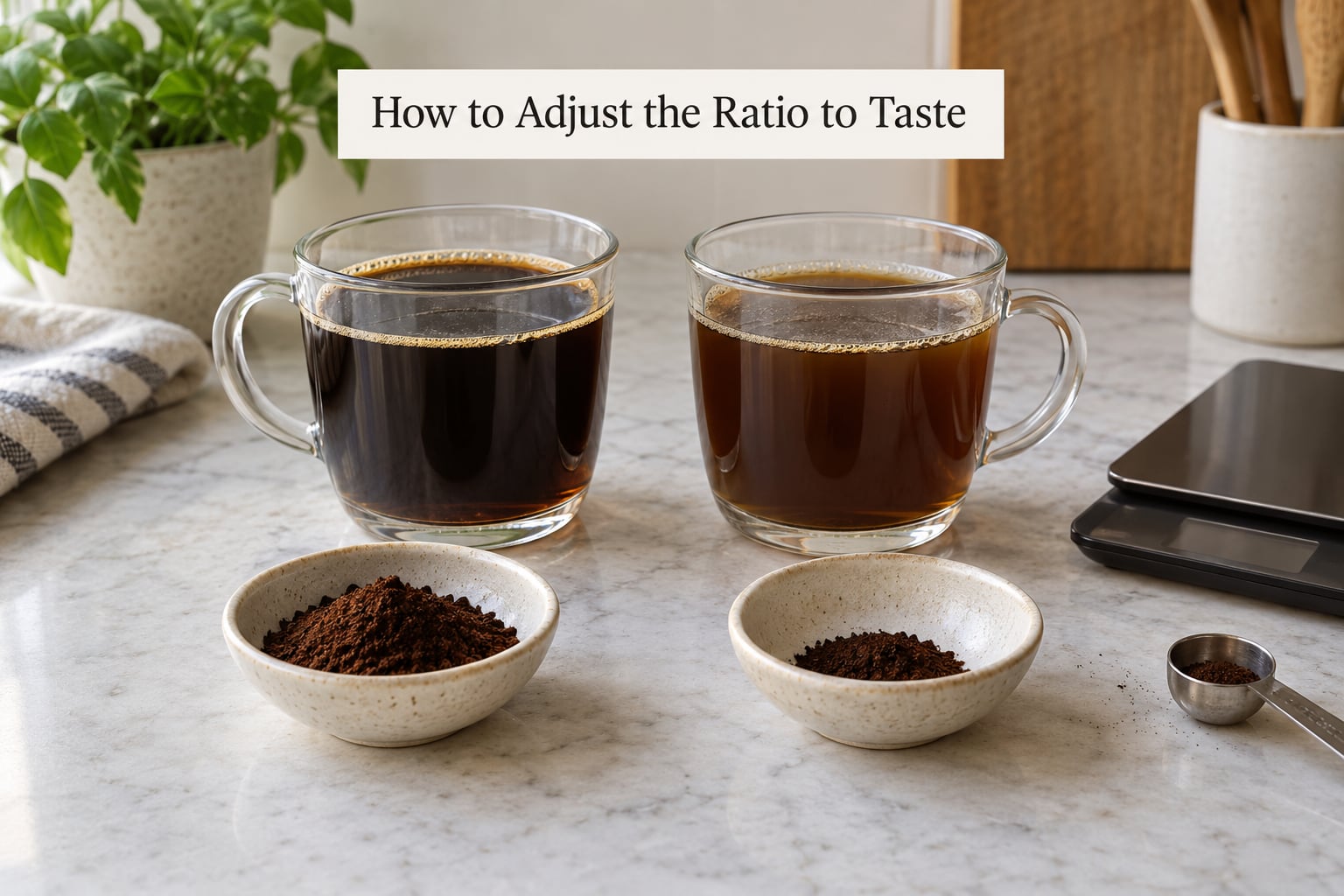
When in doubt, work through them in this order. Change the ratio first, since it is the biggest lever and the easiest to measure. If moving from 1:16 to 1:15 fixes the cup, stop there. If the taste barely shifted, leave the ratio alone and move to grind.
| What you taste | Likely cause | First fix |
|---|---|---|
| Weak, watery, no body | Not enough coffee, or a carafe filled past its real capacity | Add 1 to 2 grams per cup |
| Sour, thin, sharp edges | Under-extraction from too coarse a grind or too short a brew time | Grind finer |
| Bitter, harsh, drying | Over-extraction, usually from too fine a grind or contact with already-hot water | Grind coarser, or move to 1:17 |
| Muddy or sediment-heavy | Grind too fine for the brewer, or plunging a press too hard | Grind coarser |
| Tastes like nothing in particular | Stale beans or poor water | Grind fresh, use filtered water |
One last thing on bitterness, because it is the most common misdiagnosis. When a cup is bitter, the instinct is to use less coffee, but bitterness almost always comes from over-extraction rather than quantity. Use the same amount of coffee, grind a little coarser, and shorten the contact time. If the bitterness persists, loosen the ratio to 1:17 and taste again.
Frequently Asked Questions
How many tablespoons of coffee should I use per cup of water?
Use 2 level tablespoons for every 6 ounces of water, which lands close to 1:16 by weight at roughly 10 to 12 grams. Light the spoons level rather than heaped, since a heaping tablespoon can carry 14 grams or more. If you are brewing a full carafe, scale the same ratio up rather than estimating each cup separately.
Is 2 tablespoons of coffee enough for one cup?
For a 6-ounce cup, yes. Two level tablespoons give you roughly 10 to 12 grams, which is the balanced middle of the range most people drink. If you are filling a large 12-ounce mug, double it to 4 tablespoons, or about 22 grams. The number that trips people up is the 12-cup carafe, whose cups are closer to 5 ounces each.
How many grams of coffee are in a 12-ounce cup?
About 22 to 26 grams for a balanced cup at the 1:16 ratio, or roughly 4 level tablespoons. Stronger brews sit closer to 24 grams, and milder ones around 20. A standard 2-tablespoon coffee scoop is built to hold about 10 grams, so two scoops gets you there without a scale.
Should I use more coffee for a stronger cup or change the grind?
If the cup is simply weak, add coffee and move from 1:16 toward 1:15. If the cup is sour and thin, more coffee will not help much, because the problem is under-extraction. Grind finer in that case. If the cup is bitter and drying, the opposite applies: keep the coffee the same and grind coarser, since bitterness comes from over-extraction rather than quantity.
How do I calculate the right coffee-to-water ratio for iced coffee?
Ice dilutes, so brew the concentrate slightly stronger than you would for a hot cup, around 1:14 to 1:15, and expect the finished drink to settle closer to a normal strength. For cold brew concentrate, use roughly 1:8 by weight and steep 12 to 18 hours in the fridge. Cut that concentrate with equal parts water and ice to bring it back to something drinkable.
Conclusion
Start here: 2 level tablespoons, about 10 to 12 grams, for every 6 ounces of water. That single number works for most drip and pour-over setups, and it scales to any batch size as long as you keep the ratio constant.
From there, change one thing at a time. Weak means more coffee, sour means grind finer, bitter means grind coarser. Measure by weight when you can, use filtered water between 195 and 205 degrees Fahrenheit, and grind the beans right before you brew. Once you find the ratio you like, write it on the bag and stop thinking about it.