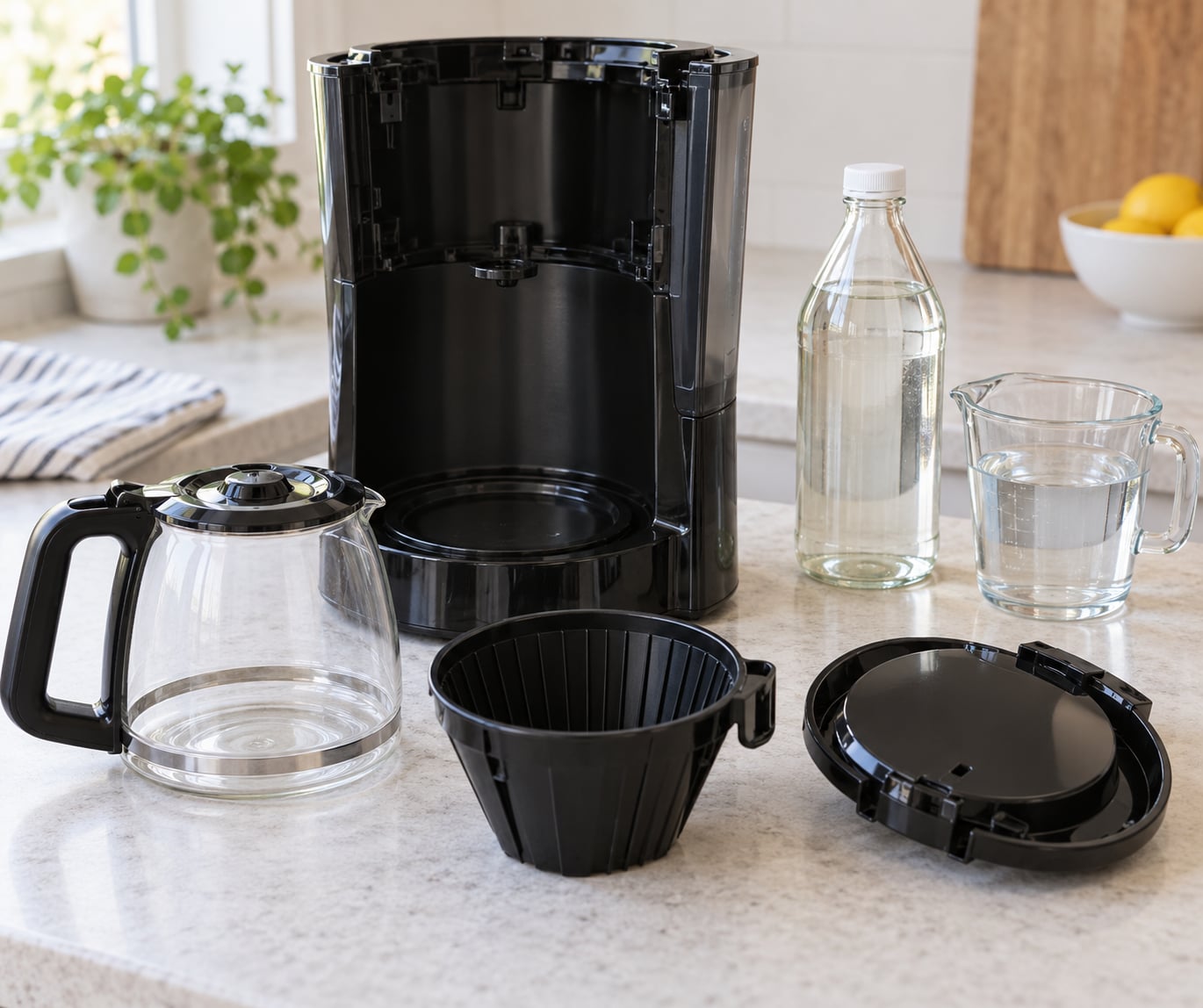
To descale a coffee maker with vinegar, mix equal parts plain white vinegar and cool water, run the solution through a full brew cycle, let it sit 30 to 60 minutes, finish the cycle, then flush two or three times with fresh water. The whole job takes about an hour and most of that is waiting.
Before you pour anything, find the manual. Most standard drip brewers are fine with vinegar, but espresso machines, integrated milk systems and anything with aluminum inside often are not, and a few manufacturers have quietly stopped endorsing vinegar entirely. If your machine is in that category, the manual will send you to a bottled descaler instead.
I keep a bottle of distilled white vinegar under the sink for exactly this, and it is the cheapest tool in the kitchen. The hardest part is not the acid, it is rinsing long enough that the next pot does not taste like a salad.
Table of Contents
How to Descale a Coffee Maker with Vinegar: What You Need
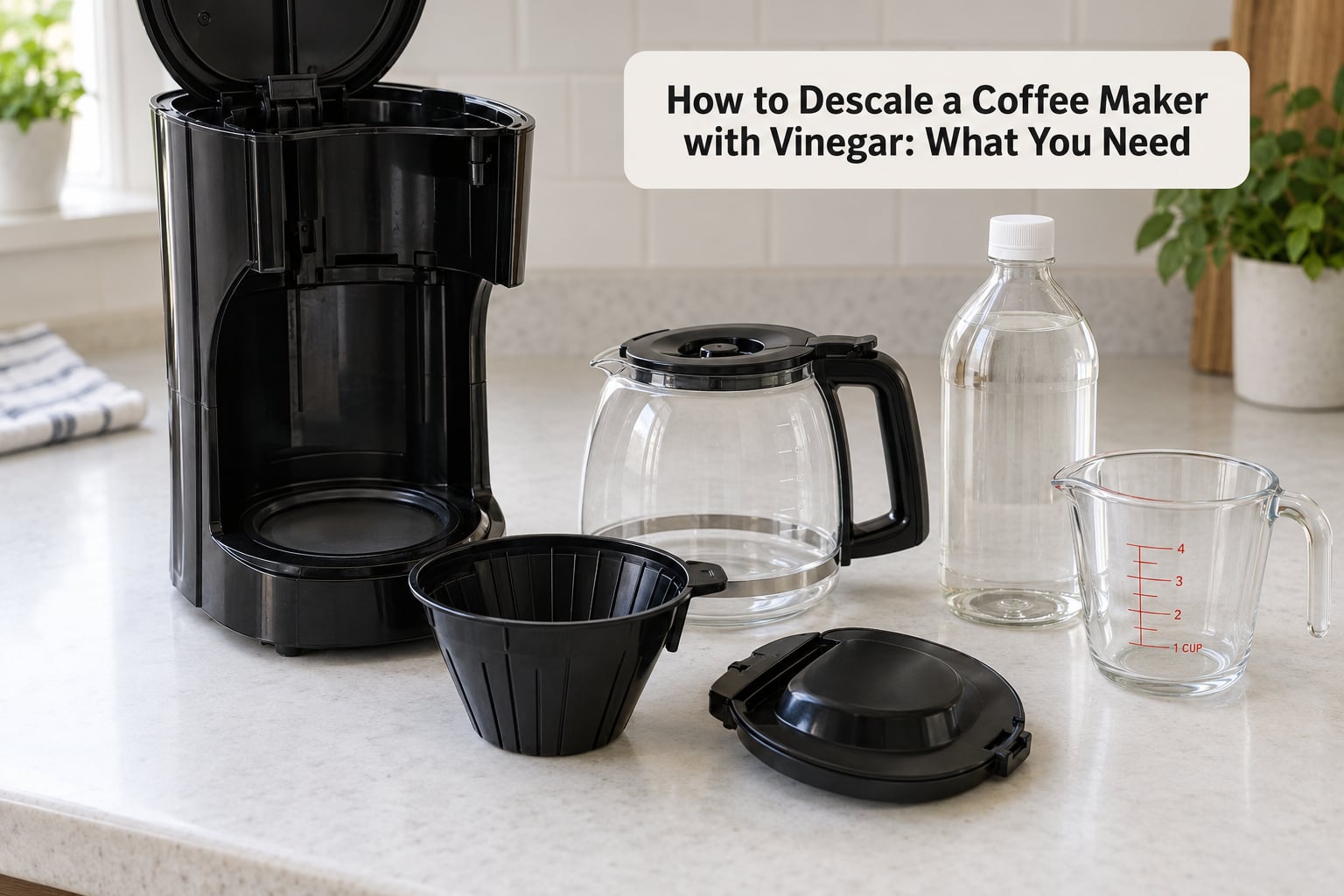
You need very little. Gather plain white vinegar with 5 percent acidity, cool water, a soft cloth or sponge, and access to a sink for the rinses. A soft-bristled brush helps with the spray head on pod machines, and having the manual nearby is genuinely useful rather than optional.
The standard solution is one part vinegar to one part water. If your machine’s manual specifies a different ratio, the manual wins, since a stronger mix on a sensitive heating plate or gasket is unnecessary risk for no extra benefit. For light scale on a small machine, forum users commonly dilute further, around one part vinegar to two or three parts water, which is gentler and still works.
How much you need depends on the reservoir. Fill the solution only to the max line, never past it, because the machine heats and expands what you pour in.
| Machine | Vinegar | Water |
|---|---|---|
| Small 4 to 5 cup brewer | 1 cup (240 ml) | 1 cup (240 ml) |
| Standard 8 to 12 cup brewer | 2 cups (480 ml) | 2 cups (480 ml) |
| Single-serve or pod machine with a 40 to 60 oz reservoir | 3 cups (710 ml) | 3 cups (710 ml) |
| Commercial or office urn | Often not approved, so check first | Check the unit instructions |
Use distilled white vinegar, not apple cider vinegar. ACV is a similar acidity, roughly 5 percent, so it dissolves scale about as well, but its color and odor cling to plastic tubing and it takes noticeably more rinsing to clear.
Step-by-Step Descaling Guide
1. Check the manual and empty the coffee maker
Unplug the machine and let it cool completely. Pull the filter basket and any paper filter out, empty the reservoir, and wash the carafe and basket with dish soap and warm water while you are there.
Confirm the manual allows vinegar. Machines with aluminum heating plates, sealed heating elements, or integrated milk frothers need a manufacturer-approved product, and using the wrong acid on those can affect seals and, in some cases, warranty coverage.
2. Mix the solution: descale a coffee maker with vinegar at a 1:1 ratio
Measure equal parts vinegar and cool water in a jug or the carafe itself. Cool water is the right call even though warm water dissolves scale a little faster, because hot water can crack old glass carafes and speeds up acetic acid off-gassing, which means a stronger smell in your kitchen.
For a small machine, one cup each is plenty. For a full 12-cup reservoir, two cups each. If your manual calls for straight vinegar or a 1:3 mix, use that instead and skip this ratio entirely.
3. Add the solution to the water reservoir
Pour the measured solution into the reservoir to the max fill line and seat the lid. If your machine has a charcoal water filter, pull it first, since it can absorb solution and hold onto vinegar odor for weeks.
Set the empty carafe under the brew head. On machines with a hot water spigot, that spigot now has a cup under it too, and you will run hot water through it later.
4. Run the first brew cycle
Turn the machine on and let it run a complete brew cycle with the solution and nothing else in the reservoir. This is the pass that carries acid through the internal lines, over the heating plate and out into the carafe.
Some brewers heat the whole reservoir to brew temperature, others brew a measured portion. If yours only heats part of the reservoir, the manual will tell you to pause or stop midway so you are not boiling vinegar, and that instruction matters for safety as much as for seal life.
5. Repeat if scale remains
Let the machine sit 30 to 60 minutes after the cycle. During the soak, the solution stays in contact with the deposits and does the dissolving quietly, and an hour is not excessive if the water in your area is hard.
Check the carafe and the reservoir walls for white crust. A second pass through the same solution is reasonable when scale was heavy, but stop after two and switch to a manufacturer-approved descaler if deposits remain. Nothing about this process involves taking the machine apart beyond the removable parts your manual describes.
6. Rinse the coffee maker thoroughly
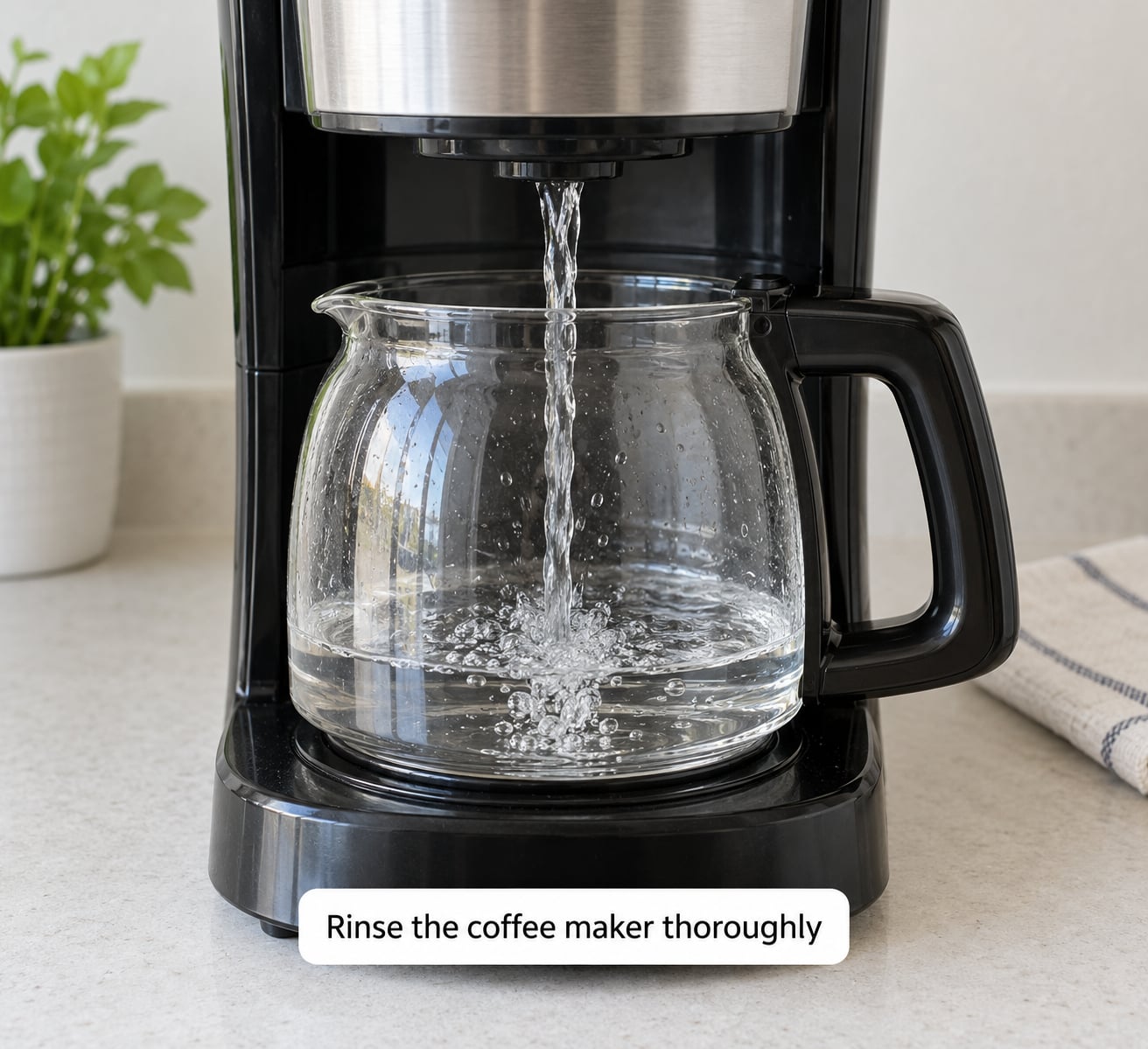
Empty the carafe and reservoir, wipe away any leftover solution, and refill with fresh cool water. Run one complete brew cycle, then dump it, then run another. Owners of pod machines in particular report needing ten or more cups of water to fully clear the smell.
Pour a cup into a clean glass and smell it before you are done. If any trace of vinegar is there, run one more cycle. This last step is what keeps the whole job worth doing, because a perfectly descaled machine that still smells sour will have you reaching for the old machine again.
7. Wipe down and reassemble
Clean the lid, filter basket and spray head with warm soapy water, rinse the carafe, and leave the reservoir open to air dry if the manufacturer allows. Dry parts reassemble better and the carafe is easier to inspect for limescale streaks.
Common Mistakes
- Using too much vinegar. Filling past the max line, or running several cups of undiluted vinegar, adds odor and risk without removing scale faster. One to one is the standard, and a stronger mix is only justified when a manual specifies it.
- Skipping or shortening the rinses. One water cycle is almost never enough. Two full cycles is the minimum, three if the water is cold, and keep going until a glass of the runoff smells clean.
- Submerging parts the manual excludes. Some machines warn against immersing the base, the carafe lid or the brew head. Acid can reach wiring and seals through openings the water path never touches, so follow the parts list in the manual.
- Using hot or boiling water. Boiling water risks old glass, and heat makes vinegar smell much more aggressively. Cool or lukewarm water works on scale just as well.
- Ignoring a scaled reservoir. If the reservoir walls and fill line have a white crust, rinsing the machine through the brew head alone leaves a reservoir that will re-scal your water. Wipe it out or run one solution cycle with nothing brewing.
- Using vinegar on an incompatible machine. Check the manual first, every time, because model guidance changes. Espresso machines with aluminum group heads, integrated milk systems and units that specify their own descaling solution are the usual exclusions.
- Combining vinegar and baking soda. The two neutralize each other into salt water, so you lose the acid that does the work. Use one or the other, never both in the same pass.
How Often Should You Descale a Coffee Maker?
There is no universal schedule, because the honest answer depends on your water, how much coffee you drink and what the manual says. As a working baseline, monthly on hard water and every two or three months on soft or filtered water is a reasonable rhythm for a daily household brewer.
These are the signs to act on sooner than any calendar: visible white crust in the reservoir or carafe, coffee that brews noticeably slower than it used to, water that fails to heat properly, a bitter or flat taste in the cup, or a descale or clean indicator light that stays on. Slow flow alone is not proof of scale, since a clogged filter or a failing pump can look the same, and a scale-stripped machine that still brews slowly deserves a service call rather than more acid.
You slow re-scaling at the source by using filtered or distilled water in the machine. That costs you nothing during the descale itself and usually stretches the interval considerably, though it is worth checking the manual first since a few machines rely on water hardness for sensor calibration.
Is Vinegar Safe for Every Coffee Maker?
No, and this is the part most guides skip. Vinegar is well suited to standard drip brewers, most pod machines and travel brewers, where the water path is simple plastic tubing and an aluminum or stainless plate that tolerates mild acid.
It is a poor choice for espresso machines with aluminum group heads, superautomatic machines that route milk through the same circuitry, and any model whose manual specifies a particular descaling product. Several manufacturers of expensive superautomatics have moved away from recommending vinegar for exactly this reason, and using the wrong descaler can complicate a warranty claim.
Citric acid is a reasonable middle ground when vinegar is discouraged but the manual does not name a product: dissolve about two tablespoons of powdered citric acid per quart of hot water, run it through the same cycle, and rinse. It works well on scale and leaves almost no odor, which is why many people on hard water prefer it to vinegar.
Frequently Asked Questions
Will vinegar clean the taste out of my coffee maker?
Vinegar removes mineral scale, not the coffee oils that make coffee taste stale, so it fixes bitterness and flatness caused by limescale but not every bad flavor. Wash the carafe, lid and filter basket with dish soap in the same session, since oils sit on surfaces the acid never touches. If coffee still tastes off after a proper descale and a full wash, the next suspects are old coffee in the grinder or beans, not the machine.
What is the best vinegar-to-water ratio for descaling a coffee maker?
One part plain white vinegar to one part cool water is the standard ratio, and it is what most manufacturer guidance describes. Use distilled white vinegar at 5 percent acidity, fill the reservoir only to the max line, and never go stronger unless your manual says to. If you have hard water and heavy scale, a 1:1 mix left to soak for a full hour works better than a harsher solution.
Can I run the vinegar solution through my coffee maker twice?
Yes, a second pass is sensible when the first one left visible white deposits, and plenty of people on hard water run the same batch through twice. Change nothing between passes and give it another 30 minutes of soak time. If deposits are still there after two passes, stop and use a manufacturer-approved descaler, because the problem is likely aluminum scaling or a machine type that vinegar was never approved for.
Why does my coffee maker still smell like vinegar?
Usually it is the tubing, not the carafe. Vinegar odor hides in plastic lines and in any charcoal water filter you left installed during the descale, and one rinse cycle will not clear either. Run two or three full brew cycles of plain cool water, remove or replace the filter, and pour a cup into a clean glass to smell it. Keep running cycles until the water is completely neutral, which on a pod machine can take ten cups or more.
When should I use a coffee descaler instead of vinegar?
Use a commercial descaler when your manual names one, when the machine is a superautomatic or espresso machine with an aluminum group head, when you have run two vinegar passes with no improvement, or when scale comes back within weeks. Proprietary solutions are formulated for specific materials and often clear aluminum and heavy scale that plain vinegar will not touch. Read the label, because some are meant to sit in the machine for far longer than a brew cycle.
Conclusion
Start at the manual, then at the machine itself: if you see white crust in the reservoir or carafe, that is your cue. From there the sequence is short and worth memorizing: mixed solution to the max line, one brew cycle, a 30 to 60 minute soak, the finishing cycle, and at least two full rinses with cool water until a glass of the runoff smells like nothing at all. That is how to descale a coffee maker with vinegar, done properly, and the coffee will tell you within a day whether it worked.