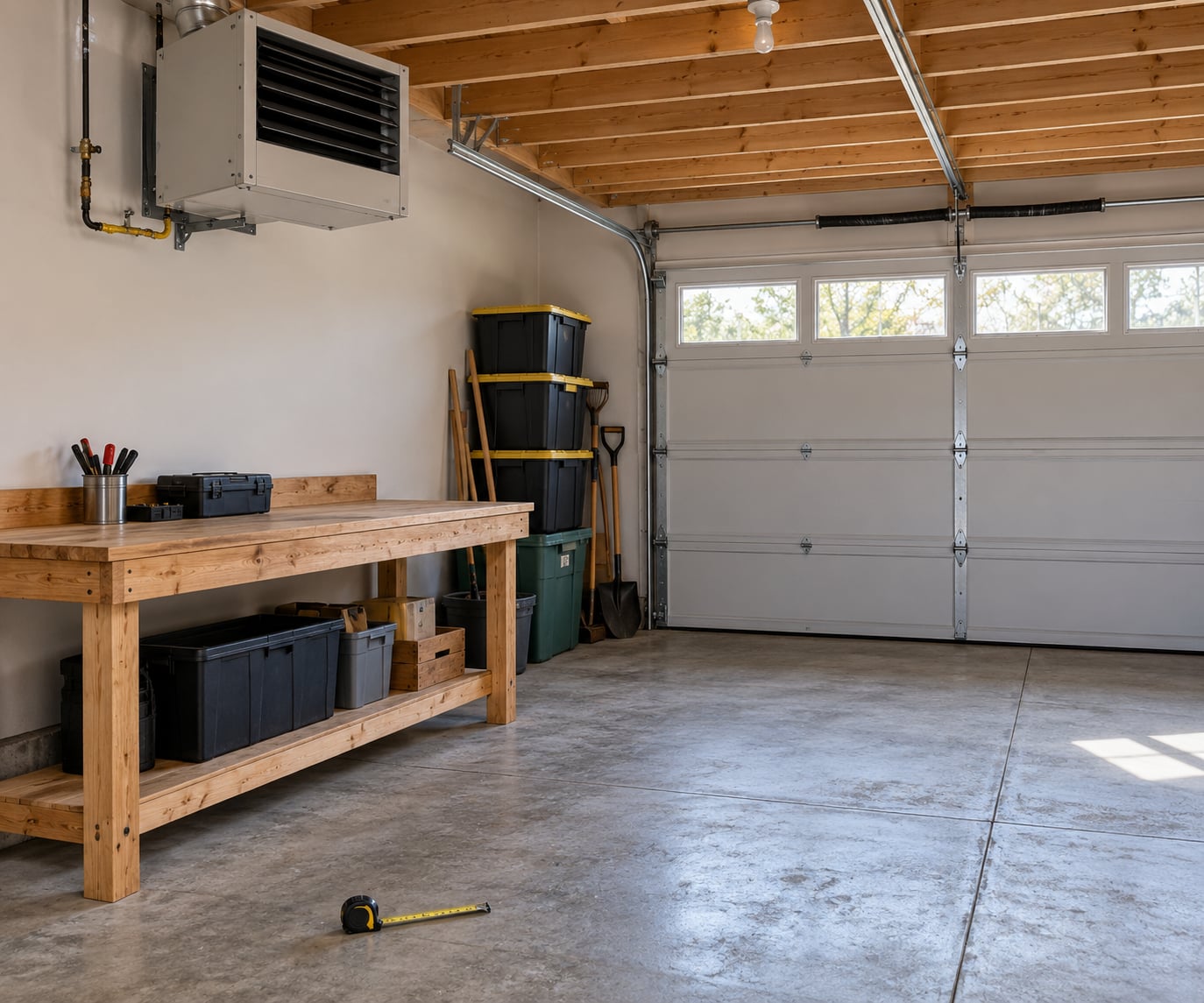
How many BTUs do you need to heat a garage? If you want one number to shop with, the answer is roughly 30,000 to 50,000 BTUs for a standard two-car garage, 8,000 to 12,000 BTUs for a one-car space, and 45,000 to 75,000 BTUs or more for a three-car garage or shop. Those numbers assume a moderately insulated space in a normal winter. Your own answer comes from square footage, insulation, ceiling height and your local winter low, and the arithmetic takes about two minutes.
I will walk through that arithmetic step by step, because the difference between a 30,000 BTU estimate and a 140,000 BTU estimate for the same garage usually comes down to assumptions a calculator never showed you.
Table of Contents
- How Many BTUs Do I Need to Heat a Garage?
- What BTU Rating Means for a Garage Heater
- How to Calculate Garage Heating Needs
- Garage Size and BTU Requirements
- How Insulation, Climate, and Ceiling Height Change the Answer
- What Temperature Should You Set for a Garage?
- Gas, Electric, or Portable Garage Heaters
- How to Choose a Garage Heater That Can Keep Up
- Safety and Efficiency Tips for Heating a Garage
- Frequently Asked Questions
- Conclusion: Start With Your Garage’s Heat Load
How Many BTUs Do I Need to Heat a Garage?
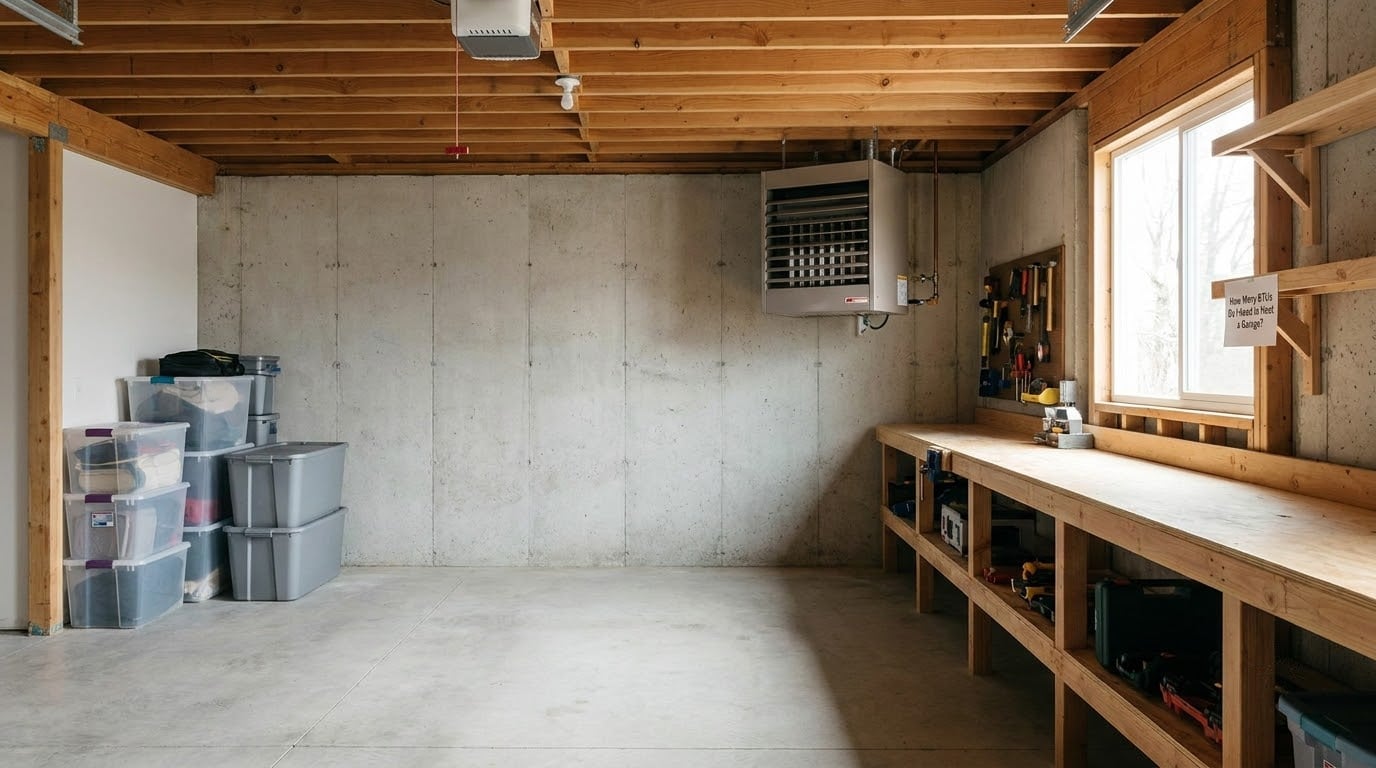
The short version, by garage type:
- One-car garage (200 to 300 sq ft): 8,000 to 12,000 BTUs when insulated and air sealed.
- Two-car garage (400 to 600 sq ft): 30,000 to 50,000 BTUs is the range most owners land on.
- Three-car garage (750 sq ft and up): 45,000 to 75,000 BTUs or more.
That range is where the useful number lives. Anything below it means the heater will run continuously and the space may never reach your target temperature. Anything far above it means the heater cycles on and off in short bursts, which wastes fuel and wears the unit out faster.
One caution before you buy: BTU is a rating, not a promise. Input rating, delivered heat and the spec sheet figure of “heating capability” are three different things, and we’ll come back to that below.
What BTU Rating Means for a Garage Heater
BTU stands for British Thermal Unit, a fixed amount of thermal energy. A BTU/hr rating (written BTUH on most nameplates) tells you how many of those units a burner releases every hour. A 40,000 BTU burner releases 40,000 BTUs an hour while it is firing.
That is the input, not always the heat that arrives in your garage. Combustion heaters lose a portion of their fuel energy up the flue, so a unit rated at 40,000 BTU input might deliver somewhere around 32,000 BTU of warmth to the room. Manufacturers rate most modern gas heaters in the high 80s to low 90s percent for efficiency, but an old unit from a decade ago can be much worse.
Electric heaters have no flue loss at all. A resistance heater puts essentially everything it draws into the room, which is why the same 5,000 watts of electricity produces about 17,000 BTU of heat with nothing wasted.
Then there is the spec sheet number labeled “heating capability,” usually expressed in square feet. Read it as a laboratory figure produced under favorable conditions, not as a recommendation for your garage. One Garage Journal user calculated 1,111 sq ft for a 50,000 BTU unit while the manufacturer’s sheet said 700 sq ft for the same heater. Both numbers came from reasonable sources. Neither described his specific garage.
How to Calculate Garage Heating Needs
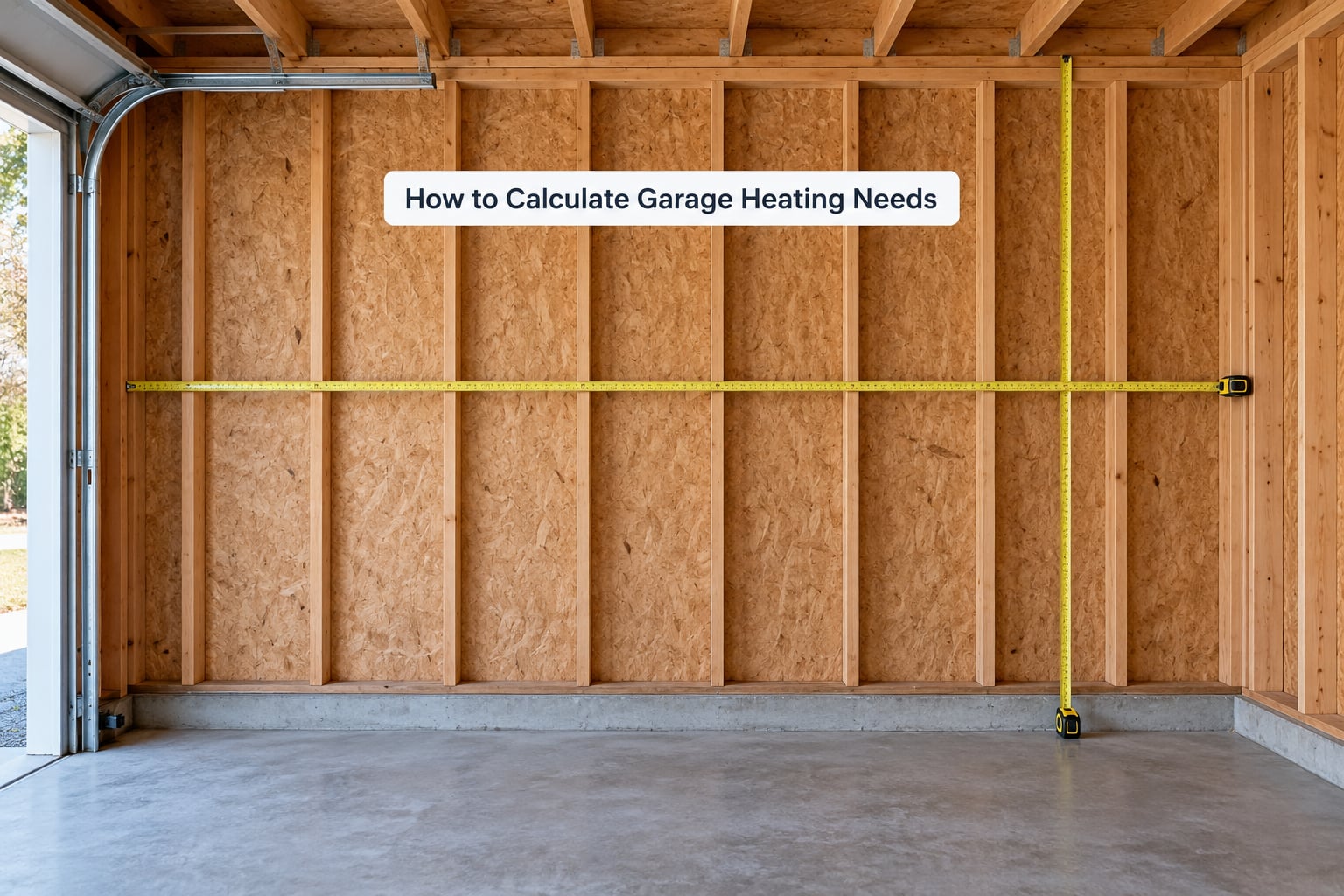
Here is the method that shows up on garage forums more than any other, because it is fast and it is right often enough to be useful:
BTUs = (square feet ÷ 200) × 9,000 for an uninsulated garage, or × 6,000 for a well-insulated, air-sealed one.
From there you adjust for climate, ceiling height and how leaky the overhead door is. Here is the full sequence.
Step 1: Measure the space
Measure length and width at floor level, then multiply for square footage. Also write down the ceiling height, because a 12 ft ceiling holds more air than a 9 ft ceiling and takes longer to recover. If your garage has a loft or a storage mezzanine, measure the actual floor area you plan to heat, not the full footprint.
Step 2: Pick your insulation multiplier honestly
Use 9,000 if the walls are bare framing, the ceiling is uncovered, or the door is a thin single-layer steel panel. Use 6,000 if you have insulation in the walls and ceiling, weatherstripping around the door, and the shared wall with your house already insulated.
If you do not know what R-value you have, you probably do not have much. Wall insulation in a garage is usually visible as pink or yellow batts between the studs, or a thick reflective barrier on the underside of roof joists.
Step 3: Adjust for climate
A garage in southern California and a garage in northern Minnesota do not have the same load. The useful rule: when your area’s winter design temperature sits below 0F, move toward 45 to 60 BTU per square foot instead of the base figure. In a milder climate where winter nights stay above 30F, you can usually go with the lower end of the range, or even undersize slightly.
Step 4: Adjust for ceiling height and leakage
Add roughly 25% for ceilings at 12 ft or higher, since the volume of cold air to warm is larger. The overhead door deserves its own adjustment because it is usually the single biggest air leak in the building, and any single-pane window in the garage can leak comparably.
Step 5: Round to a real product
Heaters are not sold at every number. Round up to the next size that exists, then read the “How to Choose” section below before you commit.
Worked example: a 24×24 two-car garage
This is the most common question on the search, so here is the full arithmetic. A 24 by 24 garage is 576 sq ft.
Uninsulated: 576 ÷ 200 = 2.88, then 2.88 × 9,000 = 25,920 BTU. Round to roughly 30,000 BTU.
Insulated and sealed: 576 ÷ 200 = 2.88, then 2.88 × 6,000 = 17,280 BTU. Round to roughly 20,000 BTU.
Now layer the adjustments. In a climate where design temperatures drop below 0F, add about 30% and you land near 23,000 BTU for the insulated case. With 12 ft ceilings, add another 25% and you are at about 29,000 BTU. So a cold-climate, tall, insulated 24×24 garage lands right back in that 30,000 to 40,000 BTU window.
Worked example: a 30×30 shop
Thirty by thirty is 900 sq ft.
Uninsulated: 900 ÷ 200 = 4.5, then 4.5 × 9,000 = 40,500 BTU. With a 12 ft ceiling in a cold climate, add 25% and 30% and you reach roughly 63,000 BTU.
Insulated with R-19 walls, an R-30 ceiling, insulated doors and heated space above the shop: 900 ÷ 200 = 4.5, then 4.5 × 6,000 = 27,000 BTU. Once air sealing is accounted for, the practical requirement drops much lower. On a Practical Machinist thread, a shop of almost exactly this description with R-9.3 garage doors and a heated attic above was estimated at just 9,000 to 12,000 BTU for maintaining temperature.
That spread is not a contradiction. It is the difference between maintaining temperature in a sealed building and recovering it on a January night after the door has been open for ten minutes.
Garage Size and BTU Requirements
Here are the numbers most readers are looking for, with separate assumptions for each type of construction.
| Garage size | Typical dimensions | Insulated and sealed | Uninsulated or drafty |
|---|---|---|---|
| 240 sq ft | 12 × 20 or 16 × 15 | 9,000 BTU | 12,000 BTU |
| 360 sq ft | 18 × 20 | 12,000 BTU | 18,000 BTU |
| 480 sq ft | 20 × 24 | 18,000 BTU | 25,000 BTU |
| 600 sq ft | 24 × 25 | 20,000 BTU | 30,000 BTU |
| 960 sq ft | 30 × 32 | 32,000 BTU | 50,000 BTU |
Now read it backwards, which is what most shoppers actually want.
| Heater rating | Approximate coverage, insulated | Approximate coverage, uninsulated |
|---|---|---|
| 12,000 BTU | up to 400 sq ft | up to 265 sq ft |
| 20,000 BTU | up to 670 sq ft | up to 445 sq ft |
| 30,000 BTU | up to 1,000 sq ft | up to 665 sq ft |
| 40,000 BTU | up to 1,330 sq ft | up to 890 sq ft |
| 50,000 BTU | up to 1,670 sq ft | up to 1,110 sq ft |
These come straight from the formula, which is why they land on round-ish numbers. Real results run inside or below these ranges depending on climate.
How Insulation, Climate, and Ceiling Height Change the Answer
Here are the adjustments as plain multipliers you can apply to your base estimate.
| Condition | Adjustment | Why |
|---|---|---|
| Uninsulated walls and ceiling | Add 30% | Heat leaves through every surface at once |
| Ceiling 12 ft or taller | Add 25% | More air volume to warm |
| Design temperature below 0F | Add 25 to 40% | Larger inside-to-outside temperature difference |
| Single-layer or uninsulated overhead door | Add 10 to 20% | Largest single air leak in most garages |
| Shared wall with a heated house | Subtract 10 to 15% | One wall loses no heat to outdoors |
| Heated floor or conditioned space above | Subtract 15 to 25% | Up and down are already taken care of |
| Air sealed, R-13 walls and R-19 ceiling | Subtract 25 to 40% | The most overlooked credit in garage sizing |
For a sense of what these numbers produce in real life: a 28 by 30 insulated garage on the Garage Journal forum was taken from -10C to +10C in under twenty minutes with a 55,000 BTU forced-air heater. A Reznor unit under 50,000 BTU held above 60F on a 0F night in northeastern Ohio in an insulated 30 by 30 outbuilding, adding about 20% to the total gas bill across fifteen years of service. Meanwhile a 30 by 22 garage with R-13 walls and an R-19 ceiling in northern Ohio heated comfortably on a 21,000 BTU output furnace.
The other lever people forget is the attic access hatch. One shop owner on a forum thread reported that blocking his walk-up hatch with plywood made a huge, noticeable difference in holding temperature. Ridge vents and a hatch in a conditioned ceiling leak as much as a small window.
What Temperature Should You Set for a Garage?
Most garages do not need living-space temperature, and sizing for one is how people end up with a unit they cannot afford to run.
For storing vehicles and protecting batteries, paint and tools from freezing, 40 to 50F is the common target. Preventing condensation on cold metal matters more than comfort at that level. For a workshop you actually stand in and work, 55 to 65F is the practical range. Above 70F you are heating a room, and that changes both the fuel bill and the sizing calculation substantially.
This is where maintain-versus-reheat sizing matters. If your garage is a maintain-temperature space that sits at 55F all winter with the door shut, size for the steady-state load and your numbers from the table above apply directly. If it is an occasional-use space that sits at 40F and gets opened up twice a week for an afternoon, size for the recovery instead, which usually means 30 to 50% more capacity than the steady-state figure.
Gas, Electric, or Portable Garage Heaters
Fuel choice constrains your BTU answer more than most people expect, because your electrical service sets a hard ceiling that has nothing to do with the garage.
| Heater type | Typical output | What limits it |
|---|---|---|
| Electric unit heater | 3,000 to 17,000 BTU | Circuit capacity: a standard 40A/240V garage circuit caps out near 17,000 BTU |
| Portable propane torpedo | 20,000 to 60,000 BTU | Tank size and where you are allowed to run it |
| Natural gas unit heater | 30,000 to 100,000+ BTU | Fuel line sizing and venting requirements |
| Radiant tube heater | 40,000 to 125,000 BTU | Mounting height, usually 8 to 12 ft for tube styles |
| Mini split heat pump | 9,000 to 24,000 BTU | Needs insulation to be efficient; poor at recovery |
The electrical ceiling deserves emphasis. If your estimate is above roughly 17,000 BTU, a plug-in electric heater is not a candidate no matter how much you want one. You would need a larger dedicated 240V circuit and a qualified electrician, and pushing a 40A circuit is not something to improvise.
For propane, the runtime math is worth doing once. Propane carries about 91,500 BTU per gallon, and a 100 lb tank holds 23.6 gallons. At roughly 80% efficiency that is around 1.7 million usable BTUs in a full tank, which is about 57 hours on a continuous 30,000 BTU load, or closer to 85 hours on a 20,000 BTU load. Note that 100 lb is a weight and 100 gallons is a volume, and they are not remotely the same tank.
Heat pumps and mini splits run at roughly a quarter of the operating cost of resistance heat for the same delivered warmth, but they do not recover a cold space quickly. If you only need the garage comfortable on Saturdays, a ducted mini split is often the better long-term purchase.
How to Choose a Garage Heater That Can Keep Up
Take your estimate and treat it as a starting point rather than a purchase order. Round up to the next available size, then check three things.
Efficiency. For combustion equipment, the annual fuel utilization efficiency rating tells you what share of the fuel becomes heat. Anything in the 80s or better is a reasonable standard.
Controls. A unit that cycles on a single push button will swing between freezing and warm. A thermostat, or a model that holds a set temperature, will do more for comfort than a slightly larger heater without one.
Matching to the load. An oversized heater does not deliver more heat to a room. It reaches temperature faster, shuts off, cools slightly, fires again, and repeats. That short cycling wastes fuel and cycles the fan and burner far more often than the design expects.
There is one case where more capacity genuinely helps: fast recovery in a large, leaky space used intermittently. And in that case, two smaller heaters pointed at different ends of the garage usually beat one large one. They also cost less per BTU, since the price per unit of capacity climbs noticeably above roughly 75,000 BTU. One forum consensus worth repeating: get three or four quotes and average them, because garage heater quotes vary widely.
Safety and Efficiency Tips for Heating a Garage
Before the heater goes in, do the cheap work that reduces what you need to buy.
- Air seal the overhead door first. Weatherstripping the top and sides, plus a threshold seal, is the cheapest heat you can buy in a garage.
- Seal the attic hatch and any ridge vents before insulating more walls.
- Insulate the ceiling if there is living space above. That single measure is usually worth more than any heater upgrade.
- Keep clearances. Combustion heaters need the clearance printed on their nameplate from combustible material, which in a garage usually means the door, stored vehicles, and shelving. Follow the manufacturer’s instructions exactly.
- Vent properly. Vented combustion heaters require a flue that exits the building per code and manufacturer instructions. Never assume a ventless heater is acceptable just because it is sold for garages.
- Install a working carbon monoxide detector if you run any fuel-burning heater, and keep combustion heaters out of confined spaces.
- Never run a vehicle inside a garage, even with the door open. Carbon monoxide from exhaust can still reach the space, and the EPA guidance is unambiguous on this point.
- Have a qualified professional handle gas and electrical work. Fuel line sizing, venting and new circuits are not DIY territory.
Be cautious with ventless radiant heaters, which are popular precisely because they need no flue. Owners on garage forums raise the same concerns repeatedly: added humidity, odor, and the fact that paint solvents, thinners and other toxics stored in a garage can pass through the flame and come out in the air you breathe. If you store those materials, a vented unit or a ducted heat pump is the safer choice.
Frequently Asked Questions
How many BTUs does it take to heat a typical two-car garage?
A standard two-car garage of 400 to 600 square feet typically needs 30,000 to 50,000 BTUs. A 24×24 garage works out to about 25,920 BTU uninsulated and 17,280 BTU insulated using the divide-by-200 formula, and climate and ceiling height push that toward 30,000 to 40,000 BTU in most of the country.
Is 40,000 BTUs enough for a two-car garage?
Yes, for most two-car garages. Forty thousand BTUs comfortably covers a 480 to 600 sq ft garage, and it also gives you the capacity to recover temperature after the overhead door has been open. In a mild climate with good insulation, you could get by with closer to 20,000 BTU and hold a maintenance temperature.
How do I know if my garage is well insulated?
Check the walls for batts between studs, the ceiling for insulation between or below the joists, and the overhead door for a thick insulated panel rather than thin single-layer steel. Look for a warm surface on the outside of the door during cold weather. If the door is the coldest thing in the garage, the door is your biggest leak.
What is the safest type of heater for a garage?
A ducted electric heat pump or a properly vented combustion heater installed to manufacturer instructions is the safest choice. Every fuel-burning heater needs its nameplate clearances, correct venting and a carbon monoxide detector. Avoid running a vehicle in the garage even with the door open, and be cautious with ventless radiant units when you store solvents or paints.
Should I use a garage heater with the garage door open?
No. Every minute the overhead door is open the heater works against outside air, and you will be chasing a temperature you cannot hold. Heat the space with the door shut and down first. If you need airflow while working, open the door briefly and then close it again rather than heating a half-open garage for hours.
How long does it take to heat a cold garage?
It depends on insulation and starting temperature. One owner reported taking an insulated 840 sq ft garage from -10C to +10C in under twenty minutes with a 55,000 BTU forced-air heater. Electric heaters are much slower to recover, and a mini split holding a set temperature in a leaky garage may take an hour or more to catch up.
Conclusion: Start With Your Garage’s Heat Load
Measure first: length, width and ceiling height. Then check what is actually between your studs and joists, and how old and how thick your overhead door is. Apply the divide-by-200 formula with the honest multiplier, adjust for climate and ceiling height, and you will have a number you can defend rather than a number a calculator invented.
Once you have it, match the answer to your fuel: if the estimate is under about 17,000 BTU, electric is realistic on a standard garage circuit. Above that, plan on propane or natural gas with proper venting. And before you size up, spend an afternoon on weatherstripping. On garage heat load, sealing the overhead door and attic hatch buys more than any heater upgrade you can make with the same money.