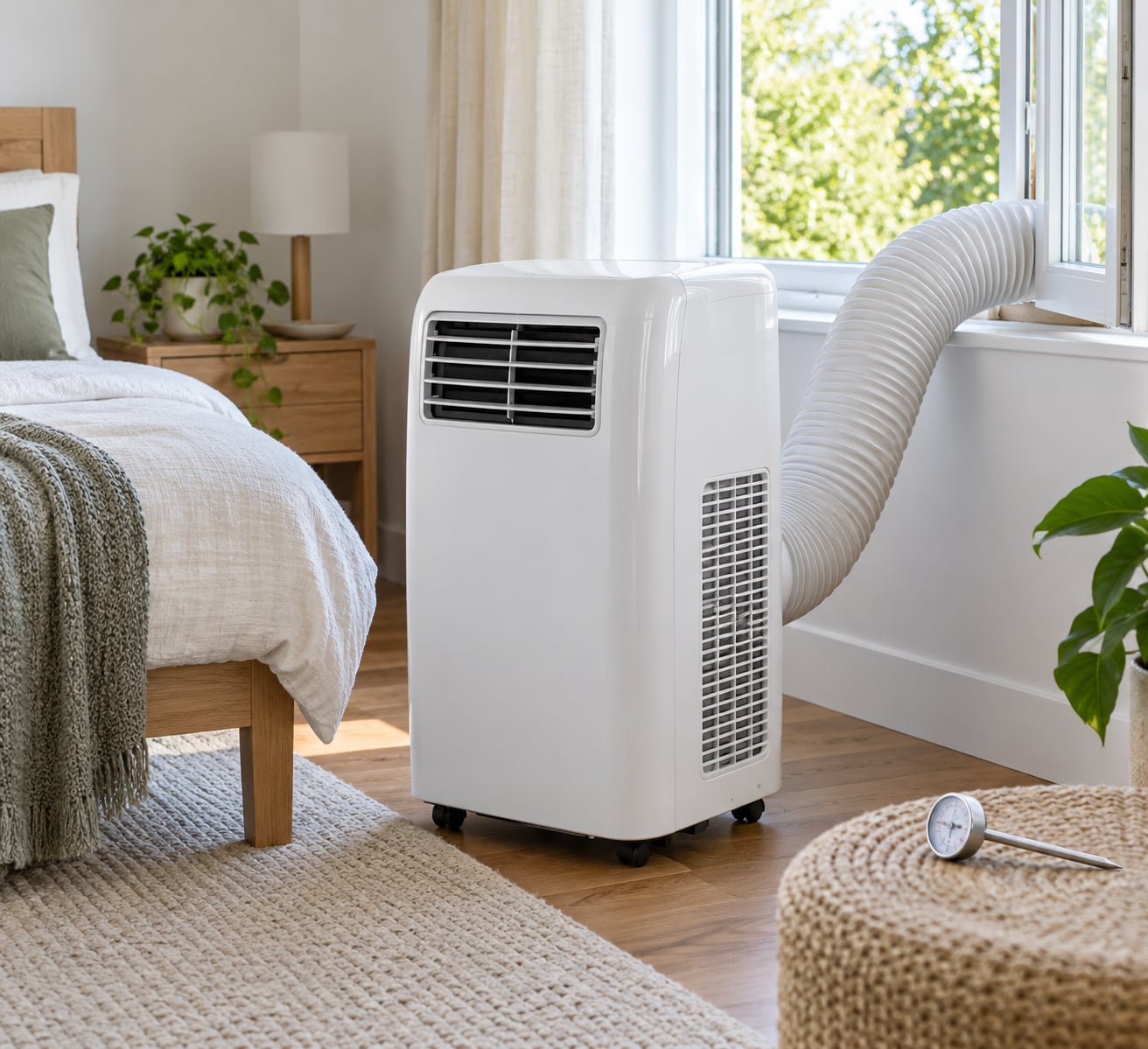
If you want the short version: a portable air conditioner is not cooling because it is set to the wrong mode, its filter or intake is blocked, its exhaust hose is kinked or unsealed, or the compressor never started. The first three are ten-minute fixes. The fourth is a repair, and no setting will change it.
The reason so many people end up ready to throw the unit away is that a running fan and a running compressor sound exactly the same from the other side of the room. Both hum. Both push air. Separating them takes a kitchen thermometer and about a minute, which is why the diagnostic below starts there.
Here is the five-minute check I would run first, in this order:
- Switch it to Cool mode and set the temperature at least 5F below the current room temperature.
- Wait three full minutes. Many units delay compressor start by up to three minutes after a mode or setpoint change.
- Pull the filter and rinse or vacuum it. A clogged filter starves the evaporator coil.
- Follow the exhaust hose from the unit to the window, looking for kinks, crushed sections and loose fittings.
- Clear 12 to 20 inches of space on the intake sides and back of the unit.
- Check that the room is above 62F. Most portable air conditioners will not cool a room below that.
Table of Contents
- What You Need
- Step-by-Step: Check Why Your Portable Air Conditioner Is Not Cooling
- Match Your Symptom to the Likely Cause
- Step 1: Confirm the unit is actually running
- Step 2: Set the thermostat and mode correctly
- Step 3: Remove airflow blockages
- Step 4: Check the exhaust hose and window setup
- Step 5: Clean or clear the drainage system
- Step 6: Check the room size and operating conditions
- Step 7: Look for signs of a mechanical or refrigerant problem
- Common Mistakes
- Frequently Asked Questions
- Can a portable air conditioner cool more than one room?
- Why is my portable air conditioner blowing air but not cooling?
- Should I replace a portable air conditioner filter when it stops cooling?
- Why does my portable air conditioner keep turning on and off?
- Is a portable air conditioner supposed to blow warm air?
- When should I call a technician instead of troubleshooting?
- Conclusion
What You Need
Gather these before you start, and you will not have to stop halfway through a diagnosis to find a screwdriver. Most of the causes below need nothing more than a flashlight and two minutes of attention.
- The owner’s manual, paper or digital, for your exact model
- A clean spare filter, or a vacuum and a sink for rinsing the dirty one
- A refrigerator or kitchen thermometer, ideally an infrared gun for checking multiple spots fast
- A flashlight for looking behind the intake grille and around the coils
- A flat level surface to set the unit on, since an out-of-level unit drains badly
- A screwdriver set that matches the housing screws, plus a wet rag
- A drain hose or a spare bucket, if your model has a continuous drain
- An electrical outlet that is not shared with a space heater or other heavy appliance
Two safety rules before you touch anything. Unplug the unit before removing the filter, the housing panels or anything else, and never open the sealed system yourself: refrigerant, compressor and capacitor work belongs to a technician. If your unit burns, smells hot when running, or trips a breaker every time it starts, stop reading this guide and unplug it.
Step-by-Step: Check Why Your Portable Air Conditioner Is Not Cooling
Work through these steps in order, cheapest and most likely cause first. Each one tells you what to look at, what a healthy result looks like and what to do next, so you can stop as soon as the problem resolves instead of running through faults that were never there.
Match Your Symptom to the Likely Cause
Start by finding your symptom in the table below rather than reading linearly. The first action column is the fastest test for that specific failure, and the final column tells you honestly whether it is a weekend job or a phone call.
| What you notice | Likely cause | First action to try | Who fixes it |
|---|---|---|---|
| Fan runs, air feels like room temperature | Compressor not starting, or drain reservoir full | Compare intake and outlet air temperature | You, then a technician |
| Cools for 10 to 15 minutes, then goes warm | Condensate float switch tripped, or low refrigerant | Unplug, drain the reservoir fully, restart | You, then a technician |
| Weak airflow, or loud rattling | Dirty filter, blocked intake, or a dirty blower | Clean the filter and clear 12 to 20 inches of clearance | You |
| Water pooling under or behind the unit | Blocked drain line, cracked reservoir, or a tipped unit | Clear the drain path and level the unit | You, then a technician |
| Clicking every few minutes, no heavy hum | Failed start capacitor or a compressor that will not start | Note the click pattern, then call for service | Technician |
| Nothing at all, no display, no fan | Tripped breaker, unplugged wall plug, dead remote battery | Reset the breaker and reseat the plug at the outlet | You, then an electrician |
Step 1: Confirm the unit is actually running
A portable air conditioner is running correctly when you feel noticeably cold air at the outlet louver within a few minutes of starting, and hear a low steady compressor hum underneath the fan noise. Anything less means one of two things: the compressor is not engaged, or it is engaged and cannot move heat.
Check the display and the mode indicator first. Make sure the unit is on Cool, not Fan or Dehumidify, and that the setpoint is below the room temperature. Then check the obvious power problems: a tripped breaker, a plug that has backed partly out of the wall receptacle, and an exhausted remote control battery that leaves the unit on its last setting or off entirely. Many units also have an LCDI plug with a reset button on the cord; press it and listen for a click.
Give the compressor up to three minutes to engage after you change mode or temperature. This delay is normal and is the reason many owners declare a healthy unit broken. If it is still only blowing room-temperature air after three minutes, use the thermometer test: hold it at the intake grille and then at the outlet. Outlet air should be at least 10F cooler than intake air.
That single reading splits the problem in half. Same temperature at both ends means the compressor is not running at all, and the fault is electrical or mechanical. A small temperature drop means the refrigerant loop is working but underperforming, which points at airflow, sizing or a partial charge. Feel the exhaust hose too. It should be noticeably warmer than room air when the unit is cooling properly.
Step 2: Set the thermostat and mode correctly
A portable air conditioner that is on the wrong mode, or set to a temperature the room has already reached, will move air without ever cooling it. This is the most common cause and the most often missed, because the unit looks and sounds identical whether it is cooling or not.
Put the unit in Cool mode. Set the temperature a few degrees below the current room temperature rather than to a number you hope for. Leave the fan on High or Auto, because in Cool mode the fan speed is what pulls room air across the evaporator coil. A timer left on from a previous session, or a sleep mode that stepped the setpoint upward overnight, will also stop cooling without any fault at all.
Test it with a separate thermometer rather than trusting the unit’s own display. Put a kitchen thermometer in the middle of the room, note the reading, then check again twenty minutes after the unit starts. If the room reading has not moved at all while the outlet felt cold earlier, the compressor has stopped and you have a problem rather than a setting. If the room sits near or below 62F, the unit is likely refusing to cool any further, since below that the evaporator coil is prone to freezing and shutting down.
Step 3: Remove airflow blockages
Cooling performance depends on room air moving freely across the evaporator coil, and a portable air conditioner draws more air than a central system through a much smaller opening. Anything that restricts that path shows up quickly as weak airflow and warm output.
Clean the filter first. Most manufacturers call for cleaning or replacing it every 30 to 90 days, and in a dusty room that interval is short. Slide it out, rinse it with cool water if it is a washable mesh type, and let it dry fully before putting it back. Many portable models ship with a thin dryer-shoe style filter that traps far less than a central HVAC filter, so the coils foul faster than the filter looks dirty.
Then check clearance. Leave 12 to 20 inches of open space on the intake sides and back, and keep the unit clear of curtains, bedding and furniture pushed against the grille. Close windows and doors. An open door does more than let warm hallway air in; on a single-hose unit it lets the heat the unit is trying to remove pour straight back into the room.
Signs of improvement are simple: stronger airflow at the outlet, noticeably colder air within a few minutes, and reduced noise. If the fan sounds strained or rattling rather than smooth, stop and check for a blocked blower wheel or a loose housing panel before you go further.
Step 4: Check the exhaust hose and window setup
The exhaust hose is the reason a portable air conditioner works at all, so any fault in it takes performance away directly. A portable unit draws room air in, cools it, and dumps the heat plus the absorbed moisture out through that hose to the outside. Crack the hot air back in through the window and you have cancelled the whole process.
Read the hose end to end while the unit is off. Look for kinks, crushed sections where it runs over a sill or behind furniture, a hose that is too long or coiled, and fittings that have worked loose. A standard hose is often too restrictive for a window or sliding door, which is why many people get better results with a longer or semi-rigid hose, routed as straight and as short as the manual allows.
Seal the window kit properly. Foam strips, weatherstripping and tape around the bracket gaps stop hot exhaust air drifting back into the room. Feel the hose while the unit runs: warm is normal and expected, hot enough to be uncomfortable means the heat is escaping somewhere, usually at the window seal.
One rule matters for safety here. Never vent the exhaust hose into an attic, garage, crawl space or closed room, because the discharge is room-temperature air laden with heat and moisture, and a confined space can build up carbon dioxide. If you have no way to reach outside, the unit should not run.
Step 5: Clean or clear the drainage system
Portable air conditioners remove the moisture they pull from the air, and that water has to go somewhere. When it cannot, the compressor shuts down to avoid flooding the cabinet, and the unit starts blowing warm air with the fan still running.
Pull the reservoir out or open the drain panel and empty it completely, then look for the warning light or the tank-full beep your manual describes. If cooling resumes after the drain and restart, the cause was a full reservoir. On top of that, a condensate float switch that has tripped often needs the unit unplugged and drained before it will reset, not just emptied while it is running.
If your model has a continuous drain hose, check that it runs downhill, is not kinked or pinched inside a wall, and ends where the manual specifies. Air that has already been cooled holds very little moisture, so a line that runs uphill or loops back up will fill and back up. Level the unit as well; a tilted cabinet drains unevenly and pushes water toward the cabinet walls instead of the outlet.
Do not bypass a float switch or improvise a drain that the manufacturer did not design. If a reservoir keeps filling faster than it drains, or water appears inside the cabinet with no visible blockage, the pump, float or reservoir has failed and that is technician work.
Step 6: Check the room size and operating conditions
A portable air conditioner that works fine in a closed bedroom will never cool an open-plan living area, and that is a design limit rather than a fault. Understanding the design limit is often the difference between buying the right unit and chasing a problem that does not exist.
Most portable units use a single-hose design: one hose carries hot exhaust air out, and the same volume of room air is drawn in to replace it. In a sealed room this works well, because incoming air is cool. In an open floor plan the replacement air arrives warm, so the unit runs constantly and still never gets the room below setpoint. Dual-hose models draw in and exhaust through separate sealed hoses, which makes them noticeably better in warm, humid conditions.
Sizing matters just as much. Portable air conditioner ratings follow the ASHRAE 2017 standard, which measures output at a specific low outdoor temperature, so the same number performs worse on a 95F afternoon than the label suggests. A general starting point for a normal bedroom is enough capacity for roughly 20 BTU per square foot of floor area, before you adjust for sun exposure, insulation and ceiling height.
Look at the room itself. Direct sunlight through a west-facing window, an uninsulated attic room, a room over a garage, a space heater or a recently used oven all add heat faster than a portable unit can remove it. High humidity is harder still, because the coil has to work against both heat and moisture. Block the sun with a blind or curtain, close off unused rooms, and shut down appliances that generate heat.
Step 7: Look for signs of a mechanical or refrigerant problem
Once you have ruled out settings, airflow, the exhaust hose, drainage and sizing, you are probably looking at a sealed-system or electrical fault. These are the symptoms worth taking to a technician rather than fixing yourself, because the sealed refrigerant loop is pressurised and the compressor and capacitor parts carry a shock risk even with the unit unplugged.
- Repeated clicking every few minutes with no heavy hum. The compressor is receiving power but failing to start. On a portable unit this is usually a failed start capacitor, and occasionally a seized compressor. A capacitor is a simple part; a compressor is not economical on a throwaway-style unit.
- Fan running, compressor silent. The same diagnosis, but check the overload protector and the wiring before assuming the worst.
- Ice on the evaporator coil or water dripping inside the cabinet after a cooling run. Often low airflow or low refrigerant. Clean the filter and coil first, since restricted airflow is the cheaper fix.
- An oily or greasy spot around the unit or on the tubing. That is compressor oil, and it means the sealed system has breached. Unplug the unit and stop running it.
- Self-diagnosis codes on the display. On many models E1 flags a water or float-switch condition, E2 flags a fan or airflow fault and P1 flags a sensor or power fault. Codes vary by brand, so the manual wins.
Portable units age fast, and a sealed-system recharge on one of these machines is frequently more than a comparable new unit costs. Ask for a straight answer on that trade-off before you authorise work. If there is any burning smell, a scorch mark near the plug or outlet, or repeated breaker trips, stop troubleshooting entirely and have the electrical supply checked.
Common Mistakes
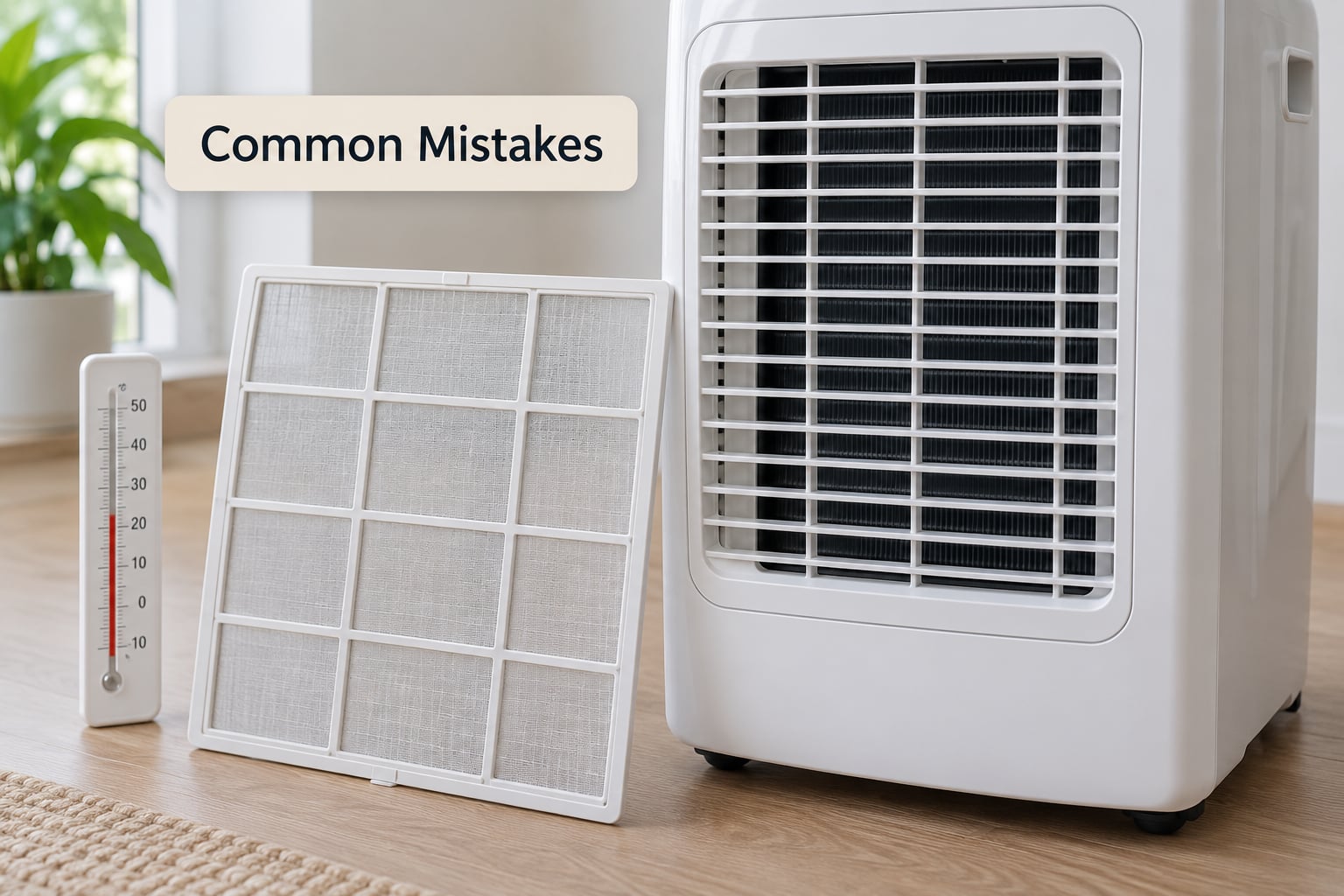
Most failed portable AC diagnoses share the same handful of errors. Each one below is something I have seen recommended on forums and video, and each one costs you a step or a trip to a technician.
- Assuming fan operation proves cooling. The blower moves air on its own circuit and will happily run with no refrigerant moving at all. Only the thermometer test at the intake and outlet tells you whether cooling is happening.
- Setting the thermostat to an unreachable number. Cranking the setpoint to 60F in a 92F room changes nothing about the physics and just leaves the compressor running at maximum with no way to reach setpoint.
- Bending or overextending the exhaust hose to reach the window. A sharp kink can restrict airflow enough to raise pressure in the sealed system. Route it with the gentlest curve the bracket allows.
- Tucking the intake inside a closet gap or behind a sofa. Starved intake means a starved coil, and the unit will cool poorly no matter how the mode is set.
- Running with a blocked or full drain. The compressor shuts itself down for a reason. Resetting the unit without draining it just repeats the cycle.
- Using an extension cord or a shared circuit. Compressors draw a heavy startup surge. Follow the manual’s guidance on cord length and never run a portable air conditioner on a circuit that is also powering a space heater.
- Ignoring repeated warning lights and short-cycling. A unit that starts, stops and starts again every few minutes is telling you the drain is full, the air is too dirty, or the compressor is failing. Leaving it running adds hours and can shorten its life.
Prevention is mostly boring and mostly effective. Clean the filter on a schedule rather than when it stops cooling, and check the coils a couple of times a season once the filter is out anyway. Keep the intake clear, drain and dry the unit before you store it for the winter so nothing sits in standing water, and run a fresh filter through the evaporator after any storage period before the first hot day.
Frequently Asked Questions
Can a portable air conditioner cool more than one room?
Only in the sense that it cools the air it pulls in, and a single-hose unit pulls in a large share of what it exhausts. In practice that means a closed room with the door shut. In an open floor plan the replacement air arrives warm, the humidity never drops and the unit runs constantly without reaching setpoint. A dual-hose model handles this better, but neither one turns into a whole-house system.
Why is my portable air conditioner blowing air but not cooling?
The usual causes are the wrong mode or setpoint, a dirty filter, a blocked intake, a kinked or unsealed exhaust hose, or a compressor that never started. Compare intake and outlet air with a thermometer: a drop of at least 10F means cooling is happening. No drop at all means the compressor is not running, which points at the capacitor, overload protector or compressor itself.
Should I replace a portable air conditioner filter when it stops cooling?
Clean it first, then replace it if it is damaged. Most manufacturers specify cleaning or changing the filter every 30 to 90 days, and a clogged filter is one of the top reasons output drops. Rinse a washable filter with cool water and let it dry completely. If a clean filter and a clear intake do not restore cold output, replacing the filter will not fix it either.
Why does my portable air conditioner keep turning on and off?
Short cycling usually means a protection cutout is active rather than a cooling fault. A full condensate reservoir tripping the float switch is the most common cause, and unplugging the unit, draining it fully and restarting clears it. Coarse filters and low airflow can freeze the evaporator coil and cause the same pattern. Repeated cycling that continues after draining points to the compressor or overload protector.
Is a portable air conditioner supposed to blow warm air?
Not when it is running in Cool mode below the setpoint. Some warm exhaust air at the hose is expected, since that is where the heat leaves. Warm air at the outlet louver means the compressor is not cooling, the room is already at the setpoint, or the unit is below its roughly 62F minimum operating temperature and has shut the cooling cycle down.
When should I call a technician instead of troubleshooting?
Call for service the moment you suspect the sealed system or the electrical supply: compressor oil near the unit, a frozen coil that a clean filter and good airflow do not resolve, repeated clicking with no compressor hum, a self-diagnosis code that returns after a reset, or any burning smell, scorch mark or tripped breaker. Portable units are rarely economical to recharge, so ask about repair versus replacement before authorising work.
Conclusion
Start in this order: confirm Cool mode with a setpoint below room temperature, wait three minutes for the compressor, then measure intake and outlet air with a thermometer. That reading tells you which half of the problem you are in. From there, clean the filter, clear 12 to 20 inches of intake space, inspect the exhaust hose end to end and seal the window kit, then drain the reservoir fully.
Stop at that line. If you find compressor oil, a self-diagnosis code that keeps returning, repeated clicking with no compressor hum, or anything involving the sealed system, the electrical supply, a burning smell or a tripped breaker, unplug the unit and follow the owner’s manual or call qualified service. Portable units are cheap to replace and expensive to recharge, so get a straight answer on which one you are looking at before you spend money on either.