Sizing a basement dehumidifier comes down to three numbers, and most basements land between 50 and 70 pints per day. Here is how to size a dehumidifier for a basement without overspending: measure the floor area, rate how damp the space gets with nothing running, then read the matching row of the capacity table below. Square footage alone gets you in the neighborhood, not the right answer. The whole process takes about twenty minutes, most of it standing around with a hygrometer.
Pints per day (PPD) is the number that matters. It is the water a dehumidifier can pull out of the air in 24 hours under the standard test conditions set by the US Department of Energy, and ratings follow the Association of Home Appliance Manufacturers convention. A 50-pint model is not a 50-gallon tank. The tank is where the water sits until you empty it; the pints-per-day rating is how fast it removes moisture.
| Basement floor area | Rated capacity to buy | What that looks like in practice |
|---|---|---|
| Up to 500 sq. ft. | 20 to 30 pints per day | Half a unit in a small, dry-ish basement |
| 500 to 1,000 sq. ft. | 30 to 50 pints per day | The common crawl space and small-basement class |
| 500 to 1,500 sq. ft. | 50 to 60 pints per day | Most lightly damp basements with musty odor |
| 1,500 to 2,500 sq. ft. | 70 to 80 pints per day | Typical full-basement size in a humid climate |
| Over 2,500 sq. ft. | 80 pints and up | Whole-basement or whole-crawl-space setups |
Those bands assume ordinary dampness. The next step is what moves the number up or down, and it is the step most sizing charts skip.
Table of Contents
- What You Need
- Step-by-Step: How to Size a Dehumidifier for a Basement
- Common Mistakes
- Frequently Asked Questions
- How big of a dehumidifier do I need for a 2,000 square foot basement?
- Is a 50 pint dehumidifier big enough for a basement?
- How many square feet will a 70 pint dehumidifier cover?
- What size dehumidifier for a 1,000 square foot basement?
- Is it better to oversize a dehumidifier?
- What month should you run a dehumidifier in my basement?
- Conclusion
What You Need
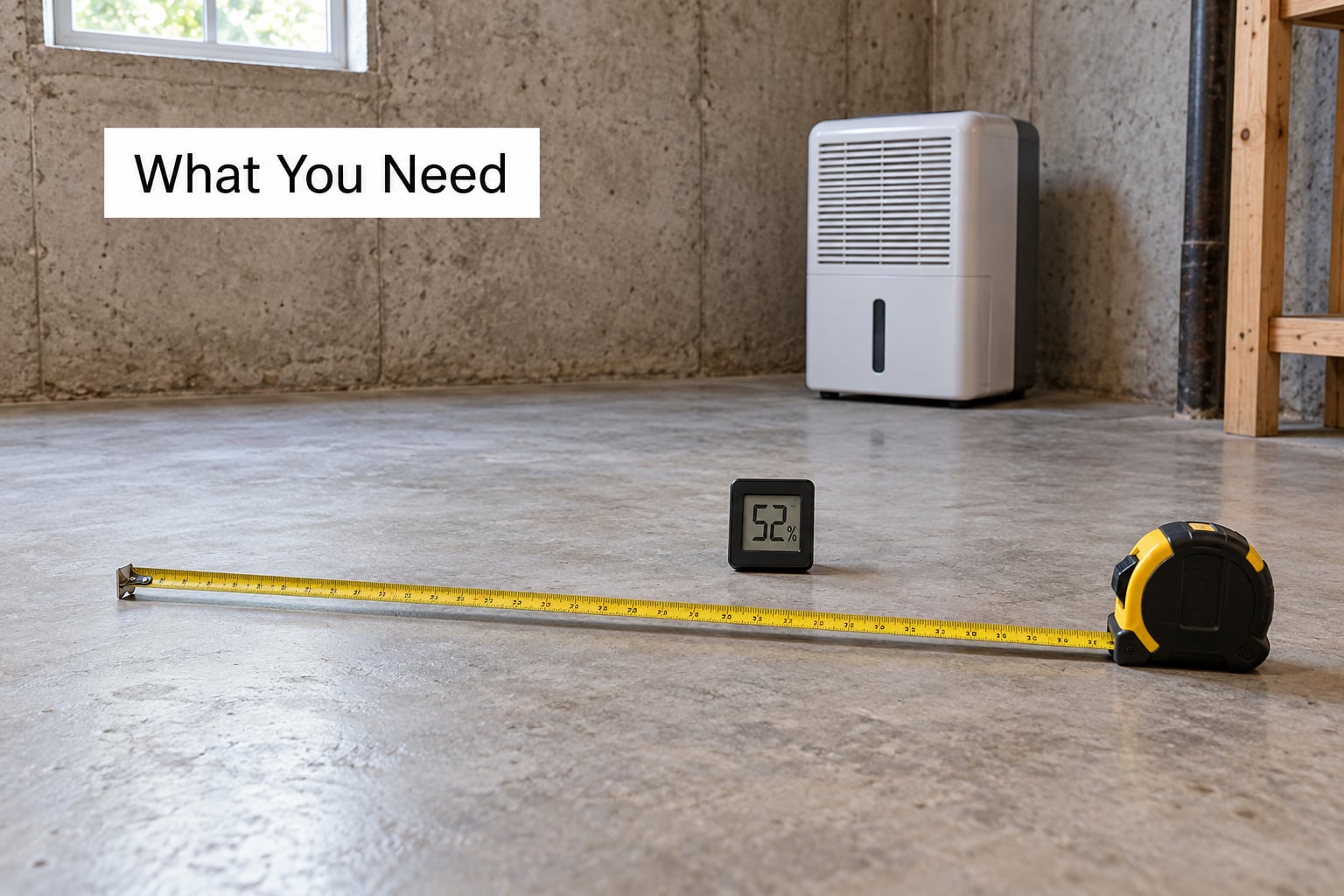
You need four things, and three of them cost almost nothing:
- A tape measure for the floor area, plus the ceiling height if the basement is taller than 8 feet.
- A hygrometer or a cheap digital humidity monitor to read relative humidity, the percentage of moisture the air holds at its current temperature.
- A way to read temperature, because capacity and temperature are linked.
- The spec sheet of the dehumidifier you are considering, so you can see rated pints per day, the area the manufacturer claims, and the minimum operating temperature.
Before you measure anything, walk the basement and note every water clue. Look for damp patches that fade as they dry, white powdery efflorescence on masonry, peeling paint near the bottom of studs, mineral deposits, musty odor, and condensation on windows in warm weather. Write down where plumbing enters and whether there is a sump pit. This list decides whether you are sizing a dehumidifier or a leak.
Step-by-Step: How to Size a Dehumidifier for a Basement
Step 1: Measure the basement floor area
Measure usable length and width in feet, then multiply. A 30 by 40 basement is 1,200 square feet. If the space is L-shaped or broken by a mechanical room, measure the rectangle that covers the occupied area rather than chasing every nook, and add the finished rooms you actually want conditioned.
Finished versus unfinished does not change the math, but it changes what you are conditioning. If half the basement is storage, a dehumidifier placed in the finished half still has to deal with moisture migrating through the partition, so size for the total footprint.
Step 2: Check the basement’s humidity and temperature
Put the hygrometer somewhere representative, away from a wall or a dehumidifier vent, and log readings several times a day for a week. Peaks during the day and drops overnight points to a seasonal or ventilation issue. A reading that sits high overnight, day after day, points to a moisture source.
Write down the worst sustained reading, not the best one. 50 to 60% relative humidity is uncomfortable; 70% sustained means mold can grow on wood and paper within days. A basement that hits 70% only after a heavy rain behaves very differently from one that never drops below 70%.
Step 3: Estimate the water-removal requirement
Find the row for your square footage in the table, then read across to a pints-per-day rating. A 1,200 sq. ft. lightly damp basement lands on 50 pints. A 2,000 sq. ft. one lands on 70 to 80.
Now adjust for the untreated condition, meaning how damp the space gets with no dehumidifier running. Lighter dampness with a musty smell and no visible water means use the number as-is. Very damp with dark wall stains, sweat on walls, or mold that returns every wet season means add about 20%. Active seepage, a sump that runs daily, or standing water means add 40% or more, and keep reading, because a dehumidifier is not going to fix that.
Round up to the next available size rather than down. A larger compressor cycles off once the air is dry instead of running nonstop, and the energy penalty for oversizing is far smaller than the penalty for undersizing.
Step 4: Adjust for basement conditions
Three conditions change the answer.
Temperature. Refrigerant dehumidifiers pull the condensing coil below the dew point, and in a basement that sits below 65°F the coil ices over until the unit shuts down or the coil defrosts, which means no water collection. Below that temperature, a desiccant or hybrid model keeps working. Check the manufacturer’s minimum operating temperature, and pair it with the room’s real winter temperature, not the average.
Ceiling height and open floor plan. Basements are rarely 8 feet. Taller space, a stairwell open to the first floor, or a wet room upstairs all add moisture the dehumidifier did not expect. Treat the extra volume as an extra 10 to 15% of capacity.
Moisture sources. Laundry drying indoors, a shower nearby, an unvented bathroom, or a refrigerator in the basement all add water faster than the walls lose it. Fix or reduce the source first, then size. Homeowners on home improvement forums keep arriving at the same conclusion: the basement that runs all summer has a source problem, not a capacity problem.
Step 5: Plan airflow, placement, and drainage
Leave clearance on all sides. Most basements need four to six inches at the front and back and enough room to slide the filter out, which is why corner placement is the most common installation mistake. Keep the unit off bare concrete if you can, or set it on a raised platform, because chasing floor moisture out of concrete pulls in a lot of extra water.
Drainage matters more in a basement than anywhere else, because there is usually nowhere convenient to put a bucket. Three options work:
- Built-in tank for testing and short-term use. A 50-pint model typically holds 13 to 15 gallons, so check how often you would be emptying it in peak season.
- Gravity drain hose running to a floor drain, standpipe or sump pit. The unit must sit above the drain, and the hose needs a loop or trap in its route so the drain line cannot siphon water back.
- Condensate pump for a unit sitting below the drain or pumping into a pit. Check the pump’s maximum lift height against the vertical distance you need to clear.
Set the humidistat to 40 to 50% if the space is used as living or storage area, and 50 to 55% in a crawl space. In an unheated crawl space below 65°F, use a desiccant model and set it higher still, around 60%.
Step 6: Test the unit and confirm results
Give it a week of real readings. Watch how much water appears, how often the tank fills, and where the hygrometer settles. A correctly sized dehumidifier in a moderately damp basement collects a gallon or a few gallons a day at first, then tapers off as the space dries. If the tank fills daily and the humidity never drops below 60%, the capacity is short or the source is still feeding it.
Check the reading again after the first heavy rain of the season. Basements that hold their level through a wet week are sized right.
Common Mistakes
Sizing by square footage alone. Area sets a floor for capacity, not the answer. A 1,500 sq. ft. basement that stays at 70% humidity needs more than a 1,500 sq. ft. basement that smells musty in June and dries out on its own.
Ignoring the temperature rating. This is the mistake that makes people think their dehumidifier is broken. It collects fine in August and produces nothing in January, because the coil ices up. Below 65°F, look for a unit rated for low-temperature operation or a desiccant design.
Pushing it into a corner. A blocked intake starves the coil. You lose capacity and the unit runs hotter and harder for less result.
Assuming the tank size is the capacity. Tank gallons tell you how often you walk downstairs with a bucket. The pints-per-day rating tells you how fast it works. A single model line can ship a tank rated at 50 pints per day and the same unit in an extended configuration holding about 7.5 gallons, roughly 60 pints of storage. Those are different measurements, and the store page puts them right next to each other.
Trusting one sizing number. Published guidance disagrees, and it is worth knowing why. One widely circulated formula starts at 10 pints for the first 500 sq. ft. and adds 4 pints per additional 500. Another chart, from a dehumidifier retailer, rates 30-pint models for up to 1,500 sq. ft. The ENERGY STAR guidance uses 20 to 50 pint bands by area and dampness. They differ because the older formula assumes a dry, conditioned room, while the ENERGY STAR bands assume untreated basements, and because the same 30-pint capacity covers 2,000 sq. ft. of lived-in home but only about 1,500 sq. ft. of basement. Where sources conflict, use the one that assumes an untreated basement and wet-season conditions, which is the conservative choice.
Buying a bigger dehumidifier to cover a leak. A dehumidifier removes moisture from air. It cannot repair a cracked wall, a failed exterior drain tile, a leaking water heater, or a foundation crack that admits water. Owners on home improvement forums report the same pattern repeatedly: a larger dehumidifier buys a few weeks before the water finds the framing. Fix the source, then size.
Skipping a moisture check on the way in. If the basement is uninsulated and below 65°F all winter, a desiccant model is the correct pick regardless of what the capacity chart says.
Frequently Asked Questions
How big of a dehumidifier do I need for a 2,000 square foot basement?
For a 2,000 sq. ft. basement, a 70 to 80 pints per day dehumidifier is the right starting point. If the space runs above 60% relative humidity in ordinary weather or has damp wall patches, step up to an 80-pint model. Below 65°F, choose a unit rated for low-temperature operation, or a desiccant model, since a standard compressor unit will ice up.
Is a 50 pint dehumidifier big enough for a basement?
A 50-pint model handles a lightly damp basement up to about 1,500 sq. ft. comfortably. It works there as long as you keep relative humidity under 50% and the space is above 65°F. If the tank fills daily, if humidity stays above 60%, or if the room is larger than 1,500 sq. ft., move up to 70 pints.
How many square feet will a 70 pint dehumidifier cover?
A 70-pint dehumidifier is a sensible match for 1,500 to 2,500 sq. ft. of untreated basement space. In a lived-in home above grade the same capacity stretches further, because the air is less damp. Basements are the harder case, so size on the basement figure and add about 20% if the space runs very damp.
What size dehumidifier for a 1,000 square foot basement?
For 1,000 sq. ft., a 30 to 50 pints per day model covers a moderately damp space, and a 50-pint model is the safer buy if you also have musty odor or seasonal dampness. Confirm the reading with a hygrometer: if it stays above 60% relative humidity, size up one class rather than down.
Is it better to oversize a dehumidifier?
Yes, within reason. An undersized dehumidifier runs continuously and may never reach the humidistat setpoint, so humidity stays high and the power bill climbs anyway. Oversizing costs a little more up front and buys shorter run cycles. If your basement is more than two-thirds of the area rated for a 50-pint model, go to 70 pints.
What month should you run a dehumidifier in my basement?
Run it whenever the reading is above your target, which in most basements means from spring through early fall and again after heavy rain in winter. Many owners simply leave it on year-round on a humidistat, since it stops drawing power at the setpoint. Below 65°F, keep a standard unit off or switch to a desiccant model, or its coil will ice up.
Conclusion
Start with three numbers, not a shopping page. Measure the basement floor area, log relative humidity and temperature for a week, and note whether the moisture comes from the season or from a water source you can fix. Match those to the capacity table, add 20% if the space runs very damp, round up to the next available pint rating, and check the minimum operating temperature against your coldest month. Set the humidistat near 45%, give it clearance from the walls, and run a continuous drain line so you are not carrying buckets down the stairs at midnight.