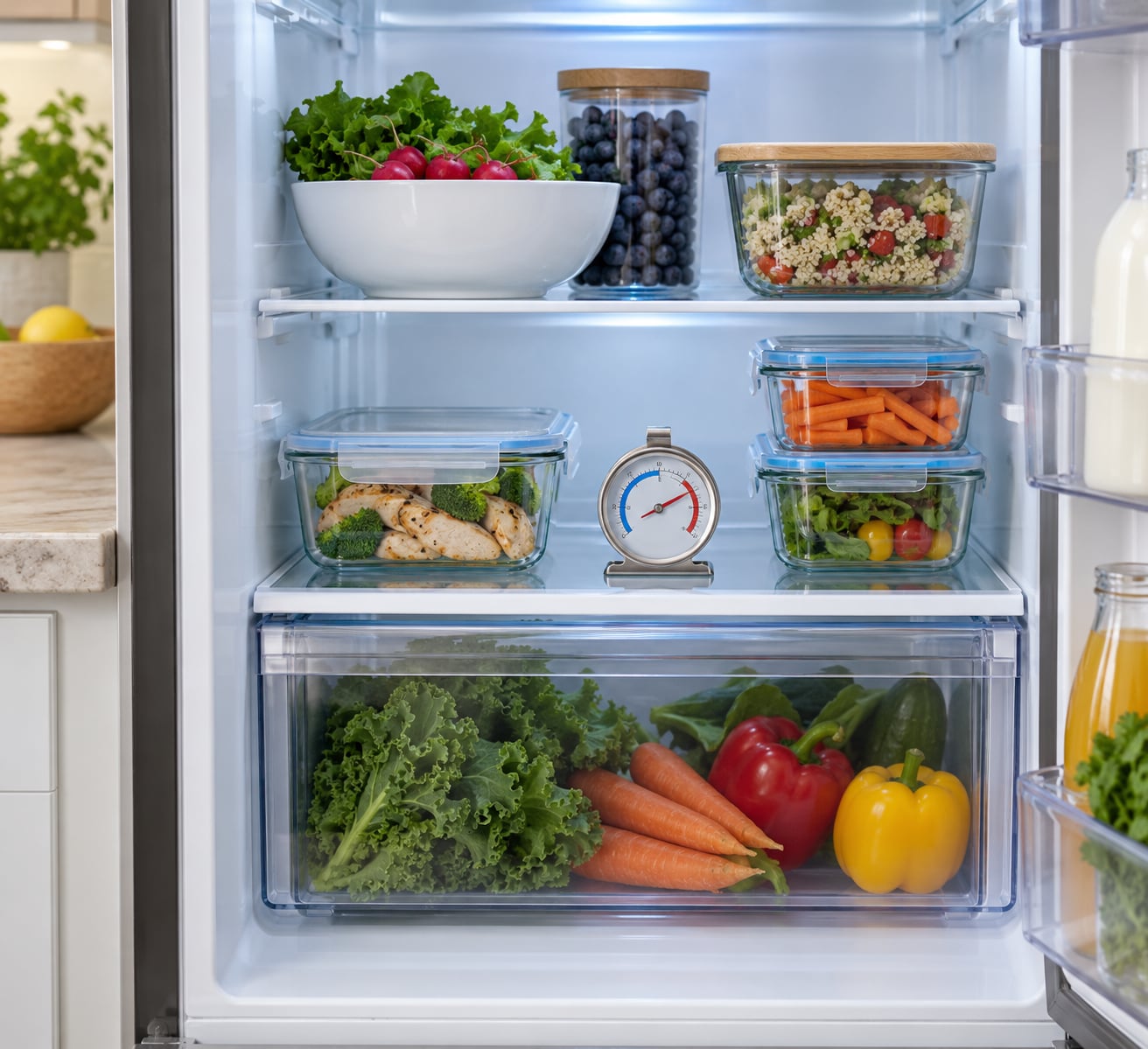
Set your refrigerator to 37°F and keep the whole interior at or below 40°F, which is the food-safety ceiling the FDA works from. Aiming for the 35°F to 38°F band gives you a safety margin above that line. Set the freezer to 0°F (-18°C).
That is the short answer. The slightly longer version is that most people who think their refrigerator is set wrong are reading the wrong number, because the display on the door shows the setting you chose, not the air temperature inside. I will come back to that below, because it is the single most common source of confusion on this topic.
Last reviewed against current FDA and USDA food-safety guidance in October 2026.
Table of Contents
What Temperature Should a Refrigerator Be Set At?
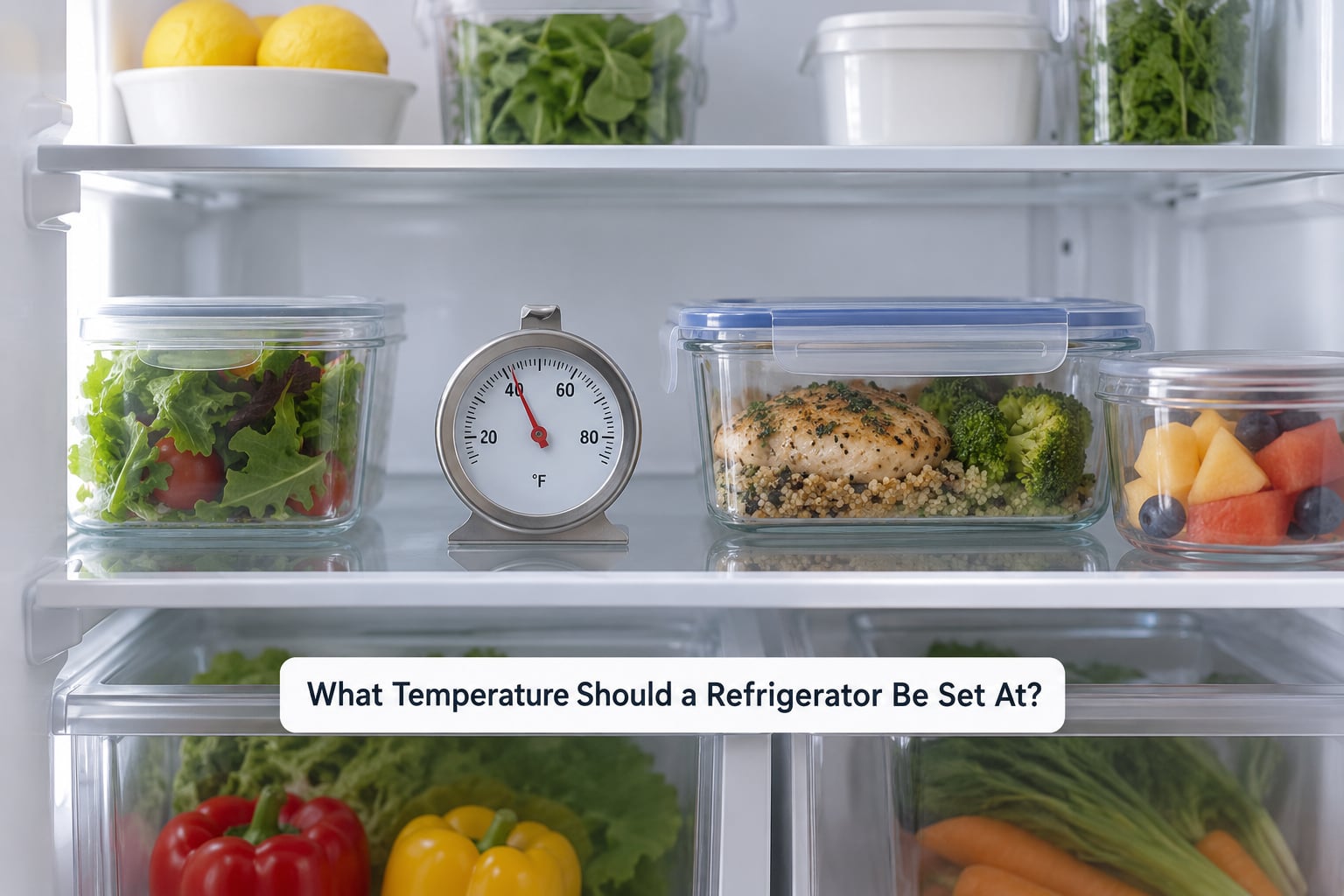
The FDA advises keeping a refrigerator at 40°F (4°C) or below, and most appliance guidance lands on 37°F (3°C) as the number to dial in. The band between 35°F and 38°F (2°C to 3°C) is the sweet spot: cold enough to stay well clear of the danger zone, warm enough that produce and wine do not freeze.
Water freezes at 32°F, so anything below that buys you nothing for food safety and starts costing you produce quality and electricity. Anything above 40°F starts costing you shelf life, and after a couple of hours it starts costing you safety.
| Appliance | Target | Acceptable band | Why it matters |
|---|---|---|---|
| Refrigerator cabinet | 37°F (3°C) | 35°F to 38°F (2°C to 3°C) | Keeps food below the 40°F danger-zone line with margin to spare |
| Refrigerator ceiling (hardest to reach) | 37°F (3°C) or below | Must stay under 40°F (4°C) | The top of the cabinet warms fastest when the door opens |
| Freezer | 0°F (-18°C) | 0°F to -5°F (-18°C to -21°C) | Foods stay solid, no thaw-refreeze cycles, no freezer burn |
| Hard limit for safety | 40°F (4°C) | Never above this for stored food | Above 40°F, bacteria start multiplying fast |
| Freezer restock / recovery | Below 0°F (-18°C) | Warmer is fine briefly, colder is better | Food refreezes faster when the box starts colder |
One caveat worth stating plainly: a cabinet set to 37°F is not a cabinet sitting at 37°F everywhere. Air near the back wall is colder than air at the door, and the door shelves are the warmest part of any refrigerator. If you measure at the door and get 37°F, the shelves toward the back are almost certainly below freezing.
Why 40°F Is a Ceiling, Not a Goal
The FDA’s 40°F figure is a limit, not a target. Treat it like a speed limit on a highway: legal, but you do not want to sit at the line. Every degree of margin between your setting and 40°F absorbs the door openings, the grocery run, the hot pan you set on the counter before it goes in.
A fridge running at 38°F with the door shut all afternoon is fine. A fridge that touches 38°F every time the sun hits the glass door in July is not, because the average is what bacteria care about, not the number on the display.
Is 37°F or 40°F Better for a Refrigerator?
Set it to 37°F if you can. The gap between 37°F and 40°F is only three degrees, but it buys you a real buffer in the situations where the temperature climbs: power interruptions, a full grocery shop, a hot kitchen, a fridge crammed so tight that cold air cannot circulate.
The case for 37°F
Cold air is drier air. At 37°F the cabinet pulls moisture out of the air, which keeps lettuce and herbs from turning into a limp mess and slows the growth of surface mold on cheese and bread.
It also costs less. Roughly speaking, a refrigerator uses about 5% more energy for every degree below the 37°F baseline, so a fridge that has drifted down to 34°F is running a colder machine for no food-safety benefit. In a kitchen where the refrigerator is on all year, that adds up.
For households that open the door constantly, 37°F is not a preference. A family of five grabbing and shutting all day generates enough warm, humid air to pull a 40°F cabinet toward the danger zone. Lower the setting, not just the expectations.
When 40°F is workable
If you travel, eat out often, or shop small amounts twice a week, the cabinet sees few warm-air intrusions and 40°F is workable. Even then, check it with a thermometer rather than assuming. Renters especially: the appliance may have been running warm long before you moved in, and a landlord is far more responsive to a thermometer reading than to a complaint that it feels warm.
What About the Freezer Temperature?
Set the freezer to 0°F (-18°C). Below that you gain very little; above it, foods begin to thaw at the edges, which starts the freezer-burn process as ice crystals form on the surface and draw moisture out of the food.
Food that is properly frozen is hard and opaque, with no slushy layer and no ice crystals. Ice on the inside of freezer walls, or food stuck together in one solid brick, means the freezer has been running too warm for too long.
On most units the refrigerator and freezer have separate controls, and on many they share a compressor. That means changing one changes the other, and the usual fix for a warm refrigerator is to turn the freezer down slightly, which pulls the whole cabinet colder. If your refrigerator comes with instructions for that, follow them. If it does not, make one change at a time and wait a full day.
How to Check the Temperature Correctly
The reliable method is an independent appliance thermometer, placed where the food actually sits. Trust the dial less than the reading, and the reading less than nothing at all if you skip the settle time.
Using a glass of water
Fill a glass with room-temperature water, stand the thermometer in it, and put the glass on an interior shelf. Leave it for several hours. Water is a better conductor than air, so it reads closer to the temperature of the food around it rather than the temperature of the air between the containers.
Placement and timing
Put the thermometer or glass on a middle shelf, not in the door and not against the back wall. Check one location first, then move it to a second on a different shelf later, because a fridge that reads 34°F in the middle and 46°F in the door is a normal fridge with a normal warm door.
Measure on a typical day rather than right after loading groceries. If you must check after a big shop, wait at least four hours, and 24 hours is better. After any change to the setting, give the cabinet a full day to stabilize before reading it again. A thermostat responds to a moving average, not to your new number.
Reading the result
Anything from 34°F to 40°F is workable, with the 37°F to 39°F zone giving you the best combination of safety and food quality. Above 40°F in the cabinet, move perishable food to the coldest part of the freezer and check the seals, the airflow and the coils. Below 32°F in the middle of the cabinet, you have a cold-side problem, not a setting problem.
Why Is My Refrigerator Warmer Than the Setting?
Start here: the display shows the set temperature, not the actual interior temperature. On most modern fridges, including smart displays with app control, the number you see is a request to the thermostat, not a measurement. This trips up almost everyone, and it is the most common complaint pattern in appliance forums.
After that, the usual causes, in rough order of how often they turn out to be the problem:
Door openings and warm-air entry
Every opening lets in room-temperature air carrying room-temperature moisture, and the compressor then has to pull that back down. A door left ajar for twenty minutes while you unload the car can raise the cabinet several degrees. If the gasket no longer grabs, the problem never stops.
Overpacking
A stuffed refrigerator blocks the cold air paths that circulate behind the rear panel. This is the one place where fuller is not better. A moderately full fridge, though, holds its temperature better than an empty one, because the food mass is a thermal buffer: the less air volume there is to heat, the slower the cabinet warms. Leave air moving around the walls and between the shelves, but do not leave the box empty.
Direct sunlight and a hot room
A fridge next to a west-facing window, an oven, or a dishwasher works harder and runs warmer. Ambient room temperature is the floor the cabinet can reach, and in a garage or laundry room in July that floor can exceed 40°F. A fridge in a hot room is genuinely harder to keep at 37°F, and no setting change fixes physics.
Blocked vents and frost buildup
If the air vents inside the cabinet are covered by containers or a tray, cold air pools in one corner. A layer of frost on the interior walls points to a defrost system that is no longer melting ice on schedule, and that waxy layer insulates the evaporator coil and forces the cabinet warm.
A worn door seal
Close the door on a dollar bill and pull. If the bill slides out with no resistance anywhere around the frame, the gasket is failing there. A fridge that pulls in warm, humid air continuously will never hold 37°F, and replacing a gasket is a cheap fix compared with a new compressor.
Worn condenser coils
If the coils on the back or underneath are furred with dust, the compressor cannot dump heat and runs longer and hotter. Vacuuming them twice a year is genuinely enough, and homes with pets need it more often.
Faulty evaporator fan, damper, or thermostat
A warm refrigerator with a cold freezer is a strong hint that cold air is not reaching the cabinet, which points at the evaporator fan or the damper that opens the air path. A refrigerator that is warm everywhere, both compartments, with a compressor that runs constantly and never seems to stop points at the thermostat or the refrigerant circuit. Those two patterns are the dividing line between a fix you can make and a call to a technician.
How to Adjust the Refrigerator and Keep It Cold
Work on the airflow first, the setting second. An appliance that cannot circulate cold air will not hold 37°F at any dial position, and lowering the setting just runs the compressor harder.
Give the air room to move
Leave a few inches of clearance around the back and sides, keep the interior vents uncovered, and avoid stacking a tray of leftovers flat against the rear panel. Keep the door bins for condiments, butter and drinks, and move dairy and leftovers to the interior shelves where the air is colder.
Change the setting in small steps
Move the control one step at a time and wait a day. On a numbered dial, remember that higher numbers usually mean colder, not warmer. On many dials, 5 is the normal running position and 0 or 1 is off or warmest. This trips people up constantly, and a social post claiming otherwise went widely shared for a reason.
On a digital panel, enter the actual number in Fahrenheit and set the freezer a degree or two lower than the fridge, as the manufacturer’s instructions typically suggest.
Know which direction to move it
If the middle of the cabinet is above 40°F, lower the setting. If lettuce is freezing and the back shelf is icing over, the setting is already low enough and the cause is airflow, a stuck damper, a mispositioned sensor, or a cold-air duct problem. In that case, moving the dial colder makes the problem worse, not better. Appliance forums are full of people who found that a correct 37°F setting should never freeze food, so treat freezing at that setting as a fault worth diagnosing.
Frequently Asked Questions
Is 37°F too warm for a refrigerator?
No. 37°F (3°C) is the figure most guidance points to, and the FDA’s ceiling is 40°F. Three degrees of margin is deliberate: it absorbs the warm air from door openings and hot weather. Measure with an independent appliance thermometer on an interior shelf rather than relying on the door display, and recheck after a day if you have changed the setting.
Is it safe to keep my refrigerator at 43°F?
Not for long. 43°F (6°C) sits inside the 40°F to 140°F danger zone where Salmonella, E. coli, Listeria and Staphylococcus aureus multiply quickly. A couple of hours is usually recoverable; a day or more means throwing out perishable food. Move leftovers, dairy and raw meat to the coldest part of the fridge or the freezer and check the door gasket and coil dust.
Is the fridge colder on the 1 or 5 setting?
Usually the 5. Most numbered dials run from warm at the low end to cold at the high end, with 5 or 4 as the normal running position and 0 or 1 as off or warmest. Scales are not universal, so confirm yours by making a one-step change and reading an appliance thermometer 24 hours later.
Does a full refrigerator stay colder than an empty one?
Moderately full, yes. The food mass acts as a thermal buffer, so a cabinet with groceries in it warms more slowly than an empty box with the same amount of air. The exception is overpacking: when containers block the air vents or press against the rear panel, cold air stops circulating and the fridge runs warm. Leave gaps at the walls and keep the vents clear.
Should eggs be kept in the fridge door?
For safety, no. The door is the warmest part of the cabinet because it opens most often and sits closest to room air, which shortens the shelf life of eggs and makes temperature swings larger. Put eggs on an interior shelf where the temperature is steadier. If you store them in the door, keep them in the original carton, which protects them from odors.
How long does a refrigerator take to get cold?
Plan on four to six hours for the food to cool down, and up to 24 hours for the cabinet to reach a stable temperature. A new appliance is often shipped with the thermostat at its warmest setting, so set it to 37°F before you load it. During the first day, keep the doors shut as much as possible and do not add large amounts of room-temperature food.
Conclusion
The first thing to do is stop reading the number on the door as if it were a measurement. Put an independent appliance thermometer on a middle shelf, leave it there through a normal day, and see what your refrigerator actually holds. Then set it to 37°F, keep the freezer at 0°F, and retest after 24 hours. If the middle of the cabinet will not hold 40°F or below no matter what you set, the problem is airflow, a seal, coils or a cooling fault, not the dial.