Roasted coffee beans taste their best from roughly 4 days to 4 weeks after roasting, and an opened bag is usually gone in 2 to 4 weeks. Stored airtight and frozen right, they stay safe to drink for 3 to 6 months or more, but the flavor fades long before that.
The gap between safe and good is the whole story here. Old coffee rarely makes anyone sick. It just goes flat, hollow, and dull. Coffee’s aroma compounds break down within weeks of roasting, so a six-month-old bag and a two-week-old bag are not the same product even though both are technically coffee.
Below is the timeline, then the storage rules that buy you the most days for the least effort.
Table of Contents
- How Long Do Coffee Beans Last After Roasting?
- What Counts as Fresh After Roasting?
- How Do You Store Roasted Coffee Beans?
- Should You Store Whole Beans or Ground Coffee?
- How Do Roast Level and Coffee Type Change Shelf Life?
- How Can You Tell When Roasted Coffee Has Gone Stale?
- Do You Need to Freeze Coffee Beans?
- Frequently Asked Questions
- Conclusion: Use Fresh Beans and Store Them Simply
How Long Do Coffee Beans Last After Roasting?
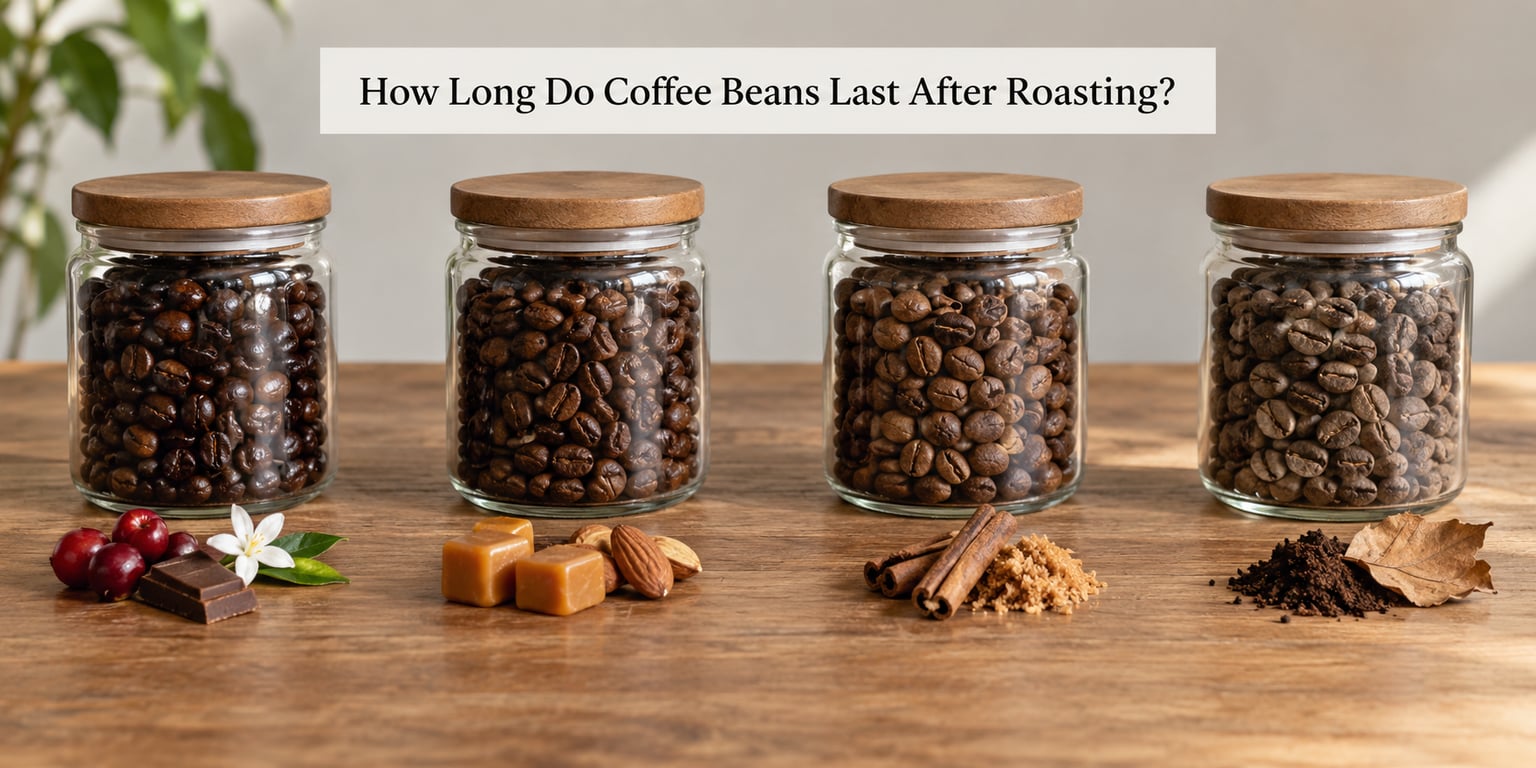
Here is the full picture of how long do coffee beans last after roasting, measured from the roast date on the bag.
| Time Since Roast | What Is Happening | Best For |
|---|---|---|
| 0-3 days | Degassing. Most carbon dioxide is still escaping, which makes espresso shots gushy and sour. | Waiting. Nothing else. |
| 4-14 days | Peak flavor. Aromatics are at full strength and acidity is bright. | Pour-over, drip, French press, cold brew. |
| 15-30 days | Still very good. Brightness softens and the sweet spot narrows. | Every brew method, including espresso. |
| 1-3 months | Staling starts. Aroma fades, body thins, acidity drops. | Batch brew, cold brew, iced coffee. |
| 3-6 months | Clearly stale unless frozen. Woody, papery, hollow. | Baking, cold brew if you like it bitter. |
| 6-12 months | Pantry coffee at best. Flavor is essentially gone. | Baking only. |
Once you crack the bag, the clock speeds up. Oxygen gets in, surface oils start oxidizing, and the beans are exposed to the four things that ruin coffee fastest: air, heat, light, and moisture.
A 12-ounce bag is roughly 20 to 25 cups for most people. Drink that in four weeks and you are buying a fresh bag every month, which is the cheapest freshness strategy there is.
What Counts as Fresh After Roasting?
Freshness is a taste and smell judgment, not a date on a package.
For the first 24 to 48 hours after roasting, beans push out carbon dioxide. Roasters on r/roasting put it at 80% gone in the first two days, with the rest trickling out over the following weeks. That trapped gas is what makes fresh espresso pour like honey and taste sour and fizzy.
Here is the part most guides leave out: that leftover off-gassing is not pure loss. One r/roasting poster put it well, once the bag is sealed airtight, the remaining CO2 helps push oxygen out and protects the beans. A valve bag is built around exactly this.
After degassing, the real enemy is oxidation. The surface oils and volatile aroma compounds start reacting with oxygen, and the cup goes flat, sweet, and papery. That process accelerates with heat, light, and humidity.
A roast date beats a best-by date, which beats an expiration date. A best-by date on supermarket coffee usually means quality, not safety, and is often printed well after the coffee is already stale. Green coffee beans keep 12 to 24 months in a warehouse. Roasted coffee is a different animal entirely.
You will also see the 15-15-15 rule floating around: 15 days for whole bean, 15 months for green, 15 something for packaging. It is community folklore, not science. Treat it as a rough social post, not a rule. The numbers on the timeline above come from how the chemistry actually behaves.
How Do You Store Roasted Coffee Beans?
Five storage rules do nearly all the work.
- Airtight. A container that seals, or a bag with a one-way degassing valve that lets CO2 out and keeps oxygen in.
- Opaque. Skip the clear glass canister on your counter. Light degrades surface oils quickly and it looks pretty doing it.
- Cool. A cabinet away from the oven or the dishwasher, not next to the toaster.
- Dark. Same cabinet. Any light exposure helps oxidation along.
- Closed. Stop opening it ten times a day. Every open cycle moves more air through the beans.
For room temperature versus cold, the answer is clear: skip the refrigerator. Cold air holds moisture, and coffee beans are hygroscopic, meaning they pull that moisture right out of the air. Repeatedly moving beans in and out of a fridge also condenses moisture on the beans, which is a fast route to off flavors.
The freezer is different, because the beans stay sealed and stay still. More on that below.
Should You Store Whole Beans or Ground Coffee?
Store whole beans whenever you can, and grind right before you brew.
Grinding multiplies the exposed surface area of each bean by a factor you do not want to think about. That surface is where the aroma lives, and once it is exposed, oxidation moves from a monthly problem to an hourly one.
How long do coffee beans last after grinding?
Ground coffee starts losing aroma within minutes of hitting the burrs and is meaningfully flat in 30 minutes or so. It is functional for about a week in an airtight container at room temperature, and roughly a month in the freezer.
If you are stuck with pre-ground coffee at home, buy small bags. A one-pound bag you can finish in three weeks beats a two-pound bag you will still be measuring out in November.
How Do Roast Level and Coffee Type Change Shelf Life?
Roast level changes both how fast coffee fades and how you notice it fading.
| Roast Level | Peak Window | How It Fades |
|---|---|---|
| Light | 5 days to 5 weeks | Slowly. Aromatics hold up because the bean is denser and less broken down. |
| Medium | 4 to 28 days | Steadily. The most forgiving window in practice. |
| Dark | 3 to 21 days | Fastest. Oils reach the surface and oxidize first. |
Dark-roasted beans are visibly oily because more lipids migrate to the surface during a longer, hotter roast. Those oils are what go rancid, which is why a two-month-old dark roast tastes stale while a two-month-old light roast still tastes bright and thin but alive.
Coffee type matters too. Dense, washed, high-altitude lots hold their character for weeks. Natural and experimental processed coffees can taste different, sometimes fruitier or boozier, within days of roasting. That early shift is fermentation character moving, not spoilage.
One practical note on brewing: coffee needs a rest before you pull it. Filter methods want 3 to 5 days after roast. Espresso wants 7 to 10 days, because trapped gas ruins pressure and extraction. Cold brew and iced coffee are the most forgiving methods with older beans and are a decent way to use up a bag that has passed its prime.
How Can You Tell When Roasted Coffee Has Gone Stale?
Three senses, in this order.
Smell it. Fresh beans smell like something specific: fruit, chocolate, toast, nuts. Stale beans smell like an empty cardboard box or old paper. If you lean into the bag and get nothing, that is your answer.
Look at them. Dark roasts should have a slight sheen from surface oils. Stale beans look dull and dusty. Any visible fuzzy white, green, or grey patch is different entirely and means you should not drink it.
Taste it. Brew a cup and compare it to something you know is fresh. Stale coffee tastes flat, hollow, papery, and often strangely bitter at the finish. Acidity drops to almost nothing and the sweetness flattens out.
That last boundary matters. Stale is a quality problem. Rancid is a quality problem with an unpleasant smell. Moldy, damp, or slimy beans are a safety problem, and those come from moisture getting into the bag, not from age.
Two-year-old beans will not hurt you. Twenty-year-old beans, assuming they stayed dry, are the same story. The flavor will be gone long before any safety concern shows up, which is why age alone is never the reason to throw coffee out.
Do You Need to Freeze Coffee Beans?
Freezing is worth it if you buy coffee in bulk, drink slowly, or cannot get to a shop often. It is not worth it for a two-week bag.
Roasters commonly place the freeze point at about 10 days after roasting. People on r/espresso who froze beans 2 to 3 days post-roast reported the coffee suffered for it and settled on waiting 7 to 10 days instead.
How to do it:
- Portion beans into amounts you will use in a week or two. Never freeze one big block.
- Push the air out of a freezer-safe bag or use a vacuum sealer. Air in the bag is the enemy.
- Seal it double, tape the valve if you have one, and label with the roast date.
- Grind straight from frozen. Frozen beans actually grind evenly.
- Take out only the portion you need and let it come to room temperature in the sealed bag. Refreezing is what ruins coffee.
Frozen properly, roasted coffee holds usable flavor for 3 to 12 months. What freezing cannot do is bring back coffee that already went stale before it went in the freezer. It pauses the damage, it does not reverse it.
If you open a bag of frozen beans and see condensation, that is normal. Let the sealed bag sit on the counter for 30 minutes before opening it.
Frequently Asked Questions
Is coffee bad after the roast date?
Bad is the wrong word. After the roast date, coffee is stale, not unsafe. It will taste flat, hollow, and less sweet, but age alone does not make it dangerous. Beans that stayed dry in an airtight container can be decades old and still be safe to drink. Discard them if they smell musty, look fuzzy or damp, or taste rancid, not simply old.
How long do coffee beans stay fresh in an airtight container?
In a sealed, opaque container at room temperature, whole bean roasted coffee peaks around 4 to 21 days after roasting, tastes good through 4 weeks, and stays drinkable to about 3 months. Opened bags lose flavor faster because oxygen gets in with every seal and reseal. That is why finishing a small bag quickly beats storing a large one for months.
Can I store roasted coffee beans in the refrigerator?
Usually not. Coffee beans are hygroscopic, so they absorb moisture from cold air, and moving them in and out of a fridge causes condensation on the beans. Both bring off flavors quickly. A cool, dark cabinet away from heat and light is a better home for coffee you will use within a few weeks. The freezer is the only place cold storage genuinely works.
How should I store coffee beans in the freezer?
Portion beans into single-use amounts, push the air out of a freezer bag or vacuum seal it, and seal it well. Freeze around 10 days after roasting, and label the bag with the roast date. Grind straight from frozen and let only the portion you are using come to room temperature while it is still sealed. Never refreeze a thawed portion.
How can I tell if coffee beans have gone bad?
Smell them first. Fresh beans have a distinct aroma, while stale beans smell like paper or cardboard. Stale beans also look dull and dusty, and the brewed cup tastes flat, papery, and hollow with almost no acidity. Smell mustiness or see fuzzy white, green, or grey patches and discard the beans, since that points to mold rather than age.
Conclusion: Use Fresh Beans and Store Them Simply
Buy coffee with a recent roast date and buy less of it. Keep whole beans in an airtight, opaque container in a cool dark cabinet, skip the refrigerator, and freeze in single-use portions only if you need coffee to last past a month. Grind only what you are about to brew.
That is the whole system. The freshness window is short because coffee is fresh food, not a shelf-stable grain, and no container fixes beans that were already stale when you bought them.