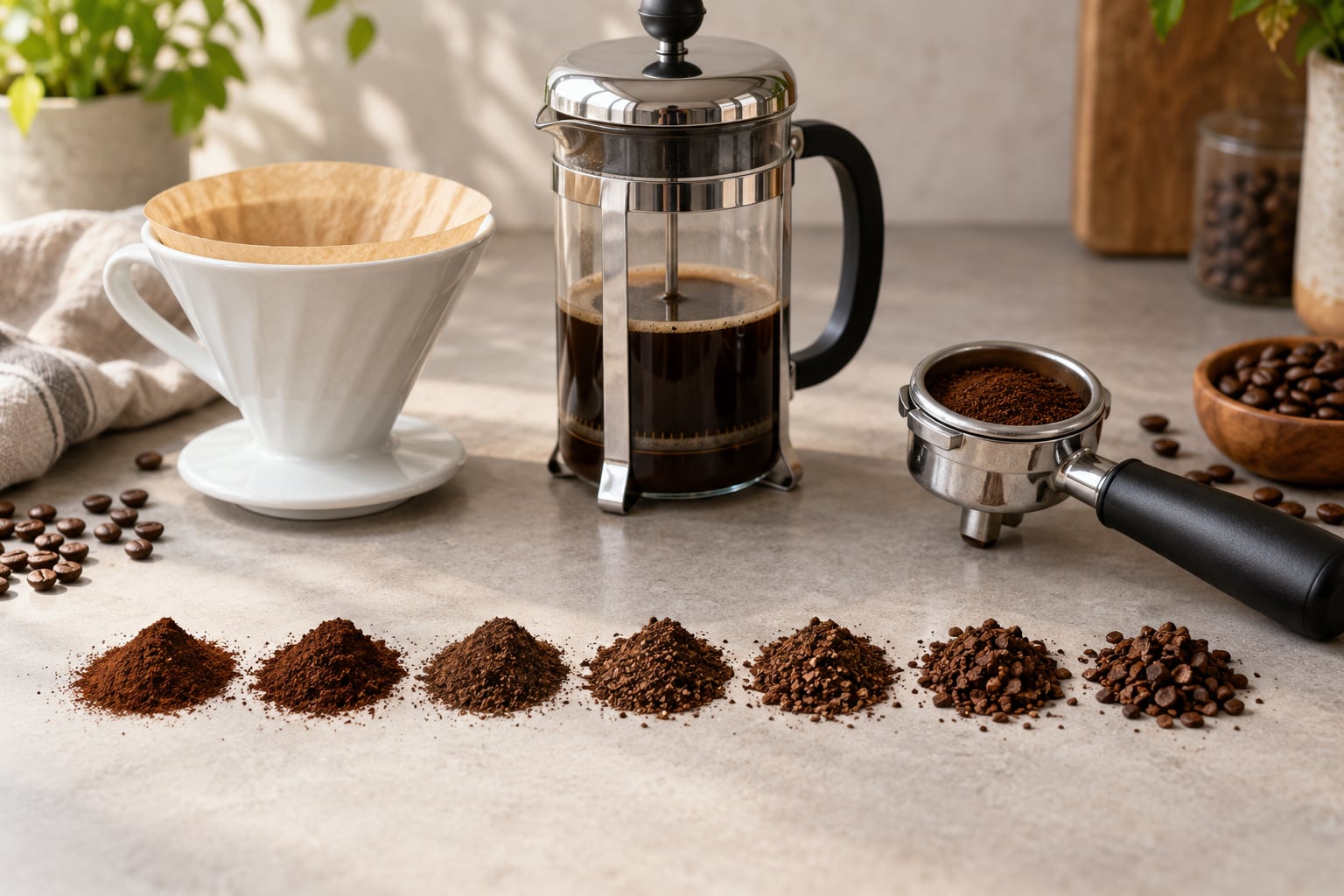
Grind size is the single fastest knob on a coffee setup, and it decides how fast water pulls flavor out of the grounds. A grind size chart for different brewing methods gives you a starting range for each brewer — roughly 100 microns for espresso up past 1200 microns for cold brew — and from there you adjust by taste. This chart is a starting point, not a rule: beans, roast level and your grinder all shift what “correct” means.
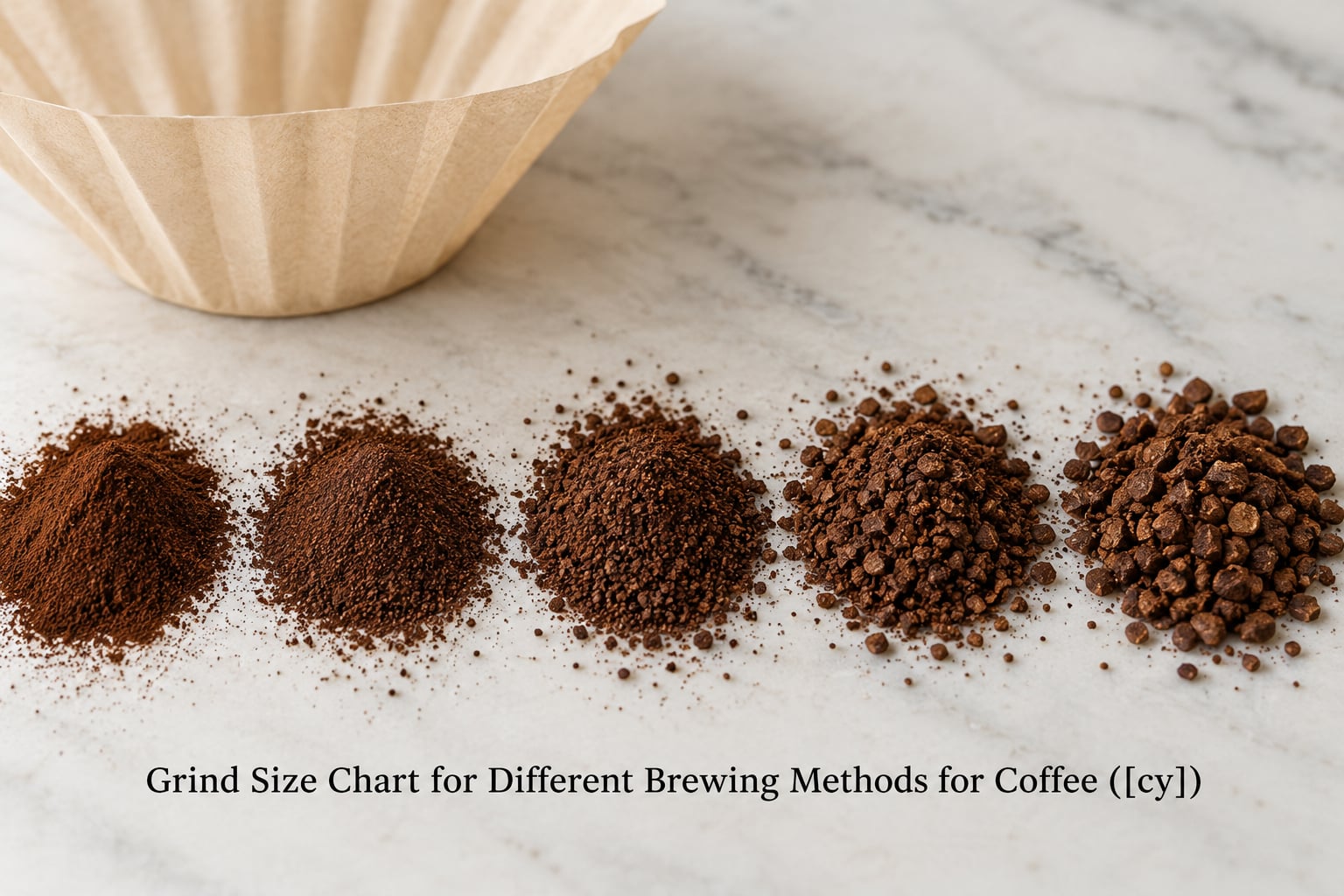
Table of Contents
- What Is the Best Grind Size for Coffee Brewing?
- Grind Size Chart for Different Brewing Methods
- How to Choose the Right Grind for Your Brewer
- What Does Each Grind Size Taste Like?
- Troubleshooting Common Grind Problems
- How to Measure Grind Size at Home
- Frequently Asked Questions
- Start With the Chart, Then Taste and Adjust
What Is the Best Grind Size for Coffee Brewing?
Grind size is simply how big the coffee particles are after grinding. Fine grounds are small and dense, coarse grounds are chunky and open. That one variable controls the surface area touching the water, and surface area controls how fast water dissolves flavor compounds.
Finer grind means more surface area, more resistance to flow, and faster extraction. Coarser grind means less surface area, faster flow, and slower extraction. Espresso works because 9 grams of very fine coffee pushed under pressure in 27 seconds can pull a startling amount of flavor out of the bed. A French press works because the same grounds sitting in water for four minutes extract gently without anyone pressing down on them.
There is no single perfect grind size for coffee. The right target is whatever balances sweetness, clarity and body for the brewer, the bean and the ratio you are using. Grind size is the variable you move first when a cup tastes wrong, which is why it is worth learning rather than guessing.
Most people name grinds with a ladder: extra-coarse, coarse, medium-coarse, medium, medium-fine, fine and extra-fine. Underneath each label sits a rough micron range, and microns are the only unit that travels between grinders.
Grind Size Chart for Different Brewing Methods
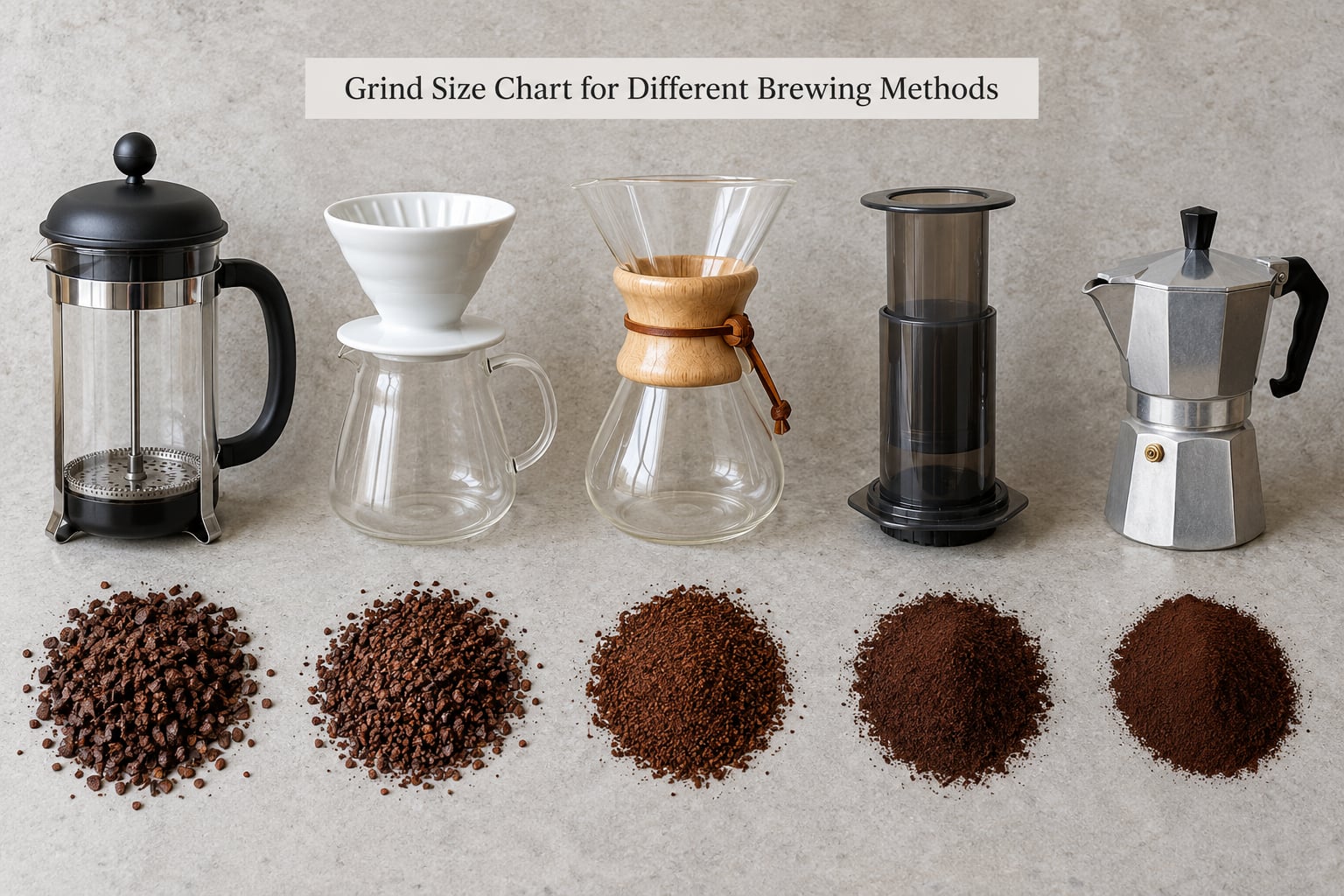
This is the part people bookmark. One row per brewing method, with the grind name, the micron range, a texture you can check with your fingers, and the brew time and ratio that go with it.
| Brewing method | Grind size | Microns | Texture reference | Brew ratio | Brew time |
|---|---|---|---|---|---|
| Espresso machine | Extra-fine to fine | 100-300 | Table salt to powdered sugar | 1:2 | 25-30 sec |
| Turkish coffee (cezve) | Extra-fine | Under 100 | Flour, almost powdery | 1:10 | 3-5 min, low heat |
| Vietnamese phin | Fine | 250-350 | Granulated sugar | 1:15 | 4-6 min |
| Moka pot | Fine to medium-fine | 300-450 | Table salt | 1:2 (fill to valve) | 4-5 min, off heat |
| AeroPress | Medium-fine | 400-500 | Coarse sand | 1:12-1:15 | 1-2 min |
| Siphon | Medium-fine | 400-500 | Table salt | 1:8 | 5-6 min |
| Kalita Wave | Medium | 550-700 | Sand | 1:16 | 3-4 min |
| Pour-over (Hario V60) | Medium to medium-fine | 500-700 | Coarse sand | 1:16 | 2:30-3:30 |
| Drip coffee maker | Medium | 500-700 | Sand | 1:17 | 5-7 min |
| Chemex | Medium-coarse | 700-900 | Coarse sand | 1:16 | 4-5 min |
| Clever Dripper | Medium-coarse | 700-800 | Coarse sand | 1:16 | 4 min |
| French press | Coarse | 900-1100 | Sea salt, cracked pepper | 1:15 | 4 min steep |
| Percolator | Coarse | 1000-1200 | Sea salt | 1:12 | 6-8 min |
| Cold brew | Extra-coarse | 1100-1400 | Peppercorns, cracked rock | 1:8 concentrate | 12-24 hours |
Two things are worth noticing in that table. The four pour-over brewers are not interchangeable: a Chemex runs coarse because its thick filter and tall bed slow the flow, while a V60 wants finer grounds to compensate for a faster drain. And supermarket pre-ground coffee rarely matches the row its brewing method calls for, which is why it usually tastes flat or harsh.
How to Choose the Right Grind for Your Brewer
Start with the row for your brewer and land in the middle of the micron range. Everything after that is adjustment, and the adjustments come from four places.
Roast level and density. Darker roasts are more porous, so they give up flavor faster, which usually means a slightly coarser grind works for them at filter methods. Dense, washed high-altitude light roasts are hard and slow to extract, so people often step a notch finer. This is a tendency, not a law — taste still decides.
Bean age. Beans off gas faster as they age, and gas physically pushes water through the bed faster. Coffee drinkers report needing a slightly finer grind after a couple of weeks off roast, and a coarser one for very fresh beans that are still gassily restless. If your cup shifted character without you changing anything else, roast age is the first thing to check.
Burr type and grinder condition. Flat burrs tend to produce a tighter particle distribution than conical burrs, so a flat-burr grinder often needs to be set slightly finer at the same setting number to hit the same microns. Worn or misaligned burrs throw fines, and those fines are what choke pour-overs and stall an espresso shot even when the setting looks right.
Brew variables. Grind is not the only input. Hotter water extracts more, a finer coffee-to-water ratio raises strength, and more pressure increases resistance. If you change your dose from 30 grams to 45 grams, you changed the brew and your old setting no longer means the same thing.
Grinder naming is part of this too. On most electric burr grinders, a higher number means a coarser grind; on a few it is the reverse. Check your manual rather than assuming.
How to Dial In Your Grind Size
Dialing in is a loop, and it is much shorter when you keep the recipe fixed and move only the grind.
- Pick your row. Find your brewing method in the chart and start in the middle of its micron range.
- Fix the recipe. Hold dose, water temperature and brew ratio constant. For espresso, that is usually 18 grams in and 38 grams out; for filter, use the ratio from the table.
- Brew and time it. Note brew time and how the flow looks — fast and gushing, slow and dribbling, or steady and even.
- Adjust by taste. Sour, thin or salty means finer. Bitter, dry, hollow or harsh means coarser. In a coffee forum thread about grind settings, people keep coming back to the same habit: hold the dose and yield, move the grind, and taste again.
- Change one notch at a time. On a stepped grinder one notch changes roughly 10-20 microns. Larger jumps make it hard to know what fixed the problem.
- Write it down. Note the setting, the dose, the yield and the time. After a few brews you will have a personal baseline, which is far more useful than any published number.
Expect to make three or four passes before a cup feels right, especially on espresso. Anyone who tells you a published setting works the first time is describing a lucky day.
What Does Each Grind Size Taste Like?
Grind size does not decide flavor on its own, but it predicts what happens when you are off. Here is how texture maps to what lands in the cup.
| Grind size | Microns | What it tastes like | Typical result |
|---|---|---|---|
| Extra-coarse | 1200+ | Soft, low acidity, sometimes watery | Under-extracted, low body |
| Coarse | 1000 | Clean, gentle, rounded flavors | Balanced immersion brews |
| Medium-coarse | 800 | Bright but smooth, clear sweetness | Clean pour-over cups |
| Medium | 600 | Balanced, readable, familiar grocery-store coffee flavor | The all-rounder |
| Medium-fine | 450 | More sweetness and body, slightly sharper edges | Sweet press brews |
| Fine | 300 | Intense, syrupy, fast extraction | Muddy if pushed finer |
| Extra-fine | 100 | Very concentrated, sediment-prone, can turn harsh | Unfiltered styles |
Sourness almost always means under-extraction, and bitterness and ashiness almost always mean over-extraction. Muddy or choking-thick usually means too many fines, which is a grind distribution problem more than a size problem. The dull, flat taste of pre-ground supermarket coffee is usually neither extreme but simply stale and inconsistent.
One useful comparison from home barista forums: drip and pour-over tend to land around the middle of a stepped grinder’s range, French press toward the coarse end, and cold brew at the very coarsest setting. Treat that as relative position, not as a number to copy.
Troubleshooting Common Grind Problems
Almost every brewing complaint traces back to grind size or grind consistency. Match your symptom here and change one thing.
| Symptom | Likely cause | Fix |
|---|---|---|
| Espresso gushes in under 20 seconds | Too coarse for the dose | Grind finer, keep 18 g in and 38 g out |
| Espresso dribbles past 45 seconds or stops entirely | Too fine, or the puck is channeled | Grind coarser one notch; repack and tamp evenly |
| Pour-over stalls and pools on the bed | Too fine, or clogged by fines | Grind coarser; if it clogs fast every time, your grinder is throwing fines |
| French press tastes bitter and gritty | Too fine, or you brewed grounds rather than just steeping | Grind coarser; plunge at 4 minutes and wait before pouring |
| Cold brew is cloudy and murky | Too fine, or over-agitated | Grind coarser, steep flat, strain twice through a fine filter |
| Moka pot tastes scorched and bitter | Too fine, or the spout ran dry | Grind one notch coarser, fill only to the valve, take it off heat before it finishes gurgling |
| Coffee tastes sour or salty | Under-extraction from a too-coarse grind | Grind finer, or extend contact time |
| Coffee tastes bitter with no sweetness | Over-extraction from a too-fine grind | Grind coarser, or shorten contact time |
| The same recipe gives different results daily | Worn or misaligned burrs, static cling, or a dose that varies | Replace burrs, grind by weight, and use a distribution tool |
Static cling is the sneaky one. Fine grounds carry a charge and clump against the chute, so the dose you weighed out is not the dose that reached the basket. Tapping the portafilter or a spoon of RDT wipes that out in a second.
How to Measure Grind Size at Home
You do not need a lab to check whether you are in the right neighborhood. You need either a physical comparison or a flow test.
The shake test. Put a teaspoon of grounds on a plate and shake it side to side. Fine grounds barely move and pile up; medium grounds dance around; coarse grounds jump and spread. This tells you roughly which third of the ladder you are on.
The fingertip check. Rub a pinch between finger and thumb. Extra-coarse feels like cracked peppercorn. Coarse is coarse sea salt. Medium-coarse is sand. Medium is sand with a little weight to it. Medium-fine is table salt. Fine is granulated sugar, and extra-fine feels powdery. This is the fastest honest check there is.
Flow test. Brew with a fixed recipe and time it against the table. Espresso at 25-30 seconds, V60 around 2:30 to 3:30, Chemex 4 to 5 minutes, French press 4 minutes. Time is a proxy for particle size, and it works on brewers where you cannot see the bed.
Smartphone macro photo. Most phones have a macro or close-focus mode. Lay grounds on a sheet of white paper, tap the pile flat, and shoot from directly above with the light off to the side. The photo is not precise enough to measure microns, but it shows particle size and, more importantly, how much variation is in the pile. A pile full of dust and boulders means your grinder needs burr work, not a different setting.
Physical comparison. Table sugar, kosher salt and cracked pepper make decent visual anchors, and a coffee grind distribution tool with two reference panels is a modest step up if you want a repeatable reference in the drawer.
Kitchen rulers measure the length of a coffee bean, not the width of a particle. Micron measurement needs either a dedicated particle analyzer or a coffee refractometer reading TDS, which is what commercial roasters use. Neither is necessary for good home brewing.
Why Grinder Setting Numbers Are Not Portable
“Setting 15” on one grinder has no relationship to “setting 15” on another. Each notch moves roughly 10-20 microns, but the starting offset, the burr diameter and the geometry all differ by model, which is why the most common frustration on coffee forums is that published settings do not transfer. Two habits fix it: measure in microns or texture instead of numbers, and keep a written log of your own baseline for each brew method.
Frequently Asked Questions
Is espresso the finest grind size?
No. Turkish coffee and Vietnamese phin are ground finer than espresso. Espresso sits at roughly 100-300 microns, which is fine to extra-fine. Turkish coffee is milled to a powder under 100 microns, and phin coffee is closer to granulated sugar. Espresso does not need the finest grind because pressure supplies the force that extraction time alone cannot.
Is a finer grind a higher or lower number?
On most electric burr grinders, a higher number means a coarser grind and a lower number means finer, so the scale runs backwards from what people expect. A few brands number it the other way around, which is why you should check the manual. The reliable answer is texture: if the grounds feel powdery, you are fine regardless of what the dial says.
Does grinding coffee finer make the coffee stronger?
Finer grind extracts more flavor faster, but it does not automatically make a cup stronger. Strength comes mostly from how much coffee you use relative to water, so a finer grind at the same dose and yield gives a more intense, sometimes sweeter cup. Push too fine and water cannot move through the bed, so you get a choked shot or a bitter, drying pour-over instead.
What grind size does Starbucks use?
Supermarket pre-ground coffee from cafe brands is usually ground for drip machines and automatic brewers, which lands near medium, roughly 500-700 microns. That is a compromise setting, so it underperforms in espresso and often tastes flat in pour-over. It is also ground weeks before you buy it, so most of the aroma has already gone.
How do I convert a blade grinder setting to a burr grinder?
You cannot convert it, because a blade grinder has no dial to convert. A blade chopper produces a mix of powder and boulders no matter how long you pulse, and that inconsistency is the reason blade-ground coffee tastes harsh. Use the blade grinder only for coarse cold brew, and treat burr grinders as the minimum for anything where flavor matters.
How do I know if my espresso grind is too fine?
A too-fine grind slows the shot down, often past 40 seconds, and water may stop moving through the puck entirely. The shot will come out dark, bitter and thin in volume, and the puck will look damp and compressed when you knock it out. Move one notch coarser and brew the same 18 grams in and 38 grams out again.
Start With the Chart, Then Taste and Adjust
Find your brewing method in the chart, grind in the middle of the micron range, and lock your dose, ratio and brew time so only one thing changes. Brew, taste, and move a single notch coarser if the cup is bitter or sour of character, finer if it is thin and salty. Three passes usually gets you there, and the notes you keep along the way become the baseline you will actually use.