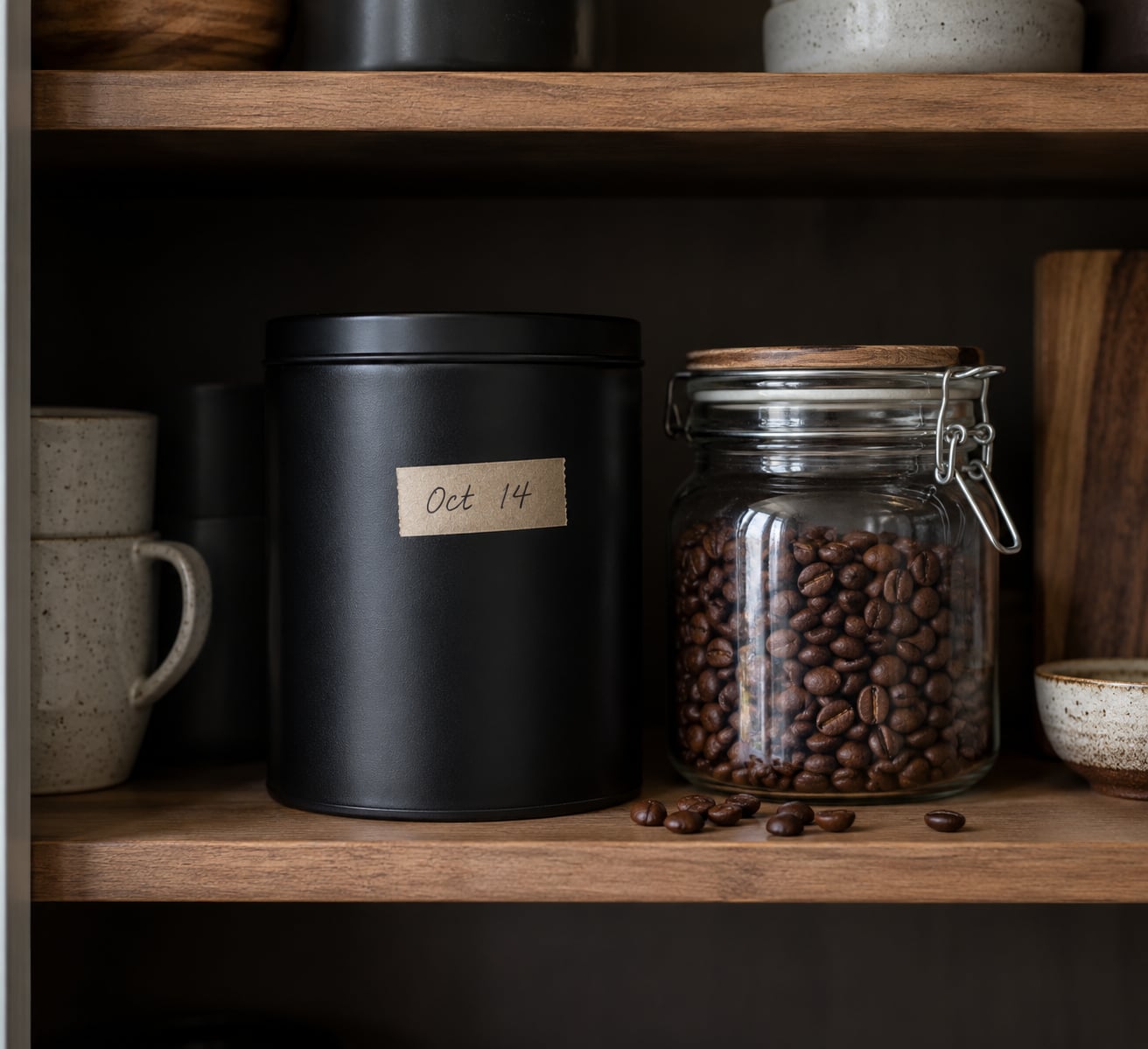
To store coffee beans so they stay fresh, keep whole beans in an airtight, opaque container in a cool, dark, dry cupboard, away from light, heat, moisture, and strong odors. Buy small amounts often, grind only what you need for each brew, and freeze single-use portions only when you need coffee to last beyond a month.
That is the whole method. The fiddly part is that most of us break at least one of those rules, usually by putting the beans in the fridge or by rolling the top of a retail bag down and calling it sealed.
Coffee is closer to fresh bread than to a bag of chips. Roasted beans peak in the first couple of weeks, then lose aroma steadily, and the aroma is the flavor. Good beans stored badly will taste worse than ordinary beans stored well, so storage is the single biggest lever most home brewers have. Everything below is built around that: first what to buy and where to put it, then how to freeze without wrecking the beans, then how to tell when a bag has gone past its window.
Table of Contents
- What You Need
- Step-by-Step: How to Store Coffee Beans So They Stay Fresh
- Common Mistakes
- Frequently Asked Questions
- Should coffee beans be stored in the refrigerator?
- Can freezing coffee beans ruin their flavor?
- How long do whole coffee beans stay fresh after roasting?
- Is it better to store coffee beans in a bag or an airtight container?
- How should opened coffee beans be stored?
- Can unopened green coffee beans be frozen?
- Conclusion
What You Need
You need very little. Most of the gear sold for coffee storage is solving a problem you do not have.
- Whole roasted beans bought in a size you will finish within four to six weeks, with a roast date you can actually read.
- One airtight, opaque container with a gasket or a proper seal. A ceramic or stainless canister, a mason jar with a rubber-seal lid, or the original valve bag rolled down hard all qualify.
- A cool, dry cupboard with a stable temperature and no sunlight reaching it.
- A marker or masking tape so you can date each batch and rotate stock instead of guessing.
- Freezer-safe bags or small containers only if you buy in bulk, travel often, or drink less than about four cups a week.
A note on the one-way valve you will find on most specialty bags. It is a degassing valve, not a freshness valve. Beans release carbon dioxide for roughly three to five days after roasting, and the valve lets that gas escape so the bag does not swell and the bag itself does not act as a freshness seal. Air can still move in and out around it. The bag stays fresh because you roll the top down and squeeze the air out, not because of the little circle on the front.
Here is how the common containers compare on the things that matter.
- Mason jar with a rubber-seal lid. Good seal, provided the gasket is clean, but it only blocks light if the glass is tinted or you wrap it. Portioning means pouring out a dose each time. Cheapest everyday option for filtered coffee.
- Air-displacement canister. Very good seal, since the plunger sweeps air out as you push beans back, and usually opaque. Ideal for daily brewing where beans go in and out every few days.
- One-way valve bag, rolled down and clipped. Fair to good seal, and it improves a lot with a binder clip. Light protection depends on the foil, and portioning is awkward. Fine for short term, when you want to see how much is left.
- Vacuum canister or vacuum-sealed pouch. Excellent while the vacuum holds, though light protection varies. You portion before sealing, not after. Best for bulk orders and multi-month storage.
- Clear glass jar with an open mouth. Poor to fair seal, no light protection, and every scoop exposes the whole batch. Countertop display only, not storage.
Ziploc bags sit outside that list because the answer is genuinely useful: a freezer bag is fine, a sandwich bag on the counter is not. Squeeze the air out, seal it, write the roast date on it with a Sharpie, and it does the same job as a vacuum pouch for most home setups. A sandwich zip bag on the counter lets more oxygen through than people expect, and the beans smell of the cupboard within a few days.
Step-by-Step: How to Store Coffee Beans So They Stay Fresh
1. Buy Beans and Check the Roast Date
Storage cannot rescue old beans, so freshness starts at the shelf. Look for a roast date, not a best-by date. A best-by date is a quality guideline printed by the packer; a roast date tells you when the beans were actually roasted, and that is the number that predicts your cup.
Specialty roasters print the roast date on the bag. Big-box bags often do not, which is a reason to buy smaller and more often rather than saving money on a two-pound bag you will finish in March.
Beans need a short rest after roasting, too. Most roasters recommend waiting about three to five days after the roast date before brewing, and somewhere around a week to two before espresso, because the carbon dioxide still leaving the beans disrupts extraction. That window is also the moment when beans are most likely to be bought off the shelf and stored badly, so plan the first brew a few days out.
2. Transfer Beans to an Airtight Container
Once a bag is opened, its packaging has already been punctured, crushed, and flexed, and the seal is never the same again. Rolling the top down buys you a day or two. Moving the beans into a container with a real gasket buys you a month.
When the bag has an inner foil or plastic liner, keep the beans in that liner and drop the liner into the container. Two layers seal better than one, and you can still see how many beans are left without opening anything.
Squeeze the excess air out of a valve bag before you roll it down, then clip it. That single step is the difference between a bag and a container, and it is the part almost everyone skips. Air sitting in the headspace is the oxygen supply that oxidizes the oils on the bean surface, and the aroma is what fades first.
Then try not to open it constantly. Every time the lid comes off, a fresh slug of oxygen and room humidity goes in. If you are the kind of brewer who measures a single dose every morning, a canister that empties from the bottom is a better fit than a jar you have to tip out into a scoop each time.
Storage duration, roughly, once the beans are sealed and in a cupboard: best flavor from about day three to day twenty-one, still very drinkable from three to six weeks, and fading past that. Frozen at the right moment, sealed and thawed once, they hold close to their peak for a year or more.
3. Keep the Container Cool, Dark, and Dry
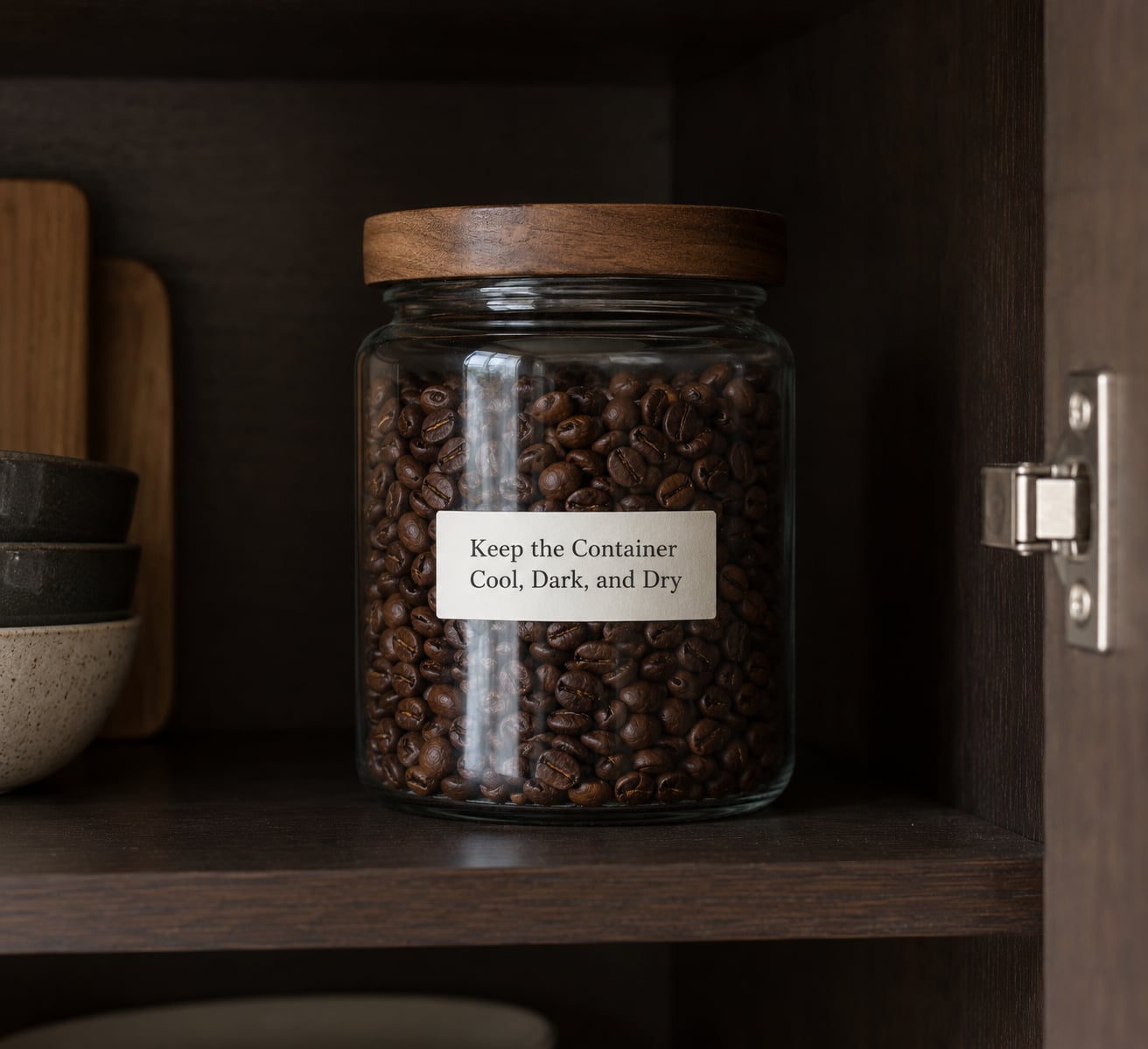
Put the container in a cupboard, not on the counter. A closed cabinet gives you darkness, stable temperature, and a barrier from food smells, which coffee picks up fast because the surface oils are exactly the sort of molecule that soaks up odors.
Here are the four things that actually break coffee down, in the order they do the most damage.
- Oxygen oxidizes the flavor compounds on the bean surface, flattening the aroma and leaving a flat, dull cup. This is why sealing matters more than anything else.
- Light breaks down the essential oils on the surface. Clear jars on a windowsill look nice and cost you flavor every day they sit there.
- Heat speeds up staling. A cupboard above the stove, next to the oven, or on top of the refrigerator is warm enough to matter, even in the middle of winter.
- Moisture and odors do two things at once. Beans are hygroscopic, so they take on humidity from the room and pick up whatever they are stored beside, including soap, spices, and onions.
Stable room temperature usually beats anything cleverer. The National Coffee Association and major roasters all land on the same simple framing: airtight, opaque, cool, dark, dry. If your kitchen is genuinely hot most of the year, a cabinet in an interior hallway is better than the coolest shelf in the main room.
Skip the top of the fridge, even though it feels cool. Fridge and freezer compressors cycle on and off, and the temperature swing brings condensation, which means moisture, which means staling and off odors faster than room temperature air ever would.
4. Grind Only What You Need
Beans hold their aroma far longer than ground coffee does. Grinding multiplies the exposed surface area, and aroma starts dropping within about twenty minutes of the burrs finishing their pass. That is the entire reason to keep whole beans at all.
For pre-ground coffee, the practical intervals are short. A bag of grounds in an airtight container is at its best in the first few days, acceptable for about a week, and past that you are drinking memory of coffee rather than coffee. If you buy pre-ground, buy the smallest bag you can finish inside that week.
Grinding in one big batch is the most common version of this mistake, and it is worse than buying pre-ground, because the whole batch starts its twenty-minute clock at the same moment. Grind a week at a time if your grinder is noisy and you hate it, but grind it weekly.
One technique worth knowing: some people grind straight from frozen beans and brew the grounds immediately, which skips the thaw step entirely. It works well for filter coffee. It is fussier for espresso, where the temperature of the cold grounds changes extraction.
5. Freeze Beans Only for Longer-Term Storage
Freezing gets a bad reputation because the arguments on both sides are usually stated as absolutes. The conditional version is much simpler: if you drink four or more cups a week, freezing buys you very little and adds a variable. If you drink one or two cups a week, or you buy in bulk, freezing is the difference between coffee that tastes fresh and coffee that tastes like a cardboard tube.
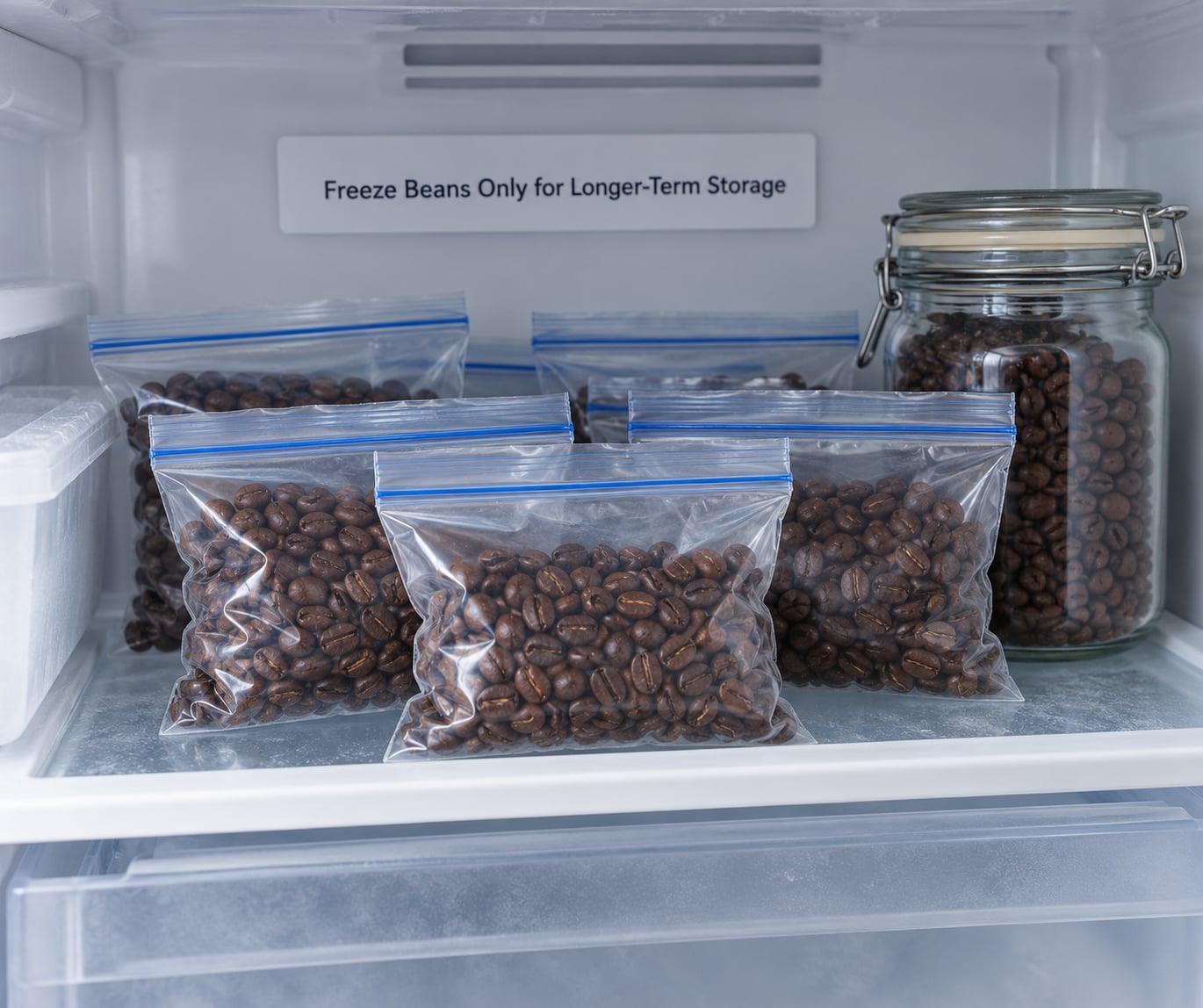
The rules that make freezing work:
- Rest first. Freeze beans that have already sat a week or two post-roast, not beans you pulled from the roaster that morning. Beans still releasing carbon dioxide can rupture when frozen.
- Portion by the week. Divide the bag into single-use amounts, roughly two weeks of coffee per portion, so you only thaw what you need. This is the step that prevents the freezer taste people complain about.
- Seal and squeeze out air. Double-bag if you are using a freezer zip bag, and press the air out before sealing.
- Tape over any one-way valve. Valve bags can lose their ability to keep air out once the rubber stiffens in the cold. A strip of packing tape over the valve closes that gap.
- Label with the roast date. When you pull a bag out in eight months, that date is the only thing telling you where it sits in its life.
- Thaw in the bag, on the counter. Let the sealed portion come to room temperature before you open it. Opening warm beans traps condensation right on the surface, and that is the single most common way frozen coffee goes bad.
- Freeze once, never twice. Repeated freeze-thaw cycles cause more damage than the freezer ever prevents. Refreezing is the line most people should not cross.
Vacuum sealing after portioning is a real upgrade if you already own a vac machine. It costs nothing extra in technique, just in equipment, and forum regulars across Reddit and the coffee forums recommend it most often for long-term storage. Everyday drinkers do not need it. The prevailing advice for normal use is simpler: anything opaque and airtight, kept cool, dry, and dark, with no vacuum gimmick required.
6. Refresh Beans and Know When to Replace Them
Do not judge coffee by appearance. A dull-looking bean can taste excellent, and a glossy, oily-looking one can be well past its peak. Appearance mostly tells you about roast level and age, not quality.
Use your nose first. Open the container and smell it without grinding. Fresh beans give off a clear, sometimes floral or fruity smell. Beans past their window smell of cardboard, dusty paper, or nothing much at all. Then brew a small batch and taste for sweetness and acidity rather than strength. Stale coffee tastes flat and dull at the same strength, which is a distinct flavor that is hard to confuse with anything else.
For beans you are not sure about, the fastest fix is freezing them right now, before they get any worse. Stale frozen coffee is still usually better than stale coffee sitting in a cupboard, and it stops getting worse from that day on.
A simple rotation system beats any gadget: label every container with the roast date, put new stock behind the old, and always take from the oldest. If you buy a two-pound bag, portion and freeze it on day one. The beans you drink in week three will be better than the ones you would have reached for in week eight.
For beans bought while traveling or on holiday, the same rules apply in miniature. Airtight container or a sealed bag, kept out of a hot car, out of a suitcase that gets sat on, and away from a hotel minibar. Coffee picks up smells faster than people expect, and a week in a car will do it in a day.
Common Mistakes
Putting beans in the refrigerator. This is the most common mistake by a wide margin, and it is one of the worst. The fridge is humid, it smells like last week’s leftovers, and its temperature cycles, so beans absorb moisture and off odors while staling. Move them to a cupboard today. If you are worried about summer heat, a shaded interior cabinet solves the actual problem without introducing three new ones.
Rolling the top of a retail bag down and calling it sealed. The crease eventually springs, and a bag that has been opened is not a container. Move the beans, ideally still in the inner liner, into something with a gasket. If you want to keep using the bag, clip it closed and accept that it is a short-term solution measured in days, not weeks.
Storing beans next to the stove or on top of the fridge. Both locations are warmer than the rest of the kitchen, and heat is one of the four enemies. The rule is simple to remember: if the container is warm to touch at any point in the day, move it.
Freezing one big bag and thawing it over and over. Every trip through the temperature cycle draws moisture onto the beans, and the flavor complaint people call freezer taste is really condensation taste. Portion by the week, thaw only one portion, and if you are done with a portion, do not put it back.
Assuming moisture or oil sheen means the beans are fresh. A visible bloom or sheen tells you about roast development, not freshness. Stale beans can look perfect. Smell and taste are the only reliable tests, and a bean that smells like dust is a bean you should have frozen two weeks ago.
Keeping ground coffee for months. Grounds have a shelf life of days, not weeks, and a big batch ground on Sunday is already declining by Tuesday. Grind weekly, grind small, and store grounds in something airtight and opaque for the same reason you store beans that way.
Two smaller habits pay off too. Buy smaller bags more often, because a twelve-ounce bag finished in five weeks is always fresher than a two-pound bag finished in five months. And label your containers, because the single most useful piece of information in your kitchen is the date on the beans in front of you.
Frequently Asked Questions
Should coffee beans be stored in the refrigerator?
No. The refrigerator is humid, carries food odors, and cycles between warm and cold, so beans absorb moisture and off smells while staling faster than they would at room temperature. A cool, dark cupboard away from the stove, oven, and sink is better for beans you will use within a few weeks. Only consider cold storage if your kitchen stays hot and you need to hold beans for months.
Can freezing coffee beans ruin their flavor?
Freezing itself is not the problem. Repeat freeze-thaw cycles and condensation are. Portion beans by the week, squeeze the air out, seal each portion, and let it reach room temperature in the closed bag before opening. Never refreeze a portion once thawed, and freeze only beans that have rested a week or two after roasting. Done that way, freezing preserves coffee far better than leaving it in a cupboard.
How long do whole coffee beans stay fresh after roasting?
Whole roasted beans are at their best from about three days to three weeks after the roast date, remain very drinkable through roughly six weeks, and fade noticeably after that. Storage method changes this window considerably: airtight, opaque, cool, dark, and dry storage holds the peak, while freezing at the right moment holds a much longer shelf life. Judge beans by aroma and taste rather than by the printed best-by date.
Is it better to store coffee beans in a bag or an airtight container?
For opened beans, a container wins clearly. Once a bag is opened, punctured, and flexed, the seal never returns to factory condition, and rolling the top down only buys a few days. Keep the beans in their inner liner if there is one and drop that liner into an airtight canister or a mason jar with a rubber-seal lid. An unopened factory bag is fine as-is for a couple of weeks.
How should opened coffee beans be stored?
Squeeze the remaining air out of the bag, roll the top down, secure it with a clip or rubber band, and keep it in a cool dark cupboard if you will finish it within a week or two. For longer, transfer the beans, ideally inside the inner liner, into an airtight opaque container and date it. If you will not finish them for months, portion and freeze instead, and write the roast date on each portion.
Can unopened green coffee beans be frozen?
Yes, and green beans freeze well because they are still dense, moist and low in oils rather than fragile and aromatic like roasted beans. Unopened green coffee in its original hermetic packaging, or in a sealed moisture-proof bag, can be kept frozen for a year or more with minimal quality loss. Let the bag sit sealed at room temperature before you open it, and roast from frozen batches rather than the whole sack at once.
Conclusion
If you do one thing this week, move your beans out of wherever they are now and into a tightly sealed, opaque container sitting in a cool, dark, dry cupboard away from heat, moisture, and odors. Label it with the roast date. Grind only what you need, and reach for the freezer only when a single bag will not get used inside a month.