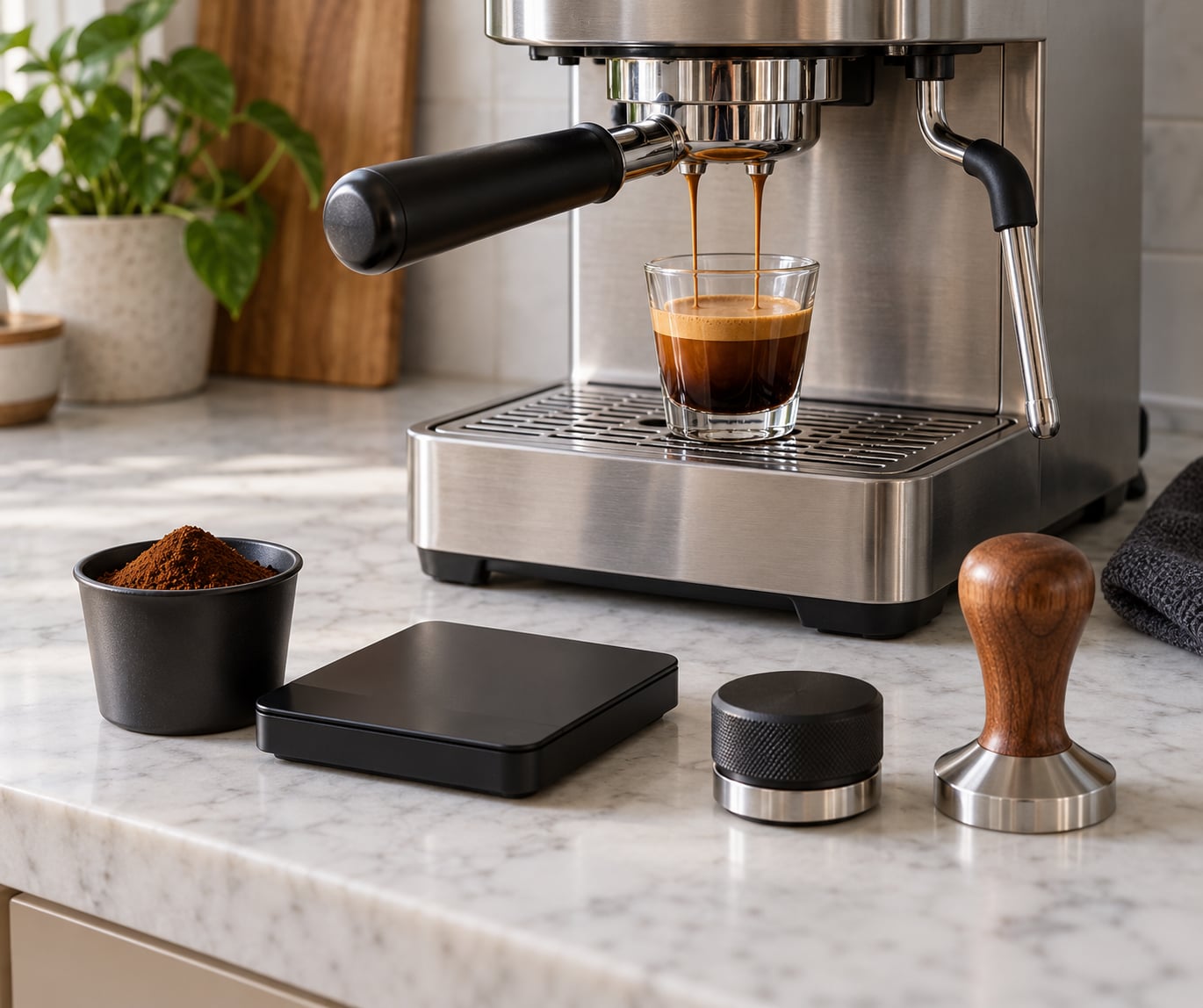
Espresso coming out too fast means the water is not meeting enough resistance inside the coffee puck, so it rushes through instead of extracting properly. The benchmark most people aim for is 18g of ground coffee in and 36g of espresso out in 25 to 30 seconds, and a shot that hits 36g in ten seconds, or gushes in five, is under-extracting. The fix is nearly always grind, dose, or puck preparation rather than the machine itself.
Short answer: grind finer, add a little more coffee, and make the puck level and dense. Work through those three before touching anything on the boiler.
Table of Contents
- What You Need to Diagnose a Fast Espresso Shot
- Step-by-Step: Why Is My Espresso Coming Out Too Fast?
- 1. Confirm the shot really is running too fast
- 2. Check whether the grind is too coarse, or too fine
- 3. Inspect dose, yield, and distribution
- 4. Improve puck preparation
- 5. Check machine temperature, pressure, and blockages when espresso is coming out too fast
- 6. Change one variable and pull another shot
- Symptom to cause: what you see maps to what to change
- Common Mistakes
- Frequently Asked Questions
- Conclusion
What You Need to Diagnose a Fast Espresso Shot
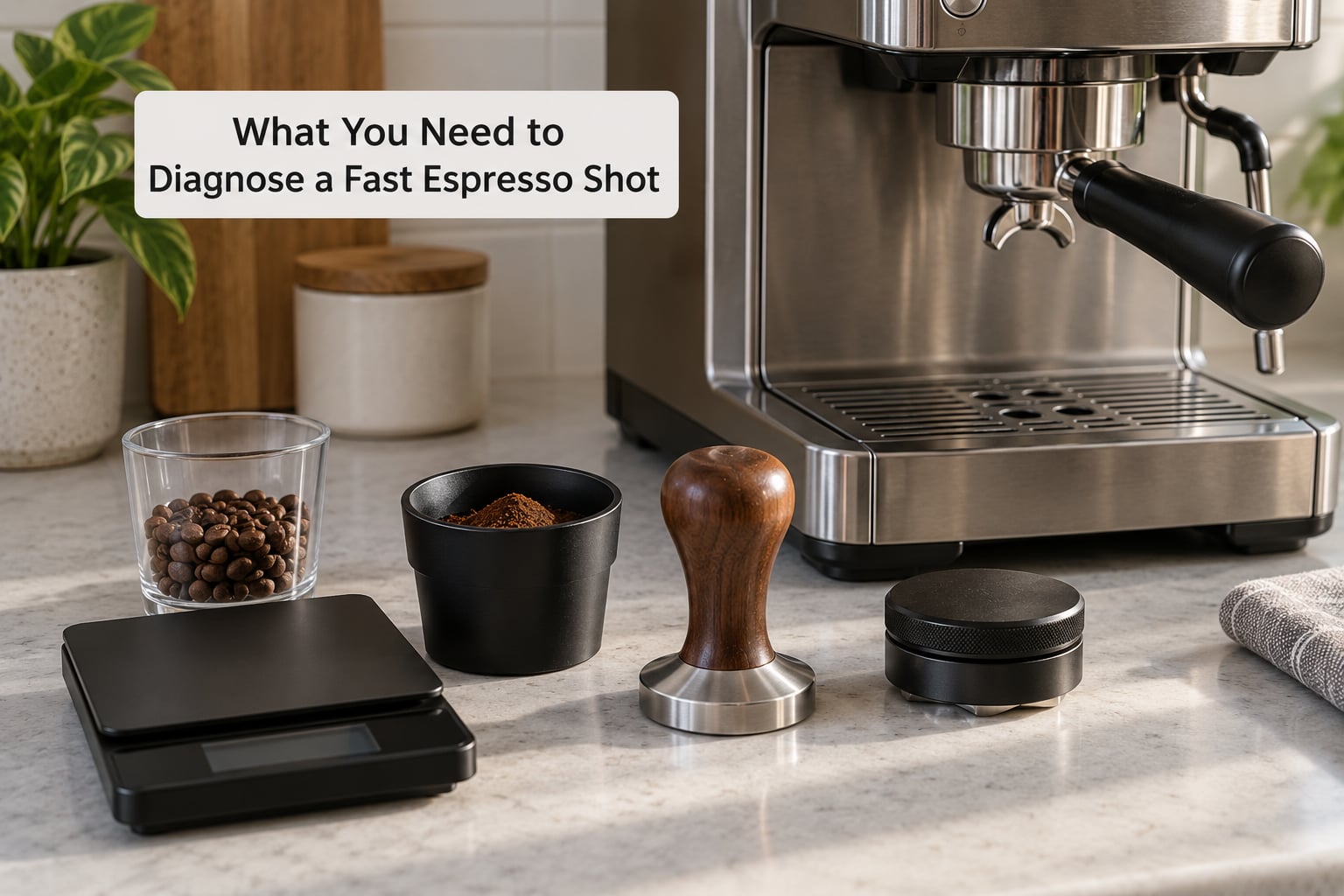
None of this is exotic, and most of it costs almost nothing. What matters is that it lets you measure, because eyeballing a fast shot is guesswork.
- A scale reading to 0.1g. Dose and yield both matter. Without a scale you are pulling shots blind.
- A timer. A phone works. Start it when the pump starts, not when liquid appears in the cup, since the first drop can lag a second or two behind pump-on.
- A tamper that fits your basket. Level matters more here than force, and a mismatched tamper is a common reason pucks come out crooked.
- A distribution tool (WDT). A few thin needles, or even a clean cocktail fork, breaks up clumps before tamping. The full name is Weiss Distribution Technique.
- A dosing cup and a knock box. A dosing cup keeps the basket rim clean, which helps the seal and the headroom calculation.
- A bottomless or naked portafilter. This is the cheapest diagnostic tool you can own. It shows you the flow pattern instead of hiding it in a spout.
- Access to your grinder settings and enough time to pull several shots.
- Filtered water and a cleaning kit for backflushing the group head, following your machine manual.
Step-by-Step: Why Is My Espresso Coming Out Too Fast?
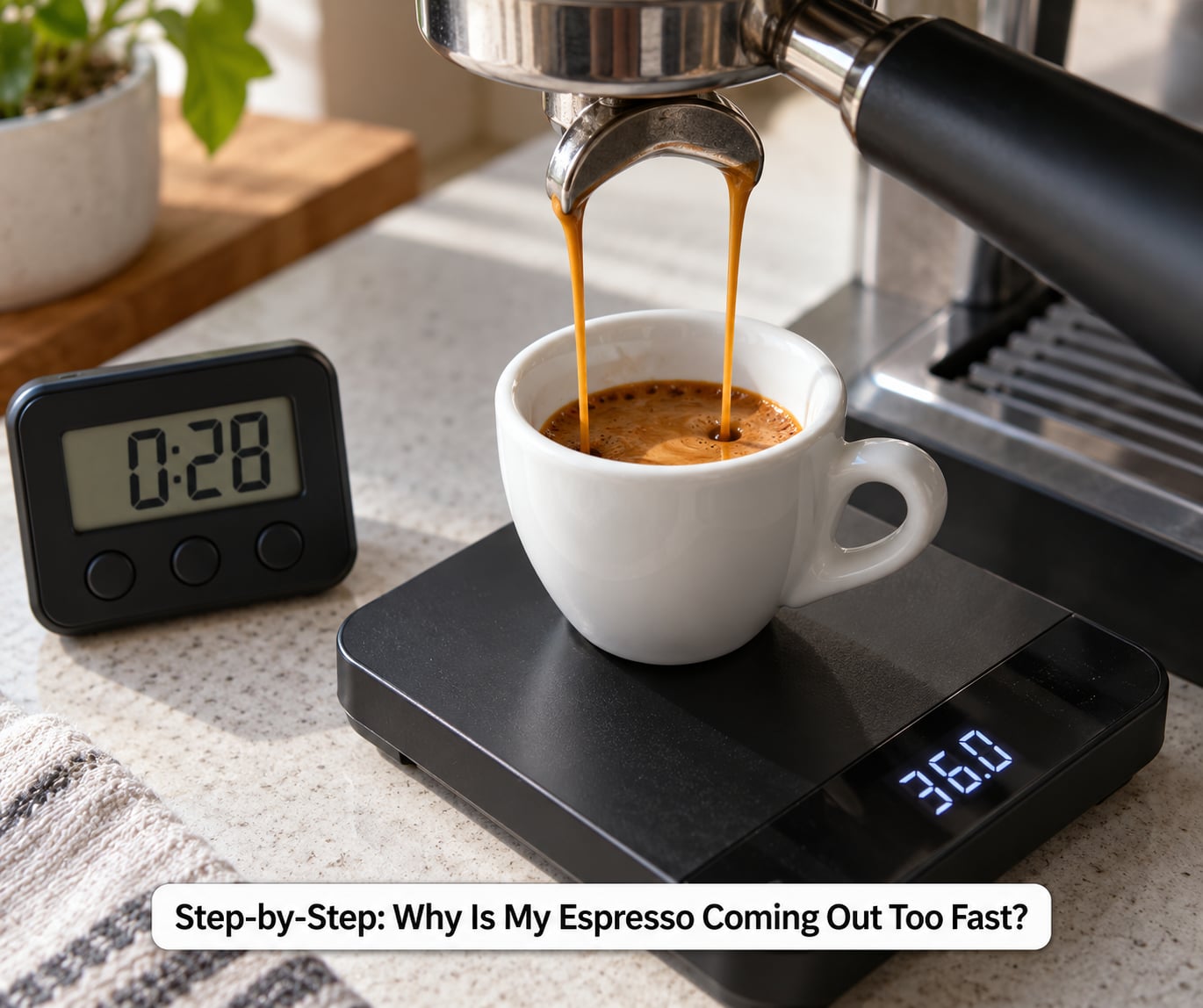
Go in this order and change one thing at a time. If you adjust grind, dose, and tamping together, a fast shot turns into a slow one and you learn nothing about which change did it.
1. Confirm the shot really is running too fast
Put an 18g basket in, dose 18g, and aim for a 1:2 ratio, meaning 36g of espresso in the cup. Time the whole thing from pump-on to the last drop. Under 20 seconds is fast and under-extracted, 25 to 30 seconds is the standard window, and anything past 35 to 40 seconds is slow.
Those bands are a reference, not a rule. A slightly shorter shot from a light, dense roast can taste excellent, and a 40 second shot from a dark roast can taste fine too. Time is a clue; taste is the verdict.
Under-extracted coffee tastes sour, thin, hollow, and sometimes astringent, with crema that is pale and disappears fast. That hollow, watery feeling in the middle of the mouth is the clearest sign you are pulling too fast.
2. Check whether the grind is too coarse, or too fine
Most fast shots are a grind that is too coarse. Water moves fastest through large gaps between big particles, so the pump finds an easy path and pushes the whole shot through before it has dissolved much. Turn the grinder one step finer and pull again.
If your grinder is already at its finest setting and the shot is still fast, other variables are in play. Add coffee to the dose or improve distribution before concluding the grinder is the limit.
The opposite failure exists too, and it confuses people. A very fine grind makes the puck so dense that brew pressure looks for a weak point, then blasts through it in one channel. That is the pattern where the machine chokes for several seconds, then dumps the rest of the shot in a few. A bottomless portafilter shows it plainly as one concentrated stream with pale blonde spots around the edge. It is a channelling problem, not a fast shot, though it feels like one.
If your grinder has stepped clicks and you hear the burrs barely turning, it is probably not making espresso-fine grounds at all. That is a common reason people pull fast shots on a new machine and assume the machine is faulty.
3. Inspect dose, yield, and distribution
Dose too little for the basket and the shot runs fast. Under-dosing leaves headroom, the empty space between the top of the puck and the shower screen, and that loose space lets the puck lift and shift as soon as the pump kicks in. Water finds the gap and partly bypasses the coffee.
Adding 0.5g to 1g of coffee is the standard move here, and it is also the fallback for anyone whose grinder cannot go finer. Over-dosing causes its own problem: the puck gets pushed up into the shower screen, flow stalls, and the shot crawls.
Distribution is the other half. Knock the basket side to side to settle the bed, then check that the grounds are flat with no visible lumps or a crater in the middle. Clumps mean some regions are dense and some are loose, and the pump will find the loose ones.
4. Improve puck preparation
Break up clumps before tamping, not after. Stir or flick the grounds with the distribution tool until the colour is even and no clumps are visible, then tap the basket to settle the bed.
Tam level, and tamp the same way every time. Water follows the lowest point, so a tilted or off-centre tamp sends the whole shot down one side, which is why bottomless shots so often flow from one stream with blonde spots in the crema.
Tamping harder is not the fix. A very heavy tamp combined with a very fine grind makes the puck so non-porous that pressure has to escape somewhere, and it escapes through a channel. Most home baristas get better results from a firm, level, consistent tamp than from maximum pressure.
After the shot, look at the spent puck. A fast shot usually leaves a very wet, smeared, uneven bed, and you may find coffee splashed on the shower screen. That is evidence of a loose, unstable puck, not of a broken machine.
5. Check machine temperature, pressure, and blockages when espresso is coming out too fast
Once grind, dose, and preparation are right, the machine is the remaining suspect. An unstable temperature, typically a cold group head on a single-boiler machine like a Gaggia Classic or Rancilio Silvia, changes extraction even when everything else is dialed in. Thermocoil machines such as the Breville Barista Express heat more steadily but behave differently with pre-infusion.
Do not raise brew pressure to slow a fast shot. That is the most common mistake on the forums, and it makes the problem worse by forcing more water through a puck that is already too easy to push through. Dropping the pump to roughly 7.5 to 8 bar, if your machine allows it, is genuinely useful as a diagnostic because a lower pressure exposes channelling that 9 bar can hide.
A partially blocked shower screen or scale in the group restricts flow, which shows up as a slow shot rather than a fast one, so it is worth clearing anyway. Backflush and descale on the schedule in your machine manual, and give the group head a proper warm-up with an empty portafilter before the first shot.
If a shot runs fast, a spray, and gushes from one side, a puck screen helps by holding the bed flat, and a precision basket with a finer perforation pattern increases resistance. Both are reasonable upgrades once your technique is sound. Before spending money on gear, be honest about whether you are distributing and tamping consistently.
6. Change one variable and pull another shot
Keep a small log, on paper or in your phone. Four columns is enough: dose, grind setting, yield and time, and how it tasted.
Grind one step finer, purge the grinder, and pull again. Note the new time and taste, then decide before the next shot what you are changing. Purging between shots matters because leftover grounds from the previous dose sit in the chute and flatten the change you just made.
Shot times that swing wildly at identical settings, 20 seconds then 35, are usually channelling rather than machine failure. Keep the dose and grind fixed for three shots in a row and see whether the times stabilize. If they do not, the puck is the problem, not the dial.
Symptom to cause: what you see maps to what to change
Cross-check what the shot actually looked like before you change anything.
- The whole shot is over in under 10 seconds. The grind is far too coarse, or you are using pre-ground shop coffee. Grind finer, and if you are already at the finest setting, add 0.5g to 1g of coffee.
- Fast, with almost no crema, pale and patchy. Stale or very old beans, or plain under-extraction. Use beans roasted within the last 7 to 21 days.
- It sprays and squirts from a bottomless portafilter. Channelling from uneven distribution or a heavy tamp. Work the grounds with a WDT, tamp level, and add a puck screen.
- Blonde spots in the shot. A fine grind plus over-compression forcing one path. Tamp lighter and more level, or go slightly coarser.
- It starts slowly, then rushes at the end. A channel opening partway through the shot. Fix the distribution, and test at a lower pump pressure.
- Water comes out one side of the basket only. A tilted tamp or a crooked basket seat. Reseat the portafilter and tamp flat.
- Very wet, smeared puck after the shot. The puck was loose and unstable, or the dose was too low. Increase the dose and settle the bed before tamping.
- Coffee on the shower screen after the shot. The puck lifted into the screen, usually from low headroom. Add coffee so the basket is properly filled.
- It tastes sour and thin. Under-extraction from fast flow. Slow the shot down first, then retaste.
- It tastes bitter and sour at the same time. Channelling: bitter from one fast path, sour from the rest. Go slightly coarser and fix the puck.
- The shot suddenly stopped and crawls. The grind is too fine, or the screen and group are blocked. Go coarser, then backflush and descale.
Common Mistakes
Almost every frustrating espresso problem comes from one of these.
Changing five things at once. Grind, dose, tamping, beans, and basket all change, then the shot comes out differently and nobody knows which move caused it. One variable per shot, always.
Chasing an exact number of seconds. 25 to 30 seconds is a useful window, not a target to hit at all costs. If 28 seconds tastes thin and 32 seconds tastes good, keep 32. Tasting is the real measurement.
Using coffee ground at a shop or supermarket. Pre-ground beans are the most common beginner trap and are the root cause of a lot of five-second gushers. They lose aroma within days, the grind is wrong for your machine, and nothing you do to the grinder dial will fix them. Buy whole beans roasted within the last few weeks and grind at home.
Coffee that has been sitting open for months. Stale beans give a thin, flat shot with weak, quickly fading crema. A bag roasted in the last 7 to 21 days behaves completely differently, and switching beans often solves a fast, sour shot faster than any grinder adjustment.
Tamper harder to slow the shot. Force does not fix a tilted or loose puck, and a very heavy tamp on fine grounds invites channelling. Level and consistent beats hard.
Reading bitterness as over-extraction. Bitter on a fast shot is a channelling signature: one narrow path over-extracts while the rest of the puck under-extracts, so you get bitter and sour at once. If it is fast, grind coarser slightly and fix the puck before anything else.
Adding a puck screen and expecting it to fix a loose puck. A screen helps when the bed is well prepared and it needs holding in place. It cannot rescue uneven distribution, and on some setups it makes flow slightly faster because the screen lifts fines off the top of the bed.
One last timing question comes up constantly, so here is a reference by dose and ratio rather than a single number:
- 15g in. Aim for 30g out in 20 to 26 seconds. Anything under 15 seconds is a serious gush.
- 18g in. Aim for 36g out in 25 to 30 seconds. This is the standard home reference shot.
- 20g in. Aim for 40g out in 28 to 34 seconds. Larger doses run slightly longer.
- 18g at a 1:1.5 ratio. Aim for 27g out in 18 to 24 seconds. Shorter ratios finish sooner by design.
- 40 seconds or more for a 36g yield. That is slow. Grind coarser, or check the group and shower screen for blockages.
Look again at the 1:1.5 line. A 27g yield in 20 seconds is a correct shot at that ratio, not a fault, which is why measuring grams beats counting seconds alone.
Frequently Asked Questions
How do I fix espresso coming out too fast?
Grind finer first, then add 0.5g to 1g of coffee, then improve distribution and tamp level. Work in that order, one change per shot, and keep 18g in and 36g out as your reference. If the grind is already at its finest setting, dose and puck preparation are where your remaining gains are.
How do I make my espresso come out slower?
Turn the grind one step finer and pull again. A finer grind closes the gaps between particles, so the pump has to work harder to push water through the whole puck instead of through a shortcut. Most shots need two or three small steps. If your grinder is stepped and already maxed out, add 0.5g to 1g of coffee instead.
Is 40 seconds too long for espresso?
It depends on dose and ratio, not on the clock alone. An 18g dose pulling 36g in 40 seconds is on the slow side and usually means the grind is too fine or the shower screen is blocked. A shorter ratio such as 18g in and 27g out in 20 seconds is perfectly normal. Judge the time against the yield you targeted, then taste it.
What happens if espresso beans are ground too fine?
Flow slows and can stall entirely, but there is a second effect people miss. A very fine, heavily tamped puck becomes so dense that brew pressure seeks out a weak point and blasts through it, so a choked shot can turn into a sudden gush. That channelled shot tastes bitter and sour at once, with blonde spots, and it is a puck problem rather than simply a slow grind.
Should I tamp harder to slow down an espresso shot?
Usually no. Tamping pressure changes the puck far less than people expect, and forcing it harder on fine grounds makes the bed non-porous, which invites channelling. What matters is that the tamp is level and repeatable, so water cannot run off one low side. A consistent moderate tamp fixes more fast shots than maximum force ever will.
What should I do if espresso is coming out too slowly?
Go one step coarser, and check for a blocked shower screen or scale in the group head, which restrict flow. Also check that you have not over-dosed and pushed the puck up against the screen, and that the basket is not too small for the amount of coffee. Slow shots also happen on a cold group head, so a proper warm-up helps.
Conclusion
Start by measuring the shot you are actually pulling: dose in grams, yield in grams, and seconds from pump-on. Then look at the puck, in a bottomless portafilter if you have one, to see whether it is level or channelling.
Then make one small adjustment, usually a single step finer on the grind, and pull again. If the flow still runs away from you, add a fraction of a gram of coffee and fix your distribution before you blame the machine. Espresso is a feedback loop: change one thing, taste the result, and let that decide the next move.