
Condensation on windows in winter has one cause: warm, moist room air touching glass that is colder than the air’s dew point. To stop it, you either lower the moisture in the air, warm the glass, or both. Most people can fix it in a weekend with things they already own, and the whole thing costs nothing if you start with the free steps.
This guide walks through the process in order, because the fix depends entirely on where the moisture shows up. Condensation on the inside of the glass is an air problem. Fog between two panes is a window problem. Water at the top of the frame is usually something else entirely.
If you only read one thing, read Step 1. Most wasted money on this problem comes from replacing windows that were never the culprit.
Table of Contents
- What You Need
- Step-by-Step: How to Stop Condensation on Windows in Winter
- Step 1: Determine Where the Moisture Is Coming From
- Step 2: Measure Indoor Humidity and Check Ventilation
- Step 3: Reduce Moisture at Its Sources
- Step 4: Improve Air Circulation Near the Window
- Step 5: Insulate Cold Window Surfaces
- Step 6: Check for Leaks, Airflow Problems, and Ventilation Faults
- Step 7: Maintain the Fix and Prevent Condensation Returning
- Common Mistakes
- Frequently Asked Questions
- Conclusion
What You Need
The list is short because most of these steps use things already in your house.
- A small digital hygrometer — a cheap wall model or a phone app will tell you indoor relative humidity. This is the single most useful tool.
- A flashlight — for checking window seals, gaps, and the outside of the glass in the dark.
- Old towels and a rag — for drying sills and glass.
- Standard cleaning supplies — dilute detergent, a soft brush, and gloves.
- Caulk or sealant — only if you own the window and find a genuine gap around the frame. Not for every condensation case.
- A box fan or ceiling fan — free air circulation if you do not own one.
Renters should read this before buying anything. Exhaust fan use, laundry habits, blinds, and towel-wiping are yours to control. Anything permanent — sealant, film, weatherstripping, a dehumidifier plugged into a dedicated outlet — needs your landlord’s OK first, and in a lot of leases it is the landlord’s responsibility anyway.
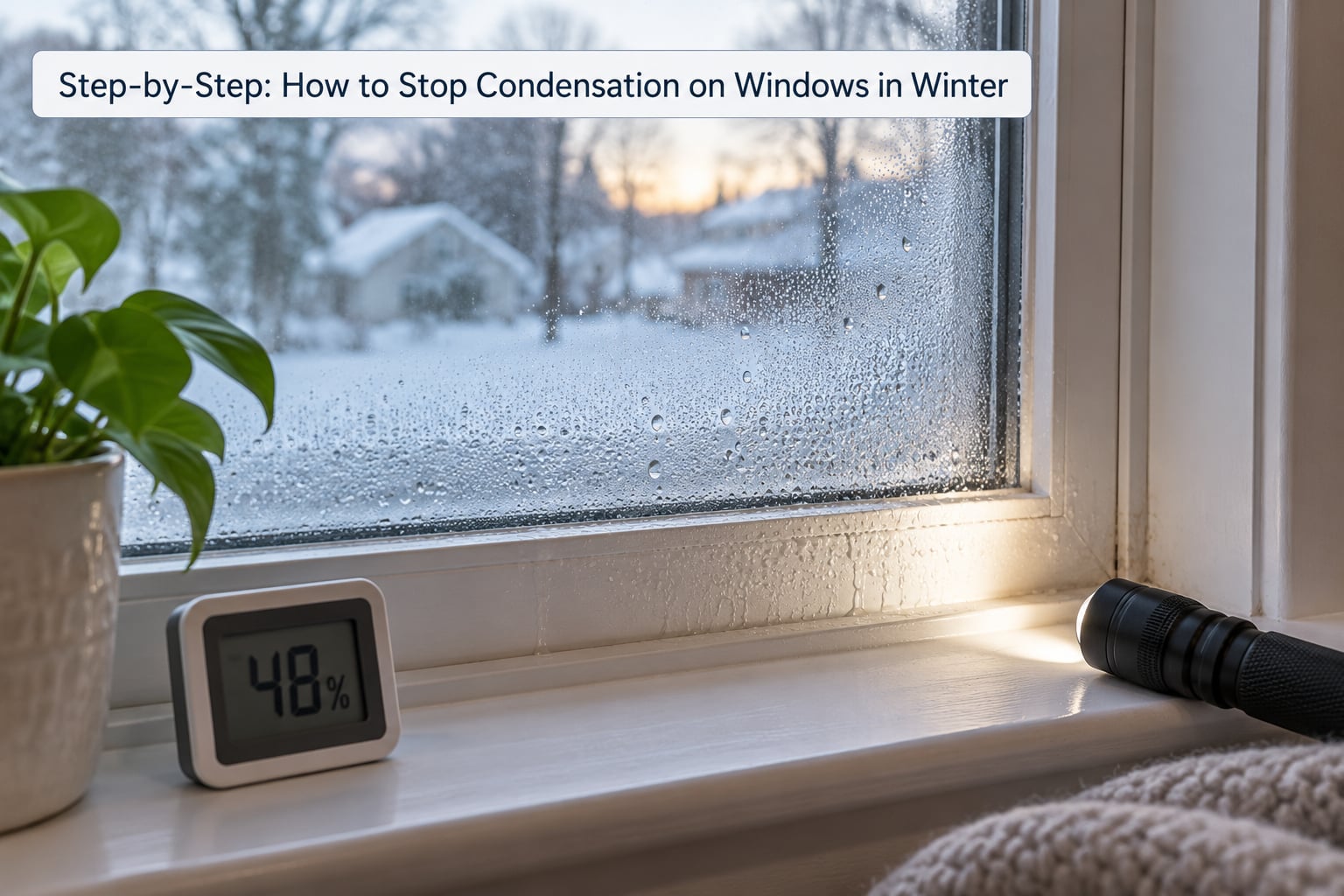
Step-by-Step: How to Stop Condensation on Windows in Winter
Step 1: Determine Where the Moisture Is Coming From
Start by locating the condensation, because the location tells you what to fix. Wipe the glass dry and watch where it comes back. That pattern is the diagnosis.
| Where the moisture appears | What it usually means | Where the fix belongs |
|---|---|---|
| On the room side of the glass, worst near the top of the pane | Warm room air hitting cold glass | Steps 2 through 4 |
| Between two panes, foggy or whitish, no drips inside the room | Seal failure letting outside air into the glazing cavity | Step 6 |
| On the outside of the glass | Overnight dew freezing or melting; normal and harmless | Nothing. Leave it alone. |
| Water running down from the top of the frame, staining the wall above | Meltwater from ice or snow entering the wall, poor flashing | Step 6 — professional |
| Damp only in one room of an otherwise dry house | A local moisture source or a cold surface in that room | Step 3 |
Two details worth noting. Condensation forming only on some windows in the same house usually means those windows are colder, not that the air in those rooms is wetter. And condensation that appears only on the lowest part of the pane points to an uninsulated sill or a leaking frame rather than a humidity problem.
Step 2: Measure Indoor Humidity and Check Ventilation
Put the hygrometer on an interior wall in the room with the worst fogging, not near a window or a vent. Read it in the morning before anyone showers and again in the evening after cooking. Then compare it to the outdoor temperature.
| Outdoor temperature | Indoor humidity to stay under |
|---|---|
| 45°F / 7°C | 30% |
| 35°F / 2°C | 35% |
| 25°F / -4°C | 40% |
| 15°F / -9°C | 45% |
| 5°F / -15°C | 50% |
| 0°F / -18°C or colder | 55-60% |
The reason the number drops as it gets colder is physics, not housekeeping. Cold glass cools the air right next to it, and that cooler air holds less moisture. When the air touching the pane crosses its dew point, the excess water has nowhere to go but onto the glass.
If your hygrometer reads 55% on a night when the outside is 30°F, you already have your answer. If it reads 35%, the problem is a cold surface — a single-pane window, a metal frame, a thermal bridge at the sill — and you should spend your effort on Steps 4 and 5 instead of buying a dehumidifier.
Also check for ventilation: does the bathroom fan actually move air, and does the kitchen hood vent outdoors rather than recirculate? A fan that has been disconnected or is clogged under a filter does nothing. Stand under it with a tissue held to the grille; if the tissue barely lifts, the fan is not doing its job.
Step 3: Reduce Moisture at Its Sources
This is the biggest win in the whole process, and it is free. Household moisture comes from a short list of predictable places.
- Bathing. Run the exhaust fan during the shower and for fifteen to twenty minutes after, with the door cracked. Run it longer after a hot, long shower.
- Cooking. Use the range hood on high for anything that steams, again running it after you are done. If the hood recirculates rather than venting outside, open a window a few inches while you cook.
- Laundry. Dry clothes outside or in a vented dryer. A clothesline over a warm radiator dumps several liters of water into the room in one cycle.
- Firewood. Seasoned firewood stored indoors gives off moisture for weeks. Move it to a garage, shed, or covered porch.
- Houseplants. Every potted plant releases water. Big collections in a small closed bedroom can measurably raise humidity.
- Unvented combustion. Gas appliances, unvented heaters, and some fireplaces send moisture straight into the room. If you use any, keep working carbon monoxide alarms on every level and never use them as primary heat. Never leave a fuel-burning heater running unattended or while you sleep.
- Breathing and daily living. People are a real moisture source, which is why bedrooms are usually the worst room. Cracking the door and letting the room share air fixes a surprising amount.
If your readings stay high after a week of these changes, a dehumidifier is the next step. Match it to the room, not the whole house — a unit rated for a larger space runs continuously and never catches up. Set the humidistat to about 35 to 40% and place it in a corner away from walls and heat sources, with an unobstructed outlet and a continuous drain if it has one. Empty the tank before it stops on its own float, because a full tank is the most common reason a dehumidifier gets abandoned.
Step 4: Improve Air Circulation Near the Window
Moving warm room air across cold glass keeps the surface above the dew point. Open blinds or curtains during the day so heated air reaches the pane, and let a ceiling fan run on low, directed at the ceiling rather than straight down.
A box fan pointed at a problem window is a well-known homeowner fix and it does help, mostly by drying the glass and the surrounding trim. Use an ordinary household fan. Do not use a portable heater for this purpose, and never place any heater near curtains, bedding, or furniture where it can tip or be left running unattended.
Two habits in the same vein: keep heat registers and supply vents clear and open, especially any that run along exterior walls with windows above them; and don’t block baseboard radiators or under-window vents with furniture or boxes, since stopping the warm air is what lets the glass get cold.
Step 5: Insulate Cold Window Surfaces
If the air in the room is dry and the glass still sweats, the glass is the problem. Raising the room-side surface temperature fixes it. There are three routes, cheapest first.
Close window treatments at night. Curtains and shades trap a layer of still, slightly warmer air against the pane and cut radiant heat loss; opened, they let the glass chill down overnight. Open them during the day for circulation, close them at night for warmth.
Add removable weatherstripping or sash seals where you find drafts. Drawn seals on the sash-to-frame gap stop air leakage that carries moist room air directly to the cold glass edge. Lift the sash and look for daylight or feel for air movement on a windy day — that is the leak.
Apply window insulation film if the window suits it. These kits are plastic sheeting with double-sided tape, fitted inside the frame over the whole window, which creates a still air pocket against the glass. They are the cheapest way to warm a single-pane or tired double-pane window without touching the wall. Follow the manufacturer’s instructions exactly, apply to a clean dry frame in mild weather, and remove them in spring. Film is not suitable for windows you need to open frequently, for gas fireplaces or heaters that must vent through the glass, or for any window where the manufacturer says otherwise — some tempered or coated glass is affected by adhesive or heat.
Keep curtains a few inches off the glass rather than pressed flat against it, so air can still move there. And if you own a dehumidifier but want it in a small bedroom, a short duct or a unit that drains continuously beats a tank you have to empty nightly.
Step 6: Check for Leaks, Airflow Problems, and Ventilation Faults
Some condensation is a defect rather than a seasonal effect, and these cases need a different response. Walk the window with a flashlight and look for daylight through the frame, crumbling caulk, gaps at the sill, or trim that is soft or swollen. Water staining or blistering paint on the wall above or below the window suggests water has entered the wall cavity, which is a flashing or roofing problem, not a humidity problem.
Between-pane fog is different from inside-surface condensation and cannot be fixed with airflow or a dehumidifier. When the seal between panes fails, moist outdoor air enters the cavity and fogs the glass from the inside of the unit. Clearing it up often means a new sealed unit or a replacement window — but first check your indoor humidity, because wetter indoor air accelerates the same seal failure.
Persistent condensation across many rooms at once usually points to an airtight house that was renovated or newly built without mechanical ventilation, or to an exhaust system that was removed. A balanced whole-house mechanical ventilator with heat recovery solves both the moisture and the ventilation side of the problem. That is installed and commissioned by a qualified professional, as is any electrical, gas, or structural work.
Get help rather than improvising if you notice water entering the wall, rot in the frame or sill, persistent mould after cleaning, or a blocked exterior vent. A small handyman job that turns into water damage costs more than a call-out would have.
Step 7: Maintain the Fix and Prevent Condensation Returning
Once readings sit in range and the sills stay dry, keep them there with a short monthly routine during the heating season.
- Read the hygrometer, morning and evening, and note the trend rather than one number.
- Run exhaust fans during and after showers and cooking, and confirm the grille is clean.
- Wipe the sill and dry the trim if water appears. Standing moisture is what causes the damage, not the condensation itself.
- Check window seals and the outside of the glass with a flashlight on a dark evening.
- Adjust blinds and curtains with the season: open by day for circulation, closed at night to keep the pane warmer.
- Empty the dehumidifier tank or check its drain line.
Common Mistakes
Craning the thermostat to the highest setting. It makes the room air drier, which helps slightly, but it also drives heat into a house that may be losing it through old windows and costs far more than it saves. Fix the humidity and the glass instead.
Using a portable heater or any open flame near the window. A space heater pointed at a cold pane can scorch paint, damage glazing, and is a fire risk if it is near curtains or bedding. Radiant heat from the room’s own system does the same job safely. Never use an unvented fuel-burning heater or fireplace as a room’s main heat source.
Sealing the room completely. Sealing off a bedroom to keep heat in traps every breath of moisture and guarantees a fogged pane. A cracked door or a five-to-ten minute airing twice a day purges more moisture than most people expect.
Wiping the glass and leaving the sill wet. Cleaning without drying just moves the water into the wood. Dry the sill, and clean the glass with a squeegee or microfiber cloth rather than letting it run down.
Painting or staining over damp trim. Paint traps moisture and the mould grows underneath, then reappears through the new coat. Dry the wood fully first — that takes days, not hours.
Using the wrong sealant. Standard latex caulk on an exterior window edge shrinks and gaps. For exterior sealing work, use a paintable sealant labelled for windows and doors, on a clean dry surface.
Assuming every condensation case means a bad window. Check the location table in Step 1 first. Fog on the room side of the glass is almost always an air problem, and new windows will not fix it. In a tighter, more airtight house the problem can actually get worse after replacement, because the same moisture has nowhere to go.
Frequently Asked Questions
How do you stop condensation on windows overnight in winter?
Overnight fogging is mostly a bedroom problem: closed doors, several hours of breathing, and a cold pane. Crack the door, run a fan on low away from the ceiling, open the blinds before bed so warm air reaches the glass, and wipe the sill dry before you sleep. If your morning humidity reading is above 45%, a dehumidifier set near 40% will change the picture within a few nights.
What can I rub on windows to stop condensation?
A thin film of shaving cream wiped across the glass, or a mix of vinegar and water, can slow the first few drops because the surfactant keeps water in larger beads that run off instead of clinging as mist. Treat it as a stopgap: it wears off in days, it does nothing between panes, and it will not help on a very cold night. It also leaves a residue that has to be cleaned off properly later.
Should you wipe condensation off windows?
Yes, and often, but dry the sill and trim as well as the glass. Repeated standing moisture soaks unfinished wood, lifts paint, and gives mould the damp surface it needs. Use a squeegee or microfiber cloth so water runs to a towel rather than down the frame, keep the sill dry afterwards, and if mould has already appeared clean it with a detergent solution and dry it fully before touching up paint.
Does condensation on windows mean the house is too cold?
Not usually. Cold glass is part of the problem, but an overly cold room is a sign that the heating is inadequate and that moisture is piling up. Keep the heated living areas comfortably warm and consistent rather than cold and variable, and aim to keep indoor relative humidity under about 40% on a night when the outdoor temperature is near freezing. If you are heating a room to below 60°F, expect condensation.
Does opening a window in the winter help with humidity?
Yes, and short bursts are the cheapest fix available. Five to ten minutes twice a day, ideally when outdoor humidity is lower than inside, moves a surprising amount of water vapour out of a room. A single opening after a shower or a night of cooking does more than an hour of a closed window. You lose a little heat, but the trade is almost always worth it in a room that fogs every morning.
Conclusion
Start by finding out where the moisture is, then check the humidity reading in that room. If the air is wet, work the free sources first: showers, cooking, laundry, firewood, houseplants, closed bedroom doors. If the air is already dry, the glass is cold, so warm it with night curtains, sash seals, or removable insulation film.
Give it seven days. Track the hygrometer morning and evening, wipe sills dry in between, and most cases either stop or drop to a level you can manage with a dehumidifier. What is left after that is worth a professional call: water entering the wall, mould that keeps returning, soft frames, or fog sealed between panes all need a tradesperson rather than another weekend project.