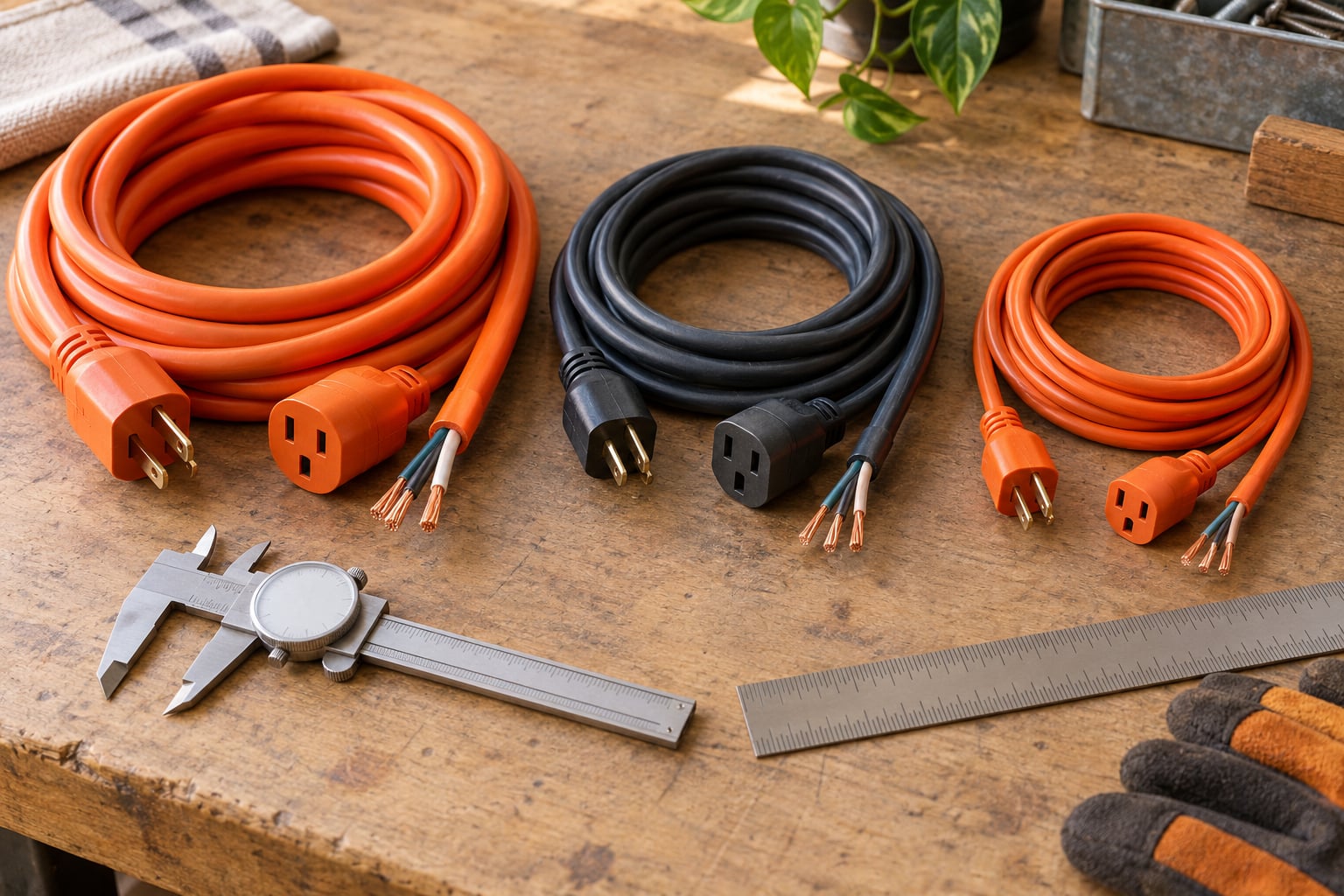
An extension cord gauge rating is the string of letters and numbers printed along the cord’s outer jacket, usually something like SJTW 12/3 125V 15A. That one line tells you the wire size, how many conductors run through the cord, the voltage, the maximum amperage, and what the jacket can handle in weather, oil or flame. Learning to read it takes about a minute and it is the difference between a cord that powers your equipment safely and one that overheats it.
The awkward part of the system is that American Wire Gauge counts backwards. A lower AWG number means thicker wire, and thicker wire carries more current with less heat. People see “12” and assume it beats “16” every time, which is backwards for safety. Once you internalise that one inversion, the rest of the marking is straightforward.
This is general education for homeowners and DIYers, not a substitute for a licensed electrician. Any permanent wiring, circuit work or unexplained heat in a wall outlet is a call for a pro.
Table of Contents
- What Does an Extension Cord Gauge Rating Mean?
- How to Read an Extension Cord Gauge Rating
- What Do 16 AWG, 14 AWG, and 12 AWG Cords Mean?
- How Much Current Can Each Gauge Carry?
- How Do You Match the Cord to Your Equipment?
- Why Do Extension Cords Get Warm, Hot, or Damaged?
- What Safety and Certification Labels Mean
- How to Read an Extension Cord Gauge Rating: Quick Checklist
- Frequently Asked Questions
- Conclusion
What Does an Extension Cord Gauge Rating Mean?
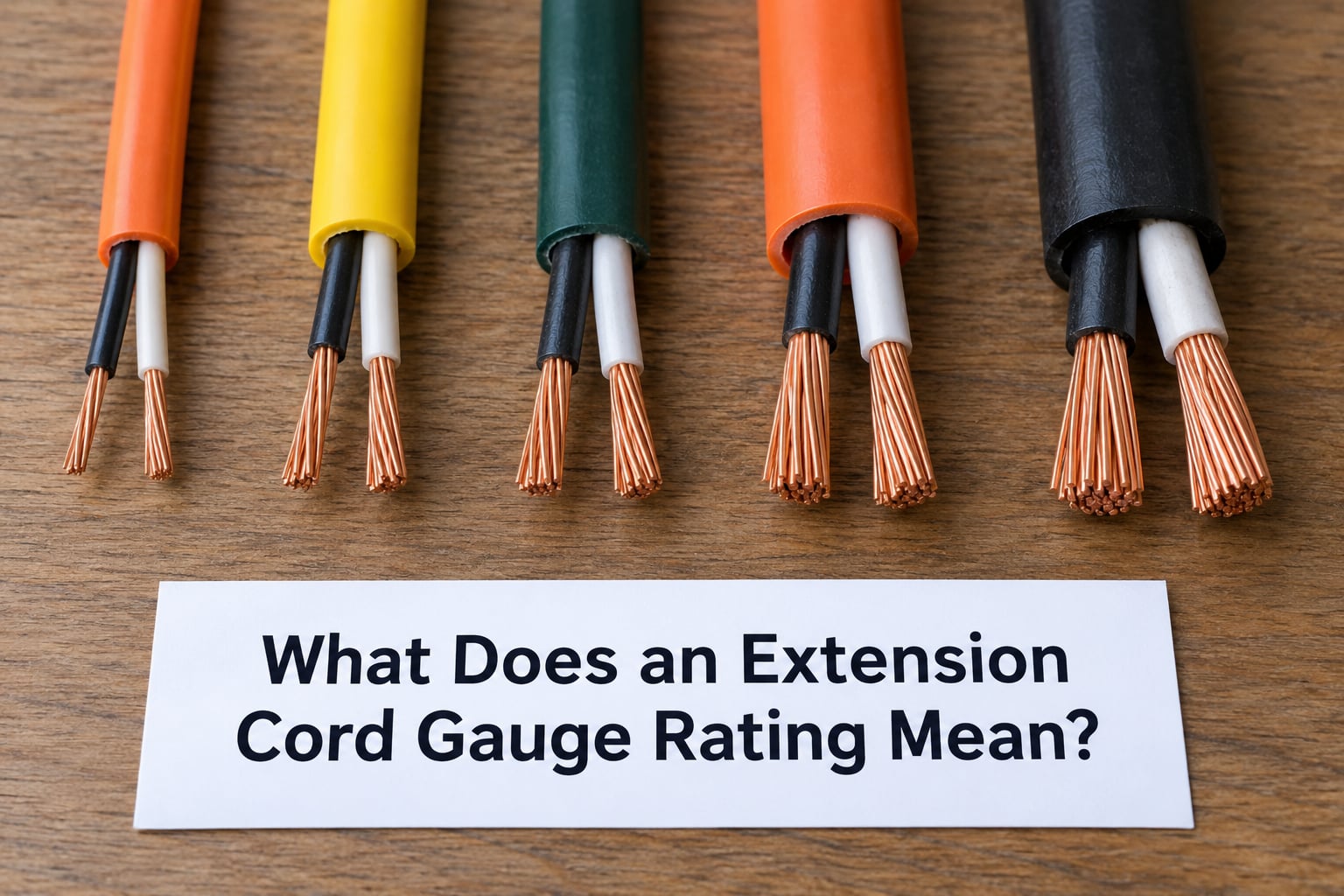
The gauge rating is the whole printed string, and each part answers a different question. The letters describe how the jacket is built. The number before the slash is the wire size. The number after the slash is the count of insulated conductors inside. The voltage and amp numbers tell you what the manufacturer tested the assembly to handle.
Wire size is measured in American Wire Gauge, a standard where diameter and current capacity move in opposite directions. 16 AWG is thin, 14 AWG is thicker, 12 AWG thicker still, 10 AWG heavier than all of them. Every step down roughly doubles the copper cross-section.
Why does thickness matter? Current moving through copper meets resistance, and resistance turns into heat. Thicker wire has less resistance, so it generates less heat at the same current and can carry more of it before the insulation rating is stressed. Heat that has nowhere to go is what melts a plug or starts a fire.
Length works the same way, only worse. The longer the cord, the more resistance in series, the more voltage lost along the run and the more heat generated at the same current. A 50 ft run and a 100 ft run of identical wire are not equivalent, which is why gauge and length always have to be considered together.
How to Read an Extension Cord Gauge Rating
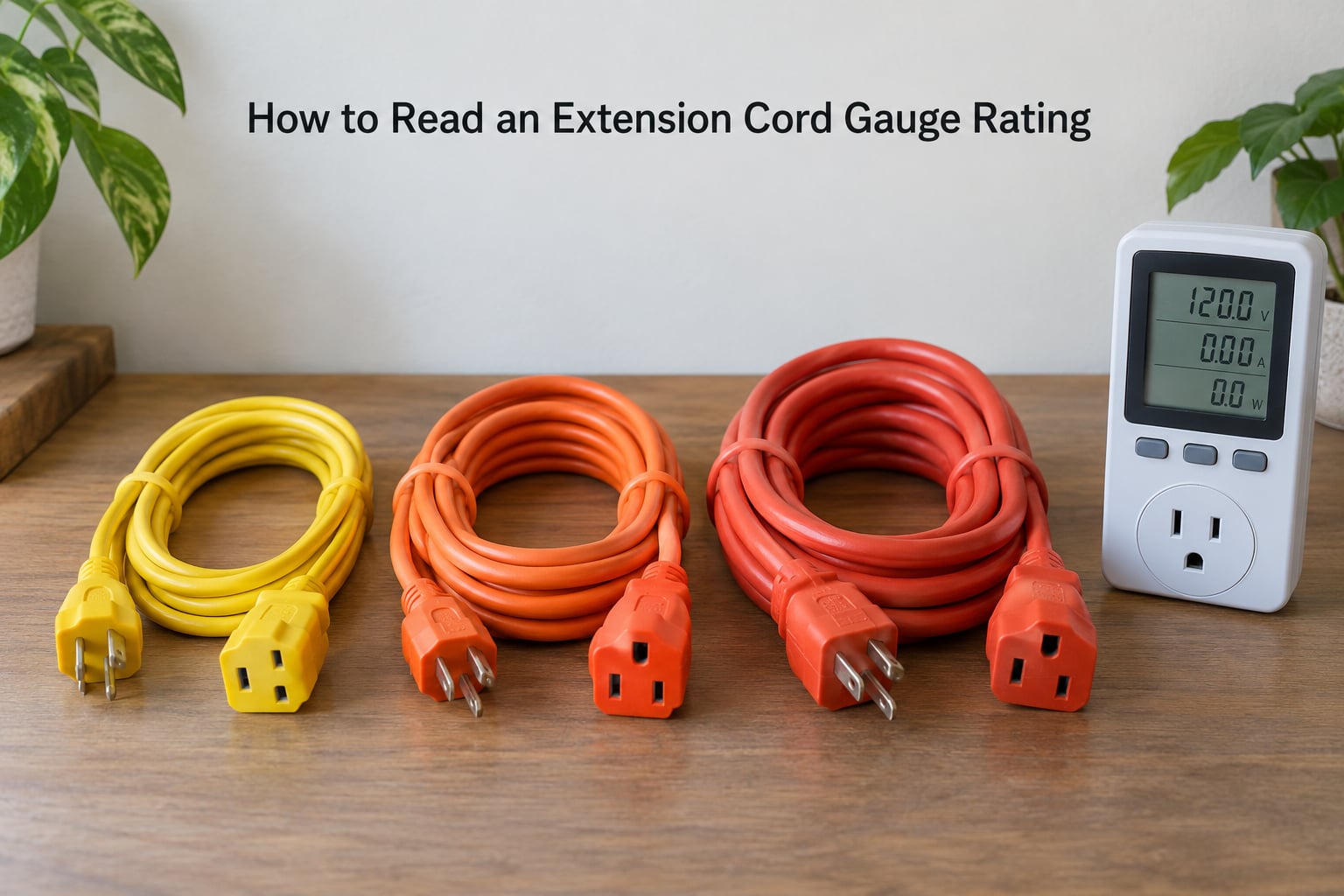
Here is the physical walkthrough. Lay the cord on a table, find the printing, and read it left to right. Four steps cover it.
- Find the jacket printing. Run your thumb along the outside of the cord. Most cords have text repeated every few inches, often on the side rather than the top.
- Read the AWG number before the slash. In 12/3, the 12 is 12 AWG. Lower number, thicker wire, more current.
- Read the number after the slash. The 3 means three insulated conductors: hot, neutral and ground. A /2 cord has only hot and neutral, which is why it has two prongs.
- Read the volts, amps and letters. 125V 15A is the rated ceiling. SJTW tells you the insulation and jacket type and whether the cord may be used outdoors.
Take SJTW 12/3 125V 15A as a worked example, since it is the most common marking on a residential heavy-duty cord.
- S — service grade, the most common rating for cords built to 600 volts.
- J — junior service grade, a thicker jacket rated to 300 volts.
- T — thermoplastic insulation, the standard household compound.
- W — weather resistant, so the cord is permitted outdoors in wet conditions.
- 12/3 — 12 AWG wire, three conductors.
- 125V — the circuit voltage it is rated for.
- 15A — the maximum amperage. Not the amperage you should run continuously.
Where Is the Gauge Marking on an Extension Cord?
On the outer jacket first, printed in raised or inked letters and repeated along the length so at least one repeat survives a scuff. Many manufacturers also mould the rating into the plug or receptacle body, where you can find it by looking at the flat face of the plug. Some cords ship with a paper tag or a sticker on the reel, and retail packaging or the listing you bought from will have the full spec if the cord itself is worn.
Not every cord states it clearly. Older cords, cords that have been coiled in a garage for a decade, and no-name cords from a drawer can have printing rubbed away to nothing. If that happens you are guessing, and the safe move is to replace the cord rather than measure your way into a false sense of confidence.
How to Read the Letter Codes When There Is No Amp Number
Some jackets carry the construction code but omit the amperage. In that case the amp ceiling comes from the wire size and the weakest physical component on the cord. Plug bodies and receptacles are usually rated 15 amps or 10 amps on residential cords, so a heavy wire attached to a cheap plug still cannot exceed the plug’s rating. Electricians point out this rule constantly: the cord, the plug and the receptacle each set a ceiling, and the lowest one wins.
One example that circulates on home improvement forums is a thick 10 AWG cord that is rated only 15 amps, not because the wire is light but because of the plug moulded onto the end. Homeowners buy it, see the wire gauge, and assume 30 amps. It is 15.
What Do 16 AWG, 14 AWG, and 12 AWG Cords Mean?
These three cover most residential extension cords. Here is how they compare, using the National Electrical Code ampacity table as the reference point rather than marketing language.
| AWG | Wire diameter | Code ampacity (60°C column) | Typical cord marking | Normal use |
|---|---|---|---|---|
| 16 AWG | 0.051 in (1.29 mm) | 10 amps | 16/3 125V 10A | Light duty: lamps, fans, holiday lighting, small hand tools |
| 14 AWG | 0.064 in (1.63 mm) | 15 amps | 14/3 125V 15A | Most power tools, TVs, small appliances, workshop use under 50 ft |
| 12 AWG | 0.081 in (2.05 mm) | 20 amps | 12/3 125V 15A | Heavy tools, portable air conditioners, refrigerators, welders |
| 10 AWG | 0.102 in (2.59 mm) | 30 amps | 10/3 125V 15A or 30A | Long runs and high-draw loads where light wire would overheat |
Two things trip people up here. First, most 12 AWG cords are printed 15A rather than 20A, because the plug on the end is a standard 15 amp three-prong plug. The wire can do more than the assembly is permitted to do.
Second, ampacity and continuous load are not the same number. A load running three hours or more is treated as continuous, and the sizing convention is to pick a conductor that can handle 125% of that load. In practice that means if your appliance draws 12 amps steadily, use a cord rated for 15 amps or more, and stay at or below 80% of the printed rating for long runs.
How Much Current Can Each Gauge Carry?
The code figures above assume house wiring conditions: a cord in open air, not wrapped in a rug, not coiled around itself, not buried in insulation, at ordinary ambient temperature. Extension cords lose some margin because heat has a harder time escaping. Treat the table as a starting point, then step down when conditions get worse.
Length is the other half. A rough calculation using copper resistance shows the effect at 10 amps:
- 14 AWG over 100 ft: about 5 volts lost, roughly 4% of a 120V circuit.
- 12 AWG over 100 ft: about 3.9 volts lost, roughly 3%.
- 10 AWG over 100 ft: about 2.4 volts lost, under 2%.
Guidance in the code aims to hold voltage drop under 3% for branch circuits and under 5% end to end. Exceed that and you get dim lamps, a compressor that never quite gets up to speed, and a motor drawing more current trying to compensate, which is exactly the condition that heats a cord.
Electricians answering questions about tool gauges usually publish a matrix like this one. Pick the row that matches your load, then the column for your run length.
| Load draw | 25 ft | 50 ft | 100 ft |
|---|---|---|---|
| 0–6 amps | 16 AWG | 16 AWG | 14 AWG |
| 6–10 amps | 16 AWG | 14 AWG | 12 AWG |
| 10–13 amps | 14 AWG | 12 AWG | 10 AWG |
| 13–15 amps | 14 AWG | 12 AWG | 10 AWG |
One question that comes up constantly in DIY forums is whether the matrix is mandatory or a floor. It is a floor. Thicker wire than the chart recommends is fine and sometimes sensible for a shared cord. Thinner is not a small compromise, it is a different operating temperature.
How Do You Match the Cord to Your Equipment?
Start at the equipment, not the cord. Find the nameplate on the back, bottom or underside of the tool or appliance and look for the current in amps, or the watts and voltage. If it lists watts, divide by volts to get amps: 1200 watts at 120 volts is 10 amps.
Next check for startup demand. Motors, compressors, welders and pumps draw a large inrush current for the first second or two. If the nameplate shows a locked-rotor amps figure or an horsepower rating, treat the running figure as too low by a wide margin. A refrigerator compressor, for example, can pull three to five times its running amps briefly at startup.
Then apply the continuous-load habit of thumb. Anything that runs for hours at a steady draw deserves a cord rated above the running current, not equal to it.
Finally pick the shortest cord that does the job. Every extra foot adds resistance, and running a 25 ft cord to reach 10 ft away is a small inefficiency you pay for twice.
Why Do Extension Cords Get Warm, Hot, or Damaged?
A cord that feels warm to the touch while carrying load is telling you something. In a correctly sized cord, only a few degrees of rise is normal. More than that means heat is being produced faster than the jacket can carry it away.
- Overloading. Plugging a 13 amp load into a cord marked 10A. The wire heats, and the insulation is not designed for sustained elevated temperature.
- Undersized wire for a long run. The 100 ft cases in the table above, where resistance in the run pushes everything up a notch.
- Poor connections. A loose or corroded plug, or a receptacle whose contacts have gone wide, concentrates resistance at one point instead of along the wire.
- Daisy-chaining. Plugging one cord into the end of another. Every joint adds resistance, and it is the most common habit electricians warn against.
- Heat trapped by storage. A cord coiled tightly or run under a rug or inside a wall loses its cooling margin. Uncoil it fully under load.
- Damaged insulation. Cracks, flat spots from furniture, staple punctures and chewed jackets change the resistance in ways nobody can predict.
- Using a cord as permanent wiring. Extension cords are not a substitute for a run of Romex or NM-B through a wall.
Warning signs worth stopping for: a hot or discoloured plug face, a sharp plastic smell, a cord that stays warm after the load is unplugged, flickering lights, a breaker that trips repeatedly, or a receptacle cover plate that feels hot to the touch. Unplug it, let it cool, and stop using it.
What Safety and Certification Labels Mean
A mark such as UL Listed, ETL Listed or CSA means an independent laboratory tested a sample of the product against a safety standard. Look for the mark on the cord itself, not just on the box. It tells you the cord was built and tested to a recognised standard; it does not tell you the cord is appropriate for your load, your length or your environment.
Two prongs versus three prongs tells you about the construction. A two-prong cord is /2, meaning no ground conductor. It is light-duty by definition and should stay on low-draw electronics. A three-prong cord is /3 and carries a ground, which is what makes it usable on workshop tools and appliances with metal housings. A missing or bent ground pin on a three-prong cord means the cord is out of service, full stop.
The letter codes handle environment. W means weather resistant and permitted outdoors in damp conditions. O or OO adds oil resistance, which matters around a lawn mower or in a garage. Look for outdoor-rated jackets for anything in the rain, and never run a cord through a doorway or under a rug where a foot can catch or pinch it.
One point worth stating plainly, because it comes up on every electrician forum: certification is not a permission slip for any load. A properly listed 16 AWG cord is still a 10 amp cord.
How to Read an Extension Cord Gauge Rating: Quick Checklist
Before you buy a cord or plug something into one, run these six checks. They take about a minute.
- Find the marking. Check the jacket first, then the moulded plug body, then any tag or packaging you still have.
- Read the AWG. The number before the slash. Lower number, thicker wire.
- Check the printed amperage against your load. Compare it to the nameplate on the equipment, with headroom for motors and for three-hour-plus runs.
- Match the length. Use the matrix, and choose the shortest run that reaches.
- Confirm the environment rating. W or OO for outdoors or damp conditions, O for oil and grease.
- Inspect the cord. No cracks, no flattened sections, no exposed copper, an intact ground pin, and it does not feel warm while in use.
On shopping: a listing that says heavy duty but shows no AWG number is telling you nothing. Look for the gauge, the conductor count and the amperage in the specifications, and if those are missing, buy from a seller who publishes them.
Frequently Asked Questions
Is there a way to tell what gauge an extension cord is?
Sometimes. If the jacket printing has worn away, you can cut off a short section of cord, strip it and measure the bare copper conductor with dial calipers, then compare against an AWG diameter table. Realistically though, measurement is unreliable on stranded wire and hard to do without cutting the cord, so replacing an unlabelled cord is the safer answer, especially for anything drawing more than a few amps.
Is 12 AWG the same as 12 gauge?
Yes, identical. AWG stands for American Wire Gauge, so 12 AWG, 12 gauge and 12-gauge wire all name the same thickness, about 0.081 inches or 2.05 mm in diameter. The only thing that trips people up is the scale runs backwards: 12 gauge wire is thicker than 16 gauge wire, and the lower number is always the heavier conductor.
What does SJTW mean on my extension cord?
S means service grade, the standard rating for cords built to 600 volts. J means junior service grade, a thicker jacket rated to 300 volts. T means thermoplastic insulation, the usual household compound. W means weather resistant, so the cord is permitted for outdoor use in wet conditions. Put together, SJTW describes the insulation and jacket, not the wire size.
What is the main difference between SJT and SJTW cords?
The single letter. SJTW carries a W, which means the jacket is weather resistant and the cord is approved for outdoor and damp use. SJT without the W is an indoor-only cord even though the two otherwise describe the same construction. If you plan to run a cord outside, through a garage or near a wet work area, the W is the letter that matters.
How many amps can a 12 gauge 100 ft extension cord handle?
The wire itself is rated for 20 amps in the code table, and most residential 12/3 cords are printed 15A because of the plug. Over 100 feet, voltage drop becomes the limiting factor: running 10 amps through 100 ft of 12 AWG loses about 3.9 volts, roughly 3% of a 120V circuit. For high-draw loads on a 100 ft run, step up to 10 AWG.
Can I run a refrigerator on a 14 gauge extension cord?
For a short run, generally yes. Most refrigerators draw between 3 and 7 amps running, and 14 AWG handles 15 amps, so 25 to 50 feet leaves plenty of margin. The complications are the startup surge, where the compressor can pull several times its running current, and voltage drop on a long run. For anything past about 50 feet, use 12 AWG, and give the compressor its own circuit if you can.
Conclusion
Start with the equipment nameplate, find the amps, then read the cord jacket and check the AWG against it. Choose the shortest cord that clears both the load and the length requirement, confirm the environment rating matches where you are running it, and inspect the cord before every use.
One rule covers the rest. If a cord is warm under load, it is wrong for that job. Unplug it and re-size the gauge.