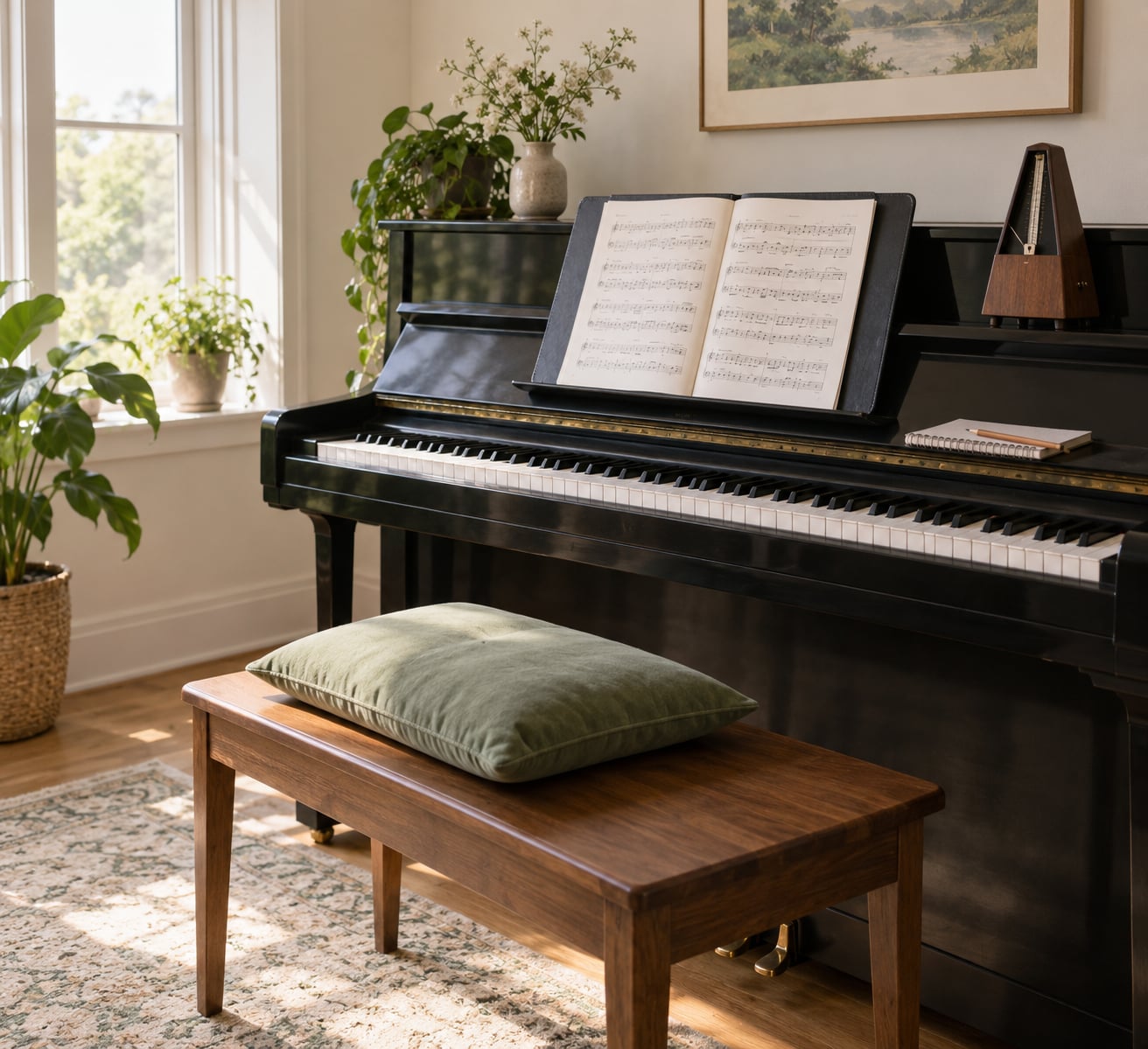
To practice piano effectively as an adult, work in short, focused sessions with a fixed order: warm up, run a technical block, fix the hardest passage of your piece one hand at a time at a slow metronome tempo, then play something you enjoy. Twenty focused minutes five days a week beats two long hours on a Sunday.
That is the whole difference, really. Adults rarely fail at piano because they lack talent or time. They fail because they sit down without deciding what to fix, play the whole piece over and over at speed, and call the twenty minutes wasted because nothing sounded finished.
The rest of this guide is the system I use and the one experienced adult players describe in online piano forums: a defined session order, a small number of measurable goals, and a way to close each session that makes the next one easier to start.
Table of Contents
What You Need
You do not need much. You need somewhere to sit, a book or folder open to the right page, a way to keep time, and a realistic number of minutes per week you can protect. Everything else is optional.
Start with the instrument. If you have an acoustic piano, use it. If not, a digital piano with 88 weighted keys behaves much closer to a real instrument than a flat unweighted keyboard, because the keys resist your finger and let you control volume. A small apartment keyboard is fine for reading music and learning theory, but finger strength and dynamics develop badly on one.
Your bench height matters more than most people expect. Sit forward on the bench with your forearms roughly level with the keyboard and your elbows just below the key surface. Too low and you hunch; too high and your shoulders lift, which is where the tension that wrecks an adult’s hands usually starts.
Hand position basics before you play a note: rounded fingers as if holding a small orange, knuckles level with the keys, thumb relaxed and slightly under, wrists soft and not dipped toward the floor. Sit about a forearm’s length from the keyboard.
A music stand matters more than the price. A laptop screen forces your neck down between the keys and the page, and you lose the reference position that tells your hand where it is. A basic stand with a shelf is enough. Beyond that you need a metronome (a free app works fine), a pencil for marking scores, and either a notebook or a voice recorder app for catching what to fix next time.
Then decide your dose. Adults on the r/piano forums commonly report around 30 minutes a day as a baseline, with busy parents landing on two to three hours a week spread across three or four sessions. Pick the version you can actually keep on a bad week, not the version you can manage on a good one.
One caution on the physical side: if practice causes pain, tingling or numbness in your wrists or fingers, stop. That is a signal, not something to push through, and adults who ignore it often lose months to problems that a week of rest would have avoided. If symptoms persist, see a qualified healthcare professional.
Step-by-Step: How to Practice Piano Effectively as an Adult
Consistency beats session length for adults, because spaced repetition is what turns effort into skill. The order of blocks matters as much as the total time, and it stays the same every session so you never waste the first five minutes deciding what to do.
Use one of these templates. Adjust the blocks, keep the order.
| Session length | Warm-up | Technique | Hard passage | Run-through | Fun music |
|---|---|---|---|---|---|
| 20 minutes | 3 min | 4 min | 7 min | 4 min | 2 min |
| 30 minutes | 4 min | 6 min | 10 min | 6 min | 4 min |
| 45 minutes | 5 min | 8 min | 15 min | 10 min | 7 min |
| 60 minutes | 5 min | 10 min | 20 min | 15 min | 10 min |
On a five-minute day, skip everything except the last two columns. Playing your piece without stopping is still practice, and it keeps the habit alive on the weeks when work eats the session.
1. Set a Specific Practice Goal
Before you sit down, write one sentence about what will be better when you stop. Not “practice piano” but “play bars 9 to 12 at 60 beats per minute without a mistake” or “read a new piece in the key of F major without stopping to check finger numbers”.
One goal per session is plenty. A second one is fine on a long day, and a third means you have planned a bad session. Stating the goal out loud takes five seconds and it is the difference between practice that goes somewhere and practice that just fills time.
You can tell it is working if you can name the thing you could not do last week and can do now.
2. Prepare the Piano and Your Materials
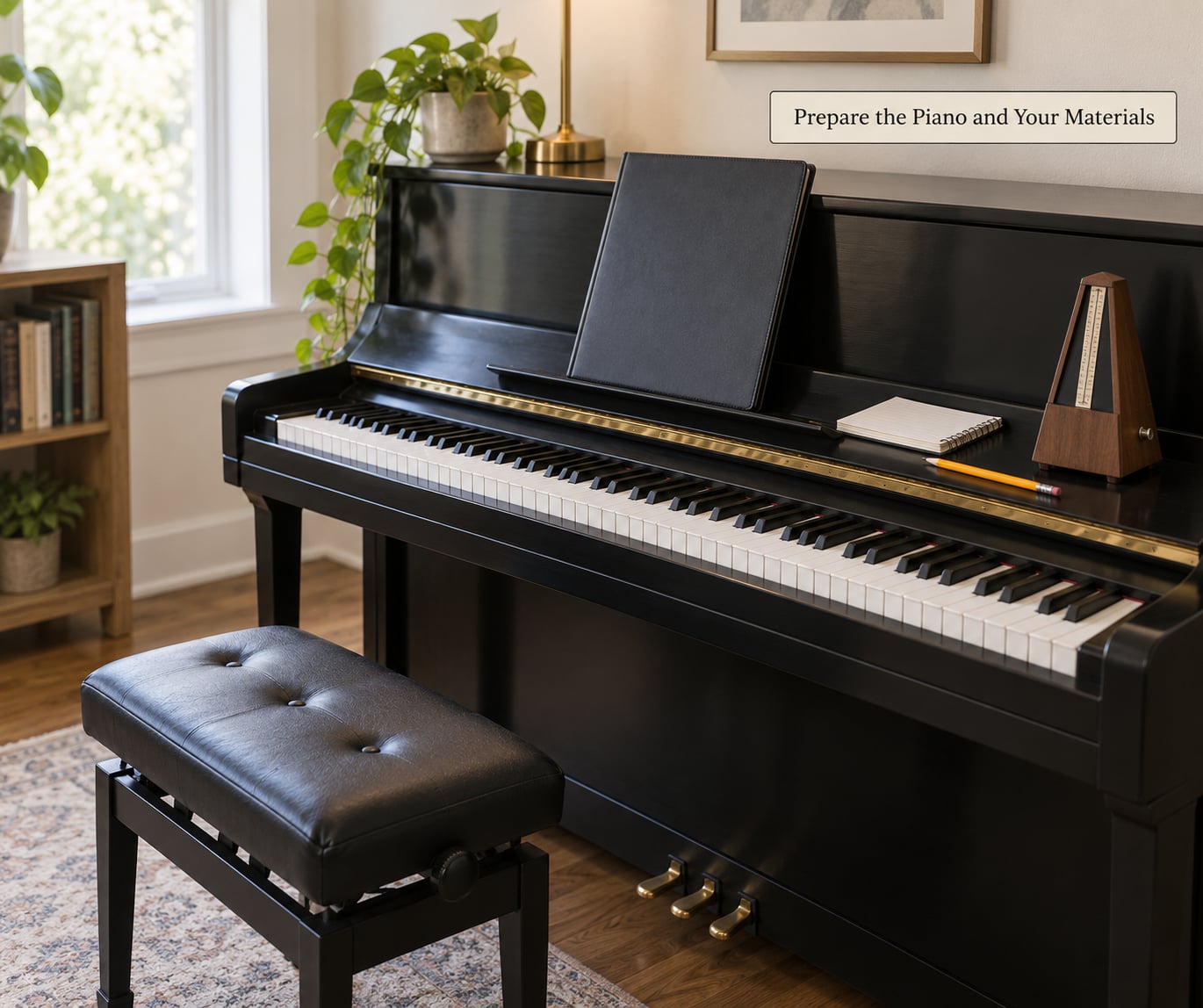
Open the lid or cover, leave the bench where it is, put the music on the stand before you sit, and start the timer on your phone while it is still in your hand. Fill the water glass now. Silence notifications rather than relying on willpower later.
This is the unglamorous part that most people skip, and it is called task resistance: the pull of a small unpleasant task when something easier is available. Every object you have to hunt for is a chance to not begin.
A pre-flight checklist worth keeping: bench at height, music open to the right page, pencil on the stand, metronome app or click track loaded, water nearby, phone out of reach or in another room.
You should be playing within thirty seconds of sitting down. If it routinely takes longer, the setup is the problem, not your motivation.
3. Warm Up With Easy, Connected Playing
Start with something you can play well. Five-finger patterns in one key, then another, then scales or arpeggios in two or three keys. A typical five-minute warm-up is two minutes of five-finger patterns, two minutes of scales in a comfortable key, and one minute of arpeggios.
The purpose is coordination, not difficulty. Shoulders down, fingers supported rather than pressing, notes even in volume so the quiet ones are still audible. That last point is how you catch tension early, since a finger pressing hard usually means tension somewhere else in the arm.
Increase speed in small steps. If you can play a pattern cleanly and evenly, raise the metronome by four or five beats per minute, and if you cannot, drop back. Warm up at the tempo of the hard passage in your piece, not a tempo that feels impressive.
4. Practice One Difficult Skill in Small Sections
Isolate the exact trouble spot, usually four to eight bars, and mark it in the score. Play it alone with no metronome until you know what the notes are without guessing. Then pick a tempo where you can play it three times in a row cleanly, put the metronome on that number, and play it several more times.
Then do the thing most people skip. Play each hand on its own at that same slow tempo, several repetitions, before you attempt it together. This hands-separately method, followed by a slow hands-together pass under the metronome, is the core routine that adult players on piano forums keep recommending to each other for a reason.
Only raise the tempo when three consecutive attempts come out clean. Ten clean repetitions at 60 beats per minute beat fifty messy ones at 90, because muscle memory is built from accuracy, and inaccurate repetition just rehearses mistakes.
When the passage is solid, play it in context, from a few bars before to a few bars after. Most stalling happens at the joins, not inside the hard bit.
Slow practice is not a warm-up for faster practice. It is the practice. If you only ever play fast, you are practicing your errors.
5. Work on Your Repertoire Musically
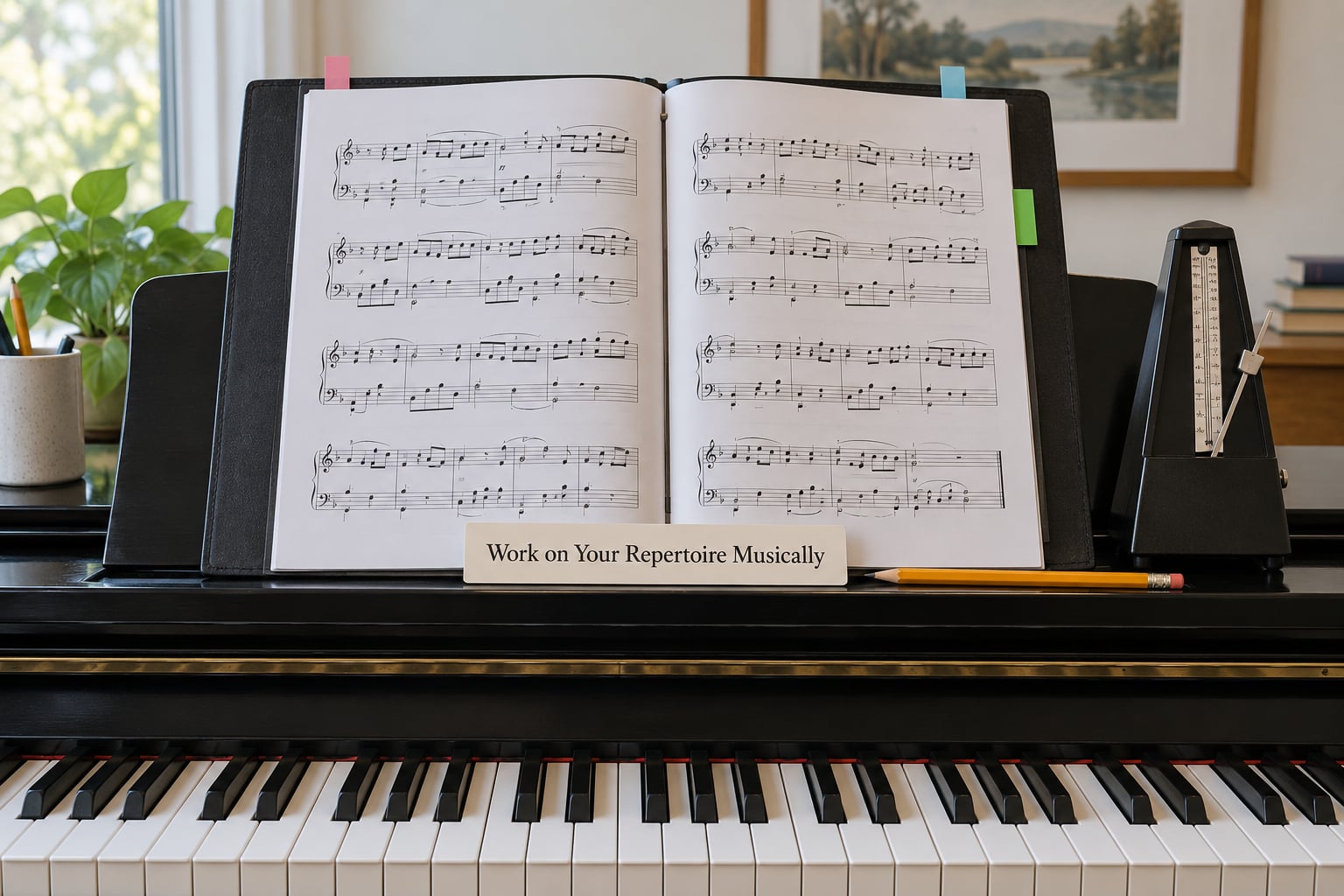
Once the notes are reliable, move up a level. Learn a piece in sections, and use landmarks in the score, a repeat sign, a change of key, a phrase break, to remember the shape rather than memorizing every note in order. If you know where you are, you can recover from a mistake instead of falling off a cliff.
Work on how it sounds: where the phrase lifts, which note is the arrival, where the melody sits above the accompaniment, where the pedal changes. Dynamics like piano and forte come from how much weight your arm carries, not from how hard each finger pushes.
Pick repertoire at your level. Adults routinely stall because they choose a piece graded years above them, and a teacher writing about adult beginners notes that even a famous little piece like Für Elise sits around an AMEB Grade 5. Choosing something easy that sounds finished is more motivating and more educational than grinding an impossible one.
Keep at least one piece you love in the rotation, even on busy weeks. It is the reason you started, and it is what carries you through the technical blocks.
6. Finish With a Short Review
Spend the last three minutes going back to the goal you wrote at the start. Play it once more and notice the difference. Record one attempt on your phone if it is a piece you want to improve, or if you have never heard yourself play and the difference between what you imagine and what you hear turns out to be revealing.
Then write the next specific action. Not “scales”, but “C major two octaves, hands together, metronome 72”. That note is what makes the next session start from where this one stopped instead of from scratch.
Open questions from Reddit and Quora keep circling the same problem: what do I work on between lessons when no one tells me. This closing note is the answer. It takes fifteen seconds and it is the habit that turns scattered practice into progress.
Common Mistakes
Playing too fast. If you stumble every time, you are rehearsing the stumble. Drop the metronome until it is boringly easy, then climb back five beats at a time.
Repeating without diagnosing. Ten blind repetitions of a hard bar usually produce ten slightly different mistakes. Play it once, listen or watch your hands, name the problem, then fix that one thing.
Using force instead of weight. Tired, aching hands after twenty minutes usually mean pressing, not fatigue. Let the arm carry the weight, keep the fingers rounded, and stop for a minute whenever you notice tension in your forearm or neck.
Skipping the warm-up. Jumping straight into the hard passage is how fingers develop habits, not strength. Three minutes of easy playing sets the hand shape you want to keep.
Practicing without a goal. An unstructured session drifts toward whatever is easiest to play, which is almost never what needs work. Write the goal first; it takes a minute and it is the single biggest upgrade to a practice session.
Treating practice as a performance test. Playing a piece start to finish every session to prove you can do it trains accuracy and nothing else. Perform it at the end of the week, not the end of every block.
For motivation, keep a visible log. Tick off the days you practiced, not the hours, and record one short clip a month. Adults who track progress report plateaus as normal, which is exactly what they are.
Frequently Asked Questions
How often should an adult practice piano?
Five short sessions a week is the most common answer among adult players, and it works better than fewer, longer ones. Around 30 minutes a day is a solid baseline; busy parents often report two to three hours a week split across three or four sessions and still see steady progress. The frequency matters more than the length because skill consolidates between sessions. Pick a schedule you can keep on your worst week, not your best one.
How long should a piano practice session be for an adult?
Twenty to forty-five minutes of focused work is the useful range for most adults. Under twenty minutes, skip the warm-up and just play your piece and one small fix. Beyond an hour without a break, accuracy usually drops and tension builds in the wrists and neck. If you have three hours one day, break them into two or three blocks rather than one long sitting. The best session is the one you repeat.
Is it too late for an adult to learn piano?
No. Adults often learn reading, rhythm and phrasing faster than children because they already understand how practice works and can diagnose their own mistakes. What takes longer is hand strength and independence, which build with regular use rather than with age. Beginners on piano forums commonly expect six weeks per comfortable piece in the first year, and that is normal. Choose easy repertoire early and your hands catch up.
Should I use a metronome when practicing piano?
Yes, mostly for the passage that is not working. Pick a tempo you can play three times cleanly, then add four or five beats per minute only after three more clean attempts. A metronome exposes uneven rhythm that your ears accept while you play. Leave it off for the run-through and the music you enjoy, where the point is expression and flow rather than timing.
What should I do when restarting piano after a long break?
Go back to the basics for two weeks. Scales and five-finger patterns in two or three keys, one easy piece you used to know well, and short sessions of fifteen to twenty minutes. Your reading and ear come back within days; your hands take longer, so expect soreness and cut the difficulty back. Do not try to recover lost ground, and do not quit during the sore stage, which usually passes.
When should an adult practice with a piano teacher?
Start with lessons if you can afford it, mainly because a teacher corrects tension and hand shape in seconds that self-teaching takes months to notice. Between lessons, the written next-action note from each session is what you should practice, and that is what to raise at the next one. Keep taking lessons if you are stuck on technique, plateauing for weeks, or preparing something specific, and stop when you have a routine you can run alone.
Conclusion
To practice piano effectively as an adult, keep the order fixed, keep the sessions short, and keep one measurable goal in front of you. Warm up, drill technique, repair the hardest passage one hand at a time at a slow metronome tempo, play a piece musically, then write down what comes next.
Start with this week: pick one song or one skill, book four or five 30-minute slots, and write a single sentence about what should be better by the end of each one. If your hands hurt, stop and get advice rather than pushing through. Everything else is repetition.