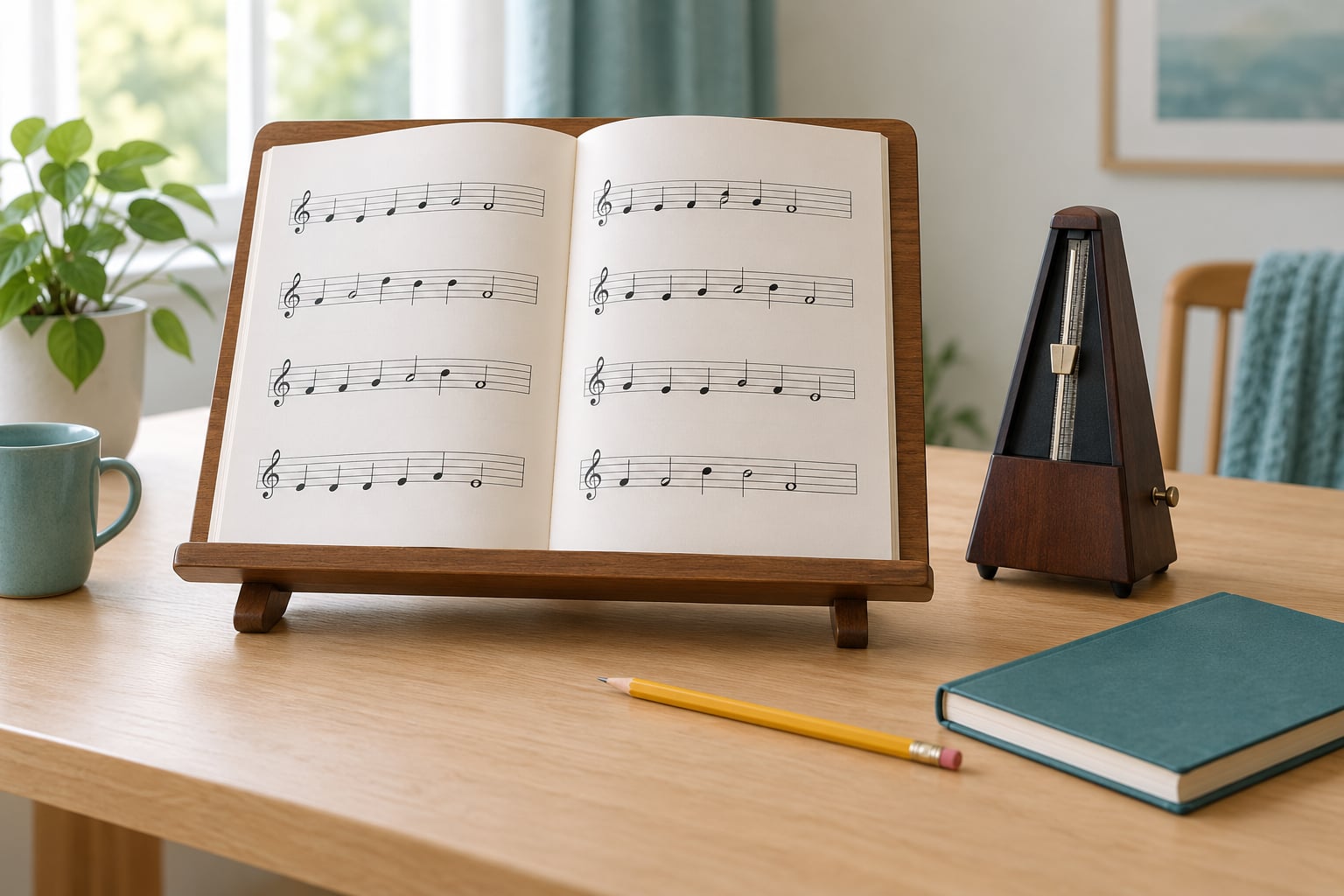
Sheet music is a written language that tells you which pitch to play, how long to hold it, and roughly how fast to play it. Notes work like letters, measures work like words, and a phrase works like a sentence. Learning how to read sheet music for beginners takes about three to six months before you can play a new piece straight through without stopping, and almost nobody gets there in a weekend.
The reason beginners stall is that they try to decode everything at once: five lines, two clefs, accidentals, note values and a time signature all landing in the same minute. Work through the symbols in a fixed order instead, one layer at a time, and the page stops looking like a code.
Table of Contents
- What You Need
- Step-by-Step: How to Read Sheet Music for Beginners
- How to Read Sheet Music for Beginners: Learn the Staff and Clef
- How to Read Sheet Music for Beginners: Identify Notes and Octaves
- How to Read Sheet Music for Beginners: Read Rhythm and Meter
- How to Read Sheet Music for Beginners: Recognize Accidentals and Key Signatures
- How to Read Sheet Music for Beginners: Follow Dynamics, Articulation, and Expression
- Common Mistakes
- Frequently Asked Questions
What You Need
You need very little to start. A single piece of printed music or a digital score you trust, a pencil for marking counts, and your instrument are enough for the first month.
Beyond that, a music stand keeps your head from dropping every few seconds, which matters more than beginners expect. A metronome or a metronome app handles the beat while you are still learning to count. A small notebook is where your practice plan and your mistakes live.
One warning about scores: a lot of free “beginner” sheet music online is actually arranged for advanced players and is genuinely unreadable at the start. Buy a level-one method book from a music shop, or use a beginner pack that a publisher has explicitly labelled, rather than grabbing whatever piano sheet music turns up.
If you have been searching how to read sheet music for beginners online, you will have seen free note-name charts and chord diagrams being pushed at you. Print one and tape it above your music stand. It is a quick reference for the first fortnight, and then you will stop needing it.
Step-by-Step: How to Read Sheet Music for Beginners
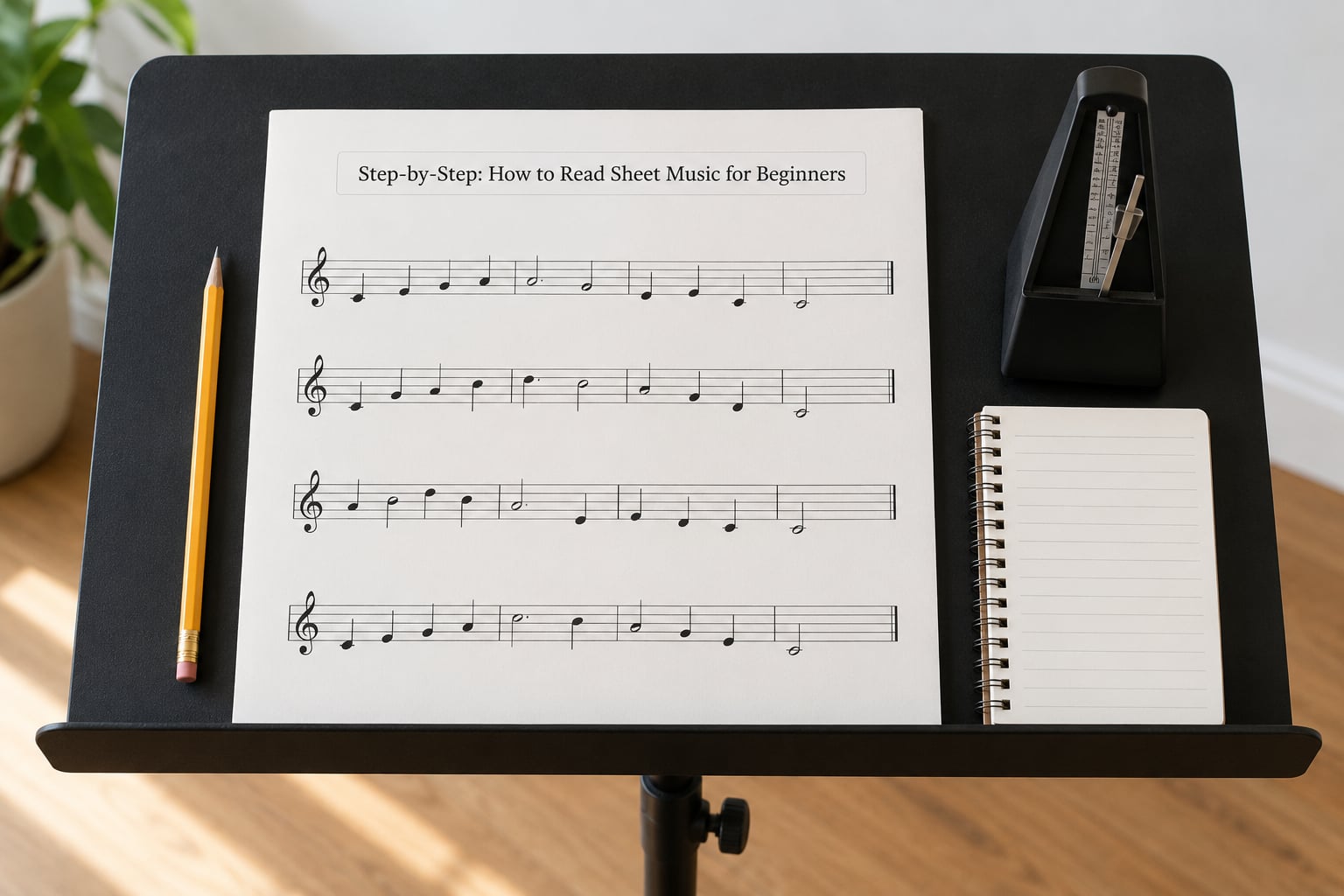
The learning order matters more than the speed. Rhythm first, then pitches, then the marks that tell you how to phrase. Here is the sequence that works.
How to Read Sheet Music for Beginners: Learn the Staff and Clef
The staff is five horizontal lines with four spaces between them, and it is the map of every pitch in the piece. The clef is what turns that map into letter names. A treble clef, also called a G clef, wraps around the second line from the bottom to tell you that line is G. A bass clef, or F clef, marks the fourth line as F.
Those lines are worth memorising early, because naming notes one at a time is slow. The treble clef lines from bottom to top are E G B D F, which players often chant as Every Good Boy Does Fine. The treble clef spaces from bottom to top are F A C E. The bass clef lines are G B D F A, and the spaces are A C E G.
You will also meet two clefs joined by a brace at the left of the page. That is the grand staff, and it is what piano, organ, harp and accordion music uses. The upper staff carries the right hand, the lower staff carries the left, and the two hands are meant to be read as one part.
How to Read Sheet Music for Beginners: Identify Notes and Octaves
A note head placed on a line or a space gives you pitch, and moving to the next line or space always moves by one step in the alphabet. That is the whole system. Once you know the clef, you can read any note in any piece.
When notes climb past the top line or drop below the bottom line, the score adds short extra lines called ledger lines. Middle C sits on a ledger line below the treble staff and on a ledger line above the bass staff, which is a good checkpoint to memorise. Notes with the same letter name but different positions are octaves apart, and small numbers above a note name often tell you which octave to play.
Here is the shortcut that speeds up everything: instead of naming every note, look at the distance between it and the note before it. Step up, step down, or skip, and the shape of the tune appears. Beginners who work by intervals find melodies far quicker than those who spell out letters one by one.
How to Read Sheet Music for Beginners: Read Rhythm and Meter
Rhythm is written duration, and it is the layer most beginners skip, which is why they get lost halfway down the page. A filled note head is a quarter note and lasts one beat. An open note head with a stem is a half note and lasts two beats. An open head with no stem is a whole note and lasts four beats. A stem with one flag is an eighth note at half a beat, and beamed eighth notes group into fours.
| Note | Head | Beats in 4/4 | How to count it |
|---|---|---|---|
| Whole note | Open, no stem | 4 | 1, 2, 3, 4 |
| Half note | Open, with stem | 2 | 1, 2 (hold) |
| Quarter note | Filled, with stem | 1 | 1, 2, 3, 4 |
| Eighth note | Filled, stem and flag | 0.5 | 1 and 2 and |
| Dotted half note | Open, stem, dot | 3 | 1, 2, 3 (hold) |
A dot after a note adds half of its value, so a dotted half note is three beats and a dotted quarter note is one and a half. Rests are the same idea in reverse: they are written symbols for silence. A whole rest hangs from a line, a half rest sits on top of one, and quarter and eighth rests are the squiggles in between.
Two more symbols trip people up. A tie joins two notes of the same pitch into one long sound, while a slur spans different pitches and means play them legato. Both are curves over the notes, so check the pitches before you assume a tie.
Meter is what groups those durations. The time signature has two numbers: the top number is how many beats fit in one measure, and the bottom number tells you which note value gets one beat. A bottom number of 4 means the quarter note is the beat. Barlines are the vertical lines that close each measure.
| Signature | Beats per measure | What it feels like |
|---|---|---|
| 4/4 | 4 quarter notes | Four even counts, the most common |
| 3/4 | 3 quarter notes | Waltz, one two three |
| 2/4 | 2 quarter notes | Marching and folk |
| 6/8 | 6 eighth notes | Two groups of three |
Tempo tells you how fast. A metronome mark such as quarter note equals 60 means sixty quarter note beats a minute, and the Italian words are shorthand for the same idea: Largo is slow, Adagio is slow and wide, Allegro is fast and bright, Presto is very fast. Start new pieces slower than you think necessary, because you can always speed up later and you cannot un-fumble a rush.
How to Read Sheet Music for Beginners: Recognize Accidentals and Key Signatures
An accidental changes a single note and holds for the rest of the measure. A sharp raises the note a half step, a flat lowers it a half step, and a natural sign cancels the earlier accidental. The number after the sharp or flat tells you which octave it applies to.
The group of sharps or flats at the very start of the staff is the key signature, and it tells you which notes are altered for the whole piece. Beginners often stall here because the key signature plus two hands plus accidentals is too much at once. Ignore it for now. Play the piece in C major with no sharps or flats until the notes and the rhythm feel automatic, then come back.
How to Read Sheet Music for Beginners: Follow Dynamics, Articulation, and Expression
Dynamics are the letters that tell you how loud or soft to play. p is soft, mp a little louder, mf medium, f loud, ff very loud. Most beginners play everything at the same volume because they are still concentrating on the notes, and adding dynamics early is usually wasted effort.
Articulation marks are the small symbols above or below a note head. An accent means hit that note harder, staccato means play it short and detached, and a dot above a note means the same thing. Slurs and ties, covered earlier, tell you to connect the notes. Phrase marks, longer curves over a group of notes, tell you where a musical thought begins and ends.
There is a practical order here too. Learn to read pitches and rhythm accurately first, then let dynamics and articulation come in on pieces you already know how to play.
Common Mistakes
Treating every symbol as a note. Rests, the clef, the time signature and the tempo mark are not notes. A rest is silence, and a key signature is a label. Count them so they do not take up a beat.
Ignoring rests. Beginners almost always play straight through the rests because they stop counting. Count them out loud at first, because the rests are what keep the piece from collapsing at the end of every line.
Confusing lines with spaces. A note head on a line means one pitch, a note head in a space means the next. If the tune sounds wrong by a step, this is the first thing to check.
Skipping ledger lines. Notes above and below the staff are written, not forbidden. Read them the same way as any other position, one step at a time.
Not looking at the time signature before you start. A minute of checking the meter prevents a whole page of wrong counting.
Learning pitch and rhythm at the same time. This is the most common self-sabotage. Spend a session on rhythm alone, tapping or clapping, then a session on pitches alone, then put them together.
Starting on a key signature. Two sharps in a piece you have never seen is a rough first experience. Use no sharps or flats until the basics are solid.
Frequently Asked Questions
How long does it take to read sheet music fluently?
Most adult beginners can read simple treble clef music at a slow, halting pace within three to six months of short daily practice. Playing a new piece straight through without stopping usually takes six to twelve months. Bass clef, key signatures and reading two hands at once add months to that. Ten to twenty minutes a day beats a long session once a week.
What are the 7 basic notes in music?
The seven letters used for pitch are A, B, C, D, E, F and G. On a treble clef staff the lines carry E, G, B, D and F and the spaces carry F, A, C and E. The mnemonics Every Good Boy Does Fine and FACE are the fastest way to recall them. There are more than seven notes in a piece, but only seven letter names.
Can you teach yourself sheet music?
Yes, and most self-taught players get surprisingly far, but the ones who improve fastest follow a sequence rather than jumping in. Learn rhythm first, then treble clef note positions, then bass clef, then key signatures. A method book gives you graded material in the right order, and a teacher mainly shortens the trial-and-error. Self-teaching works best when you play a little every day.
What app can I use to learn to read sheet music?
The most useful apps fall into three groups: interactive courses that build note reading gradually, sight-reading trainers that stream exercises at a chosen tempo, and metronome or tempo apps that hold a steady beat. Method book publishers such as Alfred and Faber also run practice apps that pair with their books. Pick one tool and use it for a month rather than cycling through several.
How do I read two staves at once on piano music?
Start by looking at the bass clef alone and playing only the left hand until those notes are automatic, then do the same with the treble clef and right hand. Once each hand is secure, put them together slowly. A brace joining two staves means the upper staff is the right hand and the lower staff is the left. Beginners who try both hands at once stall on both.
Do I need to memorize sheet music quickly?
No, and trying to is a common trap. Memorising a piece feels fast but it teaches you nothing about notation, and you will freeze the first time someone hands you something new. Learn to read by intervals, keep a steady beat, and let a piece become familiar through repetition. Pieces you can already play will quietly memorise themselves without you spending practice time on it.
Start with rhythm this week. Pick a piece with no sharps or flats, read the time signature, and tap the beat for five minutes a day for a week. Once the counting feels automatic, add the treble clef and Every Good Boy Does Fine. That sequence, held daily for a couple of months, is what turns a blank page into music you can play.