To grind venison for sausage, trim and cube the deboned meat, keep it and the metal grinder parts near freezing (about 32 to 34 F), and run it through twice: a coarse plate first, then a fine plate. Blend in 25 to 30 percent pork fat and season between the two passes. Set aside 45 to 90 minutes for a 5 pound batch.
Deer meat is close to 90 percent lean, which is exactly why it frustrates people. Grind it straight from the cooler and you get a dry, crumbly pile that will not hold together. Warm it up and the fat smears into a paste that gums the plate shut. Cold meat plus a measured fat blend plus two passes is the whole trick.
A note before you start: if you hunt in a chronic wasting disease area, most processors will not accept a whole carcass, so you are already working with boned meat. That makes trimming and cubing the first real step, and it is worth doing it properly.
Table of Contents
- What You Need
- Step-by-Step: How to Grind Venison for Sausage
- How to Keep the Venison Cold
- How to Trim and Cut Venison for the Grinder
- How to Choose the Right Grinder Plate
- How to Grind Venison for Sausage Without Clogging the Machine
- How to Check the Grind
- How to Move Ground Venison to Sausage
- Common Mistakes
- Frequently Asked Questions
- Do I need to grind venison twice?
- What do you mix with venison when grinding?
- How cold should venison be before grinding?
- Which way does a meat grinder blade face?
- What is the best binder for venison sausage?
- Why is my ground venison greasy and falling apart?
- Conclusion
What You Need
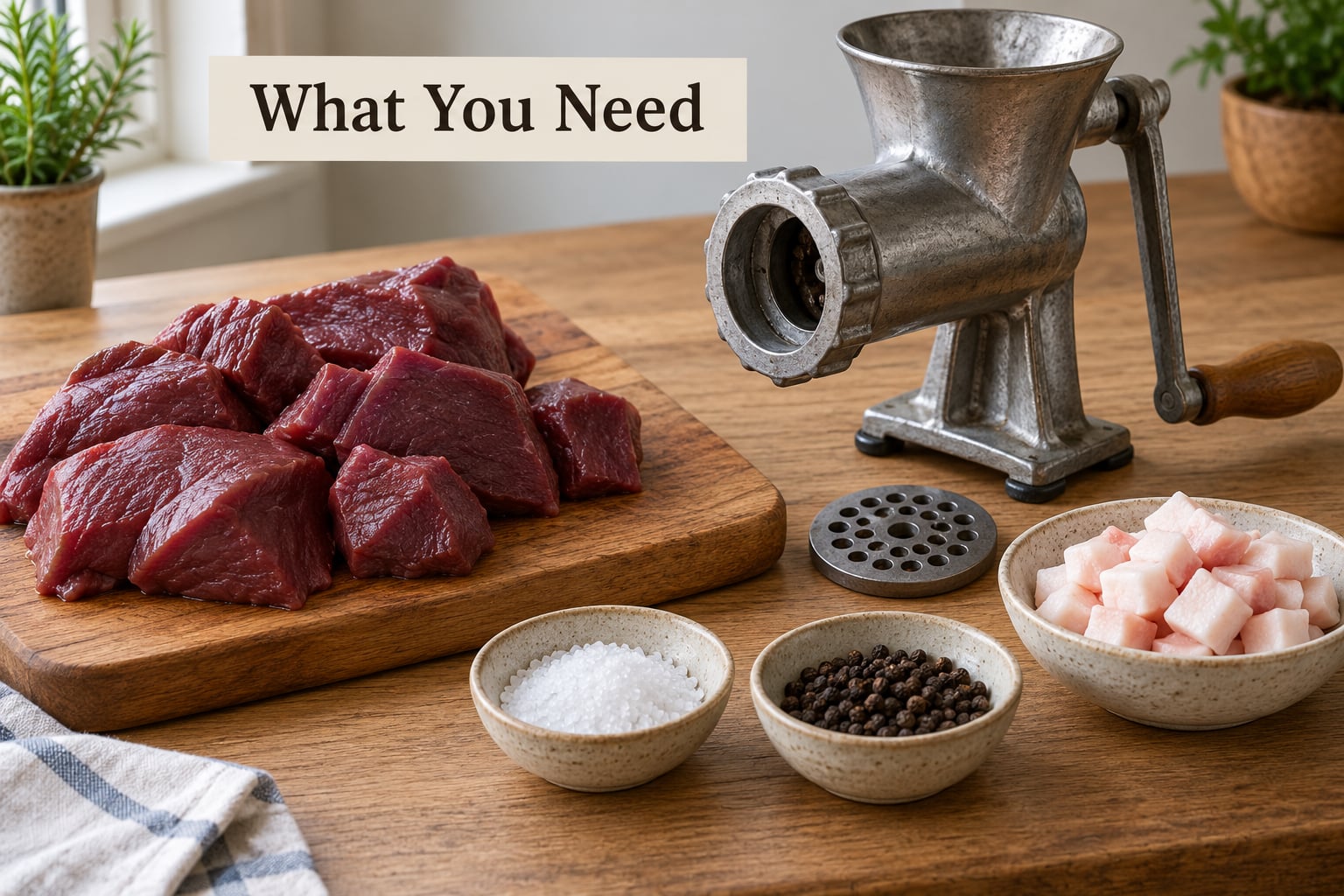
The equipment list is short, and most of it you may already own.
- A sharp boning knife and a second knife for cubing. A dull knife crushes meat instead of cutting it, which is the first step toward a mushy grind.
- A cutting board you can slide into a freezer, plus a second tray for the finished ground meat.
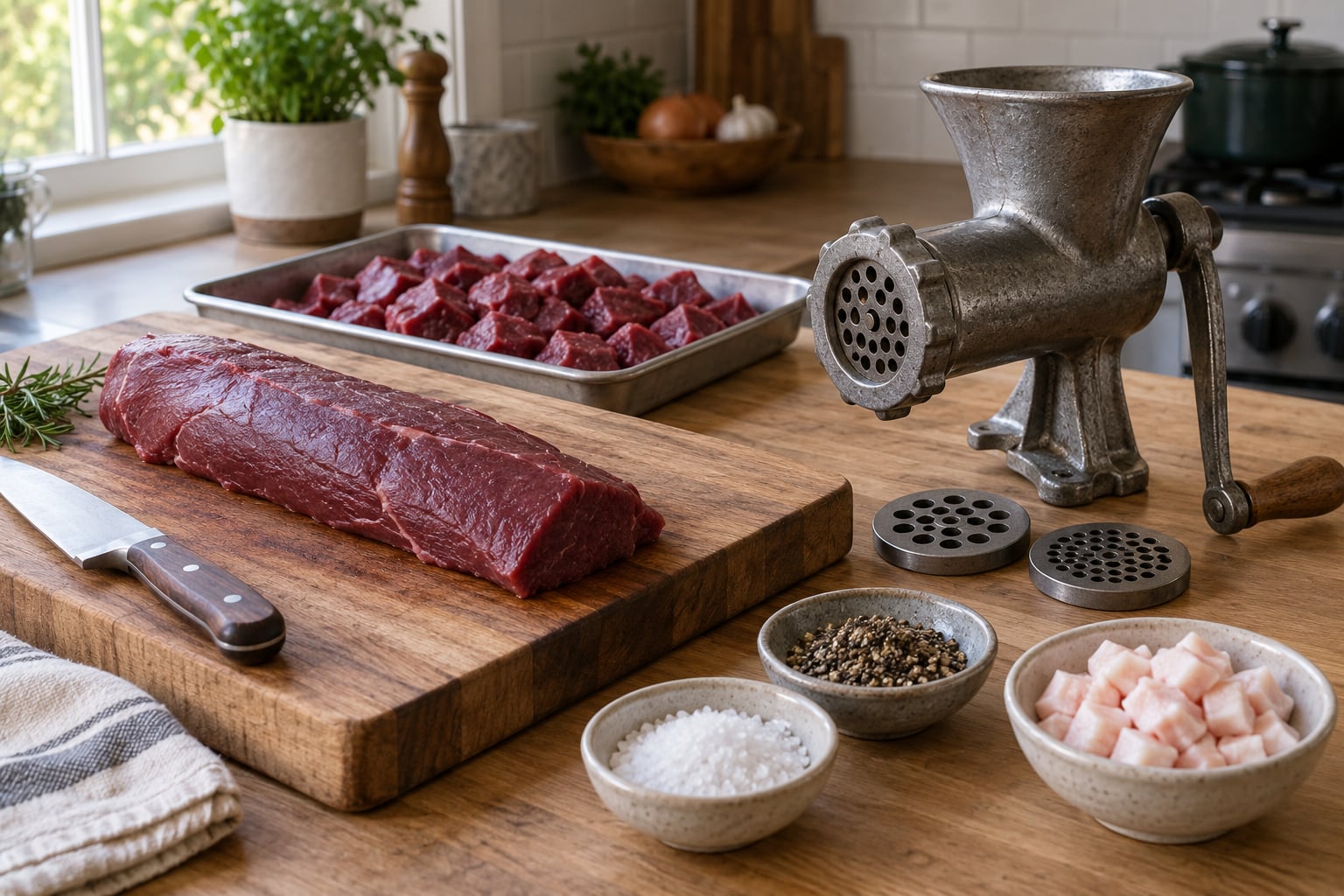
- A meat grinder with at least two plates: a coarse plate around 1/4 to 3/8 inch and a fine plate around 3/16 inch. A stand mixer attachment, an electric grinder, and a hand-crank model all work; the hand crank is the slowest and the most forgiving.
- A cold pack or a bowl of ice to chill the fat and to rest the tray between passes.
- A mixing bowl and clean hands for working the seasoning in.
- Optional: natural hog casings or collagen casings and a sausage stuffer if you are making links, Prague Powder #1 cure salt if you plan to cure or smoke, and a binder such as oat flour.
On the fat, the question people are most embarrassed to ask is what cut to request. Ask for pork shoulder and you get a workable mix of meat and fat in one purchase, which is the simplest option. Ask for pork fatback if you want precise control over the ratio. Many butchers will grind the fat separately for a small fee, which saves you a cutting session.
Start with about 5 pounds of venison on your first run. Forum advice from experienced game processors is consistent on this: a small batch lets you learn chilling, grind size, and mixing without wasting a whole hindquarter on a bad result.
Here is how the common ratios change the finished sausage:
| Blend | What it looks like | Best for |
|---|---|---|
| 75/25 venison to fat | Tender, still noticeably lean, light texture | Summer sausage, breakfast links, anything where you want the deer flavor to stay up front |
| 70/30 venison to fat | The standard home sausage blend, moist and cohesive | Brats, kielbasa, general-purpose links |
| 60/40 venison to fat | Rich, soft, closer to a pork sausage than a game sausage | First attempts, or a very lean deer |
Two pounds of pork shoulder to three pounds of venison gives you roughly 70/30, which is where most people land.
Step-by-Step: How to Grind Venison for Sausage
How to Keep the Venison Cold
Temperature controls the entire result. Fat is solid when cold and pasty when warm, and the auger will smear warm fat across the plate face until nothing moves through it.
Aim for meat around 32 to 34 F going into the first grind. A home processor on a forum thread put it at about 32.5 F, and that is a good number to hold. If you have a thermometer, probe the thickest part of a cube before it goes in the hopper.
There are two ways to get there. Spread the trimmed meat in a single layer on a sheet pan and put it in the freezer for 30 to 45 minutes, no longer. Or spread it on the cutting board, cover it, and slide the whole board into the freezer. Do not freeze it solid, because rock-hard meat will strain a small hand-crank grinder.
Chill the metal too. Put the grinder bowl, auger, and plates in the freezer while the meat chills. The metal picks up heat from the motor and the friction of grinding, and a cold bowl buys you an extra batch’s worth of time before things turn greasy.
You can tell venison is getting too warm by touch and look. The cubes go slick instead of firm, the fat looks greasy rather than chalky white, and the ground meat starts sticking to the bowl rather than dropping away in loose strands. Stop and re-chill for 10 minutes when you see that.
How to Trim and Cut Venison for the Grinder
Pull off every piece of silver skin, gristle, and thick connective tissue you can find. Those do not grind down, they smear, and they are the number one reason a first batch turns out grainy.
Trim off the heavy outside fat cap as well. Venison does not carry much usable fat on the muscle, and the fat you want to add is the pork you are blending in, so the deer fat is mostly a handling problem.
Cut the trimmed meat into 1 to 2 inch cubes. Small cubes feed evenly; big chunks stall the auger and leave you shoving a pusher against the machine. Any cube that will not fit through the throat of your grinder should be cut smaller.
Keep the pork separate from the venison at this stage. Cutting the shoulder meat into cubes of the same size means the two meats feed together in the right proportion as you alternate handfuls into the hopper.
How to Choose the Right Grinder Plate
The plate decides the particle size, and the first pass and the second pass want different sizes. Coarse breaks the meat down quickly without melting the fat. Fine evens everything out at the end and is what gives sausage its texture.
| Plate | Hole diameter | Use it for |
|---|---|---|
| Coarse | 1/4 inch | First pass, breaking venison and pork into small pieces |
| Medium-coarse | 3/8 inch | First pass for brats and kielbasa with a coarse, snappy texture |
| Fine | 3/16 inch | Second pass for breakfast sausage, summer sausage, and most links |
| Extra fine | 1/8 inch | Second pass only, for emulsified-style summer sausage |
Install the plate so the flat face points toward the meat. On most grinders the blade rides against the flat side of the plate, and a reversed plate will cut badly and load up fast.
That raises a question a lot of people search for: which way does the blade face? The blade goes on the shaft toward the plate, with its cutting edge angled so it sweeps across the plate face as the shaft turns, and it should sit about a thousandth of an inch from the plate. If the blade is mounted backwards, it drags instead of cutting, and that is the usual cause of a grind that looks torn rather than clean.
A 3/16 inch plate is a safe second pass for almost any venison sausage. Only move to the 1/8 inch plate if you are making a summer sausage you plan to smoke and want a smooth, almost spreadable texture.
How to Grind Venison for Sausage Without Clogging the Machine
Feed the meat in as a steady, moderate stream. Pushing hard does not speed anything up, it heats the meat and forces fat into the plate holes.
Alternate a handful of venison with a handful of pork as you feed, rather than dumping all of one meat in first. That keeps the fat distributed through the batch instead of arriving as a block that clogs the plate.
Run the coarse plate first. If you have a grinder with a coarse and fine plate, the two-stage setup is worth the extra step, and if you are stuck with one plate, run it twice through the same plate for a similar effect.
When the auger stalls, do not force it. Pull the hopper off, take the throat apart, and clear the obstruction. A hard-shoved auger can bend or break the shaft, and the real cause is almost always a warm batch, an oversized piece, or a bone fragment.
Turn the machine off before you reach into the throat. Never put your hand or a utensil near the auger while the motor is running, and unplug electric models before disassembly.
How to Check the Grind
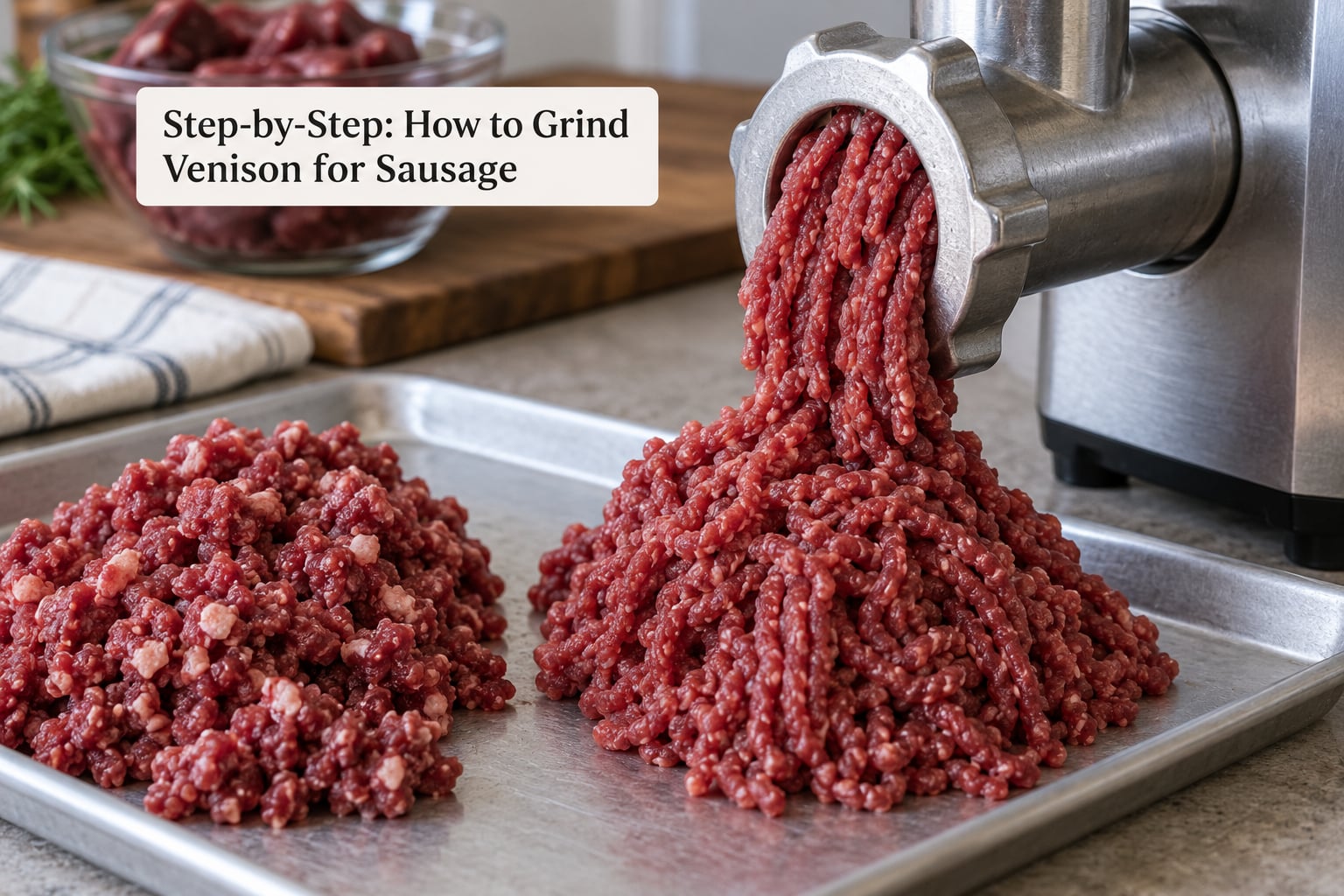
A good coarse pass looks like small, uneven crumbs with visible white flecks of pork fat, and the fat pieces should be distinct rather than a uniform paste.
The second pass should look wet, even, and lightly packed, with the fat spread evenly through the meat instead of sitting in separate pockets. A coarse grind is right for brats and kielbasa; a fine grind is right for breakfast sausage and summer sausage.
If the ground meat is greasy and shiny right off the plate, the meat ran warm. If it looks like wet paste, the fat smeared from too much heat or too much pressure. If it is snowy white and dry, the blade was probably dull or the plate was reversed. Spread the finished grind on a chilled tray and look at it before you go further.
How to Move Ground Venison to Sausage
After the coarse pass, put the ground meat in the freezer for 10 to 15 minutes to re-chill it before the second pass. This short rest firms the fat back up and gives you cleaner cutting on the second grind.
Season between the passes for a finer, more even distribution. Add your salt, pepper, sage, garlic, and a small splash of ice water, then mix by hand until the mixture turns tacky and starts clinging to itself. Two or three minutes of hand mixing is the usual target.
If you are making a cured or smoked sausage, add Prague Powder #1 at this point, mixed in evenly and at the rate on the package, typically about 1.5 teaspoons per pound. Get the measurement right; it is a safety ingredient, not a seasoning.
Then run the fine pass, rest the finished mix 10 to 15 minutes, and stuff it cold. Stuffing warm mix makes loose, greasy links because the fat melts inside the casing.
From there you have three routes. Stuff it into hog casings for links. Form it into 2 inch logs for a bulk summer sausage, pierce the casing, and bake at 350 F for about 90 minutes for a fully cooked no-smoker version. Or skip the casing entirely and make patties. Whichever route you pick, check the center with an instant-read thermometer before serving and make sure it has hit 160 F, the safe minimum the USDA recommends for any ground meat.
Freeze ground or finished sausage flat in single portions rather than as one solid block, press out the air, and use it within a few months. Sliced venison sausage is also a good flavor for a venison meal plan, and keeping the grind in portions means you only thaw what you need.
Common Mistakes
Most disappointing first batches trace back to one of a handful of problems, and each has a simple fix.
- Grinding warm meat. Fat smears, the plate gums up, and the sausage turns out greasy and loose. Chill the meat to about 32 to 34 F, chill the metal parts, and work in small batches you can keep cold.
- Skipping the trim. Silver skin and gristle do not break down. They survive grinding as stringy bits and give the sausage a grainy, chewy texture. Pull all of it before cubing.
- Not enough fat. Venison alone is roughly 90 percent lean and will not bind. That is the dry, crumbly sausage people complain about most often. Blend in 25 to 30 percent pork fat.
- Using the blade backwards or a dull blade. A reversed blade drags instead of cutting, and a dull one tears. Mount the blade toward the plate and sharpen it before the season starts.
- Feeding oversized pieces. Big chunks stall the auger and invite you to shove with the pusher. Cut 1 to 2 inch cubes, and cut anything that will not fit through the throat.
- Forcing the plate. Pushing hard heats the meat and forces fat into the holes. Slow down, keep the feed even, and clear stalls by disassembling the throat instead.
- Seasoning too early or overmixing. Seasoning in bulk before the first grind distributes unevenly, and heavy mixing after the fine grind turns the mix gluey. Season between the passes and mix only until tacky.
- Storing ground venison loose and uncovered. Ground meat oxidizes and dries out faster than a whole cut. Portion it, press the air out, and freeze it flat.
One more that shows up a lot with wild game: skipping cure salt in a sausage you intend to smoke or dry. Venison is a lean, wild meat, and any sausage meant to be kept rather than cooked fresh should carry cure salt at the proper rate.
Frequently Asked Questions
Do I need to grind venison twice?
Yes, for the best texture. The first pass through a coarse plate around 1/4 inch breaks the meat down fast without melting the fat, and the second pass through a fine plate around 3/16 inch distributes the pork fat and seasoning evenly. This is called a double grind. It is the main reason home-ground venison sausage stays tender instead of turning crumbly or greasy.
What do you mix with venison when grinding?
Pork fat, almost always, because venison is close to 90 percent lean and cannot bind on its own. Most people use 70 to 75 percent venison with 25 to 30 percent pork shoulder or fatback. Ground beef works as an alternative and adds fat plus some extra protein, and oat flour or breadcrumbs can act as a binder if you want more body.
How cold should venison be before grinding?
About 32 to 34 F for the first grind, which is roughly freezer-chilled without being frozen solid. Chill the trimmed meat in a single layer for 30 to 45 minutes and put the grinder bowl, auger, and plates in the freezer at the same time. If the fat looks greasy rather than chalk white, the meat is too warm and the fat will smear.
Which way does a meat grinder blade face?
The blade mounts on the shaft pointing toward the plate, with the cutting edge angled so it sweeps across the plate face as the shaft turns. It should sit extremely close to the plate without touching, roughly a thousandth of an inch. A blade installed backwards drags instead of cutting, which produces a torn, greasy grind and wears the blade quickly.
What is the best binder for venison sausage?
Oat flour is the most common choice, used at about 1 tablespoon per pound of meat, and breadcrumbs or a beaten egg work as alternatives. A binder absorbs moisture and gives the lean venison something to hold onto, which is what keeps links from splitting when you cook them. Ice water in the mix adds the same effect without changing the texture much.
Why is my ground venison greasy and falling apart?
Greasy usually means the meat ran warm during grinding, so the fat melted and smeared into the plate instead of staying in visible flecks. Falling apart usually means there was not enough fat, or not enough binder, for the lean venison to hold. Fix both by chilling harder, working in smaller batches, and blending in 25 to 30 percent pork fat.
Conclusion
If you only change one thing about how to grind venison for sausage, change how cold you keep it. Trim the meat clean, chill it and the metal parts to about 32 to 34 F, and blend in 25 to 30 percent pork fat before a coarse pass and a fine one.
Work in small batches, season between the grinds, and keep the finished mix cold until you stuff, form, or cook it. Start with about 5 pounds on your first run, and once you see how a full deer breaks down, a whole hindquarter will go through the grinder without surprises.