How to store knives without dulling them comes down to two rules: dry every blade completely before it goes away, and give each knife its own slot, sheath or guard so no edge ever touches another object. Most blades do not go blunt sitting still. They go blunt from contact, trapped grit and damp. Get those three things right and a sharp edge stays sharp for months at a time.
The whole process takes about five minutes per knife, including drying, and there is nothing to buy before you start. What matters is the geometry of where the blade lands and what it touches on the way in.
Table of Contents
- What You Need
- Step-by-Step: How to Store Knives Without Dulling Them
- 1. Match the method to the knife, so you store knives without dulling them
- 2. Hand-wash and dry the blade completely
- 3. Protect the cutting edge before storage
- 4. Store each knife upright and stable
- 5. Check the setup periodically
- Common Mistakes
- Frequently Asked Questions
- Do knife blocks dull knives?
- Can I keep kitchen knives in their sheaths?
- Is a magnetic knife rack safe for sharp knives?
- What is the best way to store knives in a small kitchen?
- How do I know whether a knife needs honing or sharpening?
- Conclusion
What You Need
Start by sorting your knives into groups, because one storage method will not serve a Japanese gyuto and a bread knife equally well.
- Individual sheaths or blade guards for knives that live loose in a drawer, travel in a bag, or sit in a drawer with other utensils.
- A knife block with edge-safe slots for a regular daily kitchen set, if you have the counter space and the slots fit your handles.
- A wall rack or magnetic strip for knives you reach for several times a day and want to see at a glance.
- A drawer organizer with individual slots for small kitchens and renters who cannot drill into a wall.
- The original case or a hard knife case for expensive or specialty blades you use occasionally.
- A wooden saya, or a close equivalent sheath for a Japanese knife, since wood wicks moisture away from the blade.
- A soft cleaning cloth, mild dish soap and a ventilated drying spot such as a rack near the sink, away from direct heat.
Serrated knives need a wider slot or sheath so the teeth clear the sides. Broad, thin chef’s knives chip most easily and want the softest contact you can give them. If your knife came with care instructions from the manufacturer, read them before you buy any holder, because hardened Japanese blades and ceramic blades have specific handling rules.
Step-by-Step: How to Store Knives Without Dulling Them
1. Match the method to the knife, so you store knives without dulling them
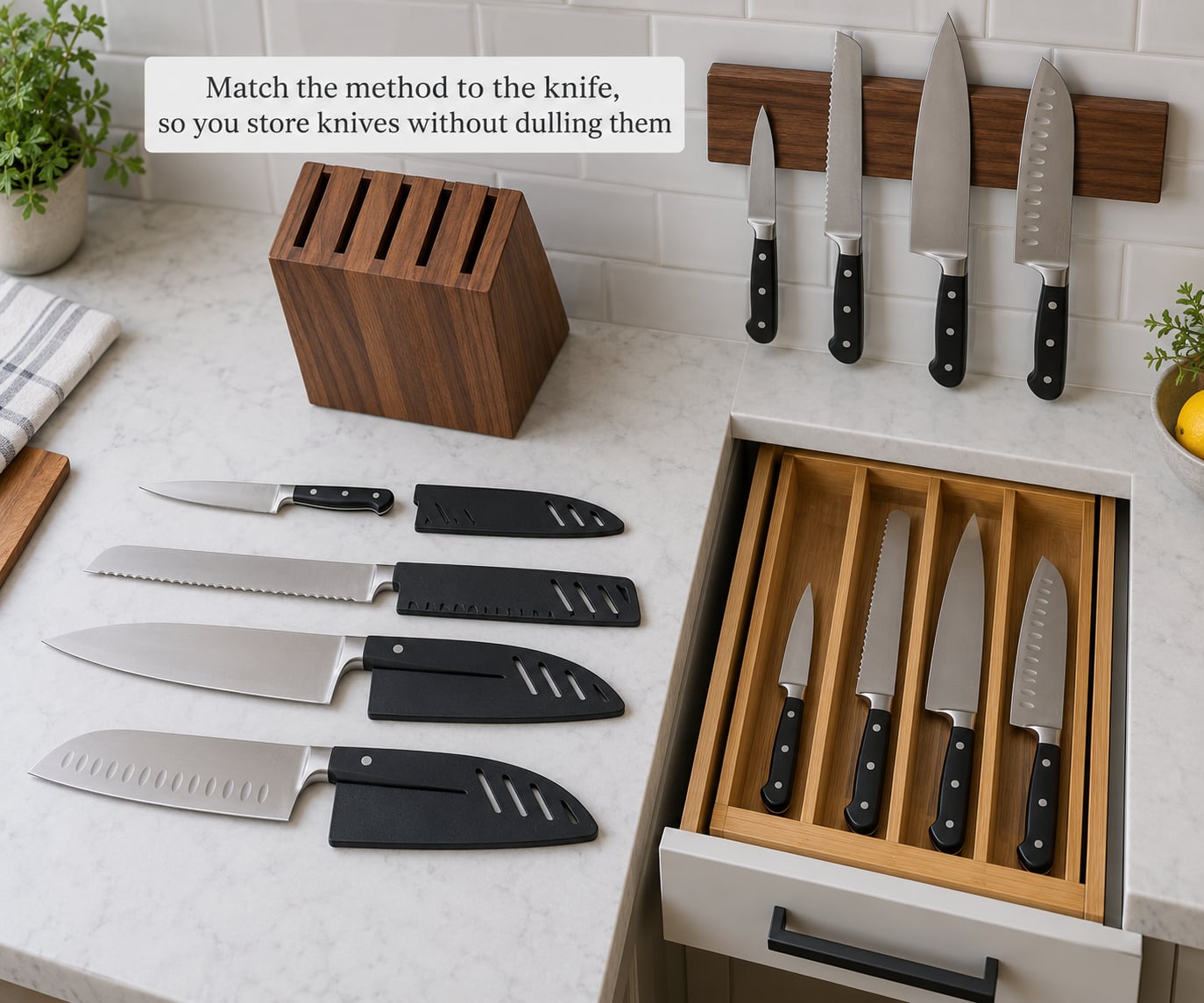
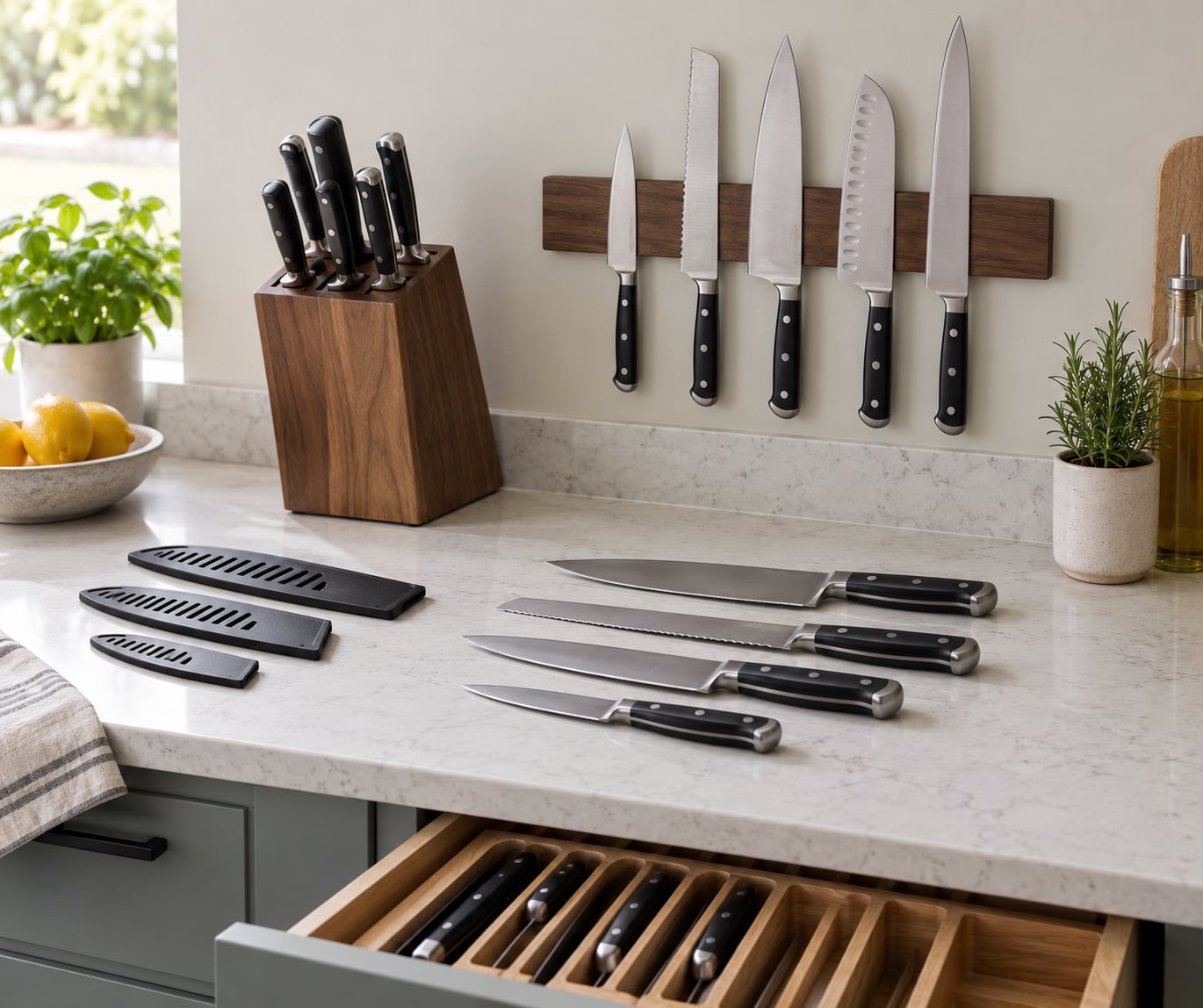
Guarded sheaths are the safest answer for any knife kept loose in a drawer, because the guard covers the cutting edge and nothing else in the drawer can reach it. Blocks and edge-safe slots suit a daily set that leaves the knife and comes straight back. Racks suit high-frequency use, where the whole point is seeing the blade and grabbing it without hunting. Cases and boxes suit the good knife you reach for twice a month.
Whatever you pick, no two unrelated blades should be able to rub edges together in storage. That contact is the mechanism behind most of the dulling people blame on their block. Success at this stage is simple: pull any knife out and put it back a dozen times without a scrape, a tap or a wobble.
2. Hand-wash and dry the blade completely
Wash by hand with mild dish soap and lukewarm water, then dry immediately with a clean soft cloth, working from the spine toward the tip so you do not drag grit along the edge. Then air-dry for a while before it goes into storage. Practitioners on knife forums commonly leave blades out an hour or two, and a reasonable rule is that if the steel still feels cool or damp under your palm, it is not ready.
Trapped moisture causes spots on stainless and outright corrosion on carbon steel. The dishwasher is worse on two counts: the heat and detergent attack the edge, and the knocking around of a loaded rack chips handles and ferrule material. Put each knife away only when it is clean and completely dry, and you have already removed the two conditions that do the most quiet damage.
3. Protect the cutting edge before storage
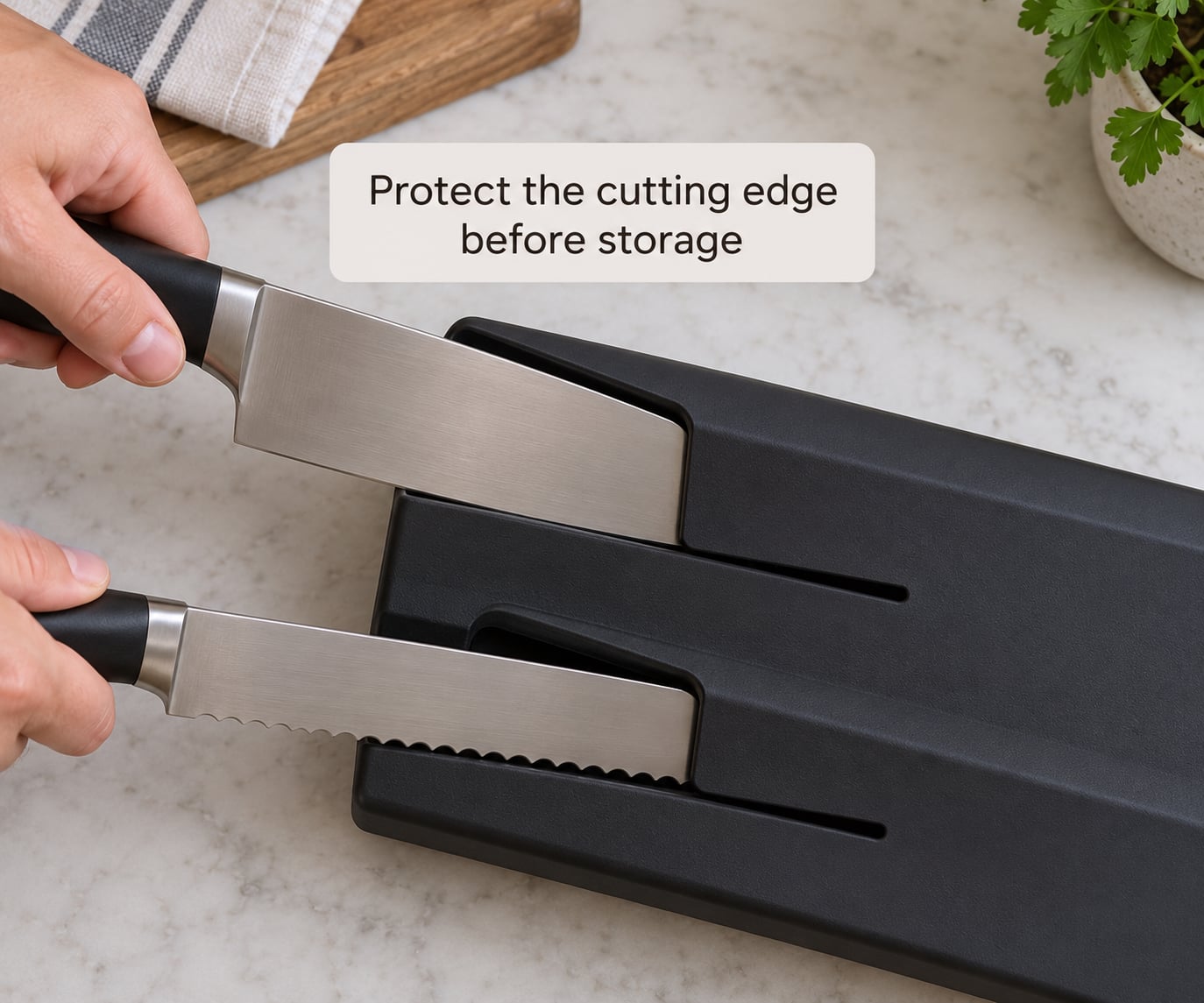
Cover the edge with something smooth. A hard plastic guard, a fitted slot, a saya or a cork-lined holder all work. What does not work is an insert lined with rough unfinished wood, a divider that pinches the blade, or a folded cloth that dries the handle but leaves the edge rubbing against fabric grit on the way in.
Orient things so the weight of the knife rests on the spine and never on the edge. In a slot, that means cutting edge facing the back wall of the compartment with the tip fully enclosed. On a magnetic strip, let the handle contact the magnet as well as the blade, so a heavy knife cannot slide down and off. For serrated knives, keep teeth from touching anything at all, and never seat a thin chef’s knife tip-down on a hard base, where one nudge chips it. Success looks like this: nothing in your storage setup presses against, scrapes or scratches the cutting edge.
4. Store each knife upright and stable
Upright storage beats flat storage because a blade lying on its side is a blade with its full length exposed to whatever shifts next to it.
A block keeps knives tucked away and off the counter, but slots must actually fit your handles, and a wa-handle Japanese knife will wobble in a slot sized for a flared Western handle. Test the block by pulling it hard on its side; if it slides or tips, it is not a safe home for a sharp knife near a counter edge. Wall racks and magnetic strips are the most convenient and the most exposed, so mount them high and out of reach of children and pets, and test a heavy knife by holding the handle until the magnet has clearly seated.
Drawer slots are the quiet winner for small kitchens. Slot spacing matters more than anything: give each knife its own compartment, do not overcrowd, leave finger clearance on both sides, and add a non-slip liner at the base so blades cannot slide into each other when the drawer opens fast. A loose blade lying flat against other utensils is the worst arrangement available, because every drawer slam becomes an impact test.
5. Check the setup periodically
Once a month, look at the storage hardware rather than the knives. Guards can crack or warp until the edge no longer clears the opening, blocks loosen at the base, rack surfaces trap grit, and cloth liners hold moisture and crumbs. Replace a wet or grit-packed insert, tighten a wobbling block and retire any guard with a crack in it.
Then test an edge safely: slice a sheet of paper with a light push. If it tears, run a honing steel before you touch a whetstone. Honing realigns an edge that is still there. Sharpening grinds away metal, so save it for an edge that has lost its bite or picked up nicks from a glass board, a stone counter or a drop. If the damage is a chip rather than a general softness, that is a sharpening job, not a honing job, and a badly chipped thin edge is best fixed by a sharpener rather than at home.
Common Mistakes
Most blade damage in a kitchen happens in storage, and almost all of it traces back to one of a handful of fixable habits.
Loose blades knocking together. Fix: give every knife a slot, guard or sheath, and add a divider between any two blades that still touch. This is the single biggest cause of nicks and chips.
Knives sharing a drawer with utensils. Fix: move them into their own organizer compartment. A fork tine or a spoon handle meeting an edge while the drawer opens is all it takes.
Abrasive wooden inserts. Fix: swap raw unfinished wood for a smooth slot, a cork-lined holder or a fitted guard. Wood is fine for a saya made to hold a blade; it is not fine when a knife rattles against a bare slot wall every time the drawer moves.
Bent or cracked guards. Fix: check the mouth of each guard with a fingernail. A guard that has deformed no longer clears the tip, and the tip becomes the contact point.
Damp sheaths. Fix: dry the blade completely first, and let damp leather or cloth air out between uses. A sheath that holds moisture against steel is worse than no sheath at all.
Overcrowded storage. Fix: if a knife needs to be angled to fit, the slot is wrong. Buy the next size of organizer rather than forcing the fit.
Unsafe blade orientation. Fix: cutting edge toward the back of the slot or the wall, never toward the front where a searching hand meets it first. Keep open racks high and consider a locked drawer for households with young children.
Sharp knives stored where you cannot retrieve them safely. Fix: choose a method you can see into. A block you cannot see into is how people end up cutting a fingertip reaching for the wrong knife.
A few maintenance habits round this out. Cut on wood or plastic boards, never on glass, stone or marble. Avoid dropping a knife onto a hard floor or letting the blade strike the inside of a sink. Keep carbon and high-carbon stainless knives on a schedule: a thin coat of food-grade mineral oil or knife wax before a long storage period, wiped and recoated every few months, because natural oils can turn rancid over long stretches and then sit on the steel as a smell and a film.
One last point on steel type. Stainless forgives neglect. Carbon steel rewards attention and develops a patina that can protect it, though forcing a patina with damp storage is exactly what provokes rust spots. Ceramic never rusts and holds an edge far longer than steel, but it is brittle and chips instead of bending, so it belongs in its own soft slot, never loose among steel knives and never in a dishwasher.
Frequently Asked Questions
Do knife blocks dull knives?
A good block does not dull knives. A block dulls knives when the slot is too small, forcing the blade to tilt, when the insert is rough unfinished wood that grinds the edge on every insertion, or when a knife rattles and taps its tip on the way in. Slots sized so the knife drops in and sits with the edge clear, and a smooth or cork-lined contact surface, keep the edge exactly as sharp as you left it.
Can I keep kitchen knives in their sheaths?
Yes, and for knives that live in a drawer it is the safest option there is. The sheath covers the cutting edge, so nothing else in the drawer can reach it. Two conditions apply: the blade must be completely dry before it goes in, and the sheath must not be leather or cloth that stays damp. Check the mouth periodically, because a guard that warps stops clearing the tip.
Is a magnetic knife rack safe for sharp knives?
A magnetic strip is easy on edges because nothing presses against the cutting side, and it keeps knives visible, which is its main advantage. The two cautions are weight and access. Let the handle touch the magnet as well as the blade so a heavy knife cannot slide off, and mount the strip high and out of reach of children and pets, or choose a locked drawer instead.
What is the best way to store knives in a small kitchen?
An in-drawer organizer with individual slots is the best fit for small kitchens, because it hides knives without costing counter space and needs no drilling. Line the base with a cloth or non-slip mat so blades do not slide into each other when the drawer opens, give each knife its own compartment with finger clearance on both sides, and store edge toward the back. This cloth-lined approach is the most commonly recommended fix among home cooks.
How do I know whether a knife needs honing or sharpening?
Honing realigns an edge that is still present; sharpening removes metal to create a new one. Test with a sheet of paper: a light push that slices cleanly usually only needs a few passes on a honing steel. If the knife skates, tears the paper, or has visible nicks and chips from glass, stone or a drop, skip the steel and go straight to a whetstone, starting around 1000 grit and progressing finer.
Conclusion
To store knives without dulling them, dry the blade completely, give it its own slot, sheath or guard, and set it down so the cutting edge touches nothing. That removes the contact, the grit and the damp that quietly do most of the damage in a drawer.
Do three things today. Pick a proper guard or edge-safe location for the knives that currently rattle around loose, hand-wash and fully dry each blade, then place it upright with the edge facing away from the front. Check back in a month with a paper test and you will see how many sharpening sessions you just skipped.