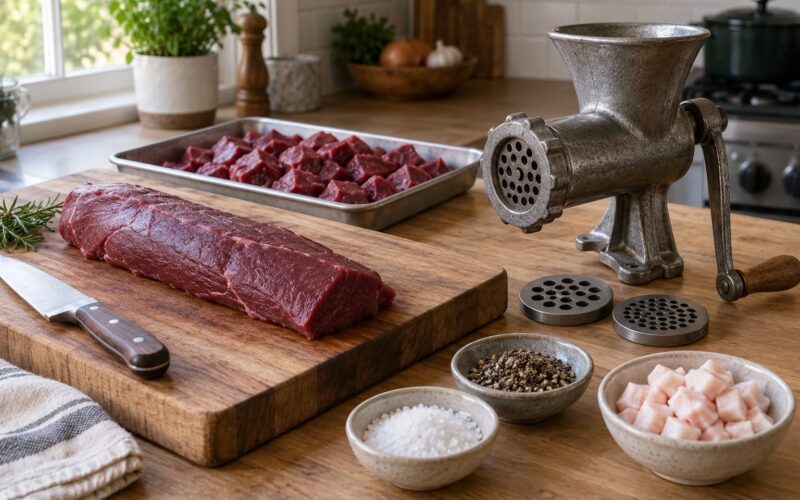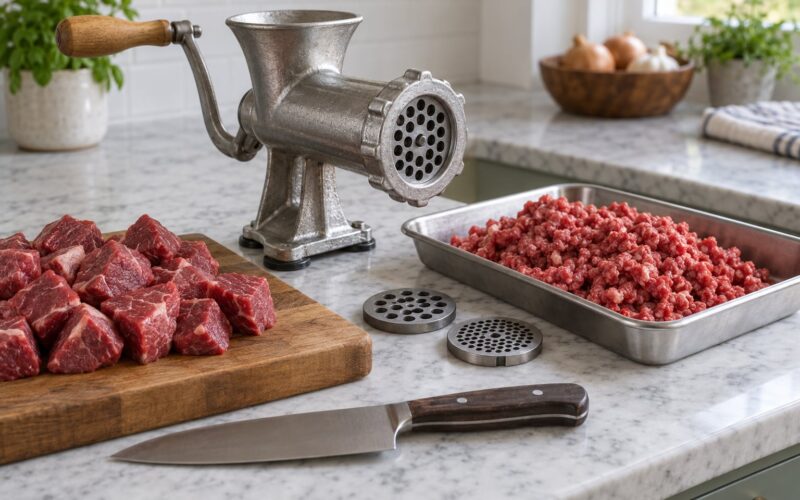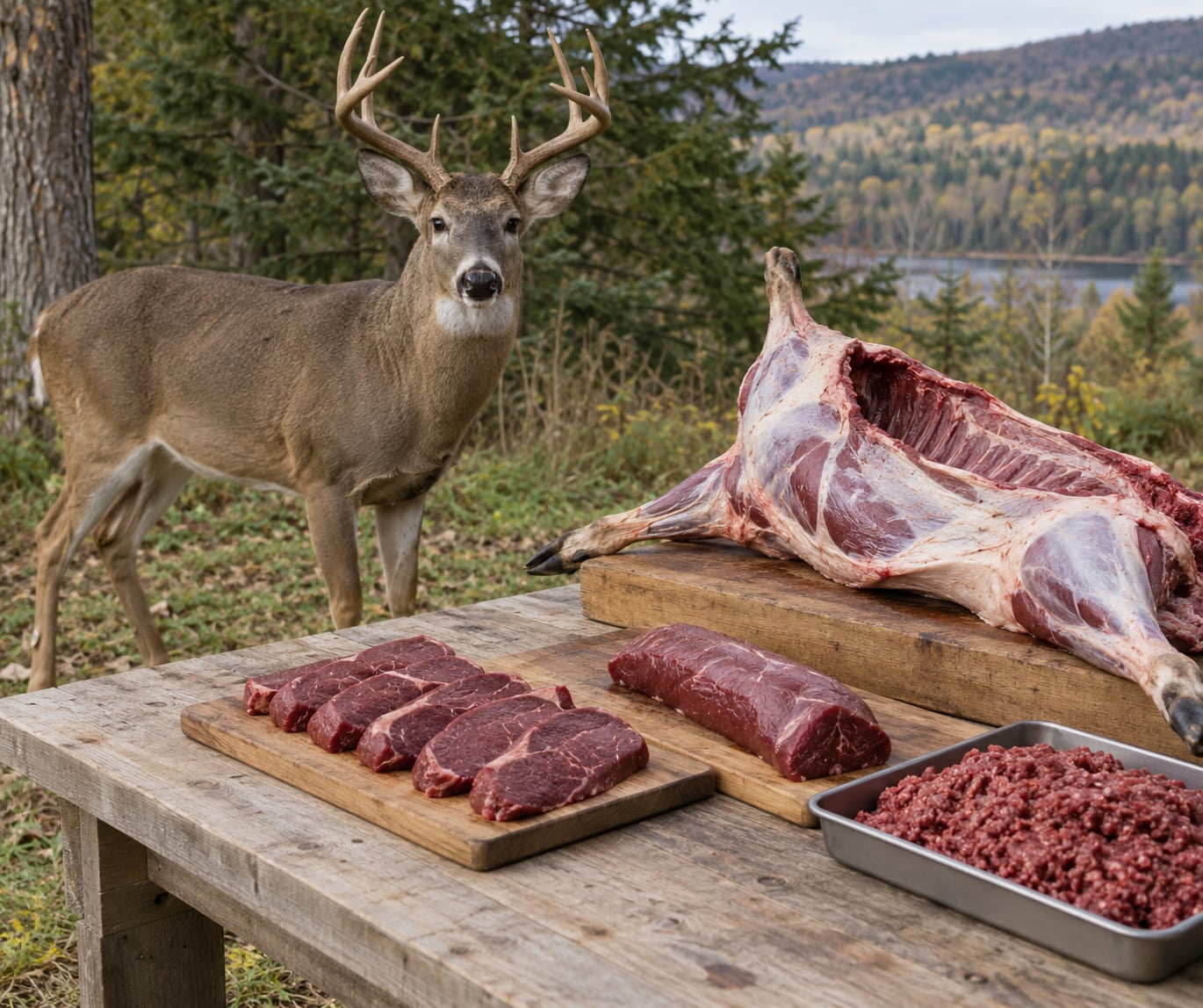
If you’re asking how much meat do you get from a deer, the short version is that most mature whitetails give back 40 to 60 pounds of boneless venison. Roughly half of your field-dressed weight comes home as packaged meat, and about 42% of the animal’s live weight does.
The number swings a lot because the same buck processed by two different people can come back with packaged weights 20 pounds apart. A hunter on the Muzzleloading Forum who weighs every piece as he works reports about 35% of dressed weight, while a commercial processor quoted on the New Jersey Woods & Water forum says 55%. Both can be honest.
Here’s what the numbers actually mean and how to estimate yours.
Table of Contents
- How Much Meat Do You Get From a Deer? Typical Yield Numbers
- What Percentage of a Deer Becomes Usable Meat?
- Deer Weight to Boneless Meat: What Should You Expect?
- What an average whitetail gives you
- What a small or young deer gives you
- How much meat do you get from a 150 pound deer
- What large mature deer give you
- How Field-Dressed Weight Differs from Boneless Meat
- What Factors Can Change the Amount of Pack-Out?
- How to Estimate Your Deer’s Meat Yield
- Step 1: get to live weight
- Step 2: apply the field-dressed percentage
- Step 3: convert to packaged meat
- Deer Meat Safety and Accurate Recordkeeping
- Frequently Asked Questions
- How many pounds of meat does a typical whitetail deer provide?
- What is the average field-dressed weight of a whitetail deer?
- How much boneless meat should I expect from a 150-pound deer?
- Does antler size determine how much venison a deer yields?
- How much less meat is there after a deer is deboned?
- Conclusion
How Much Meat Do You Get From a Deer? Typical Yield Numbers
Two tables settle most of this. The first shows where a deer’s weight goes at each stage. The second shows what you can expect back based on how big the animal is.
| Stage | What it means | Share of live weight |
|---|---|---|
| Live weight | The deer on the hoof | 100% |
| Field dressed (hog dressed) | Gutted, hide still on | About 78% |
| Hanging or rail weight | Skinned, head and feet removed | About 73% |
| Boneless packaged meat | Trimmed, deboned, bagged | About 42-50% |
Field dressing removes roughly 22 to 25% of a deer’s live weight. Skinning, removing the head and feet, and the loss of blood and body heat take off a few points more. Everything after that comes off as bone, hide, fat, silver skin, sinew, gristle, bullet damage and trim.
| Deer size | Live weight | Field-dressed weight | Boneless packaged meat |
|---|---|---|---|
| Small doe or yearling | 70-90 lb | 55-70 lb | 25-35 lb |
| Average whitetail | 110-130 lb | 85-100 lb | 40-50 lb |
| Typical antlered buck | 130-160 lb | 100-125 lb | 50-60 lb |
| Large mature buck | 180-220 lb | 140-170 lb | 65-80 lb |
| Exceptional 200 lb plus | 200-240 lb | 155-190 lb | 75-90 lb |
A national dataset of 115 harvested whitetails cited by Backfire put the average yield at 52.19 pounds of meat. That single figure is a better reality check than most percentages you’ll find quoted online.
What Percentage of a Deer Becomes Usable Meat?
About 55 to 60% of a healthy deer’s live weight is meat on the bone, gutted. That’s the dressed carcass figure most state wildlife guides use. Subtract bone, hide, waste and you’ll land nearer 42% of live weight in the freezer.
Three worked examples:
- 100 lb live deer — about 78 lb field dressed, around 73 lb hanging, and roughly 40 to 45 lb of boneless meat at the processor.
- 150 lb live deer — about 117 lb field dressed. A hunter on the HuntingPA forum estimated a 150 lb deer on the hoof at roughly 60 lb of deboned meat. That lines up with the table.
- 200 lb live buck — about 156 lb field dressed, and realistically 70 to 80 lb of packaged meat.
The trap here is that field-dressed meat and packaged meat are not the same number. A 120 lb field-dressed deer can produce 100 lb of hanging weight and still only 50 to 60 lb in the freezer, because bone and trim come off last.
Deer Weight to Boneless Meat: What Should You Expect?
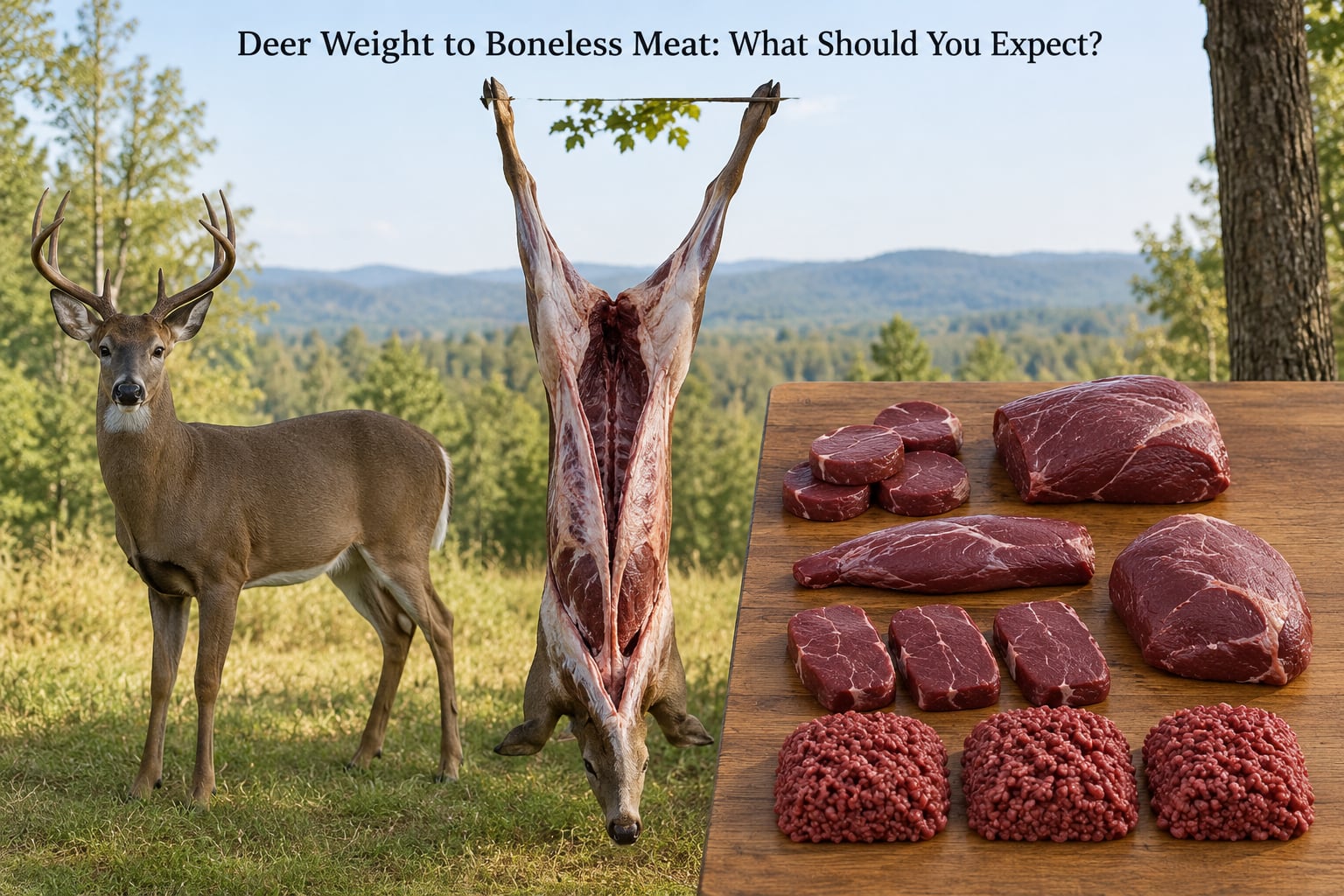
Big deer produce more meat, but they don’t produce more meat per pound. Big animals tend to carry more bone, more connective tissue and more fat in proportion to their muscle, so the extra pounds taper off.
What an average whitetail gives you
Deer in the 110 to 130 lb range are the most common harvest by a wide margin. Expect 40 to 50 lb of boneless meat. A 115 lb carcass has been used as the standard example for years, and it works out to roughly 55 lb at a 50% yield.
What a small or young deer gives you
Small deer are where disappointment hurts most, because the fixed costs don’t shrink. A 60 lb field-dressed yearling may leave you with 25 to 30 lb of meat, and a good share of that is trim and shoulder. One hunter on the Muzzleloading Forum reported an 85 lb dressed deer that produced 60 lb of packaged meat, then an 86 lb yearling that gave about 35 lb on the same trusted scale. Same weight, different result.
How much meat do you get from a 150 pound deer
A 150 lb deer field dresses to around 115 to 120 lb and usually returns 50 to 60 lb of boneless meat. On the high end, a 130 lb field-dressed antlered whitetail has been measured at about 63 lb of finished meat, close to 48% of dressed weight. That’s a well-boned animal processed carefully.
What large mature deer give you
Bucks in the 180 lb range and above can return 65 to 80 lb. The Muzzleloading Forum poster Stumpkiller worked out a 200 lb field-dressed deer at roughly 42.5% yield, breaking the losses out as hide around 20 lb, bone and brain around 45 lb, sinew, gristle and suet around 35 lb, plus about 10 lb of shot and air damage. His haunches and shoulders were heavy but his total pack-out was still mid-range.
How Field-Dressed Weight Differs from Boneless Meat
Four terms do all the work in this conversation, and mixing them up is the reason most hunters think they got shorted.
- Live weight — the animal standing in the field. If you never weighed it on the hoof, divide the dressed weight by 0.78, or use the old hunter’s shortcut of multiplying field-dressed weight by four-thirds.
- Field dressed weight, also called hog dressed — gutted with the hide still on. This is what most states want recorded on the harvest report.
- Hanging weight, also called rail weight or dressed carcass weight — skinned, with the head, feet and lower legs off. This is the number a processor bills you on.
- Boneless packaged meat — deboned, trimmed and bagged. This is what you eat.
Between rail weight and packaged meat you lose bone, intermuscular fat, silver skin, connective tissue, cartilage, damaged muscle and the trim the butcher decides isn’t worth selling. On a 140 lb hanging carcass that’s routinely 40 to 60 lb, and it’s where most of the argument between a processor’s number and a home butcher’s number happens.
What Factors Can Change the Amount of Pack-Out?
- Shot placement. Damage through the shoulder or a ham can cost an extra 2 to 3% of yield. Both hind legs, no meat left in the neck, and the money follows the wound.
- Bone-in versus boneless packaging. Leaving roasts on the bone looks like more meat and weighs more, but a bone-in rib chop and a deboned steak from the same animal are not the same thing. Many processors quote total packaged weight, bone included, which reads high.
- How hard you trim. Cutting out every scrap of silver skin and sinew means less weight but cleaner steaks. A processor who trims hard on a shoulder will hand you back fewer pounds.
- Aging and draining. Weight comes off during hanging. One Muzzleloading Forum thread on venison aging notes skin-on hanging at 34 to 36°F for up to two weeks, while processing plants hang naked carcasses only three to four days. Longer hang, lighter pack-out.
- Sex and age. An older buck carries more tendon and connective tissue through the hindquarters. Yearlings are usually the easiest to butcher clean.
- Body condition and fat. A deer in poor shape after a hard winter yields less muscle. A very fat deer carries more external and seam fat that gets trimmed away.
- Species and region. Western mule deer and blacktail run lighter than an eastern whitetail of the same live weight, which changes the estimate more than most hunters expect.
- Field dressing cleanliness. Cut-open gut contents and a torn hide cost you meat every time.
How to Estimate Your Deer’s Meat Yield
Step 1: get to live weight
If you weighed the deer in the field, you have it. If not, take your field-dressed weight and multiply by 1.28, which is the same as dividing by 0.78. When a friend’s scale was acting up, the honest fix was to estimate from body girth instead, since a 36 inch girth on a whitetail doe points to roughly 135 lb and the tape scales from there.
Step 2: apply the field-dressed percentage
Multiply live weight by 0.78 for field-dressed weight. If you skipped the scale entirely and only have a hanging weight from the processor, work backward at 0.73 of live weight instead.
Step 3: convert to packaged meat
Multiply field-dressed weight by 0.50 for a realistic number, or by 0.55 if the headshot was clean and you don’t mind a little sinew left on. To plan conservatively, use 0.45. A 120 lb field-dressed deer gives you 60 lb at 0.50 and about 54 lb at 0.45.
That packaged weight is also your freezer and meal math. One pound of meat is 16 ounces, so 50 lb is roughly 130 six-ounce servings. A 100 lb deer feeds about 260 servings, which is a lot of meals for a family of four, and it needs real estate: plan on four to five cubic feet of chest freezer per 100 lb once it’s stacked in bags.
Two more numbers worth knowing. Proximity matters for weight on the hoof, not much for yield. And a 154 lb hanging carcass in one hunter’s group post yielded 54 lb processed while a 144 lb hanging carcass yielded 58 lb, a gap explained by trim style and shot damage rather than by the deer.
Deer Meat Safety and Accurate Recordkeeping
Get the carcass cool fast. Field dressing in a clean spot, away from fuel and mud, and don’t let it sit warm past a few hours in warm weather. Keep the meat at or below 40°F during transport and refrigerate or freeze within a day or two.
Follow the USDA minimum internal temperatures for wild game: 145°F for intact cuts measured at the thickest part, and 160°F for ground deer meat. Wild game carries more organisms than domestic livestock, so a higher internal temperature on ground product is the safe call. Follow your state’s hunting regulations and your processor’s specific guidance as well.
Finally, weigh what comes back. Hang it before it’s packaged and write it on the tag with the field-dressed weight and the live weight if you had it. One season of honest numbers will tell you more than any percentage on the internet, and it’s the only way to settle an argument with your own processor.
Frequently Asked Questions
How many pounds of meat does a typical whitetail deer provide?
A typical whitetail in the 110 to 130 lb range gives you 40 to 50 pounds of boneless venison. A 115 lb carcass is the standard example and works out to about 55 lb at a 50% yield. Large mature bucks can return 65 to 80 lb, and small yearling does as little as 25 to 35 lb.
What is the average field-dressed weight of a whitetail deer?
Field-dressed weight is the gutted animal with the hide still on, and it lands near 78% of live weight. For a 120 lb deer that is about 94 lb field dressed, or roughly 117 lb for a 150 lb deer. Skinned hanging weight drops a few points more, to about 73% of live weight.
How much boneless meat should I expect from a 150-pound deer?
Expect 50 to 60 pounds of boneless meat from a 150 lb deer. It field dresses to roughly 115 to 120 lb, which at a 50% yield gives 58 to 60 lb packaged. Conservative trimming and a damaged shoulder can drop that toward 45 lb, so plan on the lower figure if you want no surprises.
Does antler size determine how much venison a deer yields?
Not directly. Antler size tracks age and testosterone, while yield tracks muscle, bone and fat proportions. A 130 lb field-dressed antlered whitetail has been measured at about 63 lb of finished meat, but an older buck with heavy antlers usually carries more tendon and trim through the hams, so percent yield often falls as the deer gets bigger.
How much less meat is there after a deer is deboned?
Deboning and trimming takes a big bite out of a hanging carcass, often 40 to 60 lb from a 140 lb rail weight. What remains as packaged meat is roughly half your field-dressed weight, or about 42 to 50% of live weight. Bone-in packaging reads heavier because the bone is still in the bag.
Conclusion
If you want to know how much meat do you get from a deer, the honest answer is 40 to 60 lb of boneless venison from an average mature whitetail, with large deer pushing toward 70 to 80 lb and small deer landing near 30. Start with your live weight, multiply by 0.78 for field dressed, then use 0.50 for packaged meat and drop to 0.45 if you prefer to plan conservatively.
Then ask your processor what their packaged weight includes before you hang the deer, and weigh what comes back.