Short answer for anyone asking how often should you sharpen a knife: if you cook a few times a week, hone before nearly every use and sharpen two or three times a year. Chop every day and you are looking at every one to three months; work a line and you touch up every few weeks. The blade, not the calendar, is the real guide.
Most home knives dull gradually rather than suddenly, so by the time you notice, weeks have passed. That is fine for a few weeks. What is not fine is pushing through months of dullness with extra hand pressure, because that is exactly how knives chip and slide.
Table of Contents
- How often should you sharpen a knife?
- Frequency guidelines by how much you cook
- What kind of knife changes the sharpening schedule?
- European chef’s knives and santoku
- Japanese knives
- Paring and utility knives
- Serrated bread knives
- Outdoor and hunting knives
- How can you tell when a knife needs sharpening?
- The Tomato Test
- The Paper Test
- The Onion Test
- Signs that show up while you cook
- How often should you sharpen each type of knife?
- What should override the schedule
- What is the difference between honing and sharpening?
- How should you sharpen a knife at home?
- Whetstone grit progression
- Honing steels and rods
- Electric sharpeners
- What to do right after sharpening
- Safety
- How do you maintain a knife between sharpenings?
- Use the right board
- Hand wash and dry immediately
- Store the blade where it cannot be hit
- Hone on a rhythm
- Cut with the right technique
- Should you sharpen a knife yourself or hire a professional?
- Frequently Asked Questions
- How often should you sharpen a kitchen knife?
- Is it better to hone or sharpen a knife?
- How often should I use a honing steel?
- How often should you sharpen a serrated knife?
- Is a whetstone better than an electric sharpener?
- The short version
How often should you sharpen a knife?
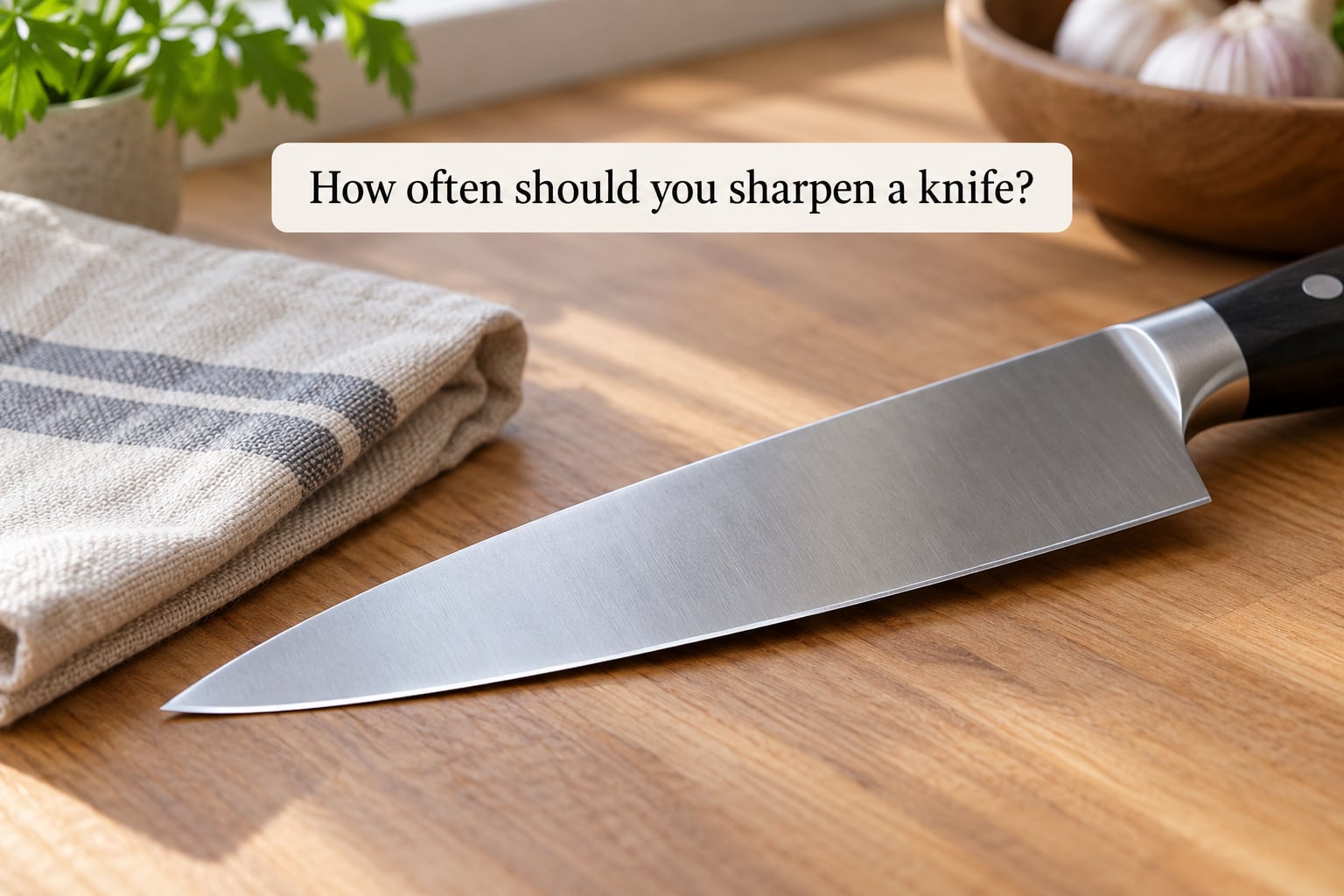
Most home knives need sharpening every 1-3 months if you cook daily, and 2-3 times a year if you cook casually. Honing happens far more often than sharpening, usually before nearly every use, because honing straightens an edge that has rolled but is not yet worn away.
Frequency guidelines by how much you cook
| Who you are | Typical use | Sharpen | Hone | Best method |
|---|---|---|---|---|
| Light home cook | A knife a few times a week, mostly soft produce | 2-3 times a year | Weekly | Honing steel, occasional whetstone touch-up |
| Regular home cook | Chopping 4-6 evenings a week, some root vegetables | Every 3-6 months | Before most uses | Whetstone or guided system, rod in between |
| Daily chopper | Meal prep most days, onions, carrots, butternut squash | Every 1-3 months | Every session | Whetstone or electric sharpener |
| Working line cook | Full prep lists, high volume, service hours | Every 1-4 weeks | Between tasks | Electric sharpener or whetstone on a schedule |
| Outdoor and bushcraft use | Camping, woodwork, occasional field dressing | About once a year | Before each trip | Whetstone, packed with the kit |
Most cut specialists land the average household at one or two sharpenings a year, with the same caveat attached: do not wait too long. That matches what cooks tend to report on knife forums, where the near-universal advice is to hone before each use and sharpen the moment the knife stops feeling right rather than on a fixed date.
What kind of knife changes the sharpening schedule?
Two things drive frequency: how hard the steel is, and how thin and fragile the edge geometry is. A hard Japanese steel holds an edge longer but chips if abused, while a softer European steel rolls over sooner but forgives a lot more.
European chef’s knives and santoku
A German or French chef’s knife usually sits around 20 degrees per side. That broader bevel gives a forgiving edge that survives a wooden board and a dropped tomato, and it typically wants sharpening every 3-6 months at typical home use. Hone the spine lightly on a steel before each prep session and the interval stretches out easily.
Japanese knives
A Japanese gyuto or yanagiba is often sharpened to about 15 degrees per side, sometimes 10 for single-bevel blades. The thinner edge glides through fish and soft vegetables with almost no resistance and cuts paper cleanly, which is a genuinely useful difference. It also chips more readily, so Japanese knives usually want more frequent, gentler sharpenings rather than one heavy correction every six months.
Paring and utility knives
Small paring knives get ignored, and they show it. They are used for everything from peeling to trimming herbs to opening mail, so they get the most varied and the most damaging work. Expect sharpening every 2-3 months even if your chef’s knife is in better shape. A snapped or loose tip on a paring knife is normal, not a sign it is finished.
Serrated bread knives
A serrated knife follows different rules entirely and cannot be sharpened the way a straight edge can. Each serration needs its own point restored, usually with a dedicated serrated sharpener or a diamond paste drawn through the scallops by hand. Once a tooth is bent flat rather than merely bent, it needs grinding back into shape, which is specialist work.
Outdoor and hunting knives
Field knives run on much lower frequency. Outdoor and bushcraft communities commonly settle on a full sharpening once a year, and that makes sense since the knife spends much of its life in a sheath rather than in a cutting task. Coat the blade in oil before you put it away and check it before a trip rather than after.
How can you tell when a knife needs sharpening?
A knife needs sharpening when it starts to ask you to push. A sharp edge goes in on its own; a dull one requires downward force, and force is what makes knives slip, tear and bruise. Here is the distinction that matters first: a rolled edge is bent out of line and honing can fix it, while a worn edge has lost metal and only sharpening restores it.
The Tomato Test
Cut a ripe tomato with a gentle, unsupported motion. If the blade slides through and the cut face is clean and glossy, the edge is sharp. If it squashes the tomato flat, leaves a watery skin behind, or you feel yourself pushing, it is time. This is the single most-shared check across knife communities for good reason: it takes ten seconds and it cannot be faked.
The Paper Test
Hold a sheet of office paper by one edge and draw the knife down it with light pressure. A well-maintained edge bites in and leaves a clean slit with almost no force. A dull one glides over the surface, snags, or needs so much pressure that your hand shakes. Professional knife makers use this same test, which is why you should not feel embarrassed trying it.
The Onion Test
Cut into a raw onion and watch the cut face and your eyes. Dull blades crush the cells rather than opening them, releasing the sulphur compounds as a fine mist instead of the heavier tear gas a clean cut produces. If onions make you cry noticeably more than they should, your knife is crushing food rather than cutting it.
Signs that show up while you cook
- Sliding. The blade slips sideways off onions, potatoes or the skin of a joint. This is the earliest warning and the most dangerous one, because a slipping blade usually means your hand is not where your eyes are.
- Forcing. You press down to get through, and the food compresses into a mangled shape instead of falling into clean slices.
- Bruising and tearing. Herbs blacken at the cut line, tomatoes bleed, onions shred. Fine cuts damage fewer cells, which is why sharp knives also keep food tasting fresher.
- Snagging and bites. The edge catches on the surface of food or on the board, or you find small nicks near the tip.
- Dull spots and uneven glints. Under good light the edge should show an even line. Patchy brightness or a visibly rounded tip means metal is missing.
None of these say anything about a perfectly polished finish. Sharpness and smoothness are different things. A well-honed European knife can be effective with a slightly matte apex, and a mirror-bright edge that snags is not better than a plain one that cuts.
How often should you sharpen each type of knife?
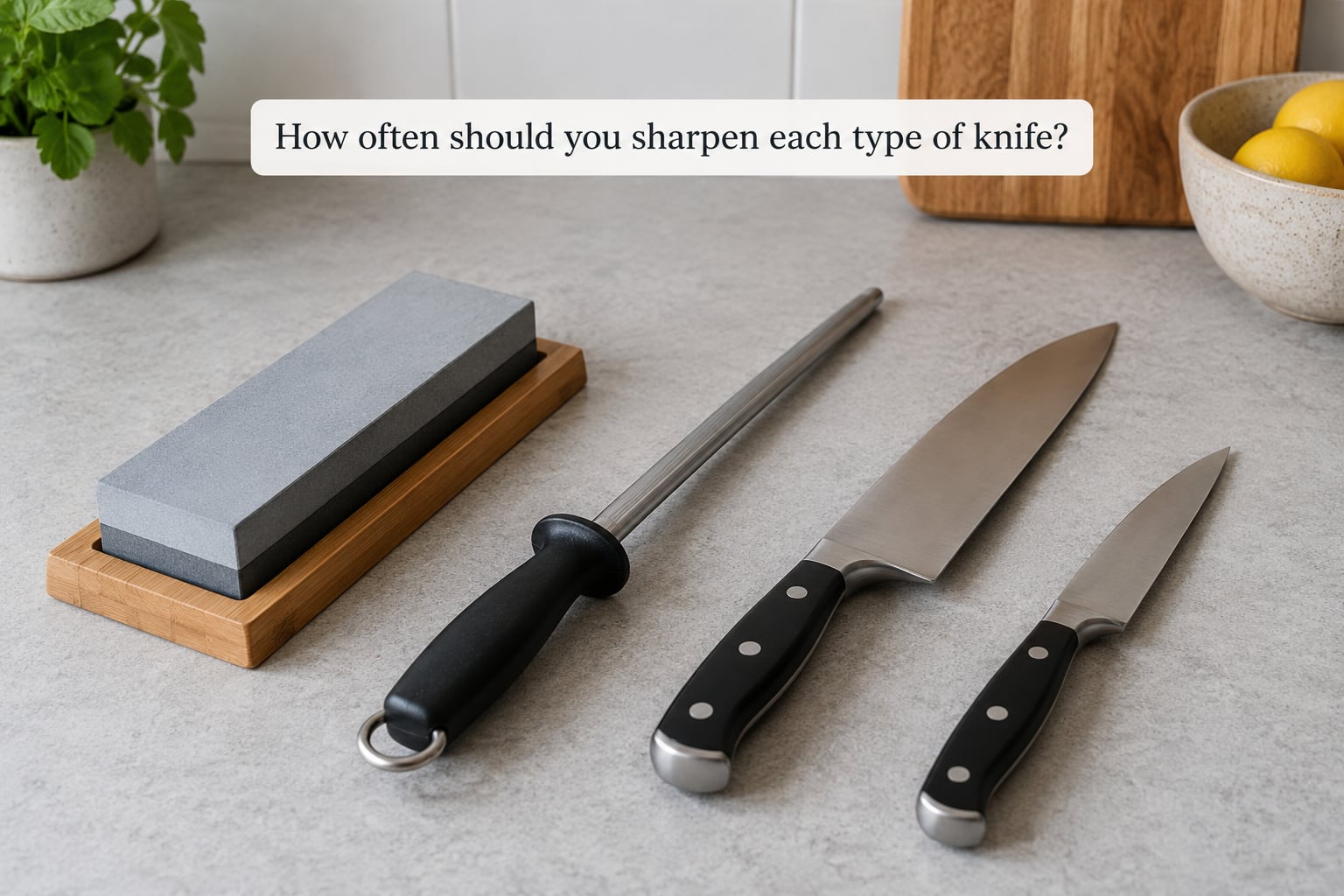
Use these numbers as a starting range and let the tomato test override them. A person who bones fish twice a week and a person who only slices bread on Sunday should not be on the same clock, even with identical knives.
| Knife type | Light home use | Regular use | Daily use | Special notes |
|---|---|---|---|---|
| Chef’s knife or santoku | 2-3 times a year | Every 3-6 months | Every 1-3 months | Hone weekly with a steel |
| Japanese knife | Every 3-4 months | Every 2-3 months | Every 4-6 weeks | Use gentler grit progressions more often |
| Paring knife | Every 3-4 months | Every 2-3 months | Monthly | High chipping risk from multitasking |
| Bread knife (serrated) | Once a year | Every 6-12 months | Every 3-6 months | Needs a serrated-specific tool |
| Utility or boning knife | Every 3-4 months | Every 2-3 months | Every 1-2 months | Fish bones and joints damage the edge |
| Hunting or field knife | About once a year | Every 4-6 months | Monthly | Check before storage, not after |
What should override the schedule
Three things reliably move the numbers. Working through bone, shells or frozen food damages an edge faster than vegetable prep does. Cutting on glass, tile or a hard plastic composite dulls an edge in a single session, so if that is your habit, your real frequency is whatever those boards dictate. And a knife with a wide 20-degree European edge holds up far better on rough work than a 15-degree Japanese edge.
Storage matters more than most people expect. A block that lets the blade rattle against other blades chips edges quietly and repeatedly, and a drawer where knives land loose is worse still. A magnetic strip or a sheath keeps the edge from taking hits it never earned.
What is the difference between honing and sharpening?
Honing realigns. Sharpening removes. Everything else, including how often you should do each, follows from that one difference.
| Honing | Sharpening | |
|---|---|---|
| What it does | Straightens a rolled edge back into line | Removes steel to create a fresh, even bevel |
| Removes metal? | No, or a negligible amount | Yes, every time |
| How often | Before most uses, weekly at minimum | Every few months, based on use |
| Tool | Honing steel, ceramic rod, leather strop | Whetstone, guided system, electric sharpener |
| Effect | Restores bite for days to weeks | Restores bite for months |
| When you need it | After the knife has been used or stored roughly | When honing no longer brings it back |
The failure that confuses people is honing a knife that has actually worn past what honing can fix. You straighten it, it cuts well for two or three days, then collapses again. That pattern shows up again and again on cooking forums, where the same description turns up: regular grooved-rod honing and losing the edge in around five months. Frequent honing does not slow down the loss of metal; it just delays noticing it.
How should you sharpen a knife at home?
There are four realistic routes, and they suit very different knives and very different patience levels. Whetstones give the most control and the longest lasting results. Steels and rods maintain an edge and remove the need to sharpen as often. Electric sharpeners are fast and consistent if your knives take it. Drop-off services handle the expensive cases.
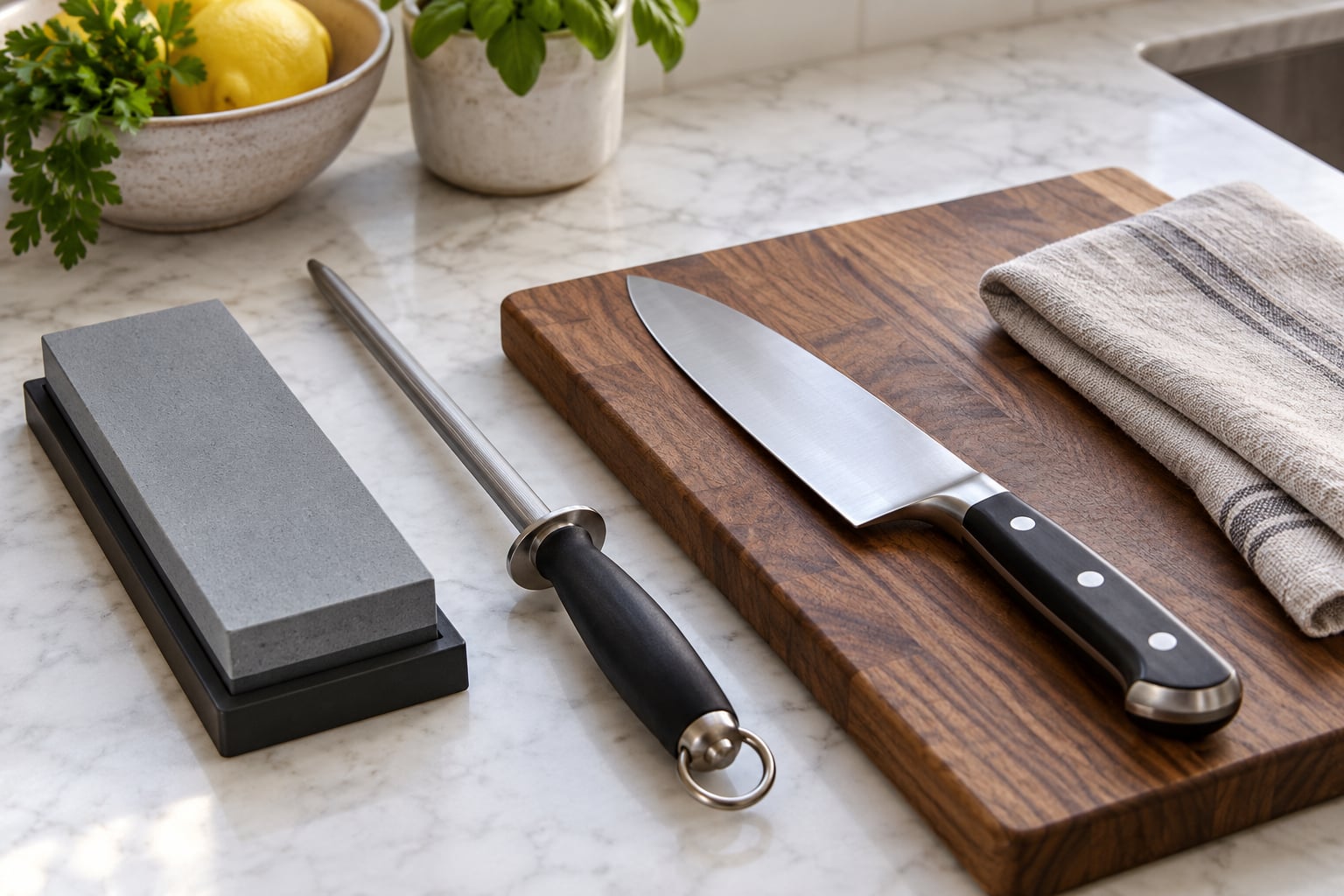
Whetstone grit progression
Water stones and oil stones work in stages. Start at 400 grit to set the bevel, move to about 1000 to refine it, then 3000 to polish, and finish at 6000 or 8000 if you want the keenest apex. A full session on stones is typically 30 to 50 strokes per side per grit, then a strop on leather or newspaper to remove the burr and put a final polish on the edge. Expect 20 to 40 minutes for one knife done properly.
Wetting is not optional. Soak a water stone until bubbles stop, keep it wet through the session, and let it dry flat afterward or it can warp. Wet stones left in a dish and allowed to freeze-thaw cycle crack, which is the most common way an expensive stone gets ruined.
Honing steels and rods
A steel straightens, a ceramic rod cuts a little as it straightens, and a diamond rod sits between the two. Hold the blade at about 15 to 20 degrees to the rod and use light strokes, alternating sides. Do not press hard; you are realigning, not grinding. Knife makers warn against aggressive steel pressure for exactly this reason, and over-confident strokes on a grooved rod can do more harm than the dullness you were fixing.
Electric sharpeners
Electric units hold a consistent angle across the whole edge, which is genuinely useful and hard to match by hand. The ongoing argument is whether the abrasive wheels overheat and burn the temper of the blade at the apex. For most stainless kitchen knives at moderate pressure, the practice is safe and widely used. For a thin, hard Japanese single-bevel knife, hand sharpening gives you more control over what happens near the edge and is what most enthusiasts recommend.
What to do right after sharpening
- Strop the edge on leather or a folded newspaper to remove the burr left by the stone.
- Rinse the blade and dry it immediately, then wipe off any stone slurry.
- Run the tomato test before putting the knife away.
- Clean the stone itself, soak it flat and let it air dry.
Safety
Keep your fingers clear and never sharpen toward yourself. Start slowly so you feel the angle before speed comes into it, and stop as soon as the tomato test passes. You can absolutely damage a knife by sharpening it wrong, usually by grinding an uneven or overly steep bevel that then cannot be corrected cheaply.
How do you maintain a knife between sharpenings?
Sharpening frequency is mostly decided by your other habits. Five changes do more for how long an edge lasts than any stone or steel.
Use the right board
End-grain wood and quality plastic composites are kind to edges. Glass, granite, marble and stone slabs are effectively whetstones for your edge at the wrong angle, and cutting on them in one session can undo a month of careful sharpening. Keep a wood or plastic board as your everyday surface.
Hand wash and dry immediately
The dishwasher heats water well past the temper threshold that steel was hardened to, which softens an edge permanently and corrodes the blade. A five-second rinse and a towel is enough. Drying matters as much as washing because water sitting at the heel and spine causes pitting and rust.
Store the blade where it cannot be hit
Prefer a magnetic strip, a sheath, or a block with wide slots that hold each knife still. Any of these beats a drawer where knives collide, and a loose knife in a drawer is the most common way an edge gets chipped in a kitchen that never touches a stone.
Hone on a rhythm
Hone before you start, not when you notice a problem. Six or eight light strokes per side takes about fifteen seconds and keeps the edge aligned. Skipping it for two months and then doing fifty strokes is where people damage steels.
Cut with the right technique
Use a rocking motion with the tip planted for most prep, keep the tip out of the board, and learn the claw grip so your knuckles stay out of the path. Cutting bone, frozen food or hard produce with a thin knife is not a technique habit, it is how edges chip, and no maintenance routine protects against it.
Should you sharpen a knife yourself or hire a professional?
DIY gives you control, an understanding of your own edge geometry, and no waiting. Professional service gives you a repeatable result and equipment most kitchens do not have. The honest answer depends on what is in your drawer.
Sharpening at home makes clear sense for a European chef’s knife, a santoku, a paring knife and most straight-edged stainless knives. If you will learn one method, learn guided sharpening or a whetstone progression. You can always pay for the awkward knives later.
Professional sharpening earns its place in a few situations. A Japanese single-bevel knife is best handed to someone who works on single bevels, because thinning the back and matching the geometry takes practice. Severely nicked or chipped edges need a machine or a skilled hand to grind back to shape. And if a knife is valuable enough that you hesitate to experiment on it, that hesitation is itself a reason to book the service.
There is also a fourth option people forget: a local drop-off sharpener or a farm-supply or hardware-store counter service. It is cheap and it is quick, but nothing teaches you what the blade actually needed. Fair point. Whatever you choose, the sharpening is one afternoon of work, and the maintenance afterwards is what keeps it sharp for months.
Before spending anything, know what you have. A knife worn flat and rounded needs a full regrind. A knife that is merely rolled and misaligned only needs a good honing session. Those are different services and different prices, and telling them apart at the counter is worth more than any saving.
Frequently Asked Questions
How often should you sharpen a kitchen knife?
Most home knives need sharpening every 3-6 months if you cook four or five times a week, and every 1-3 months if you chop daily. A light user cooking a few times a week can go 2-3 times a year. Honing happens far more often, usually before nearly every use. Let the tomato test decide rather than the calendar.
Is it better to hone or sharpen a knife?
Both, in a fixed order. Honing straightens an edge that has merely rolled sideways, and you should do it before most uses, taking only a few seconds. Sharpening removes steel to build a new bevel, and you only do it when honing no longer restores the bite. Honing first means you sharpen far less often.
How often should I use a honing steel?
Before nearly every cooking session, six to eight light strokes per side is plenty. Think weekly at minimum if you cook a few times a month, and after every prep session if you cook daily. Use light pressure and hold the blade at about 15 to 20 degrees to the rod. Honing hard on a grooved steel can damage the edge it is meant to protect.
How often should you sharpen a serrated knife?
A serrated knife needs far less sharpening than a straight edge, usually once a year at light home use and every three to six months with daily bread slicing. You are not creating one continuous edge, you are restoring individual points, so use a serrated-specific sharpener or diamond paste drawn through the scallops. Bent teeth straighten this way; flattened teeth need professional regrinding.
Is a whetstone better than an electric sharpener?
A whetstone gives more control over the final angle and leaves a finer, longer-lasting edge, and it is the safer choice for hard, thin Japanese knives. An electric sharpener is faster and holds a consistent angle across the whole edge, which matters for beginners and busy kitchens. Neither is inherently wrong; match the method to the steel and to how much time you actually spend on it.
The short version
Pick up your main knife this week and cut a tomato with it. If it slides through cleanly, find your honing steel and give it six light strokes per side before your next prep session. If it smashes the tomato, note what you have been cutting on and write down the date; that is your sharpening schedule, and it is worth more than any rule of thumb.