To keep smoker temperature steady, control three things in this order: airflow into and out of the firebox, the amount and type of fuel burning, and the thermal mass inside the cooking chamber. Airflow moves fastest, fuel moves slowest, and thermal mass is what stops small corrections from swinging the needle.
That ordering matters more than any gadget. Most temperature problems on a charcoal or wood smoker come down to a fire that is either starved of air or flooded with it, plus a chamber that has no buffer to ride out the correction. A new cook usually tries to fix a swing by throwing on more fuel, which spikes the temperature, overshoots, and then crashes once the coals burn down.
Here’s the honest version: nobody holds a dead-flat temperature. A swing of 25 to 30 degrees on a long cook is normal and nobody will ever notice it in the finished meat. What ruins a brisket is a 50-degree-plus collapse or a spike that dries the bark, not a 20-degree wobble. Set expectations there and the rest of this guide gets much calmer.
The whole method below takes about ten minutes of attention at the start and then a check every 20 to 30 minutes. Most of the work is deciding in advance what you are going to do at each temperature, so you stop reacting to a number and start following a plan.
Table of Contents
- What You Need
- Step-by-Step: How to Keep Smoker Temperature Steady
- 1. Preheat and stabilize the smoker
- 2. Use a dependable temperature probe
- 3. Control airflow before adding more fuel
- 4. Add fuel consistently
- 5. Account for wind and ambient temperature
- 6. How often to check smoker temperature
- 7. Recover from a temperature drop or spike
- 8. Hold the target temperature through the cook
- Common Mistakes
- How to Prevent Temperature Swings in Cold Weather
- Food Safety and Safe Smoker Operation
- Frequently Asked Questions
- How do I keep my smoker at 225?
- Why is my smoker not holding temperature?
- Is it better to smoke at 200 or 225?
- How often should I check smoker temperature?
- Do I need a PID controller for smoking?
- Is 350 too hot for smoking?
- Conclusion
What You Need
You do not need a stack of equipment, but four things make the job dramatically easier. The rest is technique.
- An independent probe thermometer. A cheap pit thermometer on the lid tells you almost nothing about where the heat actually sits. A second probe read from a remote display gives you a number you can trust and alarm on, which is the difference between monitoring and worrying.
- Heat-resistant gloves and a poker or hook. You will open a firebox and a chamber door repeatedly. Burns end cookouts, and doing them carefully means you keep your attention on the temperature instead of your hand.
- Dry lump charcoal or briquettes, plus your wood. Wet or damp fuel smokes heavily, burns slower, and drops the temperature as it finally catches. Seasoned wood from a supplier is worth the trip; firewood from a wet pile is the single most common cause of a fire that will not hold.
- A fire extinguisher rated for your fuel type. Grease fires and pellet fires spread faster than most people expect, and a bucket of water makes a grease fire worse. This is not optional equipment for anyone cooking outside on a wood or charcoal smoker.
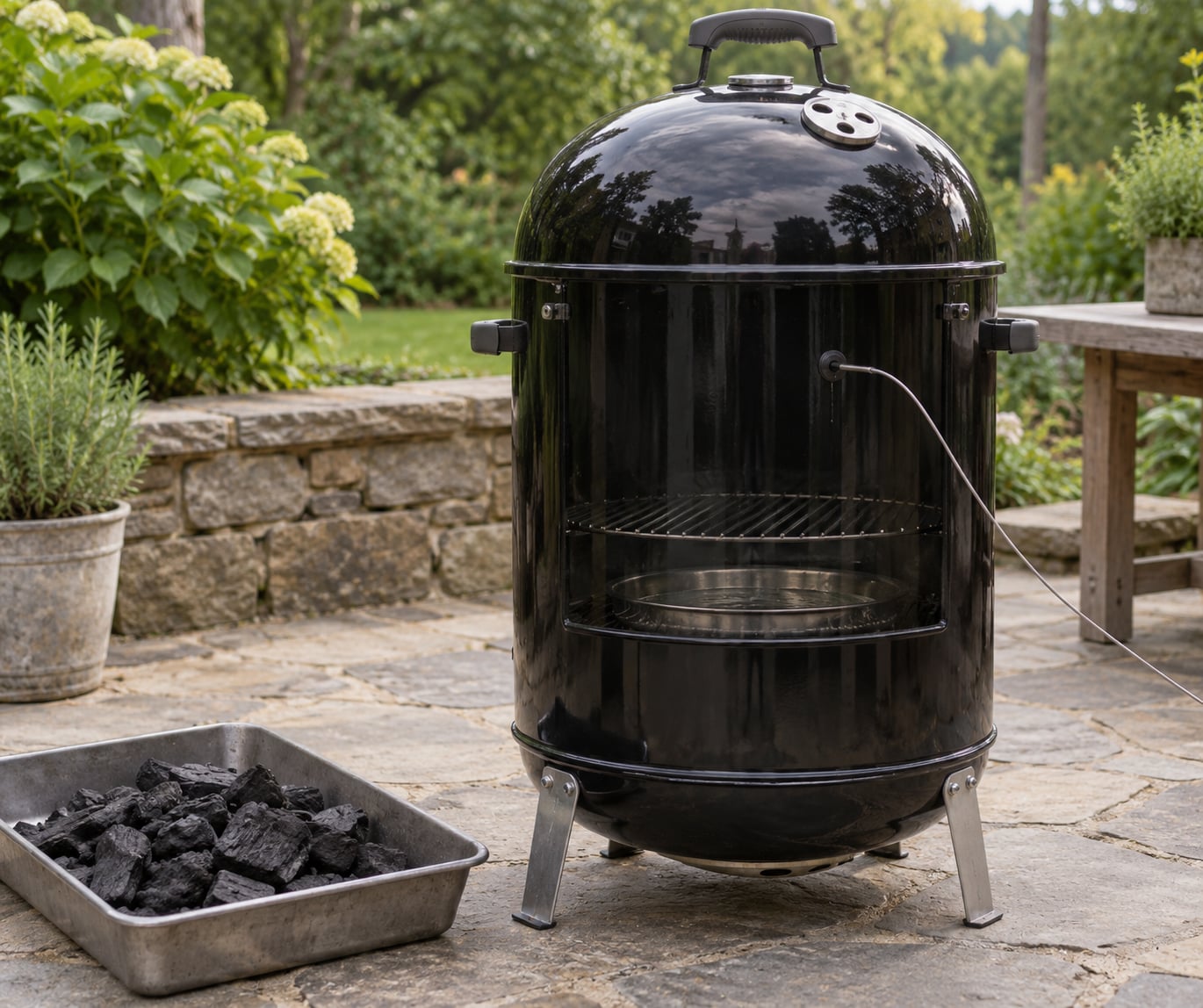
- A water pan, if your smoker has room for one. A pan of water between the fire and the food is the cheapest thermal mass you can buy. It absorbs heat when the fire is hot and gives it back when the fire cools, which flattens out swings for free.
Step-by-Step: How to Keep Smoker Temperature Steady
1. Preheat and stabilize the smoker
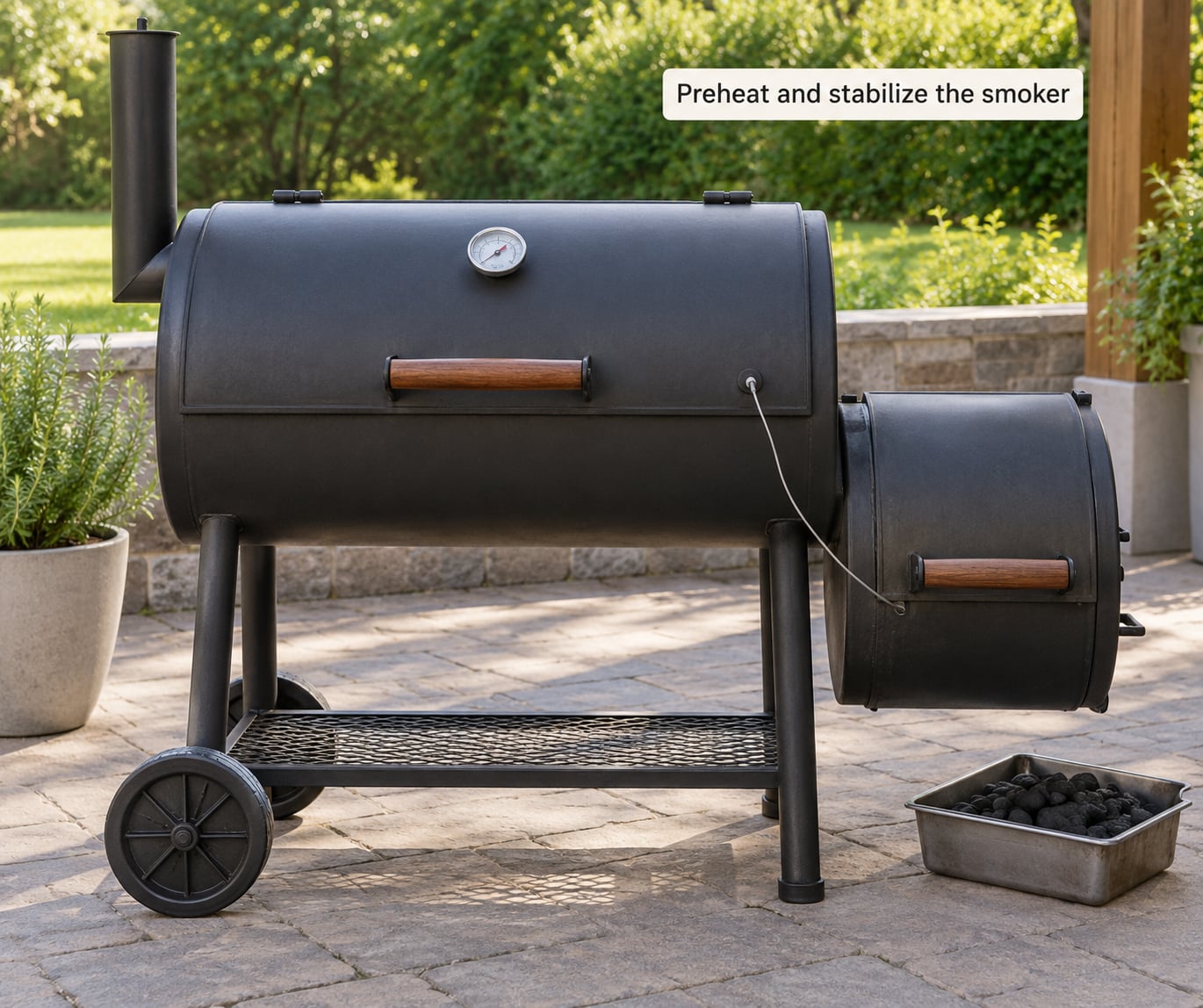
Do not load meat the moment the pit thermometer touches your target. That reading is almost always a lie, because the metal in the chamber and the probe itself are still heating up and the fire has not settled into a steady burn.
Close the lid and give the smoker a full 30 to 45 minutes at your target temperature before you judge it. You are watching for a trend, not a single number: the reading should creep up in the first 15 minutes, then flatten out into a slow, predictable climb or drift. When the change over 10 minutes is smaller than about 5 degrees, the pit is stable and the fire has found its burn rate.
2. Use a dependable temperature probe
Where you put the probe changes the number you read. A probe suspended in open air reports air temperature, which runs cooler than the cooking grate and swings faster. A probe laid across the grate or tucked near the food reports closer to grate temperature, which is what your meat actually experiences.
Compare the smoker’s built-in thermometer against your independent probe once, side by side, and note the offset. Some pit thermometers read 20 or 30 degrees off in either direction, and once you know yours does, you can stop second-guessing it. Keep the probe away from the firebox wall, away from a fresh load of coals, and away from the door, or you will get a spike every time you add fuel that has nothing to do with the chamber air.
3. Control airflow before adding more fuel
The intake damper feeds air to the fire and the exhaust vent pulls that air through the firebox and out of the chamber. Airflow is your primary control because it changes heat output immediately, while fuel takes 20 to 30 minutes to matter.
- Start small. Leave the chimney or exhaust vent fully open and set the intake to about one-quarter open, then let the fire find its level.
- Adjust gradually. Make the smallest intake change you can and wait 15 minutes before reacting. Open the intake when you need more heat, close it a crack when you are running hot.
- Choke carefully. Never shut the intake completely. Starve a fire and it smolders, produces creosote and acrid smoke, and may go out entirely.
Use the exhaust vent mostly to keep smoke moving. Leaving it fully open also pulls creosote out of the chamber instead of letting it condense on the walls and onto your food.
4. Add fuel consistently
The fire, not the damper, is the slow control. Each addition of coal dumps a burst of heat into the chamber as the new fuel ignites, which is exactly the spike-and-crash pattern people complain about.
Match your fuel to your smoker and your cook. Lump charcoal burns hot and fast and burns out quickly, so it needs a base built to last. Briquettes burn longer and more evenly, which makes them a better match for an overnight cook on a vertical or offset. Wood splits add flavor but little sustained heat, so think of them as seasoning for a fire that already exists, not as fuel to build a cook on. If you add wood too early, before the coals are established, the temperature drops while the wet wood smothers the fire and steams off.
Add fuel in small amounts, on the side of an established fire rather than dumped on the hot center, and add it earlier than you think. Adding at the 30-minute mark means the new fuel has 30 minutes to settle before it starts feeding heat again.
5. Account for wind and ambient temperature
Your pit is fighting the weather, and it loses more heat to a steady crosswind than most people expect. A cold day can cost you 20 to 30 degrees of grate temperature at the same fuel load, and a warm day does the reverse, which is why a smoker that held fine in July will not hold in January with the same settings.
Notice which side the fire is on when temperature sags, and put a windbreak on that side. Keep it far enough back that it blocks the wind without blocking your vents or your firebox door, and never drape anything over or against the smoker that can touch a hot surface. In summer heat, expect to close the intake further than your usual setting, and expect more smoke as a result.
6. How often to check smoker temperature
Checking is not the same as hovering. Check on a schedule, write the number down every time, and read the trend instead of the single digit. A single reading tells you nothing, because 230 could be a rising pit or a falling one, and those need opposite corrections. Two readings 15 minutes apart tell you the direction and the speed, which is the only thing you can actually act on.
Then set alarms instead of standing over the pit. For a 225 target, set a low alarm around 180 and a high alarm around 275. Alarms let you walk away from the smoker and do something else, and a pit that drifts within those bands is working fine. The meat has its own thermal mass, so it does not notice a 20-degree wobble over 20 minutes.
7. Recover from a temperature drop or spike
When the temperature falls, work through this in order rather than reacting to the number itself.
- Check the fire first. Look through the firebox door. No visible glow means the fire needs air or fuel, not a damper change.
- Open the intake a crack more. Wait 15 minutes. If the temperature is climbing, stop there and make no other change.
- If the fire is thin, add a small amount of fuel. Add early and add small, then leave the chamber door alone for a full 20 minutes.
- If it has not recovered in 20 minutes, suspect weather or a leak. Check the firebox door gasket, the ash pan, and whether wind is hitting the firebox side.
- If the temperature is spiking instead, close the intake slightly and leave it for 15 minutes. Do not add fuel, and do not open the chamber door, which adds oxygen to a fire that already has plenty.
Opening a chamber door during a cook typically costs 20 to 40 degrees and takes longer to recover than most people expect. Make it one trip, not four.
8. Hold the target temperature through the cook
By hour three, a well-built fire needs very little from you. The routine is simple: check every 20 to 30 minutes, compare against the last two readings, and make one small change only if the trend is clearly wrong.
Keep the chamber closed whenever practical. Keep fuel in reserve so an addition is never a panicked event. Re-evaluate your damper setting every hour or so, because a fire that needed a quarter-open intake at start-up will want slightly less by the third hour as the coal bed burns down. If you want to leave the smoker overnight, build a coal base you trust rather than a small fire you have to babysit, and keep a wide alarm band so a slow overnight drift does not wake you.
Common Mistakes
- Adding fuel too early. A cold load of coal takes 20 to 30 minutes to catch. Adding it at the moment the temperature dips guarantees a dip followed by a spike. Fix: add while there is still a glowing bed underneath.
- Opening the door out of curiosity. Each opening is a 20 to 40 degree loss. Fix: set an alarm and let it do the watching.
- Using wet fuel. Wet wood and damp charcoal smoke, steam, and stall. Fix: store wood covered and raised off the ground, and buy charcoal in sealed bags.
- Trusting a cheap pit thermometer. Fix: check it once against an independent probe and remember the offset.
- Making large corrections. Slamming the intake wide open or fully closed sends the pit in the opposite direction 15 minutes later. Fix: quarter-turn adjustments, then wait.
- Blocking the vents. A pan, a garden chair, or a stack of wood leaning against the intake chokes the fire and produces heavy, acrid smoke. Fix: keep a clear path to the intake and the firebox door.
- Loading the meat at temperature. A cold load of meat in a pit that just hit its number pulls the chamber down hard and prolongs recovery. Fix: stabilize first, then load.
How to Prevent Temperature Swings in Cold Weather
Cold weather is mostly a fuel and airflow problem wearing a coat. A smoker burning the same load at 35 degrees will read cooler than the same smoker in July, so the correction is more fuel and slightly more air, applied earlier in the cook rather than in a panic.
Put a windbreak on whichever side the wind is coming from, positioned so it never blocks a vent or touches the smoker body. Use dry fuel exclusively, since wet wood loses a large share of its heat to boiling before it ever reaches the grate. Check every 15 minutes instead of every 30, because cold ambient air makes both the fire and the metal walls of the chamber work against you. Add a water pan if you do not run one, and refill it while it is still warm so you are not pouring cold water into a hot chamber mid-cook.
Some owners add ceramic blanket or firebox door seals to reduce heat loss. Do that only if your smoker’s manual allows it, never block a vent, and never wrap anything that can contact a hot surface. Follow the manufacturer’s instructions for your specific unit on any insulation or gasket work.
Food Safety and Safe Smoker Operation
Read your smoker’s manual and follow it. Vent settings, firebox clearances, and fuel limits are specific to your unit, and the manual is the only source that knows.
Operate outdoors, on a stable non-combustible surface, away from dry vegetation, fences, and structures. Never leave a fire unattended in high wind. Keep a fire extinguisher within reach, never pour water on a grease fire, and never use lighter fluid or accelerants of any kind on a fire that is already lit. Store and handle charcoal chimney starters and any fuel oil away from heat sources and out of reach of children, and let used chimney starters cool on a non-combustible surface before disposing of them.
Temperature control only matters because of what happens to the food. Check internal temperature with a probe, not color or time, and follow the USDA minimums: 165°F for poultry, 160°F for ground meats, and 145°F for whole cuts of beef, pork, and fish. Hold food above 140°F until you serve it, and refrigerate leftovers within two hours.
Frequently Asked Questions
How do I keep my smoker at 225?
Build a fire with enough coal to last your cook, leave the exhaust vent fully open, and start with the intake about one-quarter open. Adjust the intake in small turns only, waiting 15 minutes between changes. Run a water pan for thermal mass and set probe alarms near 180 and 275 so you are not constantly checking. A 25 to 30 degree swing is normal and harmless at this target.
Why is my smoker not holding temperature?
Work through it in order: look at the fire, then the intake, then the fuel, then the weather. A dead or thin fire needs air and fuel. A hot fire needs the intake closed a crack. A pit that only drifts in one direction in cold or windy weather needs a windbreak and more fuel added earlier. A pit that reads wrong against a second probe probably needs the probe repositioned, not the fire adjusted.
Is it better to smoke at 200 or 225?
Both work well. 200 gives more smoke and a longer cook, and 225 finishes faster with a slightly bolder bark. What matters far more than the number is holding whichever target you pick. Pick one temperature, set your alarm band around it, and resist the urge to chase the reading. Switching targets mid-cook changes the cook more than a 25 degree wobble ever will.
How often should I check smoker temperature?
Every 20 to 30 minutes is plenty for most cooks, and every 15 minutes in cold or windy weather. Record each reading so you can see the trend rather than a single number. Better yet, set high and low alarms on your remote thermometer and check only when it sounds. Constant hovering leads to over-correcting, and over-correcting causes more swings than the drift you were trying to fix.
Do I need a PID controller for smoking?
Not on a charcoal or wood smoker, where there is no burner to cycle. A PID controller is for pellet and electric units, and it mainly reduces the size of swings rather than improving flavor. On a charcoal smoker, a second probe, a water pan, and a good coal base do more for stability than any controller. Add automation only if you cook long unattended meals and already have the fundamentals dialed in.
Is 350 too hot for smoking?
For low and slow cooking, yes, 350 is too hot. It dries the surface of the meat faster than the interior can catch up, and bark sets before the collagen has converted. Short hot-and-fast cooking is a different method entirely. For pork shoulder, brisket, and ribs, stay between 225 and 275 and treat any reading above 300 as something to correct slowly through the intake damper.
Conclusion
Start by preheating the smoker fully and getting a second, independent probe reading beside your pit thermometer. That single habit catches a bad probe, a leaking firebox door, and most weather problems before they become a lost cook.
From there, change one thing at a time, make the change small, and give it a full 15 minutes. Add fuel early and in modest amounts, keep the exhaust vent open, and let a water pan do the smoothing. Gradual corrections and consistent checks will hold your temperature steadier than any gadget, and your smoker’s manual will keep you safe while you do it.