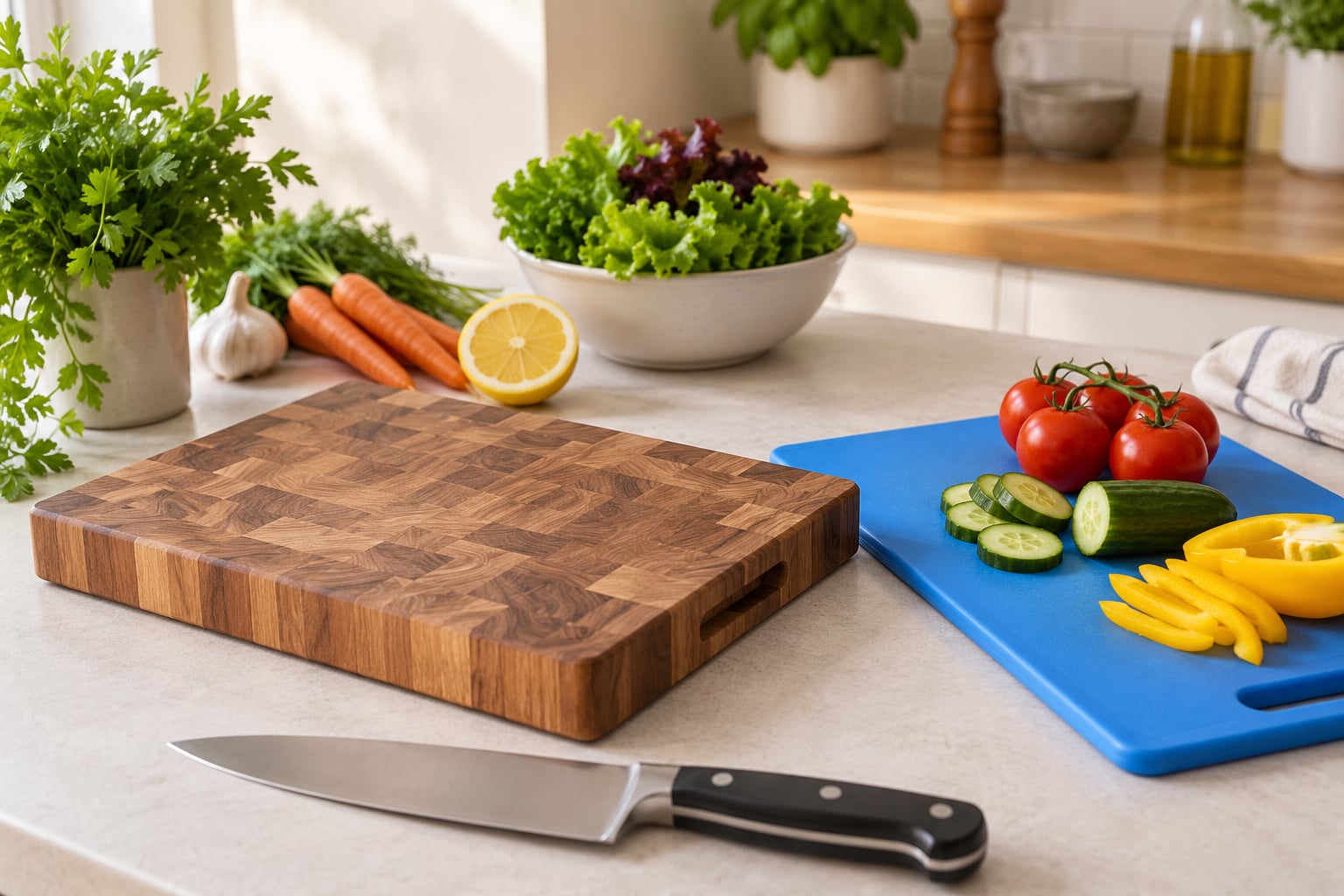
Short answer: a well-maintained wooden cutting board is safer for bacteria than a plastic one, while plastic is easier to fully sanitize and survives a dishwasher. On the question of wood vs plastic cutting boards which is safer, the honest verdict is that neither material saves you from cross-contamination if you skip separate boards for raw meat and produce.
The old warnings about wood being too porous to clean are mostly outdated. Published research from the 1990s found bacteria applied to wood surfaces couldn’t be recovered afterward, while the same bacteria survived and were recovered from plastic. That finding reversed decades of guidance, and it’s why you now see test kitchens and food editors leaning toward wood.
Still, most home cooks are not choosing on microbiology alone. Boards warp, smell, shed particles, dull knives, or land in the dishwasher against the manufacturer’s instructions. So the practical answer depends on how you cook. Let’s break it down by the things that actually decide the question.
Table of Contents
- Wood vs Plastic Cutting Boards: Which Is Safer at a Glance
- How Do Wood and Plastic Cutting Boards Affect Food Safety?
- Wood is porous, and that turned out to be a feature
- Plastic is nonporous, and that cuts both ways
- Damaged surfaces defeat both materials
- The old warning you remember was reversed by evidence
- What Is the Safest Material for a Cutting Board?
- Wood vs plastic cutting boards which is safer depends on your food
- How Does Cleaning and Maintenance Change the Answer?
- How to sanitize any cutting board with diluted bleach
- Getting stains and smells out of wood
- Glue and finishes in wood panels
- Why restaurants still use plastic boards
- Which Material Lasts Longer and Damages Knives Less?
- Knife wear
- Warping, cracking and lifetime
- Which Should You Choose?
- Frequently Asked Questions
- Does a wood or plastic cutting board hold more bacteria?
- Can I put raw meat on a plastic cutting board?
- Why do restaurants not use wooden cutting boards?
- How long can bacteria live on a wooden cutting board?
- Are plastic cutting boards safe microplastics?
- Conclusion
Wood vs Plastic Cutting Boards: Which Is Safer at a Glance
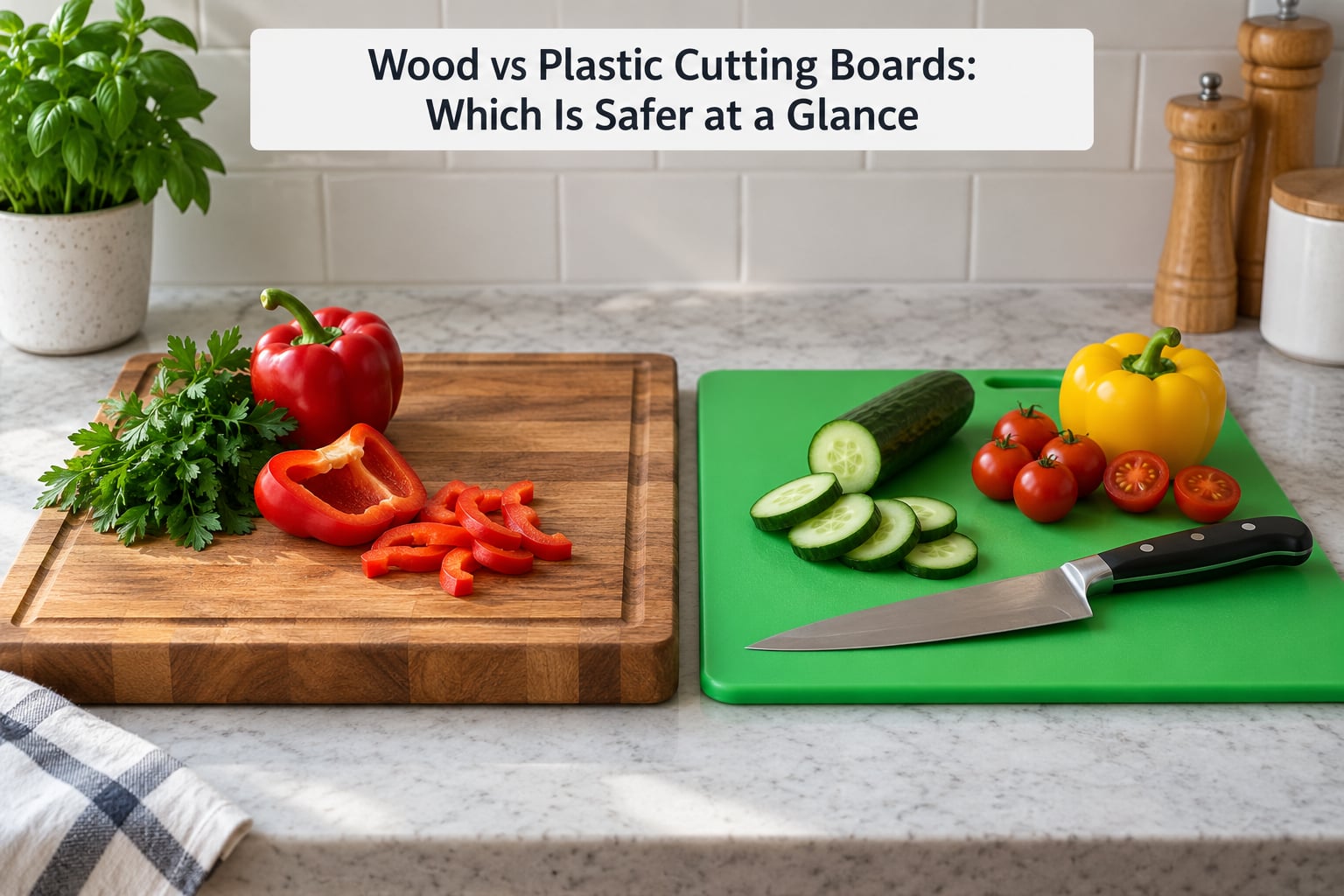
This table is the whole argument in one place. Read down the middle column first, then check where your own habits fit.
| Factor | Wooden cutting board | Plastic cutting board |
|---|---|---|
| Bacteria retention | Very low when bacteria land on intact wood; drying and surface cleaning remove residues | Low on a new board; rises sharply once deep knife grooves trap residue |
| Microplastics | Not applicable, though glued panels use binders | Cutting releases plastic particles, and harder foods release more |
| Cleaning method | Hot soapy water by hand; no soaking, no dishwasher | Hot soapy water or dishwasher; bleach solution works well |
| Knife edge impact | Softwoods give slightly and help protect edges | Harder surface, scores faster, dulls edges sooner |
| Odor and staining | Absorbs smells; removable with salt and lemon or sanding | Holds stains and odors in grooves and can be scrubbed or discarded |
| Durability | Sandable and re-oilable for years, sometimes decades | Cheap to replace once grooves get deep |
| Best suited to | Fruit, vegetables, bread, herbs, cooked foods | Raw meat, poultry, seafood, high-volume prep |
One more row that isn’t in most comparison tables: what happens when you get it wrong. A cracked, dried-out wood board hides residue in its fissures. A deeply scored plastic board hides residue in the same place. Condition beats material.
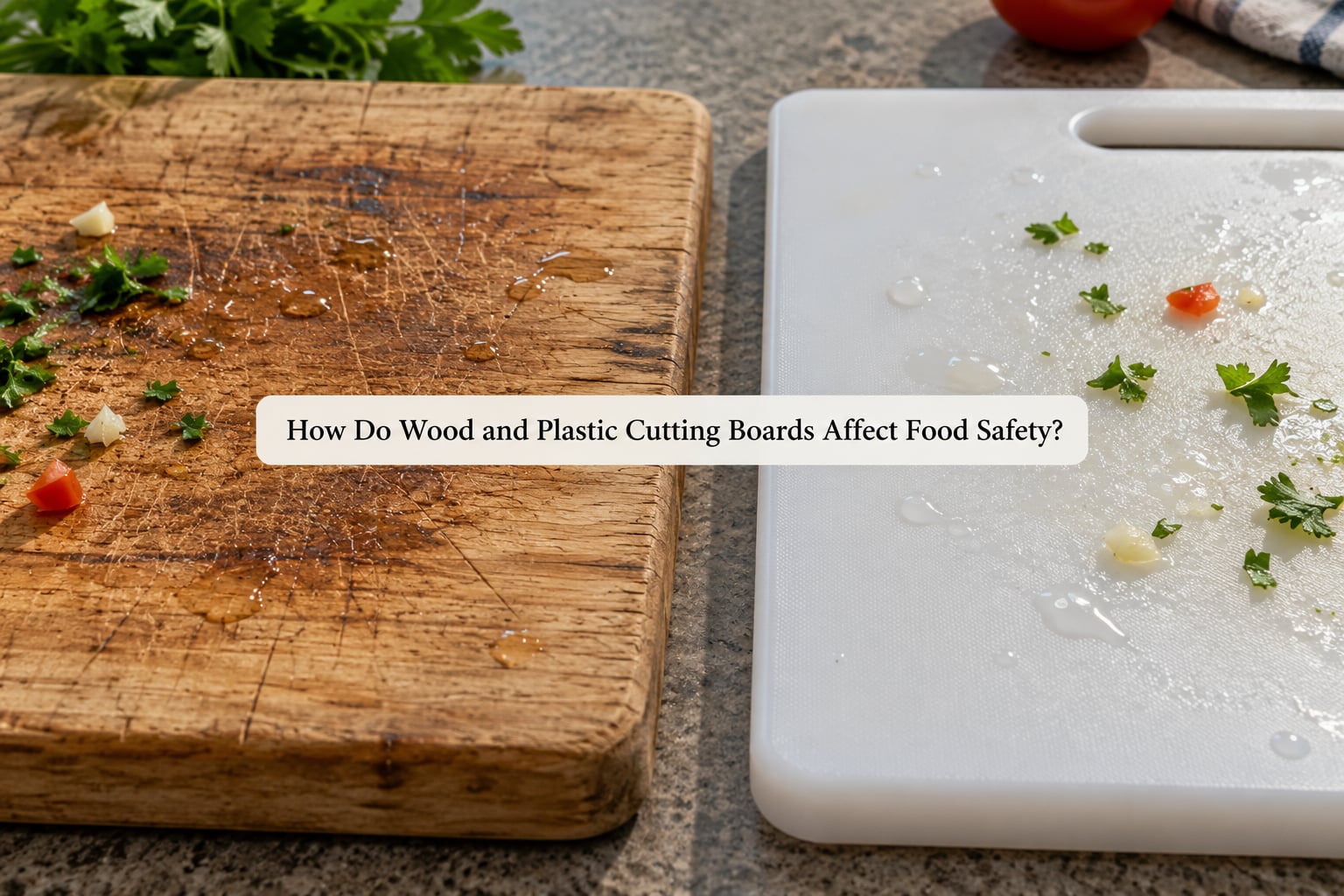
How Do Wood and Plastic Cutting Boards Affect Food Safety?
Wood is porous, and that turned out to be a feature
The case against wood has always been porosity: liquid soaks in, bacteria finds shelter, and soap can’t reach it. The flaw in that logic is that wood does not hold liquid the way a sponge does. It absorbs moisture, swells, and pushes water back out as it dries, and the same uptake-and-release cycle damages the cell walls of many bacteria that land on it.
In the research that changed the conversation, researchers contaminated wood and plastic surfaces with bacteria including Listeria, Salmonella, Escherichia coli, and Staphylococcus aureus. Bacteria could not be recovered from the wood after a short contact period, while they were recovered from the plastic. Later work with different wood species and surface conditions produced similar results.
Plastic is nonporous, and that cuts both ways
Nonporous means a wet cloth and soap reach the whole surface, and a diluted bleach solution sits on the surface instead of soaking in. That is a real advantage, and it is why plastic remains the default in clinical and institutional food handling.
The problem is scoring. A hard knife dragged across plastic leaves grooves that become deeper with use. Those grooves are where a rinse doesn’t reach, where a sponge compresses over rather than into, and where bacteria survive a wash and dry out between uses. Kitchen sponges themselves are a well-documented reservoir, and a grooved board traps the same kind of moisture.
Damaged surfaces defeat both materials
A split end-grain board full of crevices, or a plastic board with cuts you can feel with a fingernail, is a bad surface no matter what the marketing says. Bacteria hide in cracks and in the interface between two glued strips, and no amount of scrubbing reaches them.
The practical rule: replace boards based on condition, not on material loyalty. The USDA’s Food Safety and Inspection Service guidance is that both plastic and wooden cutting boards wear out over time and should be discarded once surface grooves make them hard to clean.
The old warning you remember was reversed by evidence
For decades, the standard advice was avoid wood because of its porous surface. That came from 1970s and 1980s recommendations before the antimicrobial studies. The 1990s reversal is why current food-safety bodies describe wood boards as acceptable, provided you clean them and replace them when they wear out. If someone tells you wood is inherently unsafe, they are quoting advice that has since been superseded.
What Is the Safest Material for a Cutting Board?
Quality wood is safer for bacteria retention, and plastic is safer for raw meat because it sanitizes more completely. Both are safe when maintained properly and replaced when worn, so the safest choice is the one you will actually wash after every use and keep dry.
Wood vs plastic cutting boards which is safer depends on your food
If you break down wood vs plastic cutting boards which is safer by task, the answer splits cleanly. Wood wins for ready-to-eat foods: raw vegetables, bread, herbs, cheese, cooked meat, fruit. Those foods go straight to the mouth or into a hot pan, so a surface that has quietly absorbed odor and dried residue matters less than one that is gentle on your knife.
Plastic wins for raw meat, poultry and seafood. Those are the foods that carry Salmonella and E. coli, and they are the foods where you want a surface you can hit with hot soapy water, run through a dishwasher, or drench in a bleach solution.
Neither material is a free pass. Cook for a health reason beyond this comparison? The USDA safe minimum internal temperatures still apply to the food itself: 165°F / 74°C for poultry, 160°F / 71°C for ground meat, and 145°F / 63°C for whole cuts and fish. A clean board protects the food before it hits the heat; the temperature protects it after.
How Does Cleaning and Maintenance Change the Answer?
Care is the variable that flips this comparison more often than material does. A wooden board that gets washed, dried upright, and re-oiled behaves better than a plastic board that sits wet and grooved.
How to sanitize any cutting board with diluted bleach
This method works on wood and plastic alike, and it’s the one food-safety agencies point to.
- Wash the board with hot water and dish soap, scrubbing the surface.
- Mix one gallon of water with one tablespoon of unscented liquid chlorine bleach in a sink or basin.
- Flood the surface with the solution and let it stand for a few minutes.
- Rinse with clear water and dry upright, standing rather than flat.
- Repeat after every raw meat, poultry or seafood session.
Wood boards should not be soaked or left flat to dry, because standing water is what causes warping and splitting. Dry them on edge with air moving around them. Oil a wood board when it looks dry or pale, using food-grade mineral oil; a board that feels thirsty after a week of use is ready.
Some woodworking regulars argue that any finish, including mineral oil, interferes with wood’s ability to eliminate bacteria. That’s a fair theoretical worry, but the same people point at unfinished, glue-free panels as the ideal, which most home cooks won’t have. A board you maintain and replace on schedule beats a perfect board you let sit and dry out for two years.
Getting stains and smells out of wood
Wood takes on color from beets, turmeric and red wine, and it holds garlic and onion odors. Press coarse salt onto the damp surface, cut a lemon in half, scrub the cut face over it, and let it sit for several minutes before rinsing. Then dry and re-oil. For stains that stay, sand the surface with 180- to 220-grit paper, which flattens fibers, and oil it again.
For odor that sanding won’t fix, and for cracks that never heal, replace it. Those are exactly the boards the food-safety guidance tells you to discard.
Glue and finishes in wood panels
Most wide wood boards are edge-grain strips glued and edge-laminated together, and bamboo boards are laminated and often made from strand-woven blocks. This is a fair concern from cooks who prefer a single solid slab. Look for boards made from food-safe glue and finished with food-grade mineral oil, or with a mineral oil and beeswax blend, both of which are accepted as food-safe finishes. Board makers who want to answer the question directly will say so on their care page.
Why restaurants still use plastic boards
Wood is winning the bacteria argument, yet nearly every commercial kitchen runs on plastic. The reasons are operational, not hygienic.
- Speed. A board can go from the dish pit to the line in minutes. Wood boards need hand washing, drying time and rotation through the dish rack.
- Replaceability. A commercial line burns through boards. Swapping a damaged one takes seconds and costs almost nothing.
- Certification. Food service equipment is typically listed and certified by a standards body, and those listings are mostly for plastic and similar materials.
- Volume and abuse. Boards get tossed, dropped and hit with heavy cleavers all day. A wood board in that environment would be destroyed in weeks.
- Flat, consistent surfaces. Sealed plastic gives an even work surface that doesn’t absorb juices or warp between shifts.
Home cooks don’t have any of those pressures. A wood board in a domestic kitchen is a calm tool used a few times a day, and that’s the environment where it performs well.
Which Material Lasts Longer and Damages Knives Less?
Wood is gentler on knife edges and lasts longer when maintained; plastic is tougher but harder on a knife and built to be thrown away.
Knife wear
A softer wood like maple, walnut or cypress compresses slightly under a blade and springs back, which dulls an edge more slowly than a hard surface. Harder boards, bamboo among them, take a sharper bite. Bamboo is a grass rather than a wood, and it’s denser and more scratch-resistant than most hardwoods, so it behaves closer to plastic in that respect while also drying out faster.
Plastic is the hardest of the three common options. It holds an edge fine, but the scoring is permanent until you sand it or replace it, and that permanent scoring is what damages edges over time.
Warping, cracking and lifetime
A wood board warps when one face dries faster than the other, which is why dishwasher use ruins most of them. The heat and the standing water together do it in a single cycle. A plastic board can go in the dishwasher and come out fine, though the heat will dull a plastic board over repeated cycles and eventually send it to warp.
Long-term, wood wins on replacement cycles. Sand and re-oil a wood board and it keeps going; buy-it-for-life shoppers tend toward exactly this approach for that reason. Plastic is cheaper to replace but generates more waste, and a board discarded every year or two is a recurring cost that adds up quietly.
Worth noting on end grain versus edge grain: end-grain boards are more forgiving of knives because of how the fibers orient, but they’re harder to clean because the seams between blocks trap residue. Edge-grain boards are easier to sanitize and are the better choice if washing is your main concern.
Which Should You Choose?
Pick wood if you mostly cut produce, bread, herbs and cooked foods, and you like a surface that treats your knives well. Pick plastic if raw meat and poultry go through your kitchen regularly and you want the option of the dishwasher and bleach.
For the mixed household, the recurring answer from home cooks is the same one restaurant advice gives: run two boards. Keep one board dedicated to raw meat, poultry and seafood, and a second for everything else. That arrangement makes the material question nearly irrelevant, because cross-contamination happens through shared surfaces far more often than it happens through the surface itself.
On a budget, a straightforward approach works fine: a thick plastic board for meat that you are willing to throw away, and an inexpensive end-grain wood board for produce that you sand and oil as it wears. You don’t need expensive versions of either to be safe. Condition and routine are what matter.
Whichever you land on, mark it, so you remember which board is the meat board. It’s a small habit that removes most of the risk people worry about.
Frequently Asked Questions
Does a wood or plastic cutting board hold more bacteria?
Research from the 1990s found that bacteria applied to wood surfaces could not be recovered afterward, while the same bacteria survived and were recovered from plastic. That said, a deeply scored plastic board can hold more than a smooth one, and a cracked wooden board hides residue too. Replace either board when grooves or cracks stop responding to cleaning.
Can I put raw meat on a plastic cutting board?
Yes, and plastic is the preferred material for it because the nonporous surface responds to hot soapy water and a diluted bleach solution. Wash the board right after use with one gallon of water and one tablespoon of bleach, let it stand for a few minutes, then rinse and dry. Keep a separate board for ready-to-eat foods like bread, fruit and vegetables.
Why do restaurants not use wooden cutting boards?
Commercial kitchens choose plastic for speed, replaceability and certification, not because wood is unsafe. Boards move through a dish pit in minutes, damaged ones are swapped in seconds at low cost, and restaurant equipment is typically listed to food-service safety standards that cover plastic. Wood also cannot handle the speed, heat and cleaver abuse of a busy line.
How long can bacteria live on a wooden cutting board?
Studies on intact wood found bacteria could not be recovered from the surface after brief contact, because wood absorbs moisture and the resulting cycle damages bacterial cell walls. That protection disappears on damaged surfaces, in deep cracks between glued strips, and on boards left permanently damp. Condition matters more than elapsed time.
Are plastic cutting boards safe microplastics?
Cutting on plastic does release small plastic particles, and research on cutting surfaces found that harder foods such as carrots generate more particles than softer ones. The health significance at typical household exposure is not firmly established, which is why some cooks move to wood or hybrid boards. Washing and replacing a grooved board reduces how much debris sits on it.
Sources for the claims above include USDA Food Safety and Inspection Service guidance on cutting boards, the published antimicrobial wood research that reversed the older “wood is unsafe” advice, and laboratory work on plastic particle release during cutting.
Conclusion
Wood edges out plastic on bacteria retention and knife friendliness. Plastic wins on sanitizing speed and dishwasher tolerance. The winner of wood vs plastic cutting boards which is safer is decided by what you cut: wood for produce and ready-to-eat food, plastic for raw meat, both only while the surface is intact.
Start tonight. Look at your current board, run a fingertip across it, and replace it if there are grooves you can feel or cracks that catch a cloth. Then buy a second board for raw meat and give it the same rinse-every-time rule. That habit does more for your kitchen than any material choice.