How long to smoke a pork shoulder comes down to two numbers: how many pounds of meat and how hot your smoker is running. A pork butt takes roughly 1.5 to 2 hours per pound at 225°F, so an 8 to 10 lb shoulder needs about 12 to 16 hours. Push the pit to 275°F and the same shoulder finishes in 8 to 10 hours. Time is only an estimate, though. You pull the meat on temperature and tenderness, not on the clock.
Table of Contents
- What You Need
- Step-by-Step: How Long to Smoke a Pork Shoulder
- How Long to Smoke a Pork Shoulder by Smoker Type and Cut
- How to Trim, Season, and Smoke the Shoulder
- How to Track Temperature, Handle the Stall, and Wrap
- How to Rest, Pull, and Check the Final Texture
- Common Mistakes
- Frequently Asked Questions
- How long does it take to smoke an 8 lb pork shoulder?
- What temperature should a pork shoulder be smoked at?
- Do you have to wrap a pork shoulder while smoking it?
- How do I know my pork shoulder is done instead of just cooked?
- How long can smoked pulled pork be stored?
- Conclusion
What You Need
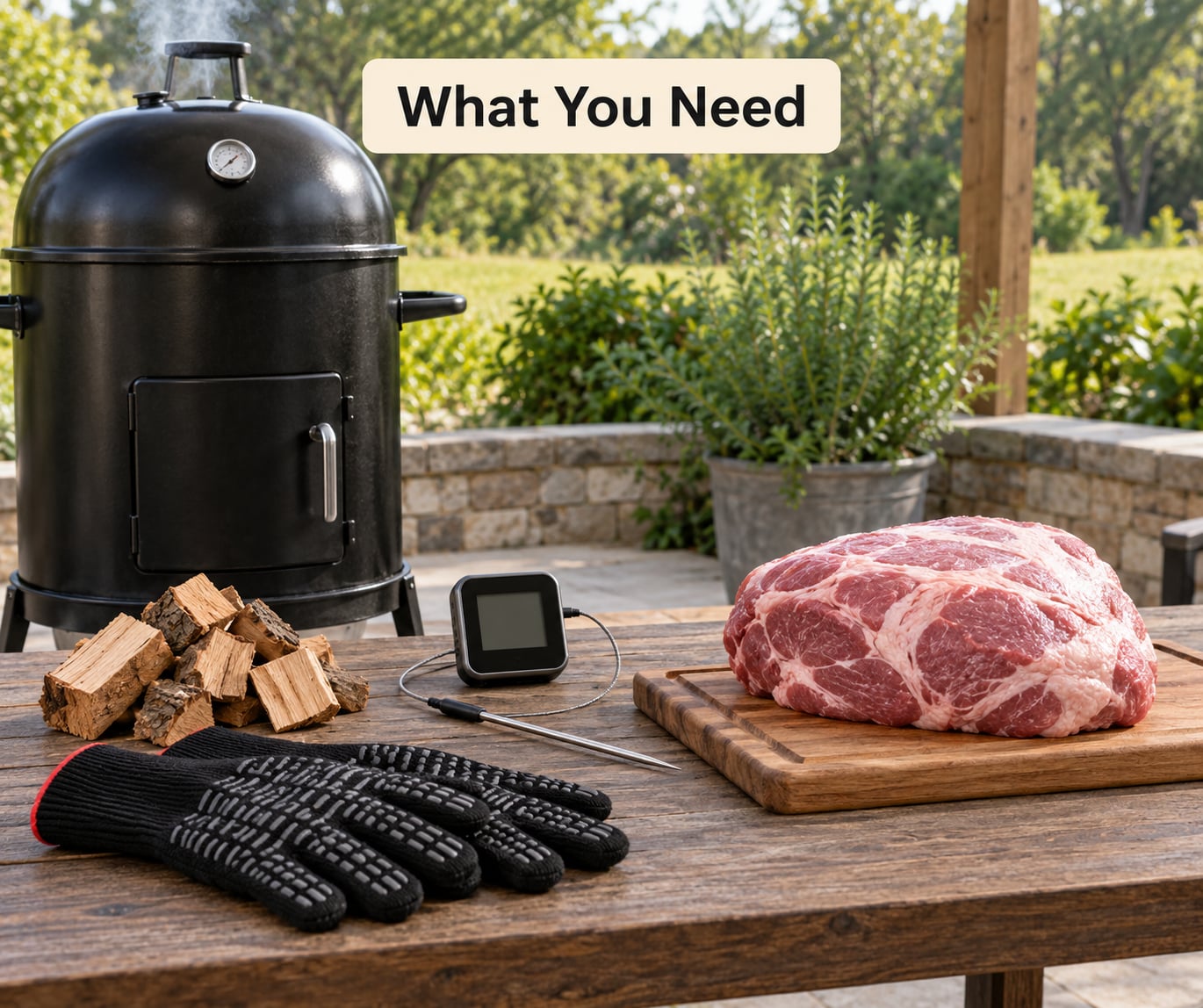
A shoulder is an all-day item, so the equipment matters more than the recipe. Grab a smoker or grill that holds temperature for 8 to 16 hours without babysitting, and a reliable probe thermometer.
- Smoker or grill with a lid thermometer, a pellet, electric, charcoal, offset, kamado, or gas setup
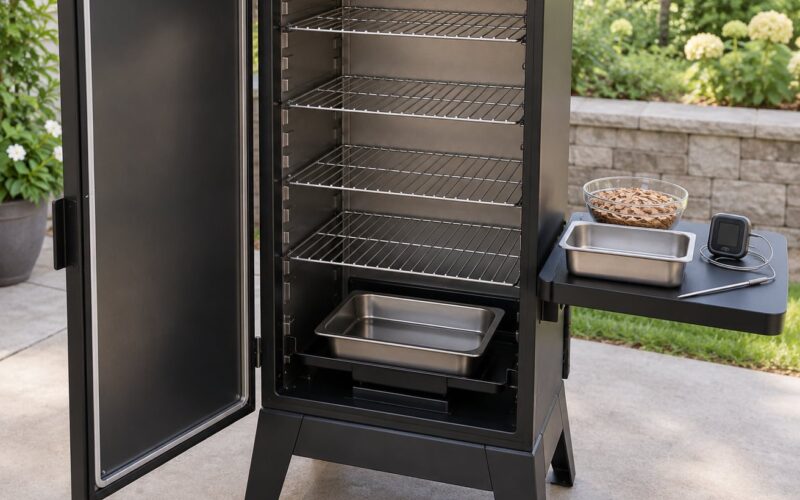
- Two thermometers — one for the pit, one left in the meat, plus a backup because cheap probes fail
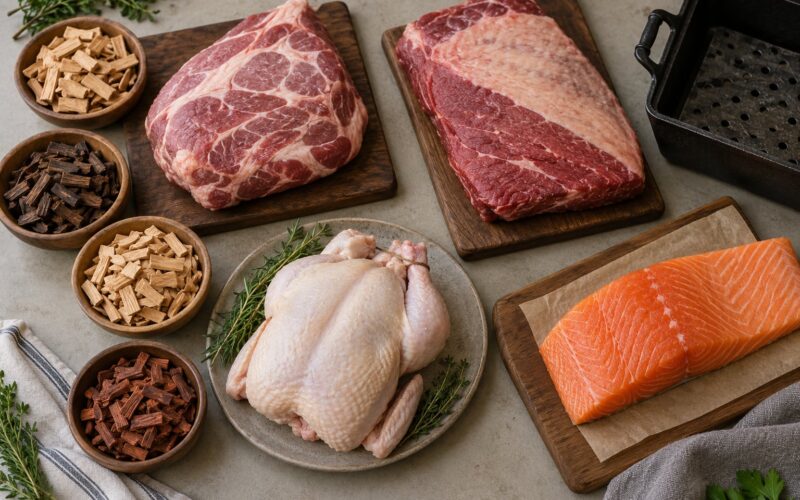
- Wood — post oak and hickory for backbone smoke, apple or cherry if you want a milder profile
- Dry rub and a squeeze bottle of yellow mustard for the slather
- Butcher paper or heavy-duty foil for the wrap, plus a wire rack
- Heat-resistant gloves, a cutting board, two carving forks, and a cooler or pan for resting
Test the pit thermometer in ice water before you commit a shoulder to it. Built-in dials are routinely off by 20 to 30°F, and a smoker quietly running at 200°F instead of 225°F is the single most common reason a cook runs four hours long.
Plan backward from serve time rather than forward from breakfast. Take your estimated cook time, add a one-hour rest, then add a two-hour buffer for a stall you have not seen before. An 11 lb shoulder estimated at 15 hours that needs to be on the table at 6 p.m. should go on the smoker around midnight at the latest.
Step-by-Step: How Long to Smoke a Pork Shoulder
How Long to Smoke a Pork Shoulder by Smoker Type and Cut
Most guides give you a per-pound rule, and the rule is only as good as the pit temperature behind it. Here is how long to smoke a pork shoulder at the four temperatures home cooks actually use.
- 225°F low and slow: about 1.5 to 2 hours per pound, the best bark and the deepest smoke
- 250°F: about 90 minutes per pound, a solid middle ground for an overnight cook
- 275°F: about 1 hour per pound, the fastest route to a tender finish without drying out
- 300°F: about 45 to 60 minutes per pound, best reserved for finishing or small shoulders
Here is the same math by weight, so you can look up your own roast. These are bone-in shoulders, and they assume a steady pit with the probe in the thickest part.
- 3 lb at 225°F: 5 to 6 hours · at 250°F: 4.5 to 5 hours · at 275°F: 3.5 to 4.5 hours · at 300°F: 3 to 4 hours
- 5 lb at 225°F: 8 to 10 hours · at 250°F: 7 to 8 hours · at 275°F: 5 to 6 hours · at 300°F: 4.5 to 5.5 hours
- 7 lb at 225°F: 10 to 12 hours · at 250°F: 9 to 10.5 hours · at 275°F: 7 to 8.5 hours · at 300°F: 6 to 7 hours
- 9 lb at 225°F: 13 to 16 hours · at 250°F: 11.5 to 13.5 hours · at 275°F: 9 to 11 hours · at 300°F: 8 to 9.5 hours
- 10 lb at 225°F: 14 to 17 hours · at 250°F: 13 to 15 hours · at 275°F: 10 to 12 hours · at 300°F: 9 to 10.5 hours
- 12 lb at 225°F: 17 to 20 hours · at 250°F: 16 to 18 hours · at 275°F: 13 to 15 hours · at 300°F: 11.5 to 13 hours
Boneless shoulders run about 20 to 30 percent faster than bone-in because there is no bone to heat through. A 9 lb boneless roast is closer to the 7 lb bone-in row than the 9 lb row. A picnic shoulder, the smaller cut from the same muscle, goes faster still and is usually the better choice for a family of four.
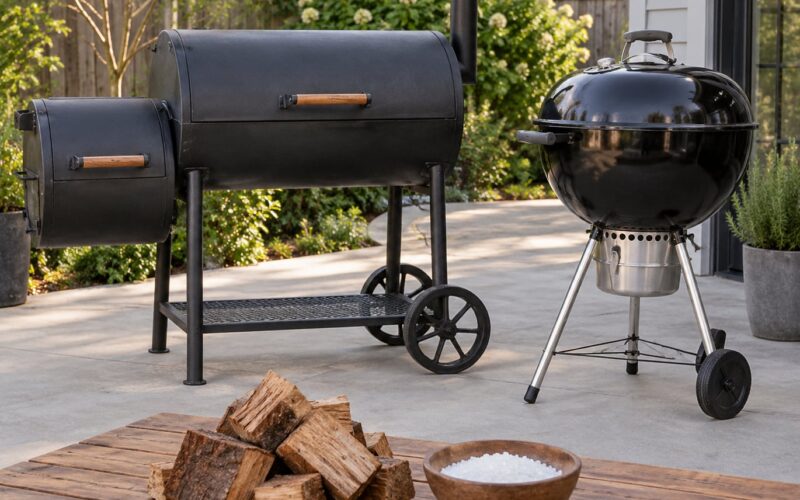
Smoker type shifts the number a little. Pellet, electric, and propane smokers hold 225°F without effort, so they track the low end of each range. A kamado running 225°F needs a deflector, and an offset with a thin firebox often drifts, which adds an hour or two.
The word “to smoke” makes people assume a long cook is the only way. Holding a 6 lb shoulder at 275°F and finishing it in about 6 to 6.5 hours is a legitimate result that backyard cooks report regularly. Cook at 275 or 300°F when you need pulled pork tonight, and keep 225°F for weekends.
How to Trim, Season, and Smoke the Shoulder
Trim the shoulder the night before if you can. Pull off the loose shoulder flap and any interior fat that hangs past the meat, and leave a thin fat cap behind — a quarter inch is plenty. Some cooks score the cap in a diamond pattern so the render has a path out, and leaving a thick cap just slows the cook while adding grease to the fire.
Slather the shoulder with yellow mustard, then press the dry rub over every surface. Let it sit 30 minutes to an hour so the seasoning forms a crust that will turn into bark. If you skip the mustard, sprinkle the rub directly on damp meat.
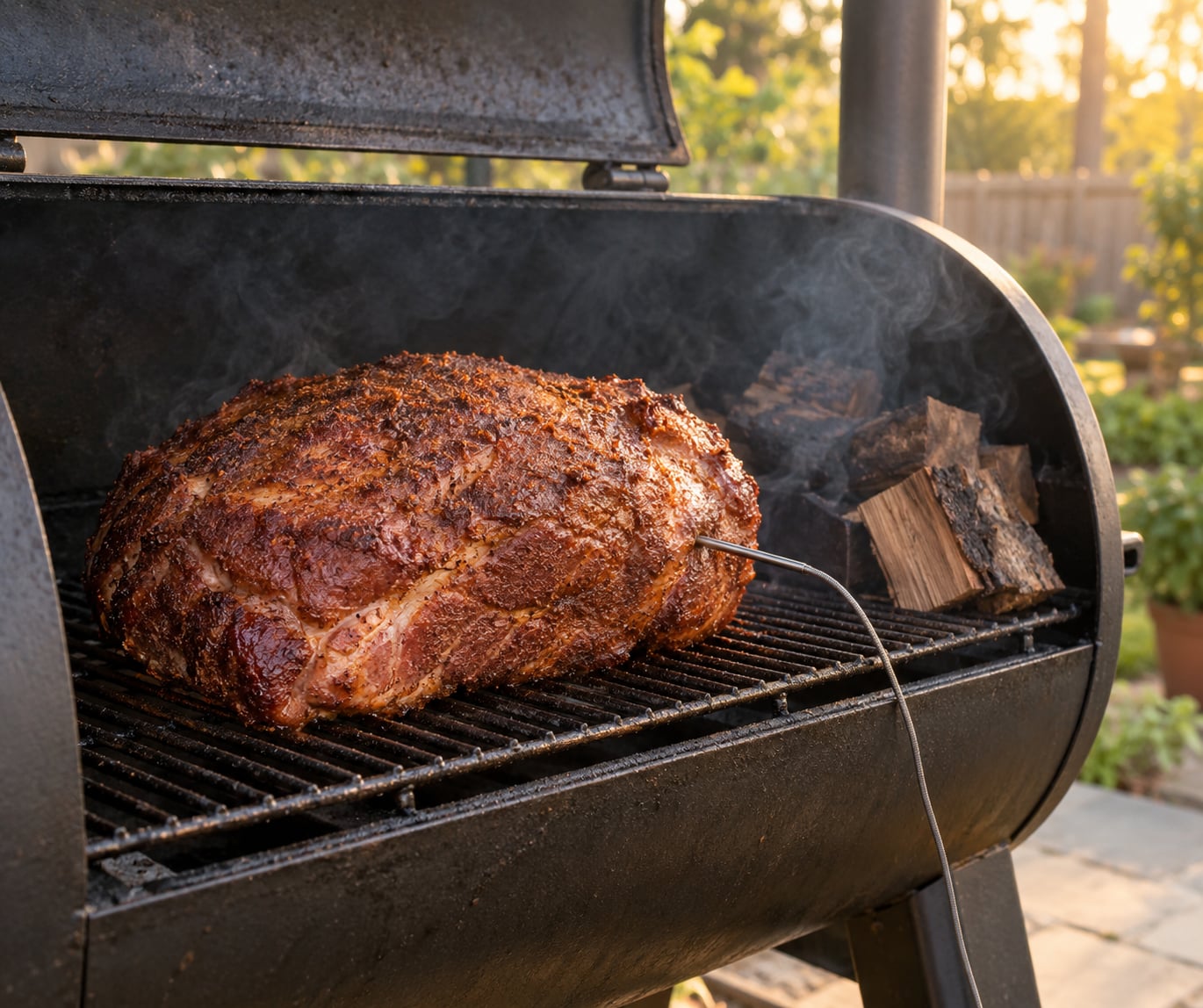
Get the smoker to target temperature before the meat goes in. A cold pit that heats up while the shoulder sits inside adds 30 to 60 minutes, and the first hour of smoke is what gives the bark its character. Put the meat on bone side down, leave a probe in the thickest muscle, and keep the door shut.
Manage the fire instead of adding wood on a timer. You want a thin blue-grey haze rather than billowing white smoke, and a light touch with the wood pile. Heavy smoke on an uncovered shoulder dries the bark and turns the finished product sooty, so if you see thick smoke, open a damper for a few minutes.
How to Track Temperature, Handle the Stall, and Wrap
Watch the pit, not the meat, for the first stretch. You are looking for a steady chamber temperature with a thin smoke ring developing on the surface. Keep a note of the pit temperature each time you check; a chart in your head beats guessing in the dark.
At some point the shoulder hits the stall, usually between 140°F and 170°F internal, and the temperature stops climbing for an hour or two. Nothing has gone wrong. The wetter meat evaporating from the surface is cooling the interior faster than the pit can heat it, so the probe sits still until enough moisture has boiled off.
A stall normally lasts 1 to 2 hours. It can be longer on a big fatty shoulder, and a 4 lb roast has been reported sitting at 160°F for many hours before moving. Hold your pit temperature steady, keep the fire going, and do not open the lid to check the water pan every 20 minutes — the lost heat is what turns a two-hour stall into a four-hour one.
Wrap between 160°F and 165°F internal if your shoulder is approaching six to eight hours with more to go. Butcher paper in a Texas twist leaves the bark intact; foil is faster and softer, and it is the right call when you are chasing a finish. The foil-and-oven shortcut works too: pull the shoulder at around 140°F, wrap it tightly, and finish it in a 250°F oven until probe-tender.
After wrapping, expect another 1.5 to 3 hours to reach 195°F. Going from 165°F to 200°F is the slow tail of the cook, which is exactly why the per-pound rule needs a two-hour buffer. If you are running long, raise the pit to 275 or 300°F and let the wrapped shoulder finish fast — pork has enough internal fat that it will not dry out the way a lean cut would.
How to Rest, Pull, and Check the Final Texture
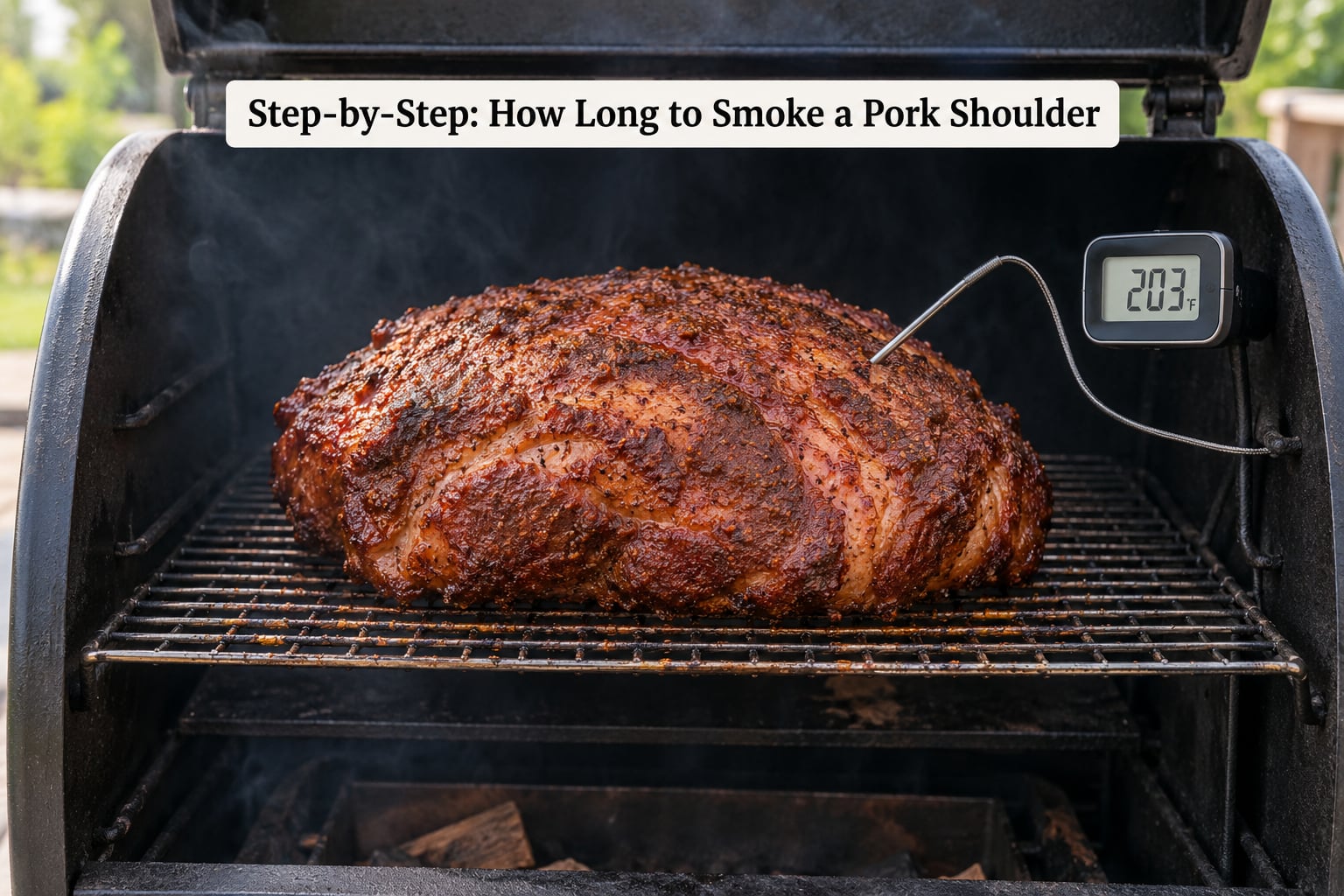
Pull the shoulder between 195°F and 205°F. Most pitmasters target 203°F, where collagen has fully converted to gelatin, and treat a probe as the final call: when the tip slides into the meat with almost no resistance and twists freely, it is time to come off the heat.
That 195°F lower bound is a matter of taste and cook style. At 195°F the shoulder shreds into distinct chunks and reads as a proper smoked butt; at 203°F to 205°F you get the softer, juicier, almost creamy texture that competition entries aim for. Both are correct. Very rarely the meat will run to 210°F and still be worth eating, which is the main reason overcooking fear is misplaced here.
Rest the shoulder for 30 to 60 minutes, loosely covered. A cooler works as an insulated rest box and is the standard trick for overnight cooks: put the wrapped meat in a clean cooler, close the lid, and it holds the same temperature for hours while the juices redistribute. Do not skip the rest because the fibers need to relax, and slicing a shoulder straight off the smoker leaves you with dry meat and a puddle on the board.
Pull it apart with two forks or your hands. Trim the bark as you go if you serve folks who like it, or leave it on for people who do not.
On yield: a shoulder loses roughly 40 percent of its raw weight to fat, bone, and render, so an 8 lb roast gives you close to 5 lb of cooked pulled pork. That is about 14 to 15 sandwiches at 5 oz each, or 10 to 12 people at a generous serving. Two pounds of pulled pork feeds roughly six people as a main, more if it is one of several dishes.
For storage, cool the meat in shallow containers within two hours, then refrigerate at 40°F or below and eat it within three to four days. Reheat covered with a splash of its own juice or water in a 250°F oven, or in a covered pot on low, and take it only to 165°F. It freezes well for three to four months in sealed portions.
Common Mistakes
Trusting a built-in thermometer. Pit dials drift, especially on a new smoker. A 20 to 30°F discrepancy quietly adds hours. Check against a probe in boiling water and in ice water before a big cook.
Peeking too often. Every lid opening drops the chamber temperature and makes recovery a matter of minutes rather than seconds. Set a probe alarm and give the meat space to move.
Wrapping too early. Paper or foil before 150°F traps steam against a soft, unfinished bark and costs you the crust. Wrapping too late burns the bark and lets it over-smoke, so aim for that 160 to 165 window.
Oversmoking. A thin haze is the goal. Heavy white smoke dries the surface and makes the finished pork taste like a campfire instead of like pork.
Trusting the timer. Real cooks report a 10 lb shoulder finishing in 9 hours on a propane smoker at 225 to 250°F, and another running 18 hours at 225°F. Published times that disagree by that much are not a problem with the meat — they are a problem with the weather, the fat cap, the fire, and the pit. Temperature wins.
Pulling the meat at 165°F. That is the safe-food temperature for reheating pork, and 145°F is the USDA minimum for whole cuts, but collagen has not broken down at either point. You will be slicing a tough shoulder and calling it barbecue.
Cutting before the rest. Juice runs out the moment you slice. Give it at least 30 minutes, up to an hour if the meat is large.
Leaving it on warm overnight. Nobody wants dry pork. Smoke until the shoulder is probe-tender, then hold it warm in a closed cooler with the wrap, not on a low pit where it slowly tightens and squeezes out moisture.
Cooking several butts without rotating. Five 7.5 lb butts on one propane smoker took about 15 hours with rotation. Without moving them, the one nearest the firebox finishes first and the one by the door is still raw hours later.
Frequently Asked Questions
How long does it take to smoke an 8 lb pork shoulder?
An 8 lb bone-in shoulder needs about 13 to 16 hours at 225u0026deg;F, 11.5 to 13.5 hours at 250u0026deg;F, and 8 to 11 hours at 275u0026deg;F. A boneless 8 lb roast finishes roughly 20 to 30 percent faster. Add a one-hour rest before serving, and pull at 195 to 205u0026deg;F internal rather than trusting the clock.
What temperature should a pork shoulder be smoked at?
Smoke at 225u0026deg;F for the best bark and deepest flavor if you have all day, at 250u0026deg;F for a balanced overnight cook, or at 275u0026deg;F when you need pulled pork the same evening. Hold the pit steady and use a probe thermometer, since the internal temperature of the meat matters far more than the pit setting.
Do you have to wrap a pork shoulder while smoking it?
No, but wrapping is worth doing. Between 160u0026deg;F and 165u0026deg;F internal, butcher paper or foil speeds the finish, protects the bark from oversmoking, and keeps the fat from over-rendering. Many backyard cooks go unwrapped and get the same result, with more careful fire management and a slightly longer finish.
How do I know my pork shoulder is done instead of just cooked?
Safety is met at 145u0026deg;F internal for whole cuts, but pulled pork texture arrives much later. Look for 195 to 205u0026deg;F internal and slide the probe in: it should enter and exit with almost no resistance, the blade bone should wiggle free, and the meat should pull into shreds. That combination is the real answer to how long to smoke a pork shoulder.
How long can smoked pulled pork be stored?
Refrigerate smoked pulled pork at 40u0026deg;F or below and eat it within three to four days, cooled in shallow containers within two hours of cooking. Reheat covered to an internal temperature of 165u0026deg;F with a splash of its own juices to keep it moist. For longer storage, freeze sealed portions for three to four months.
Conclusion
Start with the smoker, not the recipe. Set the pit, verify it with a probe, note how many pounds are on the grate, and write the estimated finish time on the lid along with a two-hour buffer. Then forget the clock and watch the meat: push through the stall, wrap at 160 to 165°F, and pull at 195 to 205°F when the probe glides in.
If you are cooking this week, your first move is simple. Test the pit thermometer tonight, pick your serve time, and start the shoulder the night before with a plan to rest it wrapped in a cooler. Everything after that is just waiting on temperature.