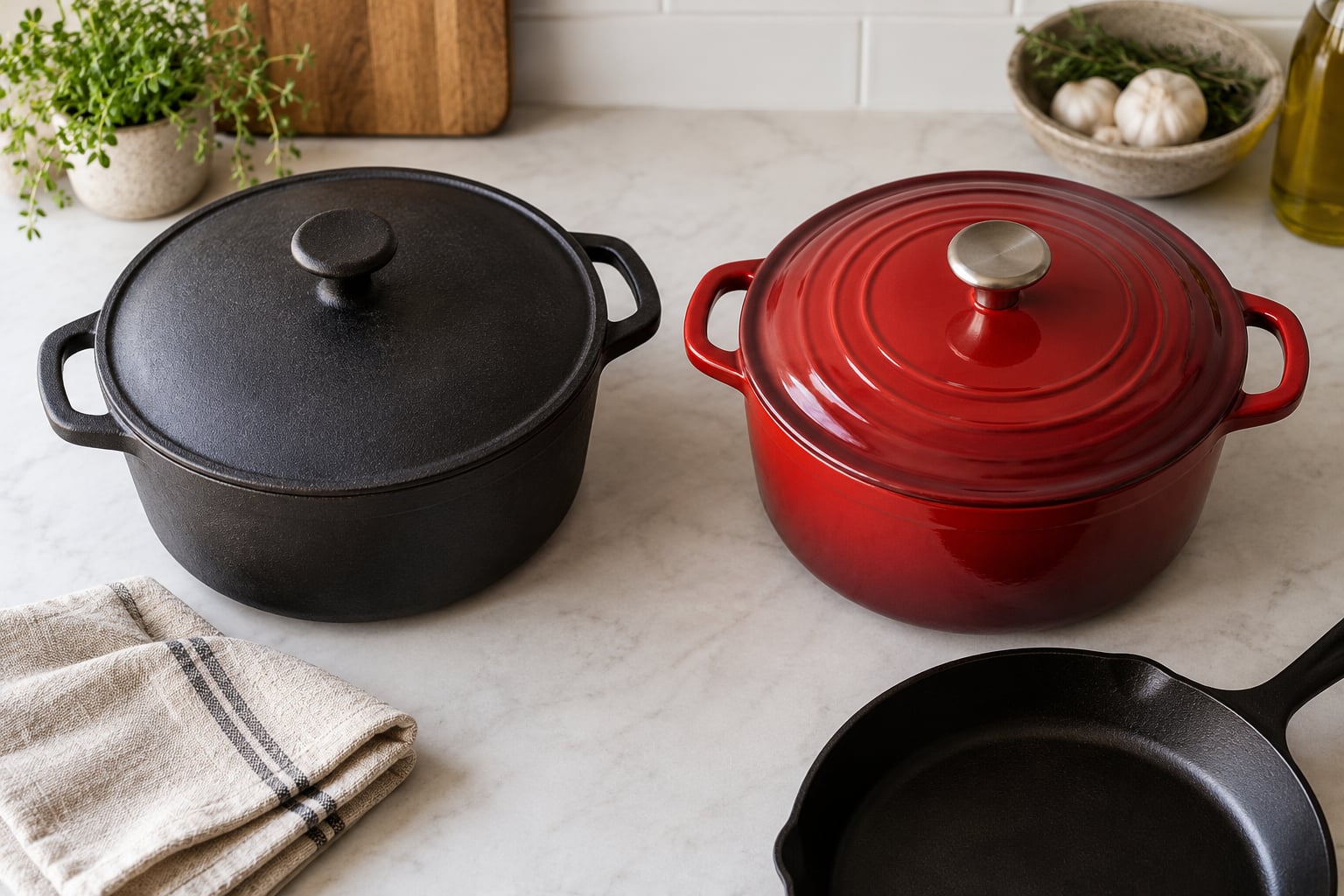
Cast iron vs enameled Dutch oven comes down to maintenance tolerance: bare cast iron gives you the best browning and the lowest entry cost, but it needs drying, oiling and an intact seasoning layer. Enameled cast iron cooks just as well, needs almost nothing, and handles acidic food without a fight. Choose by cooking style, not by brand loyalty.
Both pots are the same thing underneath, a thick body of cast iron that holds heat and distributes it slowly. The whole difference lives in the surface. That single finish decides what you can cook, how you clean it, whether it rusts, and how much fuss it asks of you on a Wednesday night.
What follows covers the differences that actually change how you cook, including the two details that catch people out: thermal shock and lid knob heat. Then you get a straight recommendation by use case.
Table of Contents
- Cast Iron vs Enameled Dutch Oven at a Glance
- What Is the Difference Between Cast Iron and Enameled Dutch Ovens?
- What bare cast iron actually is
- What enameled cast iron actually is
- The one difference that decides everything
- Which One Has Better Heat Retention?
- Why cast iron vs enameled Dutch oven heat behavior differs anyway
- The two heat warnings nobody puts in the guide
- Which One Is Easier to Clean and Maintain?
- How to clean bare cast iron
- How to clean enameled cast iron
- Storage habits that decide whether bare iron rusts
- Which One Is Better for Everyday Cooking?
- Bread and sourdough
- Braises, stews and acidic sauces
- Campfire and grill cooking
- How Do Durability, Rust and Storage Compare?
- What About Price, Weight and Color Options?
- Cast Iron vs Enameled Dutch Oven: Which Should You Choose?
- Frequently Asked Questions
- Is an enameled Dutch oven as good as bare cast iron?
- Do enameled Dutch ovens need to be seasoned?
- Can I use soap when washing a Dutch oven?
- Which type is better for baking bread?
- Can an enameled Dutch oven go in the dishwasher?
- Is bare cast iron more durable than enameled cast iron?
- Conclusion
Cast Iron vs Enameled Dutch Oven at a Glance
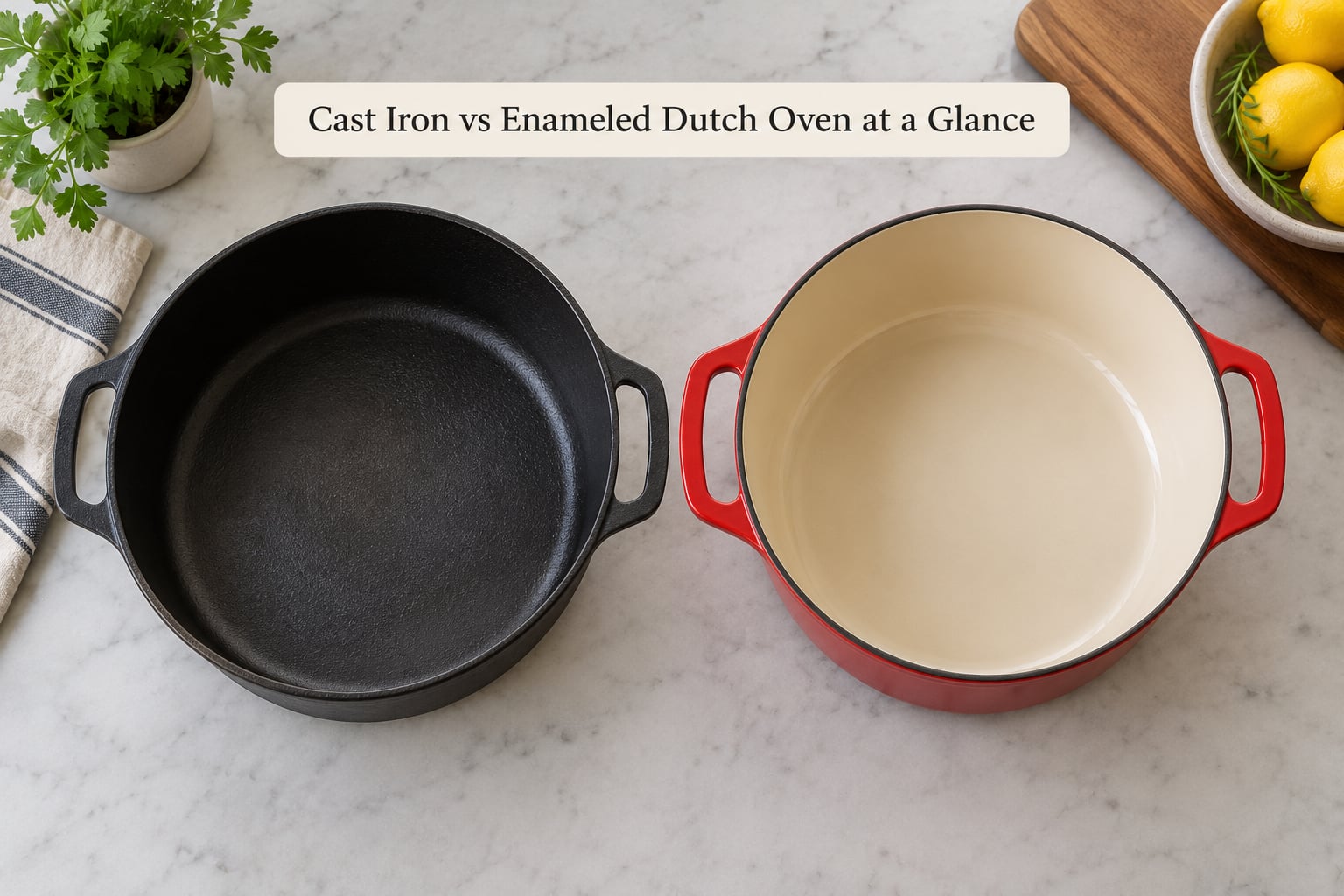
Here is the short version, criterion by criterion, before the detail.
| Criterion | Bare cast iron | Enameled cast iron |
|---|---|---|
| Seasoning | Required, and maintained by cooking and oiling | Never needed; arrives ready to use |
| Cleaning | Scrub, dry immediately, thin coat of oil | Soak and wash with soap, dry, done |
| Dishwasher | No, except some makers allow the lid | Often allowed, but hand washing protects the gloss |
| Acidic food (tomato, wine, dairy) | Short cooks only; long sims can strip seasoning and add a metallic taste | Fine for long sims and long storage |
| Rust risk | Real if left damp; removable with steel wool and a re-season | None as long as the enamel is intact |
| Heat retention | Excellent, identical cast iron body | Excellent, identical cast iron body |
| Browning and fond | Best-in-class on a well-seasoned surface | Very good, slightly less fond on light enamel |
| Oven range | Wide, no enamel or plastic parts | Wide, but check the lid knob rating before very high heat |
| Open flame and campfire | Yes, the natural choice | Works on a grill; check the maker on direct flame |
| Thermal shock | Can crack if dropped or shocked cold to hot | Can crack the enamel; never preheat empty |
| Weight | Heavy, and it stays that way | Heavy, sometimes heavier because the enamel adds glass |
| Color and finish | Matte black, utilitarian | Glossy, wide range of colors |
| Upfront cost | Lower | Higher, with a big spread between budget and premium |
| Repairable after damage | Yes, strip and re-season | No, a chip exposes bare iron that can rust |
| Typical lifespan | Decades, sometimes generations | Decades, often warranty-backed |
Two rows in that table decide most arguments. Acidic food and rust favor enamel, and outright browning plus open flame favor bare iron. Everything else is a close call that comes down to taste.
What Is the Difference Between Cast Iron and Enameled Dutch Ovens?
Both are cast iron. A Dutch oven is simply a heavy pot with thick walls, a heavy lid and two handles, and the casting process is the same whether or not a glassy coating goes on afterward. So the honest answer to what is the difference is not the metal. It is the finish.
What bare cast iron actually is
Uncoated iron, machined smooth and left porous at the microscopic level. That porosity is a feature: oil bakes into it and polymerizes into a hard, glassy-ish layer of seasoning that becomes your cooking surface. It starts out gray and rough, and after a few dozen meals it turns dark, smooth and faintly slick.
Seasoning is not a coating you apply once and forget. It is a living surface that you eat away with acidic food and abrasion, and rebuild every time you cook with a little oil. The people who describe bare cast iron as low maintenance have usually already done the maintenance.
What enameled cast iron actually is
The same cast iron body covered in a vitreous enamel, which is basically glass: enamel frit that is sprayed on in layers and fired in a kiln at very high temperature until it fuses to the metal. The result is nonporous, colored, and inert. Nothing soaks in, so there is no seasoning to build and nothing to strip.
Enamel is glass chemistry, which means it is vulnerable to two things: sudden temperature change and hard contact. Drop a cold pot on a hot burner or slam a hot lid into cold water and the enamel can craze or chip. That is the trade for having a surface that tolerates tomato sauce, red wine and a night on the counter.
The one difference that decides everything
Ask what you are cooking first, and the answer usually arrives on its own. Long, acidic, wine-heavy braises point to enamel. High-heat searing, bread, and a pot that lives on a campfire point to bare iron.
Which One Has Better Heat Retention?
Almost identically. The cast iron body does the work in both cases, and neither finish is thick enough to meaningfully change how the pot holds or releases heat. If a test kitchen said one holds heat better, that result came from a different pot shape or a different burner, not the coating.
Why cast iron vs enameled Dutch oven heat behavior differs anyway
Three practical differences show up in real kitchens, even when the physics ties.
First, a seasoned bare surface browns more readily. More browning means a hotter effective cooking surface, so a bare cast iron Dutch oven tends to get a faster, darker crust on bread and a better Maillard reaction on meat. Light-colored enamel gives up slightly less heat to the food, which some people read as more even cooking.
Second, bare iron is a small thermal sink at the surface. Once hot, it behaves predictably. Enamel over iron behaves predictably too, but a chip or a scuffed area can change the surface very slightly, and cold enamel is a touch slower to come up to temperature on a high-output burner.
Third, the lid matters more than the base. A tight-fitting lid that traps steam is what makes either pot work as a braising vessel. Weight in the lid is what re-radiates heat back down onto the food.
The two heat warnings nobody puts in the guide
Never preheat either pot empty. Not the bare one, not the enameled one. Empty cast iron in a hot oven or on a cold burner can crack outright, and bare iron will not forgive it. Bread bakers heat the pot empty for 30 to 45 minutes, so this one rule trips up a lot of new sourdough bakers.
Check the lid knob rating. Many enameled Dutch ovens ship with a phenolic resin or plastic knob that is fine at 375°F but will soften or deform near 500°F. Bare cast iron usually has a bare iron or stainless knob, so high-heat bread baking is not a problem. If you bake at 450°F or higher, look for a metal knob or a cast iron lid insert.
For food safety, cook poultry to 165°F, ground meat to 160°F, and whole cuts and fish to 145°F. A pot holds heat long enough to carry a steak through a rest, so use an instant-read thermometer rather than timing alone.
Which One Is Easier to Clean and Maintain?
Enameled, without much argument. That is the entire reason people pay more for the coating, and it is not a small difference. Bare cast iron asks for about five minutes of attention after most meals; enameled asks for maybe one.
How to clean bare cast iron
- Let the pot cool enough to handle. Washing a very hot pot in cold water is how cast iron cracks, and that applies to enamel too.
- Soak stuck food for 10 to 15 minutes, then loosen it with a chainmail scrubber or a stiff brush. Chainmail strips seasoning off faster than salt, which is a fair trade for ten saved minutes.
- Wash with hot water and a small amount of mild dish soap. Old guidance says soap strips seasoning; in practice a rinse of soap does not, because the seasoning is polymerized oil bonded to the metal, not loose grease.
- Dry on the burner over low heat for a minute or two until the water is gone.
- While it is still warm, rub a very thin layer of neutral oil over the cooking surface. Peanut, canola, grapeseed and vegetable oil all work. Skip olive oil if it is extra virgin, since it is more likely to go rancid.
That is it. Do it consistently and the seasoning layer thickens over a year or two into something that releases a good pan sauce on its own. Skip it for a few weeks and you get a tacky surface; skip it for months in a humid cupboard and you get rust.
Rust is not a death sentence. Scrub the spot with coarse steel wool, rinse, dry fully, then run a couple of stovetop seasoning cycles. Most bare Dutch ovens survive that and go right back to work.
How to clean enameled cast iron
- Cool the pot, then soak it in warm water with a drop of dish soap for burnt-on residue.
- Loosen the stuck bits with a nylon sponge or a soft brush. Avoid steel wool and metal scouring pads, which scratch the gloss.
- Cooked-on sugar is the one thing worth boiling off. Warm water and a slow simmer loosens caramelized fond in a way scrubbing alone will not.
- Rinse, dry, and you are finished. No oiling, no seasoning, no re-seasoning cycle.
The one cleaning mistake with enamel is thermal shock, not soap. Putting a hot pot under a cold tap can craze the glaze, and a craze is the beginning of the end for the finish. Let it cool before you wash it, every time.
Stain handling differs by color. Cream and light interiors show tea, turmeric and tomato permanently. Dark interiors hide staining but make it harder to see fond forming, which matters if you build pan sauces. Neither is better; pick based on whether you want to monitor browning or not.
Storage habits that decide whether bare iron rusts
Enameled pots can be washed, dried and stacked. Bare cast iron cannot be stacked, and it should not sit in a damp cupboard. Store the lid ajar or separately so air moves, put a paper towel or a pan protector between pieces, and keep it somewhere dry rather than over the stove or beside the sink.
Humidity matters more than people expect. A pot stored in a garage in a coastal climate will find rust; the same pot in a dry cabinet upstairs will not.
Which One Is Better for Everyday Cooking?
For weeknight cooking, enameled wins on logistics. You can start a braise at 6pm, eat at 7:30, soak the pot in the sink, wash it after the kids are in bed, and put it away. A bare pot in the same evening needs a dry and an oil before you can walk away from it.
Bread and sourdough
This is the strongest argument for bare cast iron, and it is not really about the pot. A heavy iron lid radiates heat onto the loaf, and a bare surface browns faster, so you get more oven spring and a darker, crisper crust. Sourdough bakers have used bare cast iron for decades for that reason, and buying one specifically for bread is a very normal thing to do.
Enameled pots work well for bread too. They hold a little more moisture, which suits lean doughs and rolls, and the color range is a real advantage if the pot lives on the counter rather than in a cabinet. Just do not ask it to do the dry, high-heat job in an empty preheat.
If the real annoyance is loading dough, consider a combo cooker: a skillet with a deep lid that lets you slide the dough in without knuckle-knocking the pot wall. It bakes bread nearly as well and handles stir-fries and one-pan dinners, which a Dutch oven does not.
Braises, stews and acidic sauces
This is the clearest divide. Tomato sauce, chili, red wine braises, vinegar-based stews and long dairy sauces strip the seasoning layer from bare iron. A short tomato sauce, under 20 minutes, is usually fine. A three-hour ragu is not, and many cooks report a metallic edge to the flavor that never quite washes out.
Enameled is inert, so the same recipes cook without any compromise and the pot can sit on the counter overnight without drying out or picking up odors. A bare pot that has been stripped by an acidic sauce needs a re-season before the next batch of anything.
Deep frying is a wash, honestly. Both hold temperature well. The bare version heats the oil a touch faster and takes high-heat searing better; the enameled one cleans up a lot easier afterward.
Campfire and grill cooking
Bare cast iron is the right answer if the pot spends time over coals. No enamel to worry about, no knob to melt, no enamel to chip from a dropped lidstone. Build a fire, set the pot on the coals, and the same pot that braised short ribs in your kitchen now braises them on a Saturday in the woods.
Enameled pots work fine on a grill and many makers rate them for direct flame, but check the specific pot. Direct flame concentrates heat on one spot, which is exactly the uneven stress that chips enamel, and a phenolic knob is a liability anywhere near a fire pit.
How Do Durability, Rust and Storage Compare?
Longevity is the one category where the two genuinely diverge, and it comes down to what happens when something goes wrong.
A bare cast iron Dutch oven can be dropped, scorched, rusted and abused for a century, and a good part of the damage is reversible. Strip it back to metal, re-season, and you are cooking again in a day. Chips do not exist as a category for bare iron; the metal is simply metal.
An enameled pot that gets chipped exposes raw cast iron. That spot rusts, and the rust creeps under the surrounding enamel, which loosens it further. The progression is slow, and it is also permanent. A premium maker will sometimes replace a pot for a chip, and a budget maker frequently will not. The chip itself is often fine to cook with; the slow part is what makes people replace the pot.
Warranty culture is worth understanding before you buy. The well-known brands in this category generally offer lifetime or long-term coverage on enamel defects, and owners on buy-it-for-life forums report repeated free replacements of pots decades old. That promise, not the color, is a large part of what the premium tier buys you. Budget enamel has a thinner coat, less consistent firing, and a shorter record of standing behind chips.
Secondhand is a genuinely smart move for a premium enameled pot. A ten-year-old Dutch oven from a major brand, inspected for chips along the rim and base, will outlast most new budget models, because the expensive part was the controlled kiln firing. What to check: run a fingernail along the rim and the interior, look for grey metal showing through the color, and check that the lid seats without wobbling.
Shape is a smaller decision but a real one. Round pots are more efficient for a burner and a campfire, and they are traditional for bread. Oval and rectangular pots fit a whole chicken or a loaf pan shape better and suit casseroles, so they are the better choice if you roast rather than stew.
What About Price, Weight and Color Options?
Bare cast iron is the cheaper entry point, and the difference is not marginal. Enameled ranges from modest to genuinely expensive, and the spread within the enameled category is wider than the gap between bare and enameled. The premium tier sells controlled enamel thickness, consistent firing, a self-basting lid, and a warranty that actually pays out decades later.
The higher enamel cost is not paying for cooking performance. The base metal cooks the same. You are paying to skip the maintenance routine and to skip the rust risk, and that is worth it for many people, but it is a convenience purchase rather than a performance purchase, and it is fair to say so out loud.
Weight is a wash that leans slightly toward enameled, because the glass adds mass to an already heavy pot. In practice the difference barely matters; both are two-handed objects, and neither belongs on an upper cabinet shelf. If you have back or wrist issues, check the listed weight before buying, and consider a smaller size.
Color is a real factor that gets dismissed as shallow. A pot you like looking at stays on the counter, gets used more, and gets washed right after use instead of shoved into a cabinet with the waffle iron. That is a small behavior change that matters more over five years than any feature list.
On sizing, match the pot to the recipes. A 4 to 5.5 quart pot handles a family dinner and a round loaf for two or three people. Six quarts and up starts earning its weight when you cook for a crowd, bake a large boule, or make stock. Going much larger than your usual recipes is how a heavy pot ends up unused.
Cast Iron vs Enameled Dutch Oven: Which Should You Choose?
Work through these five questions in order. The first one that lands on bare iron is usually your answer.
- Do you cook a lot of tomato, wine, vinegar or long dairy dishes? If yes, choose enameled. The surface is inert and nothing you simmer will strip it.
- Do you want to cook over a campfire or on a grill? If yes, choose bare cast iron. It is built for direct flame.
- Do you bake bread at 450°F or higher? If yes, choose bare cast iron, or an enameled pot with a metal lid knob.
- Do you want zero maintenance and would you rather not think about it? If yes, choose enameled, and accept the higher entry cost.
- Would you enjoy maintaining a seasoning layer? If honestly no, choose enameled. A pot you resent is a pot you stop using.
Bare cast iron is the right pick for a cook who sears often, bakes bread, camps, buys secondhand and does not mind a five-minute care routine. It costs the least, sears the best, and improves for decades.
Enameled cast iron is the right pick for a cook who makes sauces, wants color in the kitchen, dislikes rust risk, and would rather own two nice pots than maintain one. It costs more and asks less, and for most weeknight cooking that is the better trade.
And plenty of people end up with both eventually: a small bare skillet for searing, and a larger enameled Dutch oven for the braise. That is not buying twice the same pot; that is buying the tool for each job.
Frequently Asked Questions
Is an enameled Dutch oven as good as bare cast iron?
For heat retention, braising, bread baking and frying, an enameled Dutch oven performs almost identically, because the cast iron body does the work in both cases. Enameled wins on cleaning, acidic food and looks. Bare cast iron wins on sear quality, open flame work and entry cost. A well-seasoned bare pot also grows more naturally nonstick over the years.
Do enameled Dutch ovens need to be seasoned?
No. The kiln-fused enamel is nonporous and arrives ready to cook, so there is nothing to season. Soap will not harm it the way it can strip oil from bare iron. What the surface does need is restraint: no sudden temperature swings, no empty preheating, and no metal scouring pads that scratch the gloss.
Can I use soap when washing a Dutch oven?
Yes for enameled cast iron, and yes for bare cast iron if you dry it properly. A small amount of mild dish soap will not strip seasoning from bare iron, because the seasoning is polymerized oil bonded to the metal rather than loose grease. Rinse, warm the pot on the burner for a minute, then rub on a thin coat of neutral oil.
Which type is better for baking bread?
Bare cast iron gives a drier, crisper crust and is the traditional sourdough pot, plus it is the only version you can safely set over coals. Enameled Dutch ovens hold slightly more moisture, which suits wetter doughs and lean loaves, and they come in more colors. Never preheat either pot empty, and check the lid knob rating above 450°F.
Can an enameled Dutch oven go in the dishwasher?
It depends on the maker, and the manual wins. Many enameled pots are technically dishwasher safe, but harsh detergent can dull the gloss over repeated cycles, and a wood or phenolic lid can degrade in the heat. Hand washing with warm water and a soft sponge takes about a minute and keeps the finish looking new for decades.
Is bare cast iron more durable than enameled cast iron?
The base metal is equally durable in both. A bare pot can be stripped, re-seasoned and returned to service after almost any damage, while enamel cannot be repaired. A chip exposes raw iron that can rust and undercut the surrounding glass. So bare iron is easier to repair, while enameled pots usually carry better manufacturer warranties.
Conclusion
Start with your tolerance for seasoning: if you enjoy the ritual, buy bare cast iron for searing, bread and open flame. If you would rather never think about drying and oiling a pot, buy enameled and cook your sauces without compromise. Then pick the size and shape that match your usual recipes, and skip the one you will not use.