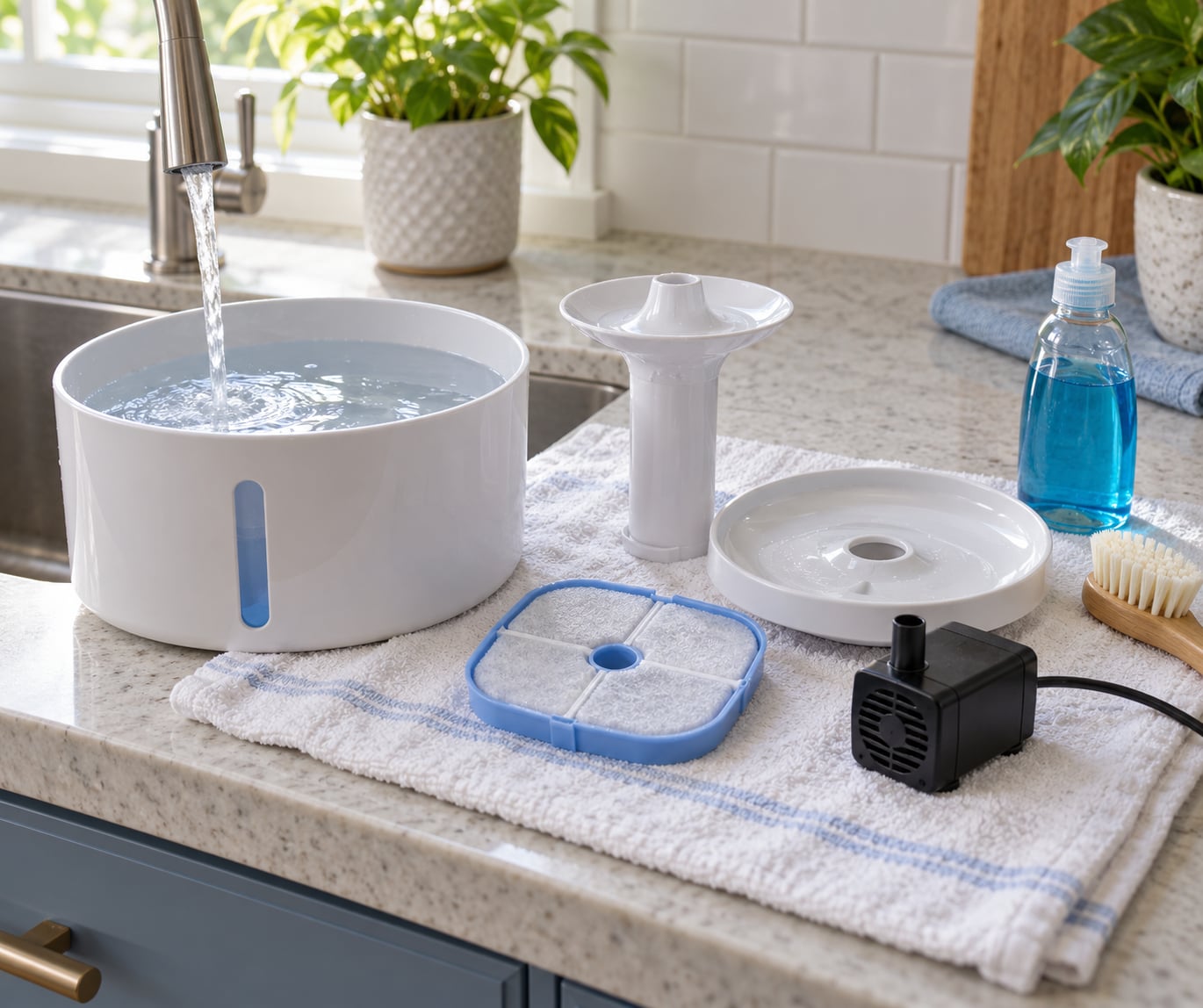
Learning how to clean a pet water fountain is mostly about taking the unit apart properly, washing every water-contact surface with warm water and unscented dish soap, scrubbing the pump, and rinsing until no soap remains. A full clean takes about 15 to 30 minutes once you know which parts come off, and doing it weekly keeps a slimy, smelly fountain from becoming a health problem.
The reason it matters is the water itself. A fountain continuously recirculates the same water over warm plastic, which is close to perfect conditions for bacteria, algae and a slimy layer called biofilm to take hold. A clean-looking top can hide a pump cavity packed with debris, and pets are famously good at refusing water that smells off, which can push them back to a less appealing bowl.
This guide covers automatic fountains, top-mount units, waterfall and tower styles, and non-electric bowls, with separate instructions for plastic, ceramic and stainless steel. Follow your own model’s manual wherever the steps here differ, because the arrangement of screws and channels varies a lot between brands.
Table of Contents
- What You Need
- Step-by-Step
- Unplug the Fountain and Check the Manual
- Disassemble the Basin, Pump, and Filter
- Wash the Water-Contact Parts
- Clean the Pump and Replace the Filter
- Remove Mineral Deposits and Stubborn Grime
- Dry, Reassemble, and Refill
- Common Mistakes
- Frequently Asked Questions
- How often should I clean a pet water fountain?
- Can I use vinegar to clean a pet water fountain?
- How do I remove stubborn algae from a water fountain?
- Do I need to replace the filter every time I clean the fountain?
- Why does my cat water fountain smell even after I cleaned it?
- When should I contact a veterinarian about a dirty fountain?
What You Need
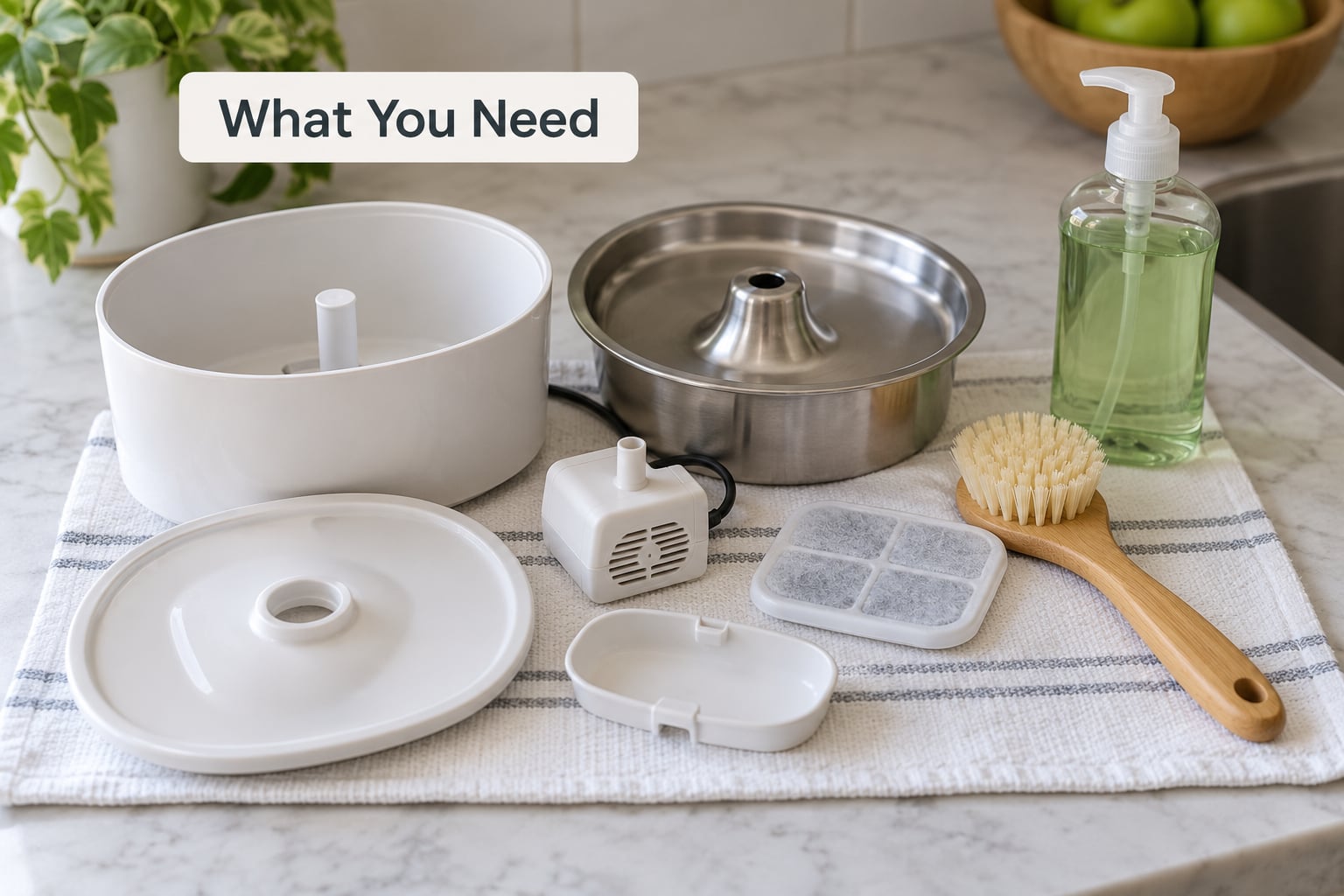
Most owners already own everything they need. The one thing worth adding before you start is a spare filter of the correct type, since many people only realise mid-clean that the old one is too degraded to reuse.
| Supply | What it is for |
|---|---|
| Mild unscented dish soap | Breaks up grease, biofilm and food film. Scented or plant-based “natural” soaps leave an oily residue pets often refuse. |
| Soft-bristled brush or old toothbrush | Works into the pump faceplate, spout and seams a sponge cannot reach. |
| Non-abrasive sponge or cloth | Safe on plastic, ceramic glaze and brushed stainless steel. |
| White vinegar | Dissolves limescale and hard water mineral deposits, provided the manufacturer allows it. |
| Cotton swabs and a small soft brush for tubes | Reaches narrow vertical pipes, waterfall channels and the pump outlet tube. |
| Clean towels or a drying rack | Air-drying parts overnight prevents water sitting in crevices and restarting biofilm growth. |
| Replacement filter | Foam and charcoal filters are usually rinsed, not washed. Keep a fresh one on hand. |
| Small wrench or screwdriver | Needed on some models to reach the pump impeller or unscrew the faceplate. |
| Dishpan or container | Holds small parts, screws and the filter so nothing disappears down the drain. |
Skip the extras. Bleach, alcohol-based cleaners, abrasive pads, dishwasher tablets and degreasers are all common in household cupboards, and none of them belong in a fountain your pet drinks from.
Step-by-Step
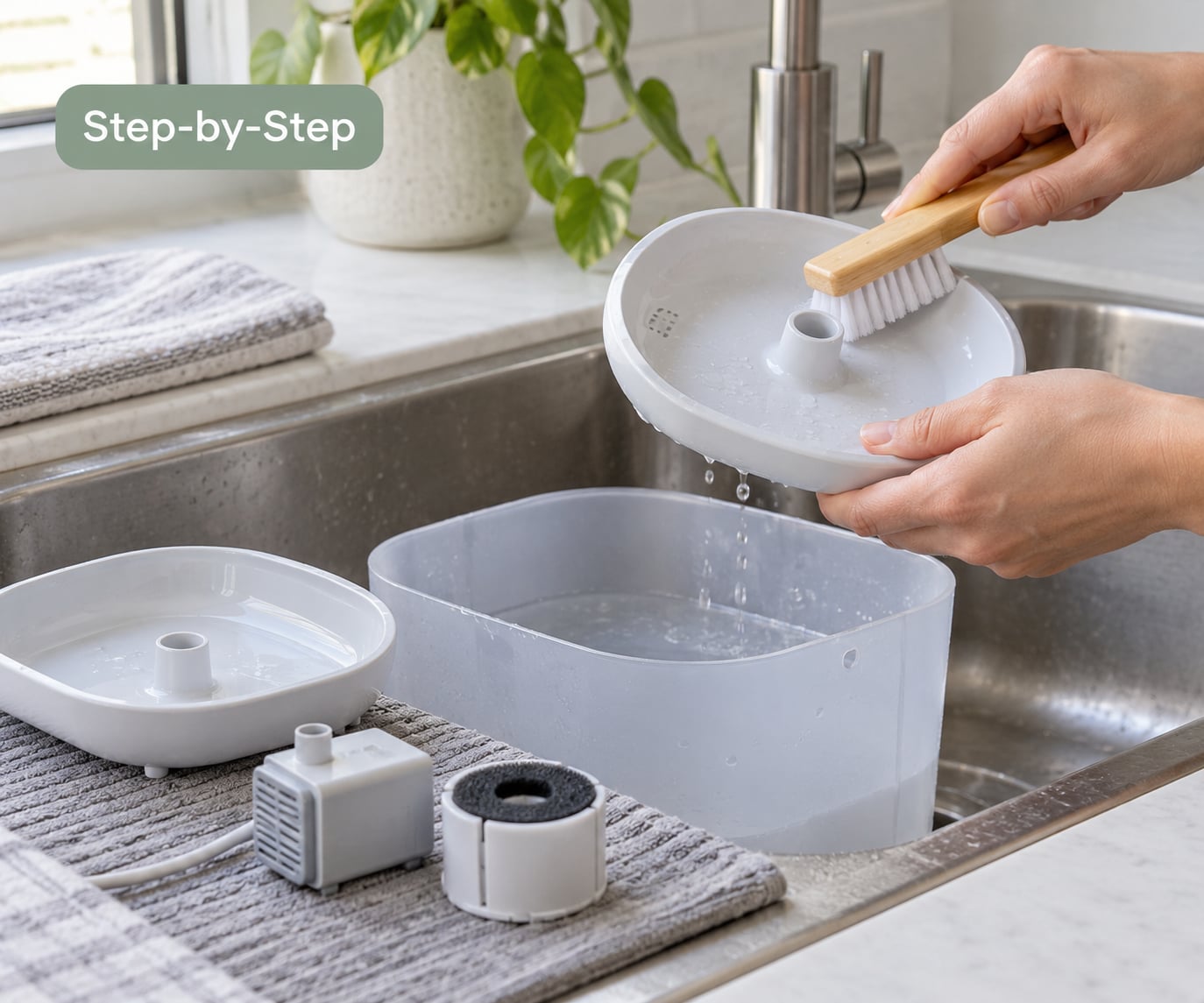
How to clean a pet water fountain comes down to six stages, and the order matters. Disassemble in the reverse of how it goes together, wash, scrub, descale, dry and refill.
Unplug the Fountain and Check the Manual
Disconnect the power before anything else. Pull the plug from the wall rather than just switching the unit off, and empty the reservoir by tipping it into a sink or onto a towel if the spout opening makes it awkward.
Then read the manual, at least the cleaning page. Manufacturers list which parts are dishwasher safe, whether vinegar is approved for the surface, and how often they want the filter changed. Following those three lines prevents almost every common mistake, and it takes two minutes.
Disassemble the Basin, Pump, and Filter
Most fountains separate into the reservoir or tank, the drinking surface or bowl, the spout or tower, the pump, the filter, and the power cable with its inline switch. Lift pieces straight up and apart where you can, and work any screws you find into your container rather than your sink drain.
Watch for gaskets and O-rings seated in grooves. They look like flat rings but they seal the pump, and one installed backwards is the most common reason a fountain stops pumping after a clean.
On waterfall and tower styles there are narrow vertical pipes and a drinking channel that a sponge will not fit into. Run a soft bottle brush or a stiff-bristled-but-non-wire brush down each one, several passes, before the parts even go near water. Owners on r/CatAdvice describe this as the single fiddliest part of the job, and it is the part most guides skip.
Wash the Water-Contact Parts
Fill a sink or dishpan with warm water and a squirt of mild unscented dish soap. Wash each plastic, ceramic, stainless steel or glass part by hand and scrub the seams, corners and spout openings with a soft brush or toothbrush.
Take extra care at the water line, where mineral haze and biofilm build a visible ring. On stainless steel, stay with a non-abrasive pad, because once a finish is scratched, limescale has a place to latch on and owners report scratches that stain permanently no matter how hard they scrub.
On ceramic, wash the glaze with the same mild soap. If the manual allows a dishwasher, the top rack on a low-temperature cycle is the fastest route for plastic and ceramic parts, but skip it for anything with a printed logo, a rubber foot, a power lead, or a manufacturer warning against heat. Warped or cracked plastic is a common dishwasher casualty.
Clean the Pump and Replace the Filter
Take the pump apart as far as it will go without force. On most models that means sliding or unscrewing the faceplate, lifting out the impeller (the small spinning fan), and noting the position of the stator, the fixed piece the impeller turns inside. A photo before you start saves a lot of guessing when you put it back together.
Soak the pump housing and impeller in warm soapy water for 15 to 30 minutes, then swab the inside with a cotton swab or a soft brush. Rinse with a gentle stream rather than a blast, and never submerge the electrical portion, the cable, or the inline switch. Let the impeller spin freely between two fingers before it goes back in; if it does not, grit is still in the hub.
For the filter, do not use soap. Foam filters can be rinsed under cool water and gently squeezed until it runs clear. Disposable charcoal filters have no rinse that restores them once loaded with debris, so replace those on the manufacturer’s schedule, commonly every 2 to 4 weeks. If the pump is weak, a clogged filter is the first thing to check before you blame the unit.
Where a full teardown is not practical, there is a shortcut: keep the pump assembled, fill it with warm water and mild soap, run it for a minute, pour that water out, refill with fresh warm water and run it again for a minute. You will pull loosened debris out through the spout, and it is much better than skipping the pump entirely.
Remove Mineral Deposits and Stubborn Grime
Hard white chalk, dull spots and crusty rings are limescale from tap water minerals, not dirt, so soap alone will not shift them. Mix white vinegar and water roughly 1:1, pour or brush it over the affected surfaces, and let it sit 10 to 20 minutes before scrubbing with a non-abrasive pad.
Green film is algae, pink or orange patches are bacterial discolouration, and black or dark grey growth in corners and under seals is mould. All three respond to a full disassembly plus hot soapy water, and stubborn patches usually need the vinegar soak on top.
Be careful where you use vinegar. It is safe on most plastic, glass and fully glazed ceramic, but avoid it on natural stone, on coated or plated metal, on aluminium and brass components, and on any electrical part unless the manufacturer explicitly approves it. Never mix vinegar with bleach or any other cleaner, and never pour boiling water into plastic, which can warp the basin and ruin the seal.
For heavy mould in a seam you cannot open, a very dilute bleach solution (roughly 1 part household bleach to 9 parts cool water), applied with a cotton swab and followed by a thorough rinse, is the option owners describe working on a monthly basis. Use it only if your model’s manual permits, keep the concentration modest, and rinse until you can smell nothing.
Dry, Reassemble, and Refill
Let the parts dry completely, ideally spread on a towel overnight. Trapped moisture in a channel or around a gasket is exactly the warm, wet gap that restarts slime, and a fountain reassembled while damp will show a film within days.
Reassemble in reverse order. Seats go back in the same direction they came out, the impeller slides on its shaft rather than being forced, and the filter sits flat in its housing with no fold or crease blocking flow. Refill with fresh water, switch the pump on, and watch it for a minute: water should climb the spout or tower and fall back in a steady stream.
If it does not pump, the unit is usually air-locked or the filter is not seated. Turn it off, press down on the pump to push water back into the housing, fill the reservoir higher than the pump, and restart. Owners who have cleaned their own fountain report finding the pump cavity packed with slime and hair, which is why the clean-looking outside is not a reason to skip this step.
Common Mistakes
Almost every problem with a dirty fountain traces back to one of seven habits. The fix is usually simple, and the cost is ten minutes a week.
Using harsh or scented cleaners. Scented dish soap, bleach in concentration, alcohol glass cleaner, and degreasers can all leave residue that a pet will not drink, and some are genuinely toxic when licked from a wet bowl. Stick to mild unscented dish soap, plus vinegar for scale only where the manual allows it.
Forgetting the filter, or washing it. A filter is not a licence to skip cleaning; it slows sludge, it does not remove it. Foam gets rinsed under cool water, charcoal gets replaced. Soap destroys charcoal’s ability to adsorb impurities, which leaves an expensive block doing nothing.
Rinsing too quickly. Most “the fountain still smells” complaints come down to a film of soap left in the basin, the spout and the filter housing. Rinse every part longer than feels necessary, until it smells of nothing and the water running off it runs clear.
Leaving biofilm in place. A slimy film does not wash off. It needs warm soapy water, dwell time and mechanical scrubbing, and the internal channels and pump cavity need the same treatment as the bowl. Run a brush down the tubes rather than assuming soap reached them.
Cleaning too rarely, or only when it is obviously foul. Once there is a smell or visible slime, you are already deep into a biofilm. A 30-second daily rinse of the bowl plus a weekly full clean prevents the whole problem.
Not drying before reassembly. Damp parts in a closed channel grow slime faster than clean parts. Let everything dry fully.
Using the dishwasher on the wrong pieces. Top-rack, low temperature is fine for many plastic and ceramic parts. It is not fine for anything with a cable, a seal, a printed surface, or a manual warning against it, and heat can warp a basin permanently.
A quick comparison of the methods people actually use:
| Method | Best for | Dilution or use | Soak time | Cautions |
|---|---|---|---|---|
| Mild unscented dish soap | Biofilm, grease, food film, pink slime | 1 squirt per sink of warm water | 5 to 15 minutes | Never on charcoal filters; rinse thoroughly |
| White vinegar | Limescale, hard water stains, light algae | 1:1 vinegar and water | 10 to 20 minutes | Not on natural stone, coated metal or electrical parts; never mixed with bleach |
| Baking soda | Mild odour neutralising, light film | 1 tablespoon per litre of warm water | 10 minutes | Weak against limescale; rinse well, as residue raises pH |
| Very dilute bleach | Persistent mould in seams | 1 part bleach to 9 parts cool water | 5 minutes, then rinse | Only if the manual allows; never combine with vinegar; rinse until odour-free |
| Boiling water | Nothing that is plastic or sealed | Not recommended | Not recommended | Warps plastic and damages seals; can crack glass and ceramic |
A routine that works, based on what owners report doing:
- Daily, 30 seconds: dump the top bowl, rinse with fresh water, refill. Wipe the spout mouth.
- Weekly, 10 minutes: full disassembly, warm soapy wash, pump scrub, rinse, dry, reassemble.
- Every 2 to 4 weeks: replace the charcoal filter, and descale if you are on hard water or see white chalk forming.
- Monthly: inspect the tower channels and pump cavity, clean the power cable and drip area, and check for cracks in seals.
- After a trip or power cut: treat the whole unit as contaminated. If the reservoir dried out entirely, do a full clean before refilling, and never return standing water to a pet.
If you cannot get a fountain clean, or it keeps going slimy within days, a new unit designed for easy disassembly is usually cheaper than the time you spend scrubbing. Stainless steel and glazed ceramic shed biofilm better than scratched plastic, and owners who switched report the same complaint largely disappearing.
One health note. A fountain that has gone slimy is generally not an emergency once cleaned, but a pet that stops drinking, vomits after drinking, has inflamed gums, or develops sores around the mouth deserves a call to your vet. Water that has sat long enough to smell should be replaced rather than topped up, and never give a pet human medication or a household cleaner.
Frequently Asked Questions
How often should I clean a pet water fountain?
Unplug and clean a fountain at least weekly, or more often if it has visible algae, slime, odor, sediment, or frequent use by multiple pets. Follow the manufacturer’s schedule, because some materials and models need monthly rather than weekly care. Rinse and refill the top bowl on a daily basis.
Can I use vinegar to clean a pet water fountain?
Vinegar may help with some mineral deposits, but it is safe only if the manufacturer allows it. Never mix vinegar with bleach or other cleaners, and do not use it on electrical parts or surfaces that are natural stone or coated metal. Dilute it about 1:1 with water, soak for 10 to 20 minutes, then rinse well.
How do I remove stubborn algae from a water fountain?
Empty and disassemble the fountain, then soak compatible removable parts briefly in warm water with mild dish soap while gently scrubbing with a soft brush or toothbrush. Do not pour boiling water into plastic or ceramic. A 1:1 white vinegar and water soak for 10 to 20 minutes shifts remaining algae, then rinse and refill with fresh water.
Do I need to replace the filter every time I clean the fountain?
Not necessarily. A filter can usually be rinsed according to the manufacturer’s instructions, but it should be replaced when it is clogged, torn, coated with debris, no longer supports proper water flow, or when the manufacturer specifies an interval, often every 2 to 4 weeks. Foam filters rinse under cool water. Charcoal filters are replaced, never washed with soap.
Why does my cat water fountain smell even after I cleaned it?
The smell usually comes from residue left inside the parts you cannot see: the spout, tower channels, pump cavity and filter housing. Soap film is the most common culprit, and biofilm in a narrow pipe is the second. Take the unit apart fully, brush a soft bottle brush down every channel, soak the pump, and rinse each part until it smells of nothing.
When should I contact a veterinarian about a dirty fountain?
Contact your vet if your pet stops drinking, vomits after drinking, has inflamed or bleeding gums, sores in the mouth, eye discharge, or a sudden change in thirst. Bacterial growth in stagnant water can irritate the mouth and gut. Never give a pet human medication, and never use bleach, alcohol or scented cleaner in a fountain they drink from.
Start here tonight: unplug the fountain, take it fully apart, and wash every piece with warm water and mild unscented dish soap. Give the pump and the tower channels fifteen minutes of soak time and a proper scrub, let everything dry, and refill. Do that once a week and the smell, the slime and the weekly deep clean all become far less of a problem.