If you’re searching how much should I feed my dog by weight, here’s the short version: most healthy adult dogs need roughly 2 to 3 percent of their ideal body weight in food per day, which for a 30-pound dog works out to somewhere around 800 calories and a bit over two cups of average dry food. That’s a starting point, not a prescription. Activity level, body condition, life stage and how calorie-dense the food is will move the number up or down, and the way to find your dog’s real number is to weigh, feed a measured portion, then watch the ribs and waist for four weeks.
Below I’ll give you a chart you can read straight off, a method for calculating a target for any dog (including ones that don’t fit neatly in a bracket), and the adjustment loop for when the weight is wrong.
Table of Contents
- Daily Dog Calories by Weight
- How much should I feed my dog by weight?
- Daily Feeding Chart for Adult Dogs
- How to Calculate Your Dog’s Daily Portion
- Step 1: Convert pounds to kilograms
- Step 2: Find the resting energy requirement
- Step 3: Apply an activity factor
- Step 4: Divide by the food’s calorie density
- Worked example: a 30-pound dog on average kibble
- What Changes How Much a Dog Should Eat?
- Activity level
- Body condition
- Life stage
- Health and environment
- Adjusting Portions Without Feeding Too Much or Too Little
- The five-step adjustment loop
- Dry Food vs. Wet Food: Does the Container Matter?
- Feeding Puppies, Senior Dogs, and Highly Active Dogs
- Safety Notes and When to Ask Your Veterinarian
- Frequently Asked Questions
- How many cups of dog food should a 20-pound dog eat?
- How many treats can I give my dog each day?
- How fast should an overweight dog lose weight?
- How much food should a puppy eat based on weight?
- When should I ask a veterinarian about my dog’s weight or appetite?
- Conclusion: Start With a Measured Daily Target
Daily Dog Calories by Weight
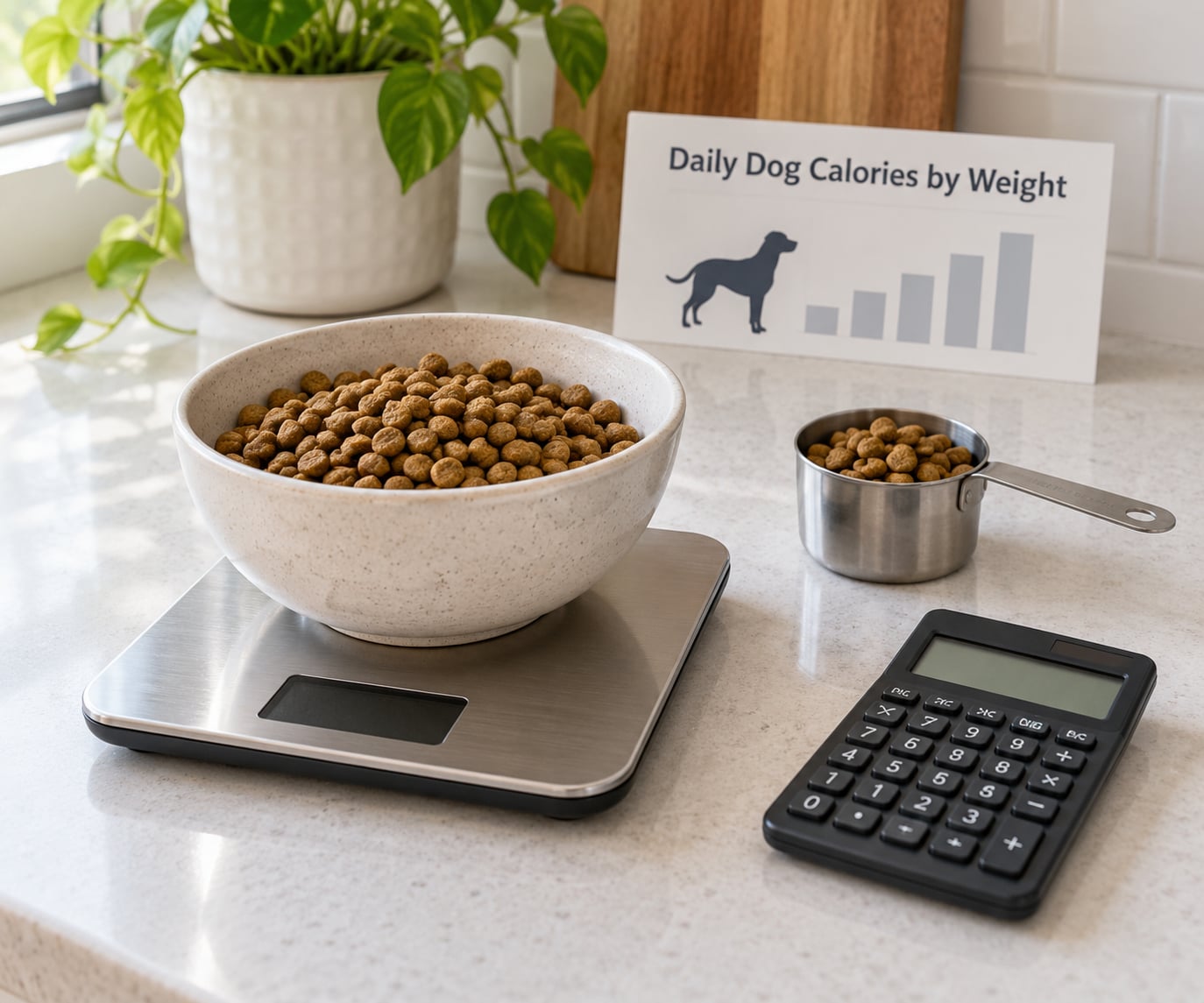
Dog food should be measured in calories, not scoops. A cup is a volume, and volume says nothing about how many calories a dog actually gets from it, because dry foods on the market range from roughly 300 to more than 500 kilocalories per cup. Two dogs eating the same two cups can be on wildly different diets, which is why cup-to-cup comparisons between brands are misleading and why cup charts shift every time you switch brands.
How much should I feed my dog by weight?
A healthy adult dog’s resting energy requirement is estimated as 70 multiplied by body weight in kilograms raised to the power of 0.75. For a 30-pound dog, that’s about 13.6 kg, which gives roughly 495 resting calories. Multiply that by an activity factor of 1.6 for a typical neutered adult and you land near 800 calories a day. That number is an estimate of what the dog needs at rest plus normal daily activity, not a prescription, and it always gets checked against body condition.
That same figure translates to food only once you account for what’s in the bowl. At 350 kilocalories per cup, 800 calories is about 2.25 cups of dry food per day, split into two meals.
| Body weight | Weight in kg | Est. calories per day | Dry food cups per day | Dry food grams per day |
|---|---|---|---|---|
| 5 lb | 2.3 kg | about 210 kcal | about 0.6 cup | about 60 g |
| 10 lb | 4.5 kg | about 350 kcal | about 1 cup | about 100 g |
| 20 lb | 9.1 kg | about 585 kcal | about 1.6 to 1.75 cups | about 170 g |
| 30 lb | 13.6 kg | about 790 kcal | about 2.25 cups | about 225 g |
| 40 lb | 18.1 kg | about 985 kcal | about 2.75 to 3 cups | about 280 g |
| 50 lb | 22.7 kg | about 1,165 kcal | about 3.25 cups | about 330 g |
| 60 lb | 27.2 kg | about 1,335 kcal | about 3.75 to 4 cups | about 380 g |
One caution about the 2 to 3 percent rule. It’s a useful cross-check for fresh and wet food, which is less calorie dense. Dense kibble hits a dog’s calorie target before it reaches 3 percent of body weight, so use the calorie column as the primary number and treat the percentage as a sanity check.
Daily Feeding Chart for Adult Dogs
The chart above assumes an average adult on an average day: neutered, moderately active, at a healthy weight. Real dogs sit somewhere on a spectrum, and the adjustments below move the target by meaningful amounts.
| Activity level | Typical day | Factor | Effect on a 790 kcal target |
|---|---|---|---|
| Inactive or sterilized senior | short walks, mostly indoors | 1.2 to 1.4 | about 590 to 690 kcal |
| Typical neutered adult | 30 to 60 minutes of exercise daily | 1.6 | about 790 kcal |
| Active adult | 1 to 3 hours of walking, running, swimming | 1.8 | about 890 kcal |
| Working or sport dog | 3 hours or more of hard work daily | 2.0 to 5.0 | 990 kcal and up, set with a vet |
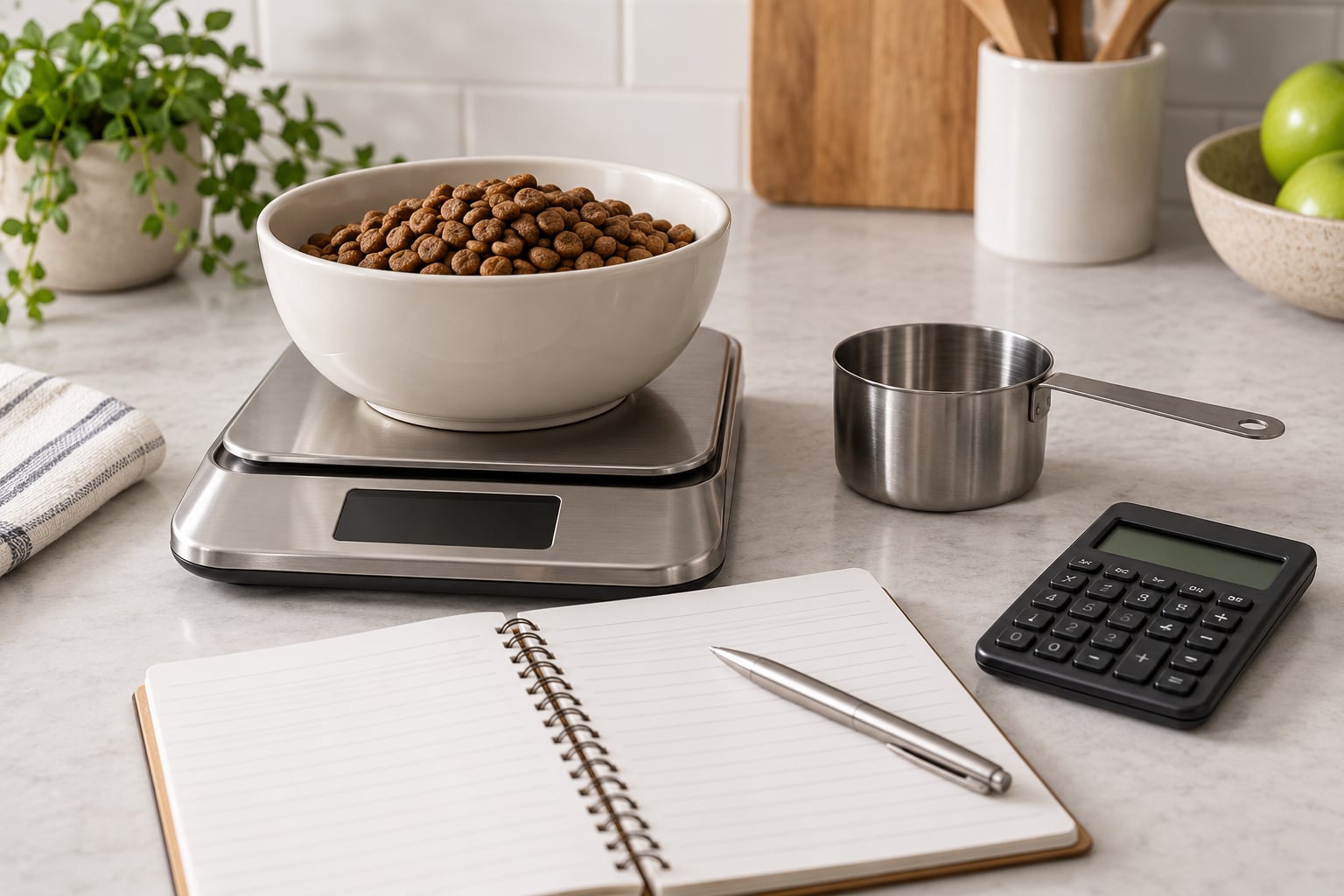
If your dog sits on a bracket boundary, use the lower bracket and let body condition tell you whether to move up. Owners comparing notes in r/PetAdvice threads land on the same view: the chart is a starting point, not an instrument, and a couple of ounces matters far less than where the ribs and waist sit. Weighing food on a kitchen scale beats a free scoop every time, mostly because a scoop drifts week to week as the bag empties.
Split the daily total into two meals for an adult. Two measured meals make it obvious whether the dog is eating, and they cut down on the frantic scavenging some dogs do with one big evening meal.
How to Calculate Your Dog’s Daily Portion
You can work out a calorie target for any dog in four steps, and once you have that target, the portion is just a division problem. This is the method that lets you audit your own food bag, which matters because owners rarely trust the printed chart.
Step 1: Convert pounds to kilograms
Divide body weight in pounds by 2.2046. A 50-pound dog is about 22.7 kg.
Step 2: Find the resting energy requirement
Multiply 70 by your dog’s weight in kilograms raised to 0.75. Most phone calculators have a power button. A 22.7 kg dog comes out around 730 resting calories.
Step 3: Apply an activity factor
Multiply the resting figure by the factor from the table above. For an active 50-pound dog, 730 times 1.8 is roughly 1,310 calories a day.
Step 4: Divide by the food’s calorie density
Read the kilocalories per cup or per can from the bag or can label. If that food is 400 kcal per cup, 1,310 calories is about 3.25 cups per day.
Worked example: a 30-pound dog on average kibble
30 lb is 13.6 kg. The resting energy requirement is about 495 calories. At a 1.6 factor for a neutered adult, the daily target is roughly 790 calories. The bag says 350 kcal per cup, so 790 divided by 350 is about 2.25 cups a day, or 1.1 cups at breakfast and 1.1 at dinner. The same dog on a 500 kcal-per-cup food needs only 1.6 cups, which is the clearest argument for reading the label instead of copying someone else’s cup count.
Two smaller examples for the same math. A 10-pound dog’s resting requirement is about 218 calories, which at a 1.6 factor lands near 350 calories, or roughly one cup of average kibble a day. A 50-pound dog at a 1.6 factor needs about 1,165 calories, which is about 3.25 cups and about 330 grams. If that dog is spayed or neutered and walks half an hour a day, drop the factor to 1.4 and you land near 1,020 calories instead, a reduction of roughly 15 percent that most owners never make.
What Changes How Much a Dog Should Eat?
The chart gives you a number to start from. Four things move it from there, and the order of importance is usually activity, body condition, then life stage, then health.
Activity level
Dogs that get three hours of hard exercise a day need meaningfully more than dogs that get one gentle walk. Many owners underestimate how much a busy dog’s metabolism demands, and underfeeding an active dog shows up fast as weight loss, poor coat condition and no energy. Walking dogs, hunting breeds, agility dogs and herding breeds typically need a factor between 1.8 and 2.0, and a working dog on top of that should have its ration set by a veterinarian.
Body condition
Weight on the scale is only half the story. Body condition is what the ribs, waist and abdominal tuck look like now, and it’s the trigger for every portion change you should make.
| Sign | Underweight | Ideal weight | Overweight |
|---|---|---|---|
| Ribs | clearly visible and prominent from across the room | easy to feel under a thin layer of fat, visible when you look down | difficult to feel even with firm pressure |
| Waist from above | very narrow, spine and hip bones sharply prominent | a clear hourglass shape behind the ribs | no waist, back is level or rounded |
| Side profile | flat abdomen with a sharp tuck and sunken flanks | slight upward curve from the deep chest to the waist | abdomen hangs or sags level with the chest |
Life stage
Puppies need more than adults per pound of body weight, commonly 4 to 6 percent of current weight, and seniors often need slightly less, in the neighborhood of 1.8 to 2 percent. Neutering drops metabolic rate for many dogs, and an adult that is a few pounds heavy after being spayed or neutered usually needs 10 to 15 percent off the previous portion rather than a crash diet.
Health and environment
Medical conditions change requirements substantially, and so does the room the dog lives in. A dog that spends its days in a cold garage or a hot climate eats differently than one that’s outside in mild weather. Dogs on prescription diets, kidney or liver patients, and dogs with diabetes, hypothyroidism, arthritis or a history of bloat should be on a ration set by their veterinarian, not by any chart, including this one.
Adjusting Portions Without Feeding Too Much or Too Little
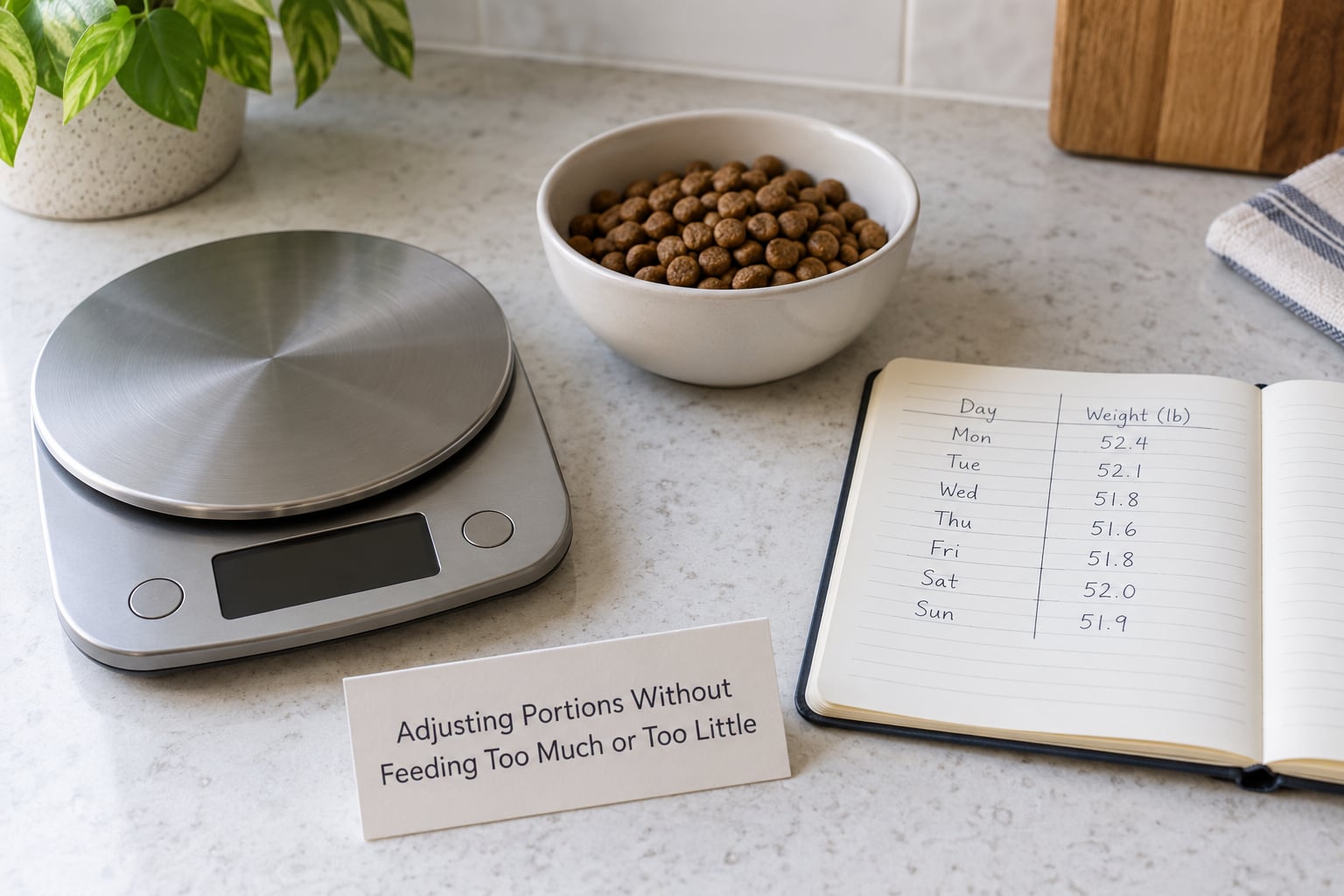
The adjustment loop matters more than any single number, because every dog is an individual and every food is a little different. Give it four weeks and follow the same steps each time.
The five-step adjustment loop
- Weigh the dog. Use the same scale, at the same time of day, once a week. Aiming for the scale is only meaningful if the conditions are repeatable.
- Do the body condition check. Ribs, waist from above, and side profile. This tells you what the scale alone can’t, especially for a dog whose breed is built long and lean.
- Adjust the daily total by about 10 percent. Up or down, but small. A 10 percent change is roughly 80 calories on an 800-calorie dog, which is enough to show up in four weeks and small enough that you won’t upset the stomach.
- Subtract treats from the meal. Keep treats, chews and table scraps under 10 percent of daily calories, ideally under 5. Drop an equal number of calories from the meal portion rather than adding them on top.
- Wait a week, then look again. Change one variable at a time and give each change time to show.
For a dog that needs to lose weight, aim for a slow, steady loss of about 1 percent of body weight per week, which for a 30-pound dog is roughly a quarter pound. Losing faster than that usually costs muscle rather than fat and is the point at a weight clinic tells you to stop and reassess. For an underweight dog, add calories in the same 10 percent steps and switch to a more calorie-dense food if the volume is the problem rather than the total.
Track it in a notebook or your phone. Weight drift of a pound or two week to week is often water, digestion and time of day, not fat, which is another reason to change one thing at a time.
Dry Food vs. Wet Food: Does the Container Matter?
The container doesn’t matter, the calories do. The same dog’s daily total is the same number whether it arrives in kibble, in cans, as fresh food, or as a mix, and the only job the container does is change how you get to that total.
Wet food is far less calorie dense and far more moist. A standard 5.5-ounce can with about 250 kcal means a 790-calorie target takes roughly three cans a day. Dry food at 350 kcal per cup takes about 2.25 cups for the same dog. When owners on r/dogs try to combine both at once, the usual problem is applying two separate feeding directions instead of one calorie total: subtract the calories from the can, then work out what’s left for the kibble.
| Body weight | Est. calories per day | Wet food cans per day | Dry food cups per day |
|---|---|---|---|
| 10 lb | about 350 kcal | about 1.4 cans | about 1 cup |
| 20 lb | about 585 kcal | about 2.3 cans | about 1.6 to 1.75 cups |
| 30 lb | about 790 kcal | about 3.2 cans | about 2.25 cups |
| 40 lb | about 985 kcal | about 3.9 cans | about 2.75 to 3 cups |
| 50 lb | about 1,165 kcal | about 4.7 cans | about 3.25 cups |
| 60 lb | about 1,335 kcal | about 5.3 cans | about 3.75 to 4 cups |
Fresh and homemade food usually lands near 2 to 3 percent of body weight by weight, which is why the percentage rule is most often quoted for raw and fresh feeding. Whatever the format, the total is the total, and every treat, chew, training biscuit and scrap of table food counts against it.
Feeding Puppies, Senior Dogs, and Highly Active Dogs
Puppies are the exception to the weight chart, because a puppy’s job is growth rather than maintenance. A puppy generally needs 4 to 6 percent of current body weight per day, and the right row to start from is the puppy’s expected adult weight, not its current weight. Puppies also eat more often, and small meals are safer for a stomach that isn’t finished growing.
| Age | Meals per day | Portion basis |
|---|---|---|
| 6 to 8 weeks | 4 | 4 to 6 percent of current weight, using expected adult weight for food choice |
| 8 to 16 weeks | 3 to 4 | 4 to 6 percent of current weight |
| 4 to 6 months | 3 | 4 to 6 percent of current weight |
| 6 to 12 months | 2 to 3 | taper toward adult portions, watching body condition |
Large and giant breed puppies are the case to watch. Feeding them for their expected adult growth too quickly is linked to joint and bone problems, so they move onto adult food later than small breeds do: roughly 12 months for small breeds, 12 to 15 for medium, and 18 to 24 months for giant breeds. Growing too fast is as damaging as growing too slowly.
Senior dogs need less as their metabolism slows and their activity drops, and many do better on 1.8 to 2 percent of body weight. Some also need more moisture and more easily digestible protein, which is a conversation for a veterinarian rather than a chart. Working and athletic dogs sit at the other end of the range and should have their ration calculated with a vet, since a 2.0 factor and a 5.0 factor are very different animals.
Safety Notes and When to Ask Your Veterinarian
A portion estimate is enough for a healthy adult at a healthy weight. It stops being enough the moment something changes, and the signs worth acting on are behavioral and physical rather than numeric.
- Appetite changes that last more than a few days. A dog that stops eating or starts eating much more than usual needs an examination, not a re-portioned bowl.
- Vomiting, diarrhea, or a change in stool quality that doesn’t settle with a dietary change.
- Lethargy, limping, or stiffness that shows up alongside a weight change.
- Difficulty chewing, dental pain, or dropping food, especially in an older dog, which changes what they can physically eat.
- Marked weight loss or gain in a matter of weeks with no change in food.
- Any chronic condition, including kidney, liver, heart and endocrine disease, where the food itself is part of the treatment.
- Pregnancy, nursing, or a new litter, where requirements climb sharply and a growth plan matters.
Never give a dog human medication. Ibuprofen, acetaminophen, and many over-the-counter products are toxic to dogs, and a dog in pain needs to be seen rather than dosed at home.
Veterinary nutrition guidance does move as research accumulates, and this version reflects what we could verify for 2026. Two outside sources are worth keeping on hand: the Association for Pet Obesity Prevention’s daily caloric needs chart, and the feeding guide printed on your specific bag of food. Between the two, you have a range to work with, and your own dog’s body condition is the tiebreaker.
Frequently Asked Questions
How many cups of dog food should a 20-pound dog eat?
A 20-pound adult dog needs roughly 585 calories a day. At 350 kilocalories per cup, that works out to about 1.6 to 1.75 cups of dry food across two meals. Food with a different calorie density will give a different number: at 500 kcal per cup the same dog needs only about 1.2 cups. Check the label and then confirm with body condition.
How many treats can I give my dog each day?
Keep treats, chews, training biscuits and table scraps under 10 percent of your dog’s daily calories, and under 5 percent if the dog is overweight or prone to dental problems. For a dog on an 800-calorie day, that ceiling is about 80 calories, which is a few small biscuits rather than a chunk of cheese. Subtract treat calories from the meal portion instead of adding them on top of it.
How fast should an overweight dog lose weight?
Aim for about 1 percent of body weight per week, so roughly a quarter pound on a 30-pound dog. Losing faster tends to strip muscle rather than fat and is difficult to sustain. Reduce the current daily total by 10 percent, keep two measured meals, reassess ribs and waist weekly, and cut another 10 percent only after a full month of no progress. A weight clinic can set a safe target for your dog’s body condition.
How much food should a puppy eat based on weight?
Puppies usually need 4 to 6 percent of their current body weight per day, split into 3 to 4 meals depending on age. Use the puppy’s expected adult weight to choose the food and the portion row, because a large-breed puppy needs to grow more slowly than a small-breed one. Move to adult portions and adult food gradually, later for giant breeds, and keep portions adjusted with a body condition check every couple of weeks.
When should I ask a veterinarian about my dog’s weight or appetite?
Ask your veterinarian any time weight changes quickly without a change in food, appetite shifts last more than a few days, or your dog vomits, has diarrhea, seems lame or lethargic, or struggles to chew. Appetite changes can signal dental pain, digestive disease or metabolic problems, and a portion chart cannot help with any of those. Pregnancy, nursing, chronic kidney, liver or heart conditions, and any prescription diet also belong in that conversation.
Conclusion: Start With a Measured Daily Target
Start here: find your dog’s weight, pick the row, and feed the calorie target from the chart in two measured meals while you watch the ribs and waist for four weeks. Weigh the food rather than scooping it, count treats against the total, and change one thing by 10 percent at a time. If the number stops agreeing with what you see on the dog, or if appetite, weight or stool changes suddenly, that’s the point to stop calculating and call your veterinarian.