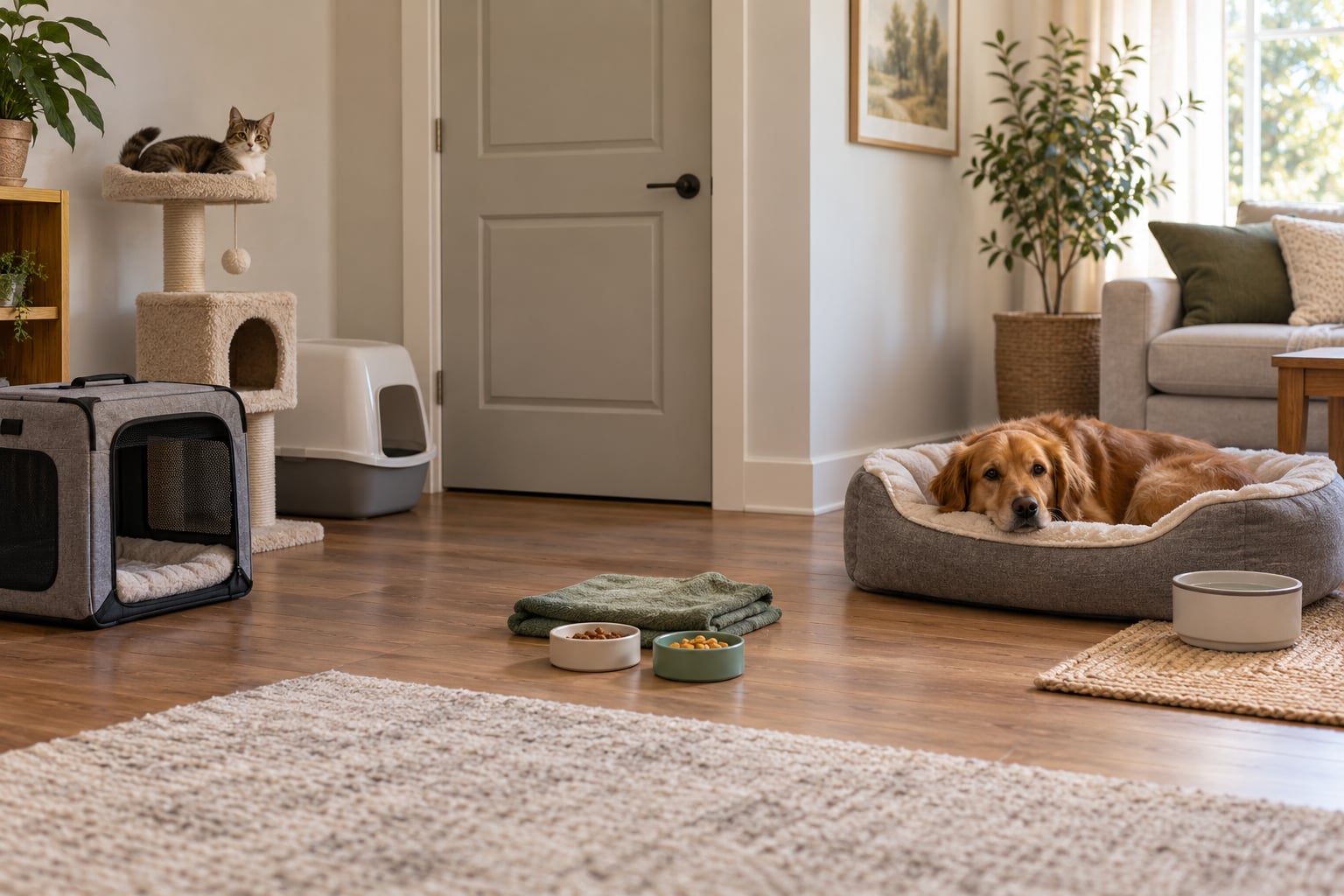
The safest way to introduce a new cat to a dog is to go slowly, over days and often weeks, starting with scent and ending with short supervised sessions in the same room. A cat reads the world through smell first, so the pair usually has to learn about each other behind a door, then through a gate, and only then face to face. Most of the work is preparation, and the whole thing usually takes anywhere from a few days for an easygoing pair to a few months for a nervous cat and a dog with strong prey drive.
The rule that matters most is simple: you move to the next stage only when both animals are calm at the current one. If either one stalks, lunges, freezes, growls, or bolts to hide, drop back to the last stage that worked and stay there until it is boring again. Boredom is your signal that you have gone too slowly, which is the better error to make.
Nothing here replaces a vet visit for the new cat or a conversation with a qualified behaviour professional if either animal has a history of fear-based aggression, has bitten another animal, or has been injured in a previous introduction. Those cases need a plan built around the specific animal, and a generic protocol is not it.
Table of Contents
- What You Need to Introduce a New Cat to a Dog Safely
- Step-by-Step: How to Introduce a New Cat to a Dog
- 1. Prepare Separate Safe Spaces
- 2. Exchange Scent Without Direct Contact
- 3. Allow Visual Contact Through a Secure Barrier
- 4. Add Positive, Controlled Contact
- 5. Move Toward Shared Household Supervision
- Common Mistakes That Ruin a Cat and Dog Introduction
- Rushing the stages
- Letting the dog chase or invade the cat’s space
- Using the cat as a play object
- Taking away the cat’s safe room
- Rewarding stalking
- Leaving them alone too soon
- Frequently Asked Questions
- How long does it take to introduce a new cat to a dog?
- Can I leave my new cat and dog alone together after introducing them?
- What should I do if my dog barks or chases the new cat?
- Does the new cat need a separate room permanently?
- When should I call a veterinarian or dog-training professional?
- How do I prevent my dog from eating the cat’s food or entering the litter box?
- Conclusion
What You Need to Introduce a New Cat to a Dog Safely
You can run this process with a few household items, but a couple of them make a real difference. The list is short, and most of it costs nothing more than moving furniture.
- One closed-door room for the cat. A spare bedroom is ideal. A bathroom works. A studio apartment can work too, with adaptations below.
- Two solid doors or a gate. A baby gate across a doorway keeps a dog out of the cat’s room. If you have no gate, a screen door, a stack of baby gates across the hall, or a door that latches shut all work as barriers.
- Separate resources. At least one litter box, and in a two-animal home the usual advice is one box per animal plus one spare, all in areas the dog cannot reach.
- Hiding spots and height. A cat tree, a shelf, or a cardboard box gives the cat somewhere the dog cannot get to, which is what turns a corner into an exit rather than a trap.
- Two soft cloths or small towels. For the scent swap. Wash them separately and never use the same one on both animals.
- Treats and a long line. Treats pair the other animal’s smell with something good. A long line gives you back control of the dog without grabbing the cat.
- A carrier. A closed carrier is a safe spot for the cat during early sessions and a way to move the cat without picking it up.
Before you bring the cat home, check doors, windows, and any gap a kitten could squeeze through, and move the dog’s food, bed, and toys out of the cat’s room. Do the same for anything the dog resource guards, because a dog who guards a couch will guard a couch with a cat on it later. If your dog is used to crate rest, working on that cue in the weeks before arrival is time well spent; owners who pre-trained sit, stay, and leave it report noticeably calmer early sessions.
Step-by-Step: How to Introduce a New Cat to a Dog
Think of this as five stages, each one a little closer than the last. Move at the pace of the more nervous animal, not the more confident one.
1. Prepare Separate Safe Spaces
Set the cat up in a closed room before the dog sees or smells anything new: food, water, litter box, scratching post, and at least two hiding places. Bring the cat in through the front door in a carrier and let it out in that room alone, then close the door. Keep the dog completely away for the first two or three days so the cat can eat, use the box, and start grooming, which is how a cat says it feels settled.
You are ready to move on when the cat is eating normally, using the litter box, and coming out to greet you at the door. Hiding that eases within a day or two is normal transition. Hiding that continues past a week, or hiding that comes with not eating, is a vet call, not a training problem.
2. Exchange Scent Without Direct Contact
Cats identify animals far more by smell than by sight, so scent does most of the quiet work here. Rub a cloth on the dog’s cheeks, neck, and flanks and place it near the cat’s food bowl. Rub a second cloth on the cat’s cheeks and body and set it beside the dog’s bed or on a toy the dog likes. Let the animals investigate and move away whenever they want.
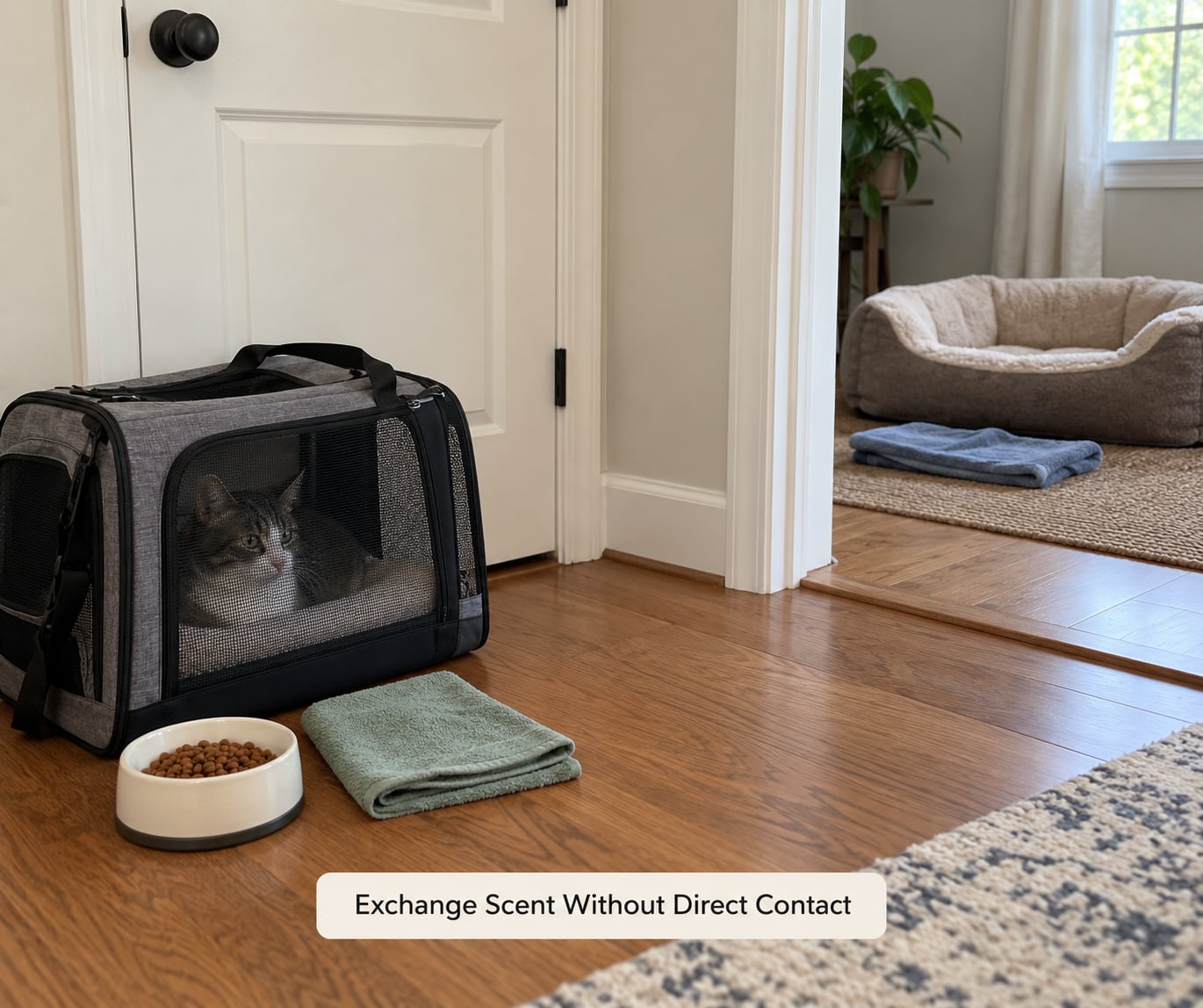
Keep sessions short and end them on a good note. If the dog fixates on the cloth, growls at it, or refuses to go near it, try a lighter offering such as a treat the dog already likes, or go back a step and start with bedding the cat has not slept on. Do not scold either animal for hissing or growling; that reaction is information, and punishing it teaches the cat that you are part of the threat.
You are ready to move on when both animals can investigate the scent and then disengage without fuss. That usually takes a few days, sometimes a single session.
3. Allow Visual Contact Through a Secure Barrier
Now let them see each other without letting them reach each other. Open the cat’s door a crack, or put the cat behind a baby gate, screen, or a door with a gap, and keep the dog on a long line. Start with about a minute. Watch the body language, not the noise, and end the session early while it is still calm.
Hissing and a lashing tail at this stage are not failure. They are a cat negotiating at a distance, and most cats go through a few days of it. What you do not want to see is a dog whose body goes stiff and tall, a hard unblinking stare, or a cat that flattens, charges, or bolts and will not come out.
You are ready to move on when both animals can notice each other for a few minutes without stalking, lunging, freezing, or repeated hiding. Sessions that end with a relaxed yawn and a snack are the ones that count as progress.
4. Add Positive, Controlled Contact
Once sight is boring, put treats or meals out on opposite sides of the barrier, or bring the cat into the room in its carrier and feed the dog nearby without letting him approach. Closed-door feeding on opposite sides of a door is the stage that produces the biggest visible change for most households, so do not rush past it.
After that, allow a short session in the same room. Take the dog out on a long walk first, let him relieve himself, then bring him in on the long line, feed him something chewy away from the cat, and keep sessions to a few minutes. Do not pick the cat up and carry it to the dog; a restrained cat that cannot get away will defend itself, and you are the one holding it. If the dog is comfortable in a well-fitted head collar and long line, use that instead of reaching for a collar over his head.
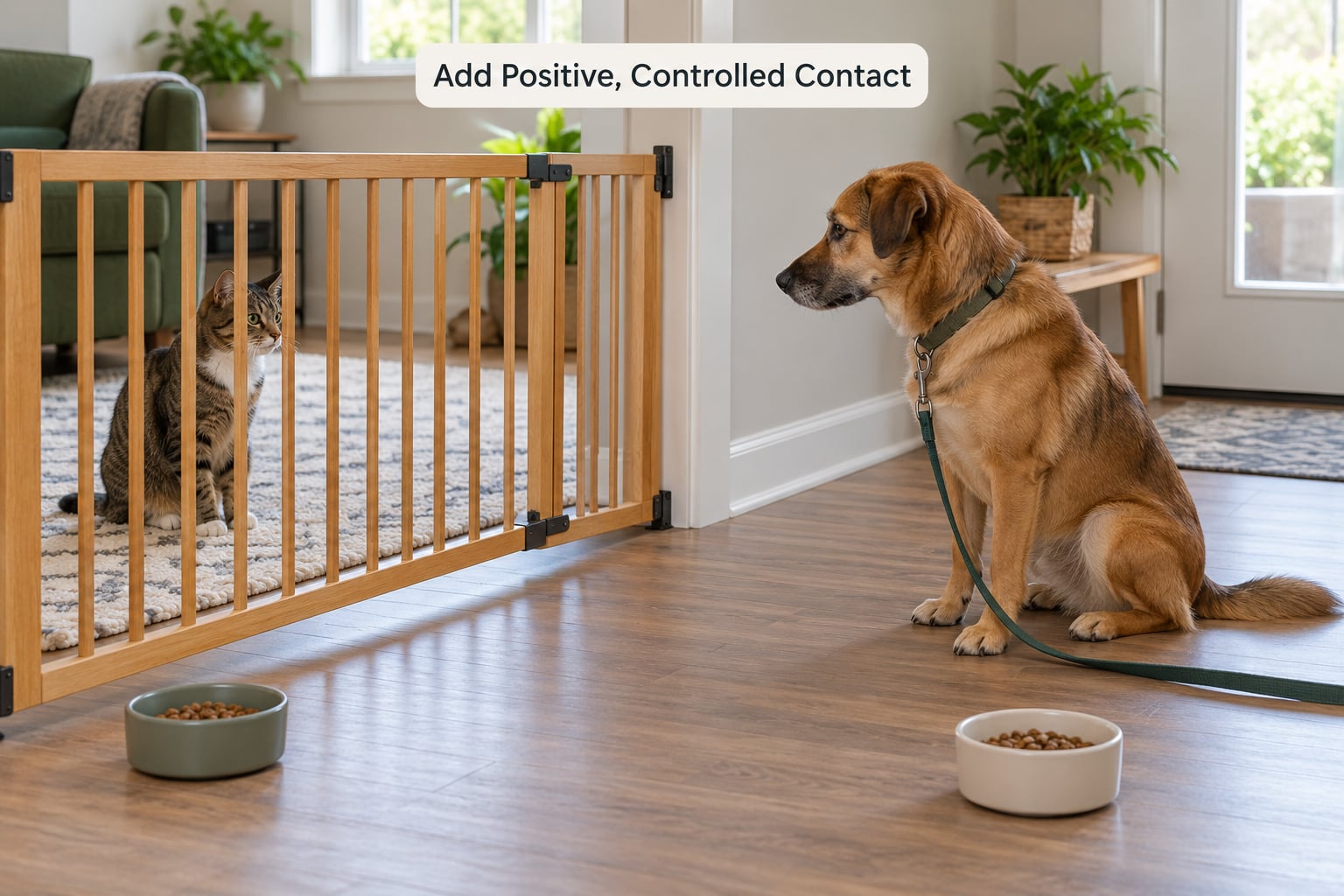
You are ready to move on when you can run two or three sessions in a row with no stalking, no chasing, and no cornering. If the dog is fixated on the cat with a rigid body and a hard stare, that is predatory interest, not play, and you end the session and go back to barrier work.
5. Move Toward Shared Household Supervision
Now you are watching them in a normal home rather than managing a meeting. Keep the cat’s safe room open and available as a permanent retreat, because most cats will use it their whole life. Feed them separately, spread resources out, and give the cat an elevated perch the dog cannot reach.
Watch the first weeks in this stage closely. Week one is usually short, boring encounters where the dog checks in and walks away. Weeks two and three are where play starts, often rudely, with a cat that did not ask to be ambushed. By around the second month most pairs are sharing a room comfortably, though plenty of cats keep a personal space and grumble about it indefinitely, and that is fine.
Do not leave them unsupervised until you have seen consistent calm behaviour over weeks, not one good afternoon. Leaving them alone for a few minutes while you run a bath or a load of laundry is a reasonable early test once both animals settle quickly when you return. A full workday is a different question, and asking a neighbour to check in is a reasonable bridge.
If you live in a small apartment with no spare room and no gate, the same stages still apply with substitutions. Use the bathroom or a corner behind a bookshelf as the safe room, keep the door ajar with the cat inside at first, and use a folding screen or a propped door as the visual barrier. Distance is the real tool here, and a small space mostly means shorter sessions.
If the dog is the new arrival instead of the cat, the order reverses slightly. The dog stays in a separate area with its own crate or bed, and the resident cat keeps its territory. Let the cat investigate the dog’s scent on its own schedule, and never carry the dog into the cat’s space, because that is an invasion no amount of treats fully undoes.
If you have two dogs, introduce the cat to one dog at a time, fully, before involving the second. Dogs in a pack will feed off each other’s arousal, and a dog who would have been calm alone may not be calm beside a housemate.
Common Mistakes That Ruin a Cat and Dog Introduction
Almost every introduction that goes badly shares a cause: someone moved faster than the animals were ready for. The corrections are simple once you know what went wrong.
Rushing the stages
Going from day one straight to face-to-face because a video of a calm dog and cat made it look easy. Fix it by going back one stage and staying there for two or three calm sessions before you try again. A slow introduction takes a few extra weeks. A rushed one can take months, or end in a bite.
Letting the dog chase or invade the cat’s space
A dog allowed to chase a cat learns that the cat is a toy, and that lesson is hard to unlearn. Keep the cat’s room genuinely off limits, and never use a cat as a training reward for recall. If your dog’s recall is weak, work on it with a long line and high-value treats before any in-room sessions.
Using the cat as a play object
Rough play that chases, corners, and pins is a setup for a defensive swipe, and a defensive swipe teaches the dog to escalate. Interrupt play that gets too intense by calling the dog away to a mat, not by picking up the cat. Two play sessions a day that the dog ends on a settle cue beat one long chase.
Taking away the cat’s safe room
People close the door on the cat’s room once things seem to be going well. It is the one mistake that can undo weeks. Leave that room open permanently, even after they are fully integrated, and expect the cat to nap in there.
Rewarding stalking
Praising or treating a dog the instant he locks onto the cat teaches the exact behaviour you want less of. Stay neutral, interrupt calmly, and mark the moment he disengages instead.
Leaving them alone too soon
Chasing and cornering rarely happen in front of you. Days of calm supervision followed by a ten-minute absence can undo a month of work, and the damage is often the thing that ends a pairing. Treat unattended time as a reward you earn over weeks, not a step you reach on schedule.
Two more habits help more than anything else in the first month. Walk the dog before sessions so he arrives tired rather than wound up, and never punish either animal for hissing, growling, or hiding, because a warning you punish is a warning that stops being given.
Frequently Asked Questions
How long does it take to introduce a new cat to a dog?
Most pairs reach calm, supervised hangout in two to six weeks, and a nervous cat with a high-drive dog can take three months or more. The speed is set by the slower animal, not the calendar. Judge progress by behaviour, not dates: if both animals relax in each other’s presence for several sessions in a row, you can move up, and if either one hides, stalks, or freezes, step back down.
Can I leave my new cat and dog alone together after introducing them?
Not yet, and probably not for several weeks. Work up to it in stages: a few minutes while you are in the next room with the door open, then longer, then a full outing only after weeks of calm, boring interactions. A short absence that goes well matters more than a long one, because a chase or cornering you never saw can undo weeks of careful work.
What should I do if my dog barks or chases the new cat?
End the session calmly, put the cat back in its safe room, and go back a stage. Barking alone is often excitement rather than aggression, but chasing is a hard stop because it teaches the dog to see the cat as prey. Keep sessions shorter, walk the dog before them, work on a leave-it cue with a long line, and consider a certified behaviourist if the chasing continues.
Does the new cat need a separate room permanently?
No, but keep the room permanently available. Most cats use a private space their whole lives, even after they are fully integrated and seem unbothered by the dog. Closing it off because the introduction looks finished removes the cat’s guaranteed exit, which is where cornering incidents usually start. Leave the door open, stocked, and reachable at all times.
When should I call a veterinarian or dog-training professional?
Call a vet if the new cat is not eating after a day or two, stops using the litter box, or hides for more than a week, since that can signal illness rather than stress. Call a vet or a certified behaviourist immediately if either animal bites, if growling escalates across sessions, or if the dog stalks with a rigid body and a hard stare.
How do I prevent my dog from eating the cat’s food or entering the litter box?
Put the cat’s food and litter box in rooms the dog cannot enter, or use a covered litter box in a space your dog is not allowed in. Feed the dog first, at a time when the cat is not eating, and give the cat elevated feeding spots such as a cat tree shelf. If the dog guards furniture the cat uses, work that cue separately before they share rooms.
Conclusion
The first thing to do is protect the cat’s space, not plan the meeting. Set up a closed room the dog cannot reach, keep the dog’s food and beds out of it, and let the cat settle for two or three days before anything else. Then move through scent, then a door, then a gate, and only then the same room, advancing solely on what the animals are doing rather than on how many days have passed. If fear or aggression escalates, step back a stage or call your vet and a qualified behaviour professional.
Nobody is on a fixed timetable. The pairs that settle well are the ones where the owner kept the process boring, stayed consistent for weeks, and measured success in calm behaviour rather than a single tidy meeting. Take it slowly, and the dog and cat will tell you when they are ready.