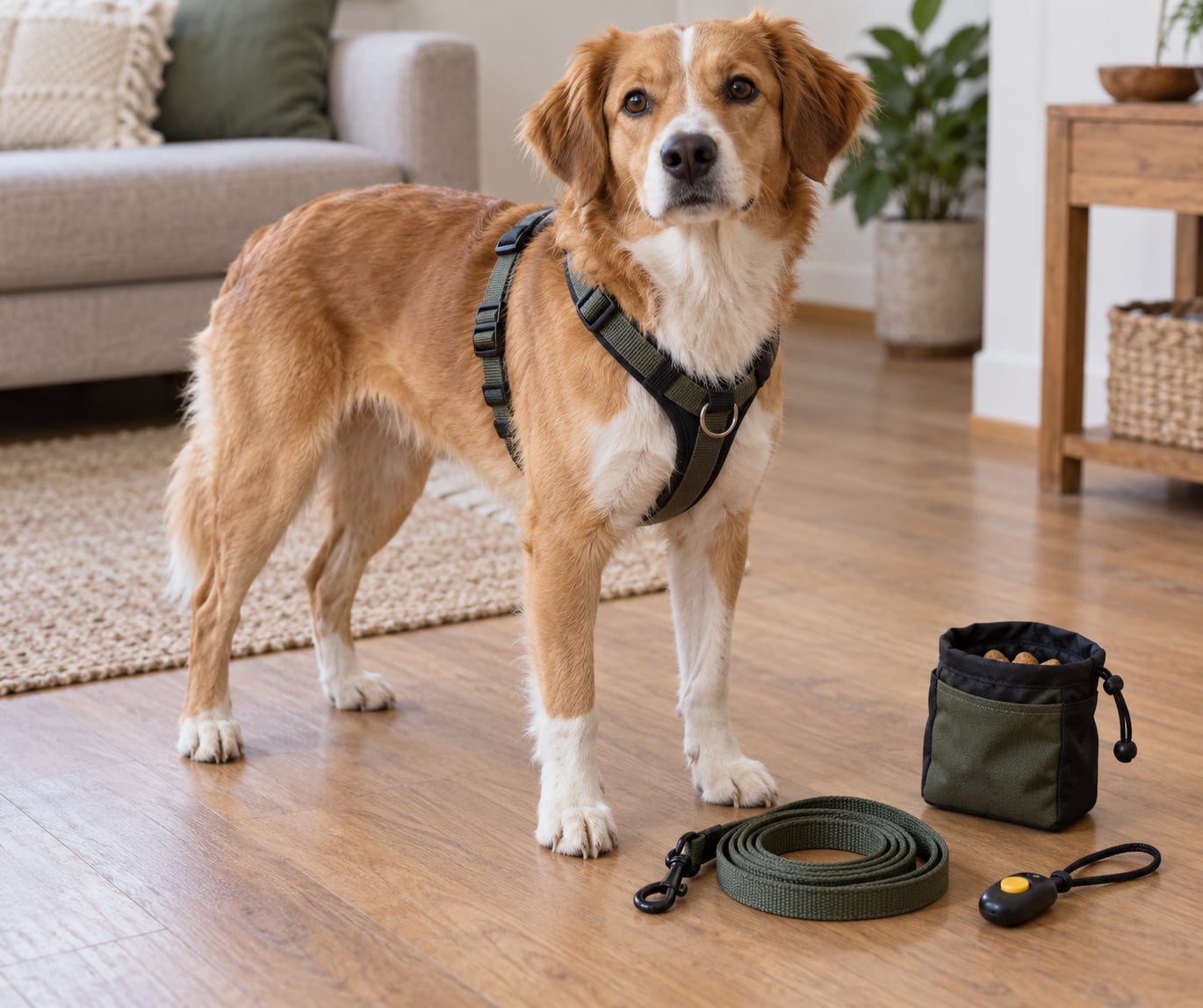
To stop a dog from pulling on the leash, use the stop-and-wait method (also called be a tree), the 180-degree turn, and positive reinforcement: the moment the leash goes tight you stop walking and stand still until the dog puts slack in it, then you reward that slack and start moving again. Pulling stops paying off, and a loose leash becomes the thing that keeps the walk going.
Most pulling is habit, not defiance. Your dog learned that leaning forward gets them to a smell, a squirrel or another dog faster, and they will happily keep doing what works. You’re not breaking an attitude, you’re replacing a habit that got rewarded a few thousand times a day.
How long it takes depends on the dog and the consistency. A puppy usually needs a couple of weeks of short daily sessions. An adult dog that has dragged you down the block for six years can take a month or more, and it will backslide whenever a squirrel appears. Expect progress, not a switch flipping.
Here is the short version of the whole plan:
Table of Contents
- Step-by-Step Training Methods
- What You Need
- Step-by-Step
- How to Stop a Dog from Pulling on the Leash
- Use a Marker Word or Clicker
- Add a Change of Direction
- Practice With Intentional Distractions
- Keep the Dog Slightly Away From Pressure
- Rehearse Before the Door and in the Car
- Use a Short, Consistent Daily Plan
- Common Mistakes
- Frequently Asked Questions
- Why is my dog still pulling after a few training sessions?
- Should I use a head collar or front-clip harness for a dog that pulls?
- What is the best leash-training method for a strong or stubborn dog?
- How long does it take a dog to learn not to pull on the leash?
- Should I walk my dog if they pull every time the leash goes tight?
- When should I ask a veterinarian or professional dog trainer for help?
- Conclusion
Step-by-Step Training Methods
- Stop-and-wait (be a tree). The leash goes tight, you plant your feet and say nothing. The dog learns that tension ends movement and quiet brings treats back.
- 180-degree turn. When the leash tightens, walk in the opposite direction. The dog has to come with you or lose the walk, so he comes.
- Reward the position you want. Pay for slack leash, not for sitting while pulling. Use high-value treats the moment the leash goes loose.
- Manage the environment. Walk quieter streets, go out before the squirrels wake up, and train indoors first. A dog under threshold can’t rehearse good manners.
- Progress slowly. Advance from your living room to the yard to a quiet block, one distraction at a time. Drop back a step whenever he starts dragging again.
What You Need
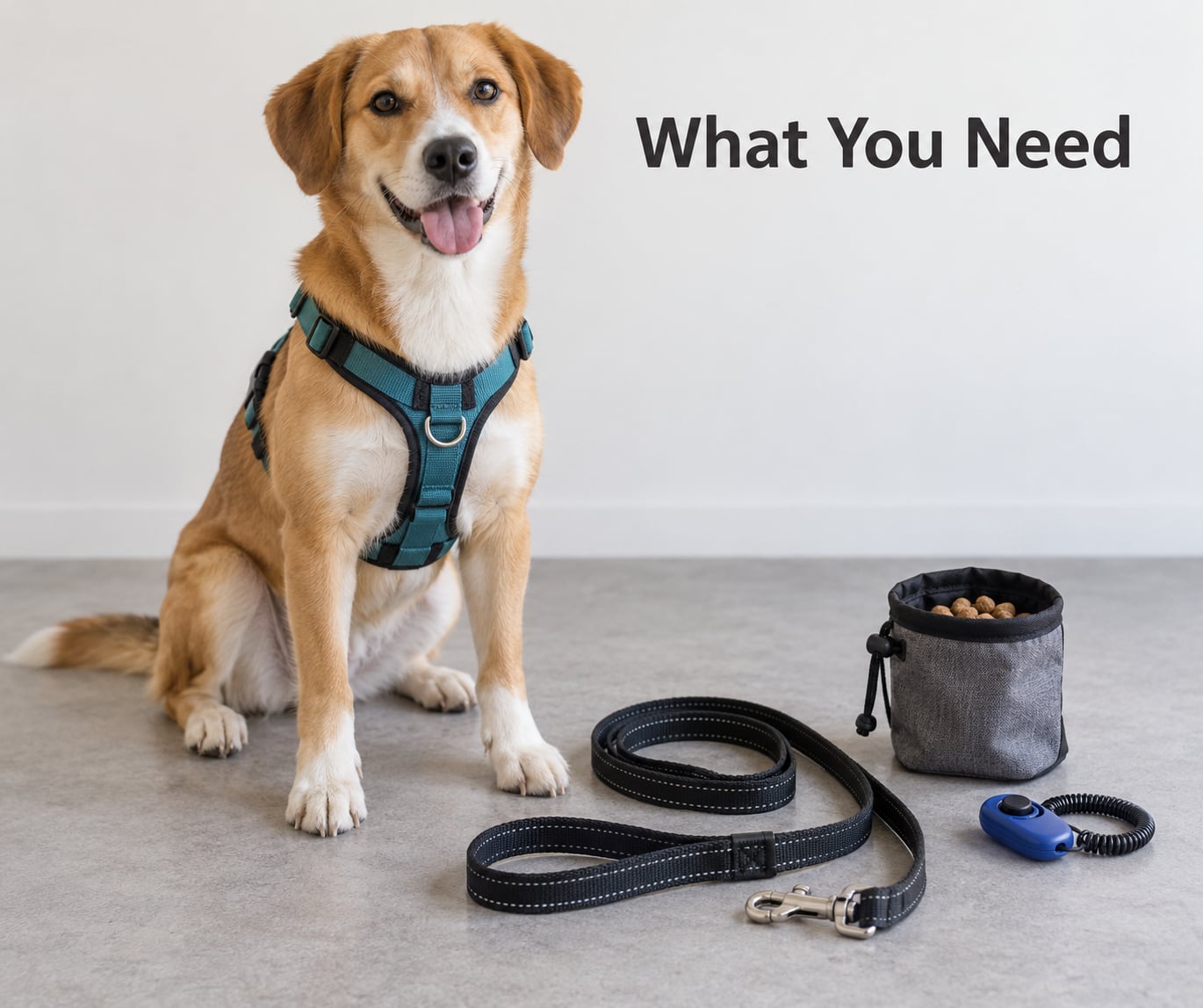
You need very little, and most of it you already own.
- A properly fitted collar or harness. Two fingers should slide under any strap. A collar is fine for a dog who does not pull; for a puller you’ll want more control, which usually means a harness.
- A standard fixed-length leash. Four to six feet, attached to a collar or harness. Skip retractable leashes for now. They teach exactly the wrong thing, because the dog can set the tension.
- High-value treats. Something your dog would not normally get. Liver, cheese, hot dogs, small bits of cooked meat, a lickmat with something sticky on it. If your dog eats kibble like that, kibble is not high value to them.
- A marker. A clicker or a word like yes that means the treat is coming. Marking tells the dog exactly which behavior earned the treat, which speeds everything up.
- A treat pouch. Or a treat bag on your belt. You want both hands free.
- A quiet training area. Your living room or hallway is the single most useful thing on this list.
- Later, more control. A front-clip harness or a headcollar gives you steering without force. Think of it as training wheels, not a permanent fix.
Step-by-Step
How to Stop a Dog from Pulling on the Leash
Step one is teaching your dog to notice slack. Not to sit. Not to heel. Just to register that the leash is loose.
Clip on the leash inside your house, ask your dog to sit, then start walking. The instant he steps forward and the leash goes tight, stop walking. Do not speak, do not tug, do not look at him. Stand there until he steps back and there is slack in the leash.
The moment you feel slack, mark and give a treat. That’s the whole technique. It feels awkward for the first two sessions because you’re mostly standing in your kitchen. That’s fine. Kitchen time is much better than the emergency room.
You want a visible change of state on his face. Before you say his name or offer anything, you should see a hesitation: a pause, a look back at you, a dropped head. That pause is the moment the association forms. Reward it every single time and the leash slack becomes something he actively looks for.
Use a Marker Word or Clicker
A clicker or a marker word tells the dog which exact behavior earned the reward. Without it, your dog has to guess, and what he usually guesses is food appeared, not I put slack in the leash and got treated for it.
Click or say yes at the instant he matches your pace, turns toward you when you turn, or steps back off the pressure. Then deliver the treat. Timing matters more than anything else here. A click that’s half a second late teaches him to anticipate your hands, and anticipating your hands is a different, worse habit.
Once he reliably offers a behavior, fade the marker. Say yes only occasionally, then stop marking entirely. You also want to fade the treat frequency. Reward generously for the first few days, then deliver treats at random rather than on every single step, otherwise a dog who stops seeing treats stops trying.
Add a Change of Direction
Stop-and-wait alone can plateau. The complaint you see most often in training forums is that the dog sits down every time the leash tightens but never learns to walk beside you. That’s a real limit of the method, not a failure on your part.
The fix is the 180-degree turn. The instant you feel tension, turn and walk the other way, your treat hand low near your hip. Do not yank the dog toward you and do not argue with him. Walk into a dead end if you have to. Your dog has two choices: come with you or lose forward progress, and dogs choose the walk.
When he catches up and puts slack in the leash, mark and pay him. Then add movement again. Some trainers reward following your hand by dropping treats off the route on the turn itself, so the dog learns to track where your hand goes rather than staring at your pockets.
Say the cue once, calmly, if you say anything at all. Words like let’s go or this way become useful if your dog stays with you during the turn.
Practice With Intentional Distractions
Progress has a ladder, and you climb it one rung at a time.
- Rung one: an empty hallway or a quiet living room.
- Rung two: a fenced yard with no dogs in view.
- Rung three: a quiet street, early, before anyone’s walking.
- Rung four: other dogs at distance, then closer.
- Rung five: doors, cars, bicycles, wildlife, kids.
At each rung, your criterion for moving up is simple: three or four walks in a row where the leash stays loose for most of the time. If he drags at rung three, you were too ambitious at rung four. Drop back down and rebuild. Owners who skip this step are the ones who think the method does not work.
When distraction rises, raise the value of the reward and shorten the session. Fifteen focused minutes at a hard level beats an hour of shouting at squirrels. Allow him to sniff. A dog that gets to sniff is a dog with something to lose, and sniffing is not a failure of loose-leash walking.
Keep the Dog Slightly Away From Pressure
The whole principle is prevention. A dog that reaches the end of the slack leash cannot pull, and a dog that has never felt sustained tension has nothing to push against. This is why headcollars and front-clip harnesses help so much: they steer the dog’s head and chest, so you never have to yank a neck.
What to avoid is any correction based on force or pain. Best Friends Animal Society advises against choke chains, prong collars and shock collars, and their reasoning is straightforward: pain teaches a dog to fear your hand, not to shorten the leash. Jerking a dog backward to stop forward behavior also teaches the wrong lesson, because forward pressure is what he’s producing, and pulling back hands him the tension he wanted.
If your dog lunges, redirects and still pulls while wearing a front-clip harness, the problem isn’t the tool. Stop, lower the distraction, and go back a rung. If he keeps pulling with no gear at all and is over threshold around triggers, get qualified help rather than adding hardware.
Rehearse Before the Door and in the Car
Most indoor failures happen in the eight seconds around the door. The leash goes on, the door opens, and arousal arrives before good manners do.
Rehearse the whole routine without leaving. Clip the leash on, sit him down, wait for a calm exhale, put your hand on the door handle, deliver a treat, and say let’s go. Repeat until he offers calm at the handle on his own. Then open the door, step outside with him loose, and reward heavily. One short, perfect walk beats a long one that starts with a lunge.
Do the same in the car. Leash on before the door opens, treat at the tailgate, wait for a settled dog before you release him. The pattern has to end with the walk starting on your terms, not his.
Use a Short, Consistent Daily Plan
Two or three minutes a day beats a long session once a week. Dogs learn by frequency, not by marathons.
Pick a fixed moment, usually after a meal or after a play session when he’s already settled. Use the same cue words every time. Pay for slack leash on a schedule you build up gradually: every step at first, then every few steps, then every twenty paces, then on variable random rewards for the rest of his life.
Track what happened in a notebook or your phone. One note a day, twenty words. In two weeks you’ll see the pattern, which matters more than any one walk.
And stop the walk if he gets frustrated or unsafe. Being out of sight and being attached to a choking dog are different states. A short walk beats a long one that ends badly.
Common Mistakes
Yanking the leash. Pulling back hands him exactly the resistance he was looking for, and on a collar it loads the neck. Safer fix: turn and walk away from him.
Repeating the same command with no consequence. Saying heel forty times while the leash is tight teaches nothing except that you talk a lot. Words only work when a loose leash is already what followed the last one.
Rewarding him mid-pull. If he gets a treat for tugging, you have not trained him to stop pulling. You have trained him to pull. Wait for slack, then pay.
Using painful or restrictive equipment. Choke chains, prong collars and shock collars carry real costs in fear and handling sensitivity. A front-clip harness and patience do more.
Retractable leashes. Great for letting a dog have the run. Bad for teaching anything, because the dog controls the tension.
Expecting change overnight. Most dogs need two to four weeks of daily work, and most need more than one round of that over a lifetime. A dog that walked well for years can start pulling again at eight months, in a new environment, or after something uncomfortable happened to them.
Starting on the busiest street. You cannot train a dog who is over threshold. Pick an easier location this week.
One practice tip that ties it together: reward the walk you want, not the dog you have. Loose leash, calm sniff, checked-in glance. Everything else is a training step, not a finish line.
Frequently Asked Questions
Why is my dog still pulling after a few training sessions?
Usually the reward is too small, the distraction is too big, or the criterion is moving faster than the dog’s learning. Try three changes: move to a quieter place, use a higher-value treat, and shorten the session. If your dog walks fine indoors but drags outside, that is a distraction problem, not a training failure. Drop back one rung on the ladder and rebuild for a few days.
Should I use a head collar or front-clip harness for a dog that pulls?
Either works better than a plain collar for a puller. A front-clip harness steers the dog’s chest and is the more comfortable, gradual choice. A head collar gives more direct control over direction and is useful for very strong dogs on busy routes. Introduce either one slowly on low-distraction walks, and stop using it if your dog still pulls hard while wearing it. Both are training support, not a permanent fix.
What is the best leash-training method for a strong or stubborn dog?
Combine stop-and-wait with the 180-degree turn, and set the walk up so tension rarely happens. Use a harness or head collar for steering, walk quiet routes, and reward slack leash generously at first. For dogs who genuinely overpower their handler, running the walk as two or three short decompression outings beats one long one, and working with a certified trainer for a few sessions usually pays the cost back fast.
How long does it take a dog to learn not to pull on the leash?
A puppy with consistent daily practice often improves within one to two weeks. An adult dog who has pulled for years commonly needs a month or more, plus occasional backslides. Progress is not linear: there will be days it looks perfect and days it reverts. Judge progress over two weeks of notes, not on a single walk, and expect adolescent regressions between eight and eighteen months.
Should I walk my dog if they pull every time the leash goes tight?
Yes, but change the walk rather than skipping it. Cut the route down to five calm minutes, go at a quiet time, and work on slack leash the whole way. Walking at your dog’s pace, letting him sniff and rewarding calm is far more productive than cancelling the outing or shouting through every pull. If he is snapping, charging traffic or pulling unmanageably, shorten further or stop and train indoors.
When should I ask a veterinarian or professional dog trainer for help?
Ask a vet first if pulling starts suddenly, especially in an older dog, or comes with limping, neck discomfort, breathing changes or sudden attempts to pull backward, since pain and neck or thyroid problems are worth ruling out. Ask a certified trainer if you are exhausted, if the dog pulls hard despite consistent weeks of work, if he is fearful or reactive around triggers, or if you are considering harsher gear.
Conclusion
Start in your living room. Clip the leash on, walk, stop dead the moment it tightens, and pay your dog the second it gives the slack back. Two minutes of that, most days, does more than any piece of gear.
Then work up the ladder one rung at a time, keep the rewards high while distractions grow, and when your dog starts pulling again, drop back a step instead of adding tension. That’s how to stop a dog from pulling on the leash: not force, not gadgets, just a consistent few minutes a day.