The short version of how to clean a litter box to reduce odor: remove waste every day, scrub the empty pan with unscented dish soap and hot water, rinse until the water runs clear, let the box air-dry completely, then refill with two to three inches of unscented clumping litter. Skip bleach, ammonia cleaners, and heavy fragrance. Drying is not optional. A damp box restarts the smell within a day.
Most odor complaints are not cleaning failures. They are timing failures: waste stays a day too long, the box gets refilled before it dries, or the plastic has micro-scratches that hold urine compounds no amount of scrubbing reaches. The method below fixes the sequence, and it takes about fifteen minutes for the full reset plus a minute a day for scooping.
One note before you start. If the smell is a new, sharp change rather than a gradual buildup, cleaning will not fix it. Sudden strong ammonia often points to a urinary problem, and that is a veterinarian conversation, not a scrubbing one.
Table of Contents
- What You Need to Clean a Litter Box Without Odor
- Step-by-Step: How to Clean a Litter Box to Reduce Odor
- Remove Waste and Litter
- Rinse the Litter Box
- Scrub Away Odor-Causing Residue
- Clean the Litter Scoop and Mat
- Dry the Box Completely
- Add Fresh Litter
- Common Mistakes That Bring the Odor Back
- Maintain a Fresh-Smelling Box Between Deep Cleanings
- The 3-Minute Daily Scoop Routine
- How Often to Change Litter Completely
- How to Clean a Litter Box to Reduce Odor Between Deep Cleanings
- Frequently Asked Questions
- What is the best way to clean a litter box that smells?
- Can I use bleach or ammonia to clean a litter box?
- How often should I completely clean a litter box?
- Is scented litter better at reducing odor than unscented litter?
- When does a strong litter-box odor mean I should see a veterinarian?
- Conclusion
What You Need to Clean a Litter Box Without Odor
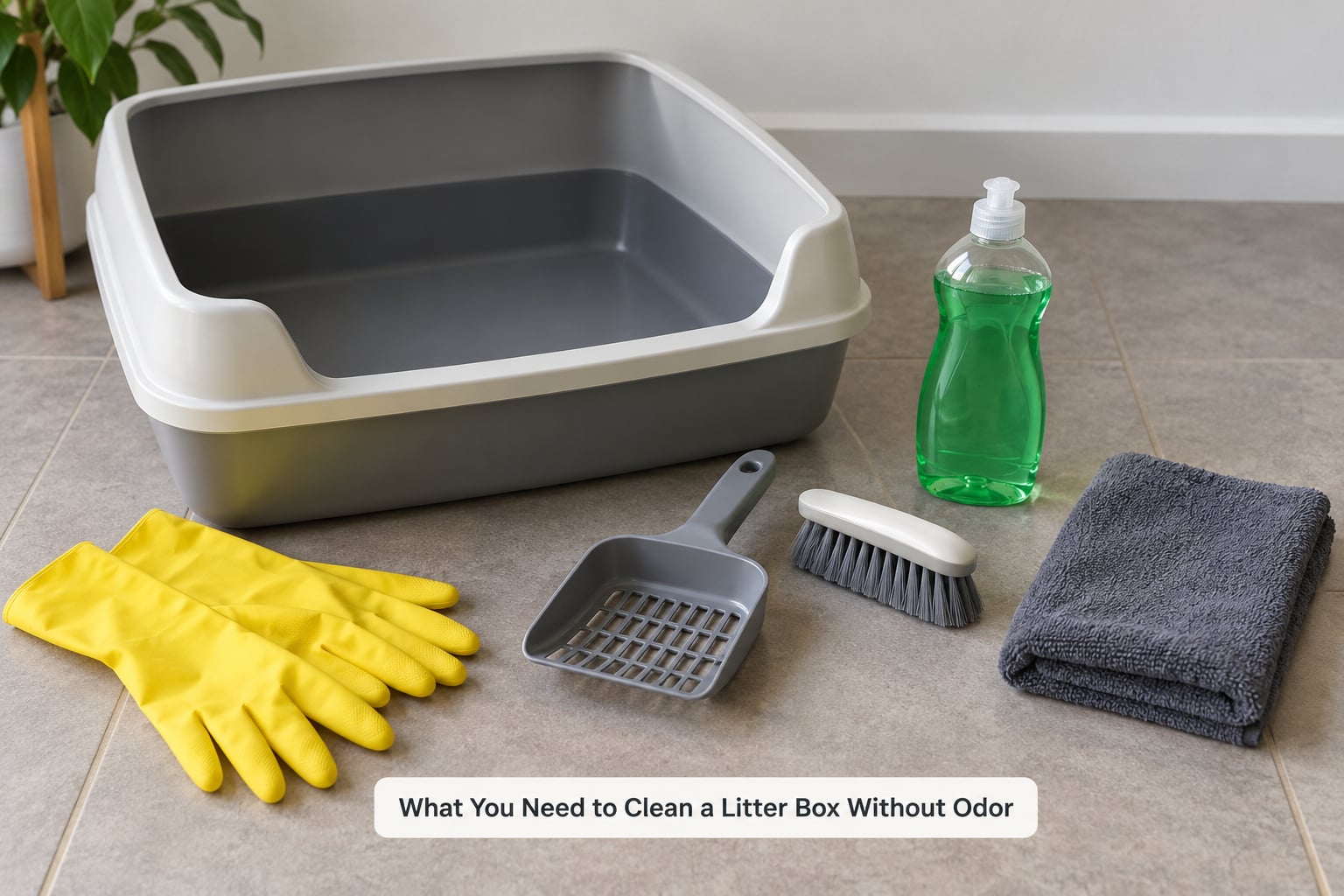
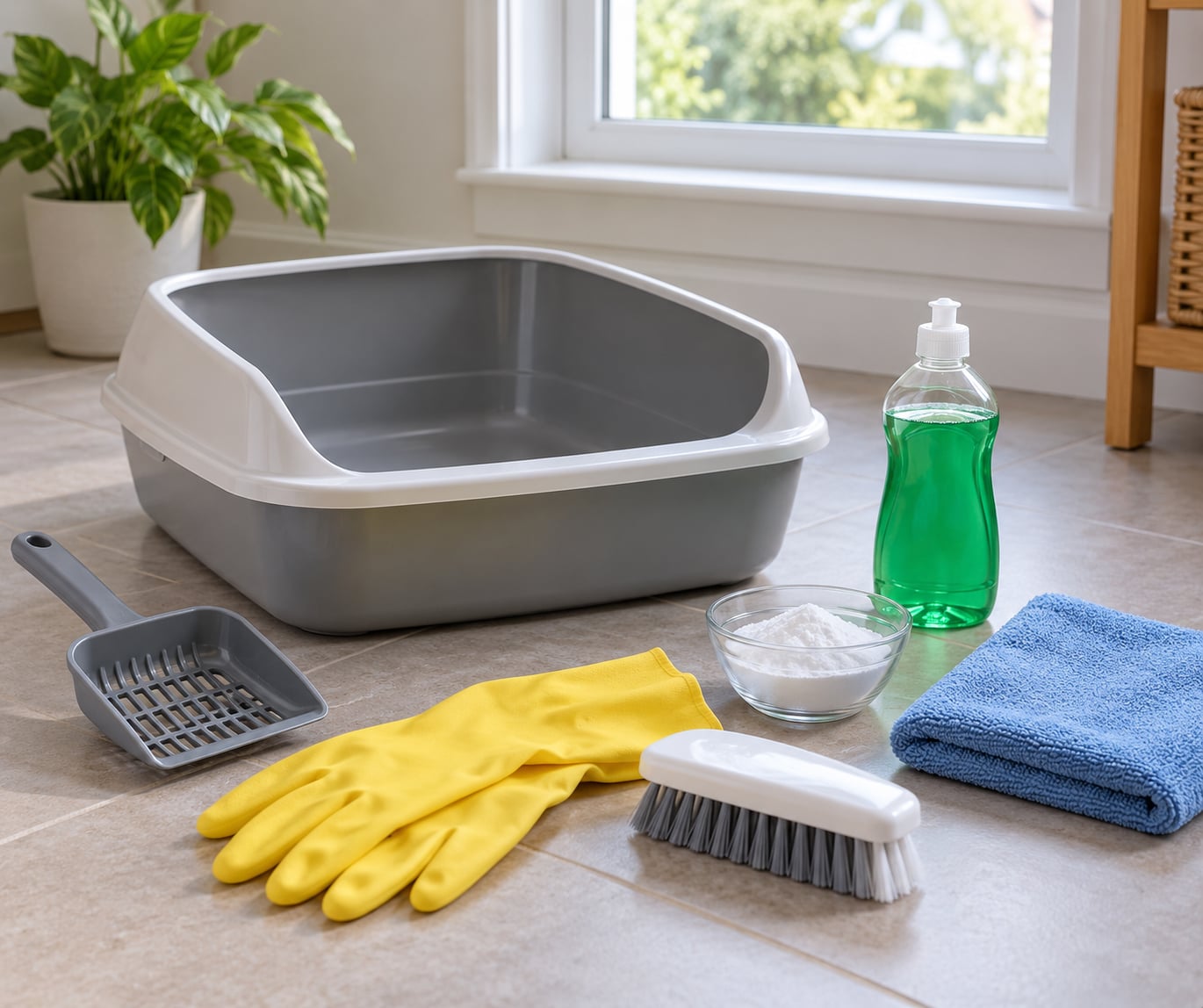
You need very little, and most households already have it. A scoop, gloves, unscented dish soap, hot water, a stiff-bristled brush, a towel, and plain baking soda cover the whole job. Add an enzyme cleaner if the box has soaked urine into the plastic or if there are accidents outside the box.
Here is what each item is for, and one short column on what to avoid.
| Item | What it does | How often | Avoid |
|---|---|---|---|
| Rubber or nitrile gloves | Protects hands from ammonia and bacteria | Every scoop and every wash | Reaching in bare hands with damp litter |
| Unscented dish soap | Breaks up grease and residue film | Every full clean | Anything scented, including scented dish soap |
| Stiff brush or old toothbrush | Works corners, edges, and the rim | Every full clean | Soft brushes on hardened clumps |
| Plain baking soda | Neutralizes residual ammonia | A light dusting at each change | Heavy pours and scented baking soda |
| Enzyme cleaner | Digests uric acid crystals | For soaked plastic and accidents | Mixing with bleach or vinegar |
| Towel | Speeds the dry step | Every full clean | Refilling before the surface is fully dry |
| Bleach | None worth the risk here | Not recommended | Never use, and never mix with vinegar or ammonia |
| Ammonia-based cleaner | Adds more of the same gas | Not recommended | Never, for any reason |
| Borax | Limited deodorizing, real risk if licked | Not recommended | Keep it away from the box entirely |
Worth adding: a litter mat sized larger than the box footprint. A surprising amount of smell comes from litter ground into the floor around the pan rather than from the box itself.
Step-by-Step: How to Clean a Litter Box to Reduce Odor
Work through these in order. Each step is there because the next one fails without it. A full reset takes about fifteen minutes plus drying time.
Remove Waste and Litter
Bag solid waste in a sealed bag and tie it before it leaves the room. Then take out damp clumps and any litter that has stuck to the bottom or the sides of the pan.
Empty enough that you can see the floor of the box, but keep an eye on how you carry it. A full pan of loose litter is a spill risk, and spilled litter tracked across the floor becomes a second odor source. If litter has ground into the floor around the box, lift the mat or the box edge and scoop that up too.
You know this step worked when the bare pan bottom is visible and there is no damp litter clinging in the corners.
Rinse the Litter Box
Take the pan to a utility sink, shower, or outdoors and rinse it with hot water. Hot water matters more than people expect: it loosens dried residue and melted clumps far better than cold.
Direct the water at the corners, the edges, and the underside of the rim, which is where splash-over collects unnoticed. Rinse until the water leaving the pan runs clear with no gray or foamy residue in it.
A clear rinse is your checkpoint. If the runoff still looks cloudy or smells, the box is not clean yet, and no amount of fresh litter will cover it.
Scrub Away Odor-Causing Residue
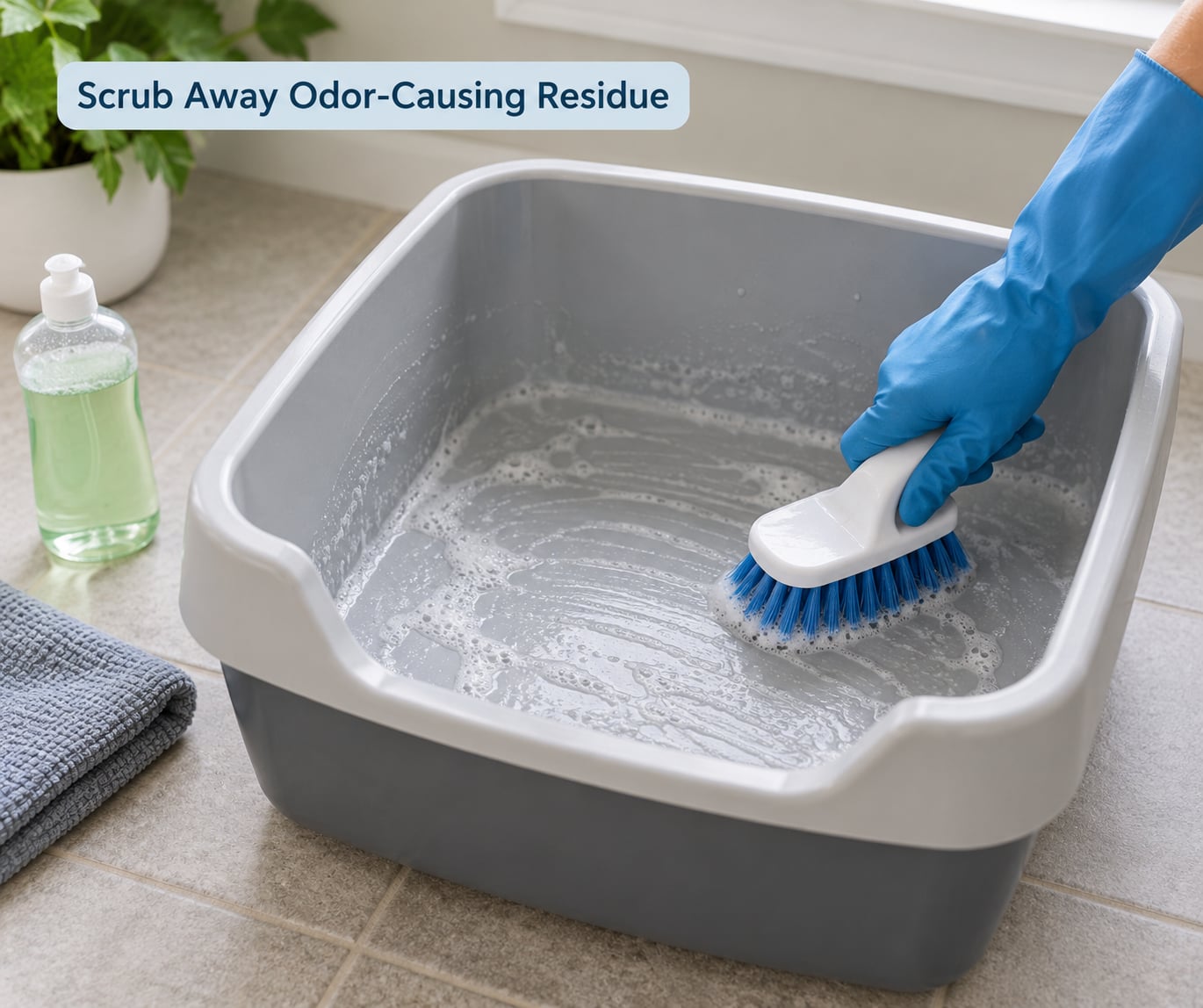
Apply a small amount of unscented dish soap to a damp sponge or the stiff brush. Scrub the bottom, the four corners, the sides, and the rim.
Spend your time on the corners and the area behind the rim. Urine compounds pool there, and if the box has a lining habit, they soak into micro-scratches in the plastic. Those scratches are the reason some boxes never stop smelling. Once the surface roughens with use, a surface clean no longer reaches what is underneath.
If the plastic holds ammonia odor even when it looks clean, apply an enzyme cleaner and give it the full 10 to 15 minutes before rinsing. That dwell time is the difference between an enzyme cleaner working and doing nothing.
Then rinse twice. Rinse once and a thin film of soap stays behind, and that film is a second odor problem. It smells faintly chemical, it traps dust, and it gives bacteria something to feed on once fresh litter goes in.
Soap residue is the mistake most people make without realizing it. The box can look, feel, and even smell clean when it is not.
Clean the Litter Scoop and Mat
The scoop sits in the room all day holding smell, and owners routinely clean the pan while ignoring it. Rinse the scoop in the same soapy water, scrub the perforations where waste clings, and rinse it until nothing shows in the water.
Wash or shake out the litter mat, and if it is washable, put it through a laundry cycle. Scrape hardened litter off the floor under the mat. A rubber mat that has soaked urine for months can be the main source of a smell that a spotless box cannot fix.
If you have a wall-mounted scoop holder, wipe it down as well. Small plastic parts collect residue in ways people rarely notice until someone picks them up.
Dry the Box Completely
Towel-dry the pan, then set it somewhere with airflow until it is completely dry to the touch. Outdoors on a porch or near an open window works. A bathroom with a fan running is fine. A closed closet is not.
Check the bottom, where a film of water hides under the litter. Press a dry paper towel flat against the pan floor and around the corners. If it comes away damp, the box is not ready.
This is the step that gets skipped, and skipping it explains a lot of complaints. Clean the box thoroughly, refill it before it dries, and the smell is back the next morning. Refilling a warm, damp box reseeds exactly the bacteria the wash was supposed to remove, and damp litter holds odor near the cat’s nose instead of letting it dissipate.
How long drying takes depends on the box and the room. Thirty minutes in a ventilated space is usually enough. If the pan is cool and clammy to the palm, wait longer.
Add Fresh Litter
With the box dry, spread a thin layer of plain baking soda across the bottom. A light dusting, not a pour. Baking soda neutralizes the ammonia that keeps rising, and a thin layer does the job without turning the box into a dust pan.
Then add two to three inches of unscented clumping clay litter on top. Depth matters more than most people expect. Too shallow and urine reaches the pan instead of being absorbed, which means odor and splash-over on the walls and floor.
Put the box back where it was. If you moved it, put it in its usual spot rather than somewhere new. A relocated box sometimes gets ignored, and an ignored box gets used as a bathroom somewhere worse.
One more thing to consider after refilling: if your cat has started going just outside the box, urine is missing the litter and drying into the plastic. A deeper layer, a larger box, or a second box usually fixes it faster than any cleaner.
Common Mistakes That Bring the Odor Back
Most repeat odor has a specific cause, and it is usually one of these.
Using bleach, or mixing cleaners. Never mix bleach with vinegar, and never use bleach in a box that has urine in it. Urine breaks down into ammonia, and bleach reacting with ammonia produces chloramine gas, which is toxic to you and to your cat. Litter box cleaning is not worth that risk, and ordinary dish soap handles the job.
Using an ammonia-based cleaner. This is the one people reach for because ammonia smells sharp, and they assume sharp means clean. It is the same compound you are trying to remove, so it never leaves the box. It is the most common mistake people make with litter box odor.
Rinsing once and refilling. That leftover soap film smells chemical, holds dust, and gives bacteria a foothold. Rinse until the water runs clear.
Refilling before the box is dry. A damp box smells again within a day. Wait.
Overdoing the fragrance. Strongly scented cleaners and heavily scented litter mask odor for an hour, then fade. Worse, many cats dislike them and stop using the box, which creates a second smell outside it. The result is a loop: perfumed cleaner, cat avoids the box, accident on the floor, more odor to clean.
Pouring baking soda in by the cupful. Too much creates dust your cat will not stand to dig through, and a cat that avoids the box makes the problem worse. One cat dislikes scented baking soda, so keep it plain.
Using borax. Borax is asked about constantly, and the answer is no. It has limited deodorizing value, and if a cat licks dried powder from the pan it can cause illness. Keep it in the laundry closet where it belongs.
Waiting too long between full changes. Most people are scooping daily and still pouring fresh litter over weeks of accumulated residue.
One decision rule covers most of the rest. If the smell returns within 48 hours of a thorough wash, the box itself is the source. The plastic has reached the end of its useful life, and a new box is cheaper than any deodorizing product. The other possibility is the cat, and that means a veterinarian.
Maintain a Fresh-Smelling Box Between Deep Cleanings
The 3-Minute Daily Scoop Routine
Daily scooping does more than remove waste. It is what keeps ammonia from accumulating at all, because the smell builds from urea breaking down over hours, not days. A box scooped every day stays weeks ahead of a box scooped every three.
Three things to do in order. Bag solid waste first so nothing sits in an open bucket. Then scoop damp clumps and anything wet against the pan. Finish by checking the rim, the mat, and the floor around the box, where a surprising amount of mess hides.
With two cats, scoop twice a day. Twice-daily scooping plus a full wash every two weeks is what actually works in a small home.
How Often to Change Litter Completely
Advice online ranges from weekly to monthly, and the honest answer depends on the number of cats, the litter, and the box. This table reconciles them.
| Household | Scoop | Full wash and change | Replace the box |
|---|---|---|---|
| One cat, strong smells | Once a day | Every 7 to 10 days | Every 12 to 18 months |
| One cat, easygoing | Once a day | Every 2 to 3 weeks | Every 12 to 18 months |
| Two cats | Twice a day | Every 1 to 2 weeks | Every 12 months |
| Three or more cats | Twice a day, more if needed | Every 2 weeks | Every 12 months, or sooner |
| Automatic or self-cleaning box | Check the waste drawer every 1 to 2 days | Every 2 to 4 weeks, plus wipe the rake and sensors | Follow the manufacturer |
Replace the box sooner than the schedule when you see deep scratches, gray or yellow discoloration, or odor that returns in under a day. Metal boxes last longer than plastic for exactly this reason, and many owners switch after hitting the scratched-plastic wall.
Automatic boxes need their own attention. Empty the waste drawer every one to two days even if the cycle rotates, wipe the rake and the sensor strip with a damp cloth, and wash the drawer on the same cadence as a pan. Skipping the sensor wipe is what turns an otherwise self-cleaning machine into a mystery smell.
How to Clean a Litter Box to Reduce Odor Between Deep Cleanings
Two habits do most of the work in the days between washes: airflow and odor control that sits in the litter rather than in the air.
Run an exhaust fan for about ten minutes after you scoop, especially in a bathroom or a small apartment where the smell has nowhere to go. A HEPA purifier with a carbon filter helps too, and it needs to be within roughly three feet of the box to do much. HEPA alone catches particles but not the gas molecules, so the carbon stage is the part doing the odor work.
On litter choice, unscented clumping clay gives the most reliable odor control for the least trouble. Scented clay masks rather than removes. Silica crystal litter tracks less and dusts less, but some cats dislike the hard texture. Pine, corn, and walnut plant-based litters smell mild on their own and are worth testing if your cat tolerates them.
On box count, the standard rule is one box per cat plus one. More boxes mean less crowding, less urine concentration, and fewer accidents. Spots matter too: a box in a laundry room or a basement with no airflow will smell worse than the same box near a vent, no matter how clean it is.
For accidents outside the box, enzyme cleaner on the floor and baseboards, not a scented spray. Soap and bleach remove the surface smell and leave the uric acid crystals behind, which is why the spot reappears in a few days.
Two DIY methods worth a try: a light layer of baking soda at the base of an empty pan with a splash of white vinegar poured over it, which foams, lifts residue, and deodorizes before you rinse, and wood ash from a fireplace laid thin at the bottom of the box, which reduces acidity and cuts ammonia. Both are cheap, and neither replaces drying the box properly.
Finally, know when to stop cleaning. Straining in the litter box with no urine produced, or a sudden change in how a cat urinates, is a urinary emergency risk and needs a veterinarian the same day. So does a smell that appears suddenly in a box that was fine last week. Odor is often the first sign something is wrong, and it is worth taking seriously rather than reaching for a stronger cleaner.
Frequently Asked Questions
What is the best way to clean a litter box that smells?
Empty the pan completely, bag all waste, and rinse with hot water until it runs clear. Scrub the bottom, corners, and rim with unscented dish soap and a stiff brush, then rinse twice so no soap film remains. Towel-dry and let the box air-dry fully in a ventilated space. Only then add a light dusting of plain baking soda and two to three inches of unscented clumping litter.
Can I use bleach or ammonia to clean a litter box?
No to both. Urine breaks down into ammonia, and bleach reacting with that ammonia produces chloramine gas, which is toxic to people and cats. Mixing bleach with vinegar makes the same risk worse. Plain unscented dish soap and hot water clean a litter box effectively, and an enzyme cleaner handles soaked plastic better than either chemical.
How often should I completely clean a litter box?
For one cat, every two to three weeks, or every seven to ten days if odor is a problem in your home. Two cats usually need a full wash every one to two weeks, and three or more cats every two weeks with twice-daily scooping. Scoop solid waste every day in every case, and never refill a box until it is completely dry.
Is scented litter better at reducing odor than unscented litter?
No. Scented litter masks odor with fragrance that fades within hours, and it does nothing about the source. Unscented clumping clay controls odor by absorbing moisture and letting you remove soiled litter completely, which is the mechanism that actually works. Strong fragrance also puts some cats off using the box, which can lead to house-soiling and a second odor problem elsewhere in the home.
When does a strong litter-box odor mean I should see a veterinarian?
See a veterinarian when the odor is a sudden change rather than a gradual buildup, and especially if your cat is straining in the box without producing urine, which can signal a urinary blockage and is an emergency. Urinary infection, kidney problems, and pain can all change how a cat urinates, and odor is often the first visible sign. A steady smell that responds to cleaning is a cleaning problem, not a health one.
Conclusion
Start here: remove all waste and litter, scrub the empty pan with unscented dish soap and a stiff brush, rinse until the water runs clear with no soap film, and let the box dry completely in a ventilated spot. Only then add a light layer of plain baking soda and two to three inches of unscented clumping litter.
That sequence takes about fifteen minutes, and the daily scoop takes about a minute. If the smell is back within 48 hours of a clean wash, the box has reached the end of its life, or your cat needs a veterinarian. Either way, more deodorizing spray is the wrong next move.