Puppy-proofing a house means getting down on the floor to see your space at a puppy’s eye level, then removing, securing or gating off everything a curious 8-to-16-week-old dog could reach, chew, swallow or trip over. Most homes take an afternoon or a weekend to do properly. Start by building one safe room before you touch the rest of the house, because a puppy that spends its first days loose in an unfinished job is the one that chews a lamp cord on day two.
Here is how to puppy proof a house in the order that actually works, room by room, with a checklist you can walk through on the floor rather than from standing height.
Table of Contents
- What You Need
- How to Puppy Proof a House, Step by Step
- Start with a Safe Puppy Zone
- Secure Doors, Gates, and Stairs
- Protect Cords, Outlets, and Furniture
- Childproof Cabinets and Drawers
- Remove Food, Trash, and Toxic Plants
- Check the Kitchen, Bathroom, and Laundry
- Test the Space Before Increasing Access
- Common Mistakes
- Frequently Asked Questions
- How long does it take to puppy proof a house?
- What age should a house be puppy proofed?
- Do I need a gate for every room?
- How do I keep a puppy from getting into cabinets?
- Which houseplants are dangerous to puppies?
- What should I do if my puppy eats something toxic?
- Conclusion
What You Need
You do not need all of this. A one-bedroom apartment needs far less than a house with stairs, a garage and a yard. Buy or borrow what matches your space.
- A puppy gate, playpen or exercise pen — one is essential for giving the puppy a defined area on day one. Hardware-mounted gates suit stair openings; pressure-mounted gates suit doorways in a flat home.
- Cord covers or cord concealers — flexible sleeves that enclose lamp and charger cables along baseboards.
- Outlet covers — sliding plates for any unused outlet below counter height.
- Child-safe latches — for the pantry, the bathroom cabinet and the cupboard under the sink.
- A toilet-lid lock — inexpensive and solves an entire category of risk in one move.
- A trash can with a locking lid — or a pedal can secured against tipping.
- Storage bins — opaque lidded bins for small objects, cables and anything you would otherwise sweep up daily.
- Blind-cord ties — loop ties or cleats for window blind pull cords.
- A door wedge — holds an interior door open without blocking an exit path.
- Enzyme-based cleaner — not for the puppy’s mouth, for accidents on your floor.
A flashlight is genuinely useful. When you kneel down and shine it along baseboards, gaps you would never have noticed show up immediately.
How to Puppy Proof a House, Step by Step
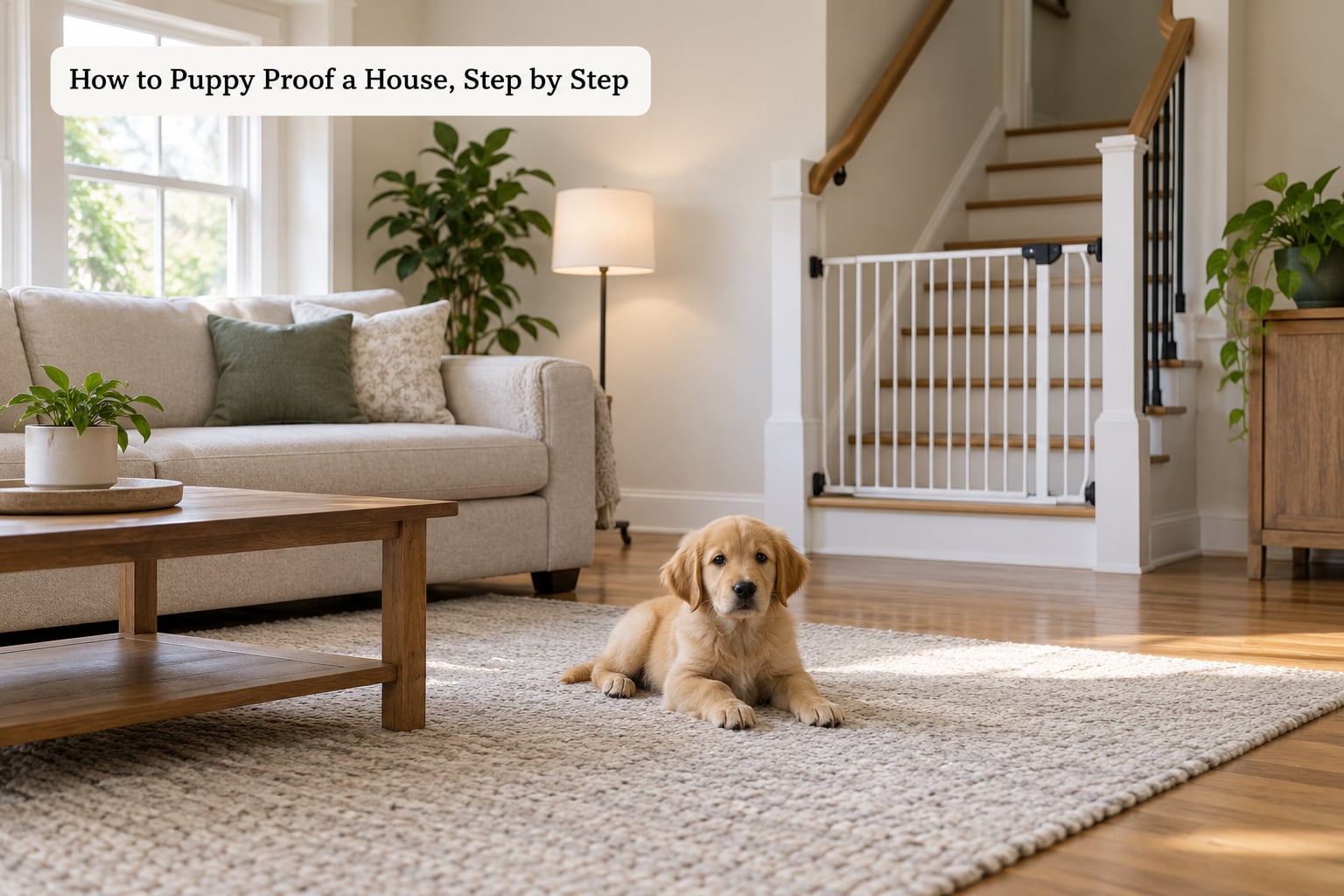
Work in this order and the whole job gets easier. Confirm the safe zone, then block the falls, then work at floor level room by room.
| Room | What a puppy reaches | The fix |
|---|---|---|
| Living room | Charging cables, remote batteries, low shelf decor | Sleeve cords, cap outlets, clear the bottom shelf |
| Kitchen | Trash, food, cleaners, hot pans | Locking bin, child-safe latches, turn pot handles inward |
| Bathroom | Toilet water, cleaning tablets, standing water | Lid lock, latched cabinet, dry the tub and sink |
| Bedroom | Electrical cords, small jewellery, dropped pills | Move items up, close the door or gate the opening |
| Hall and stairs | Falls, escape through the front door | Gate the top and bottom, add a higher lever or latch |
| Laundry and garage | Detergent pods, antifreeze, blades, tools | Locked cabinet, raise chemicals off the floor, store tools high |
| Yard and patio | Fence gaps, pool water, fertilizer | Fill gaps, fit a pool fence or cover, isolate treated areas |
Start with a Safe Puppy Zone
The most common first-time-owner mistake is proofing the whole house and hoping the puppy waits politely. Build one contained room first — a spare bedroom, the laundry room, or a corner of the living room sectioned off with a gate or pen.
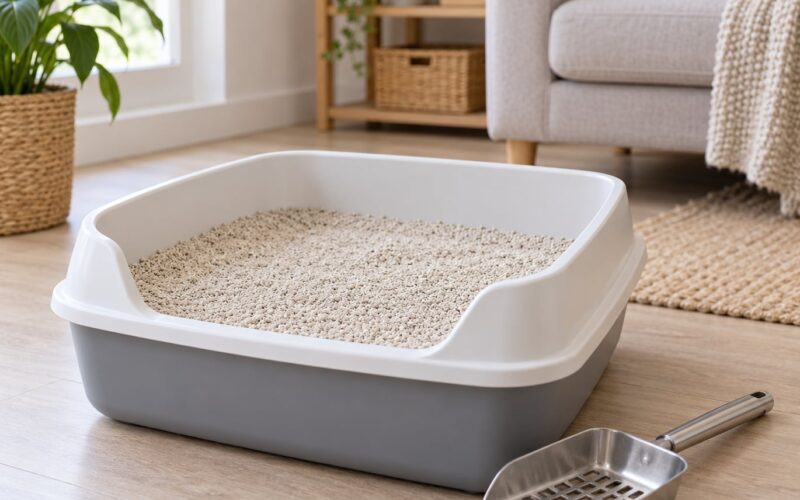
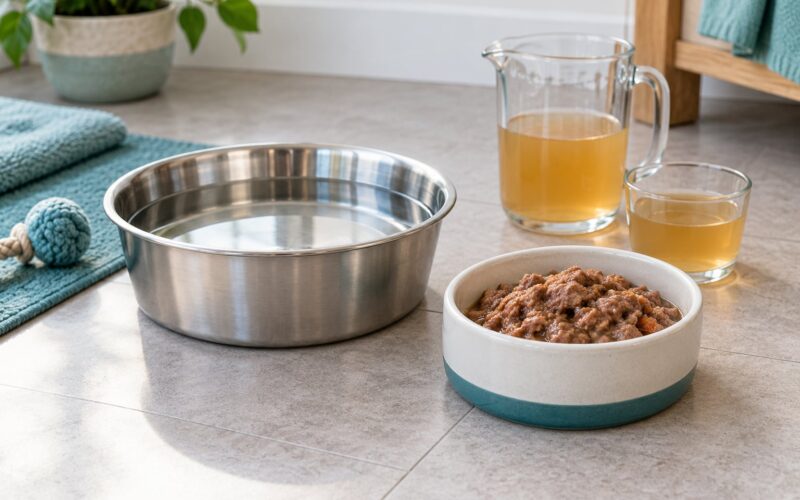
Put in four things: the puppy’s bed or crate, a water bowl, two or three chew toys, and a toileting setup. That last one matters more than people expect. If your puppy is under about 16 weeks old, take them outside first thing in the morning, after naps, and right after meals, and reward the correct spot.
How to puppy proof a house without losing your mind comes down to this: the safe zone is not temporary. It stays as a place where the puppy can always rest without being watched, even after you expand access later.
Secure Doors, Gates, and Stairs
Go room to room and physically test every exterior door. Pull each one open with your hip. Most homes have at least one door with a lever a puppy can press down, a slide latch a paw can shift, or a gap at the bottom big enough to squeeze through.
Fit a higher lever handle, install a child-safe latch on the door to the yard, and check that every door swings or slides toward an exit you can open from the outside. In an apartment building, never wedge a fire door open or block a stairwell door.
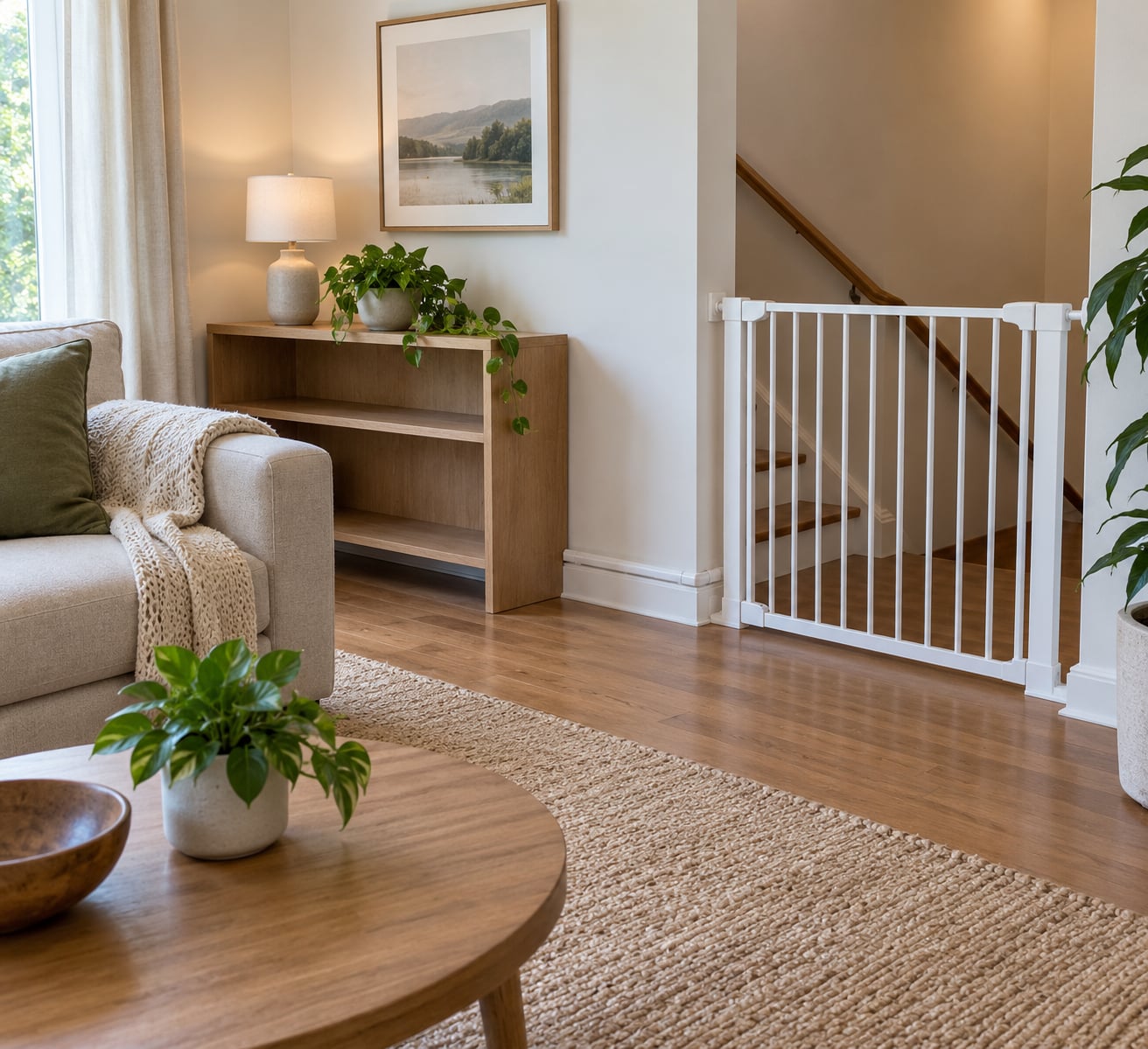
For stairs, gate the top opening and the bottom opening. Use a hardware-mounted gate, which screws into the frame, anywhere there is a drop. Pressure-mounted gates belong in flat doorways between two rooms, and they are not rated for a determined large-breed puppy who pushes through or jumps.
Check low windows, balconies and decks too. A six-month-old retriever can open a sliding door that a human would not have tried.
Protect Cords, Outlets, and Furniture
Cords and dangling blind pulls are the two electrical items owners cite most often, and the risk is mouth burns and electrocution rather than a tidy cable. Sleeve every lamp and extension cord that runs along a baseboard, route chargers up onto a shelf, and cut the power to unused outlets with sliding cover plates.
Looping blind pull cords through a cord tie and tacking them to the wall takes about a minute per blind. Do not cut cords without checking that the blind still raises and lowers.
For furniture, think weight rather than style. A flat-screen on a narrow stand, a lamp with a light base, a tall étagère in a corner — these are the pieces that tip when a puppy leans against them at exactly the wrong angle. Anchor the big ones to the wall, move the rest, and put breakables on high shelves.
Never rewire an outlet yourself to solve this. If a circuit keeps tripping or a socket is warm to the touch, that is a call for a licensed electrician.
Childproof Cabinets and Drawers
Prioritise by what is inside, not by which door is easiest to reach. Lock away medicines of any kind, prescription and over-the-counter, in a high or locked cabinet. The same goes for cleaning products, bleach, drain opener, pesticides, fertiliser, ice melt, antifreeze, razor blades, sewing needles, batteries and button cells.
Button cells deserve their own line because the damage they do in a few hours is severe, and coin cells hide in remote controls, key fobs, thermometers and hearing aids.
For lower drawers holding small objects, a child-safe latch costs almost nothing and works better than a lock. For the kitchen pantry, a self-adhesive or magnetic latch that a determined puppy cannot paw open is the better buy.
Remove Food, Trash, and Toxic Plants
Trash is the single most attractive object in most homes. Dogs raid it because a bag smells like dinner, and a loose bin gets tipped with a nose and paw. The bag can then go over the head, which suffocates.
Two fixes solve nearly everything: swap to a bin with a locking lid, or weigh down a pedal can with a brick in the base so it cannot tip. Keep a lidded bin in the kitchen and take the bag straight out rather than letting it sit overnight.
Clear the counters. Coffee grounds, food packaging, cereal, chocolate, onions and garlic, grapes and raisins, and anything sweetened with xylitol such as sugar-free gum and peanut butter belong in a closed cupboard, not within reach of an eight-week-old mouth.
For plants, check every one against the ASPCA list rather than trusting the name on the pot. Common problems in a home include lilies, sago palm, oleander, foxglove, azalea, rhododendron, daffodils and tulips, plus indoor pothos and philodendron. If a new plant arrives from a garden centre and you cannot identify it, put it somewhere the puppy cannot reach until you have checked it.
Check the Kitchen, Bathroom, and Laundry
In the kitchen the real risks are heat and gravity. Turn pot handles toward the back of the stove so a puppy cannot walk into them, use a stove-knob cover if you cook with the door open, and keep the oven and dishwasher closed. Run the dishwasher before you let a puppy near the kitchen floor, since detergent residue and broken glass are both unpleasant discoveries.
The bathroom is a drowning risk as well as a chemical risk. Keep the toilet lid down with a lock, close the cabinet holding cleaning tablets and drain cleaner, dry the sink and tub after use, and keep the door closed or gated. Five centimetres of water in a bathtub is enough for a very young puppy.
In the laundry room, detergent pods are the thing to worry about. They are brightly coloured, concentrated and attractive. They go in a locked cabinet, not a decorative basket on top of the machine. Check pockets before the wash cycle, and store scissors, craft supplies and small tools above reach.
Test the Space Before Increasing Access
Once the room is done, sit or kneel on the floor and look at it from the puppy’s height, roughly ten inches for a young pup. You will find the things you missed — a gap beside the sofa, a cable under the rug, an unstable lamp.
Then watch. A proofed room only counts as proofed once the puppy has spent several days in it without incident. After that, open up one zone at a time, keep the safe zone available permanently, and re-sweep the floors daily for a few months.
Proofing is a habit, not an event. Most damage happens because a bag of rubbish sat on the floor for twenty minutes, and that habit has to keep running after the gates go up.
Common Mistakes
Relying on a fragile decoration to slow a puppy down. A vase or a stack of magazines is a delay, not a barrier. The fix is height or a locked door — both take about the same amount of time to arrange.
Buying the wrong gate. A pressure-mounted gate across stairs, or a short one for a breed that jumps, fails on the first serious attempt. Use hardware-mounted gates at any drop and match the height to your puppy’s adult size, with several inches to spare.
Storing chemicals in an unlatched cabinet. Moving bleach up a shelf does nothing when a puppy can open the door. The fix is a latch or a lock, not a higher position.
Skipping the plant check because the plant was already there. An older dog may ignore a plant your puppy will strip in a day. Check every plant against a toxic-plant list before access is expanded.
Correcting instead of preventing. Punishment for chewing teaches avoidance at best and fear at worst. Remove the object, not the puppy’s interest in it.
Cleaning once and forgetting. A perfect deep-clean lasts until the first dropped battery. A ten-minute floor sweep each evening keeps up with what a puppy actually does.
Proofing every room before the safe zone exists. You end up with a house you cannot relax in. One room first, then expand.
Frequently Asked Questions
How long does it take to puppy proof a house?
A single safe room takes two to three hours once you have supplies. The whole house is usually a weekend, and longer if you must buy gates and latches first. Do the safe room on day one and finish the rest during your first week, when the puppy is small enough to manage in one contained space.
What age should a house be puppy proofed?
Before the puppy comes home if you can, since everything is much easier without a curious dog underfoot. If the puppy is already with you, proof the safe room the same day and the rest within the first week. Re-check the house monthly, because puppies grow into new hazards they could not reach at eight weeks.
Do I need a gate for every room?
No. Gate the openings that matter: the top and bottom of any staircase, the kitchen, and any door onto the yard. Closed doors work for the rest. Most homes need two or three gates, not one per room, and a playpen can cover the hours you are asleep or at work.
How do I keep a puppy from getting into cabinets?
Child-safe latches on lower doors and a locked cabinet for medicines, cleaners and batteries. Keep food in closed containers on high shelves, and move the items your puppy can already reach before adding a latch, or you will be rearranging the same cupboard forever. Magnetic and self-adhesive latches hold up better than hook-and-eye.
Which houseplants are dangerous to puppies?
Lilies, sago palm, oleander, foxglove, azalea, rhododendron, daffodils and tulips are the usual indoor and garden culprits, along with pothos and philodendron. Check every plant against the ASPCA toxic-plant list, including anything bought recently that you cannot identify by name.
What should I do if my puppy eats something toxic?
Contact a veterinarian or an animal poison control service such as ASPCA Animal Poison Control or the Pet Poison Helpline straight away, and bring the packaging or a photo of the plant. Do not induce vomiting unless a veterinary professional instructs you to. Note the time, the amount and whether your puppy seems unwell.
Conclusion
If you do four things this week, make them these: build one safe room with food, water, a bed and a toileting spot; block every stair opening and exterior door; lock away medicines, cleaners, batteries and the trash; and check every plant against a toxic-plant list.
Then keep supervising. Proofing reduces risk, it does not remove it, and a puppy that is left loose in a house that was proofed six months ago will find whatever has changed since. If you suspect your puppy has swallowed something toxic, contact your veterinarian or an animal poison control service immediately rather than waiting to see whether it passes.