Most indoor plants need 12 to 16 hours of light a day, followed by at least 8 hours of uninterrupted darkness. That is the range nearly every houseplant lands inside, but it is a starting point rather than a rule, because a ZZ plant in a dim hallway and a flowering begonia on a sunny sill both need light and they do not need the same hours or the same intensity. The useful skill is turning that range into a number for the plants you actually own.
I grew up moving a handful of pots between windows and guessing, so this guide walks through the hour ranges by light level and plant type, how to work out what your own window actually delivers, and how to read the signs a plant gives you when it has too much or too little.
Table of Contents
- How Many Hours of Light Do Indoor Plants Need?
- What Counts as Light? Duration, Intensity, and the Dark Period
- Hours of light are not the same as hours of sun
- Why plants need hours of darkness
- How Many Hours of Light Do Different Plant Types Need?
- How many hours of light do houseplants need a day?
- Light Requirements by Tier: Low, Medium, Bright Indirect, and Direct Sun
- How Much Light Your Window Actually Provides
- Too Little Light or Too Much Light? Signs and Fixes
- How to Combine Window Light and Grow Light Into One Daily Budget
- How Long to Leave Grow Lights On: Distance, Timer, and Running Cost
- Do Seasons and Growth Stages Change the Hours?
- Terrariums, Vivariums, and Other Enclosed Setups
- Frequently Asked Questions
- Can plants tolerate 24 hour light?
- Do houseplants need periods of darkness?
- Is 12 hours of light too much for plants?
- Do plants get enough light through windows?
- How to tell if my grow light is too close?
- Can plants survive 3 days without light?
- What to Do First
How Many Hours of Light Do Indoor Plants Need?
Most indoor plants need 12 to 16 hours of light per day plus at least 8 hours of darkness. Low light plants do fine on 8 to 12 hours, flowering plants usually want 14 to 16, and seedlings are the usual exception at 16 to 18.
| Light level | Hours of light per day | Common examples | Where the plant sits |
|---|---|---|---|
| Low light | 8 to 12 hours | Snake plant, ZZ plant, pothos, cast iron plant | Several feet back from a window, a north-facing room, a lit hallway or stairwell |
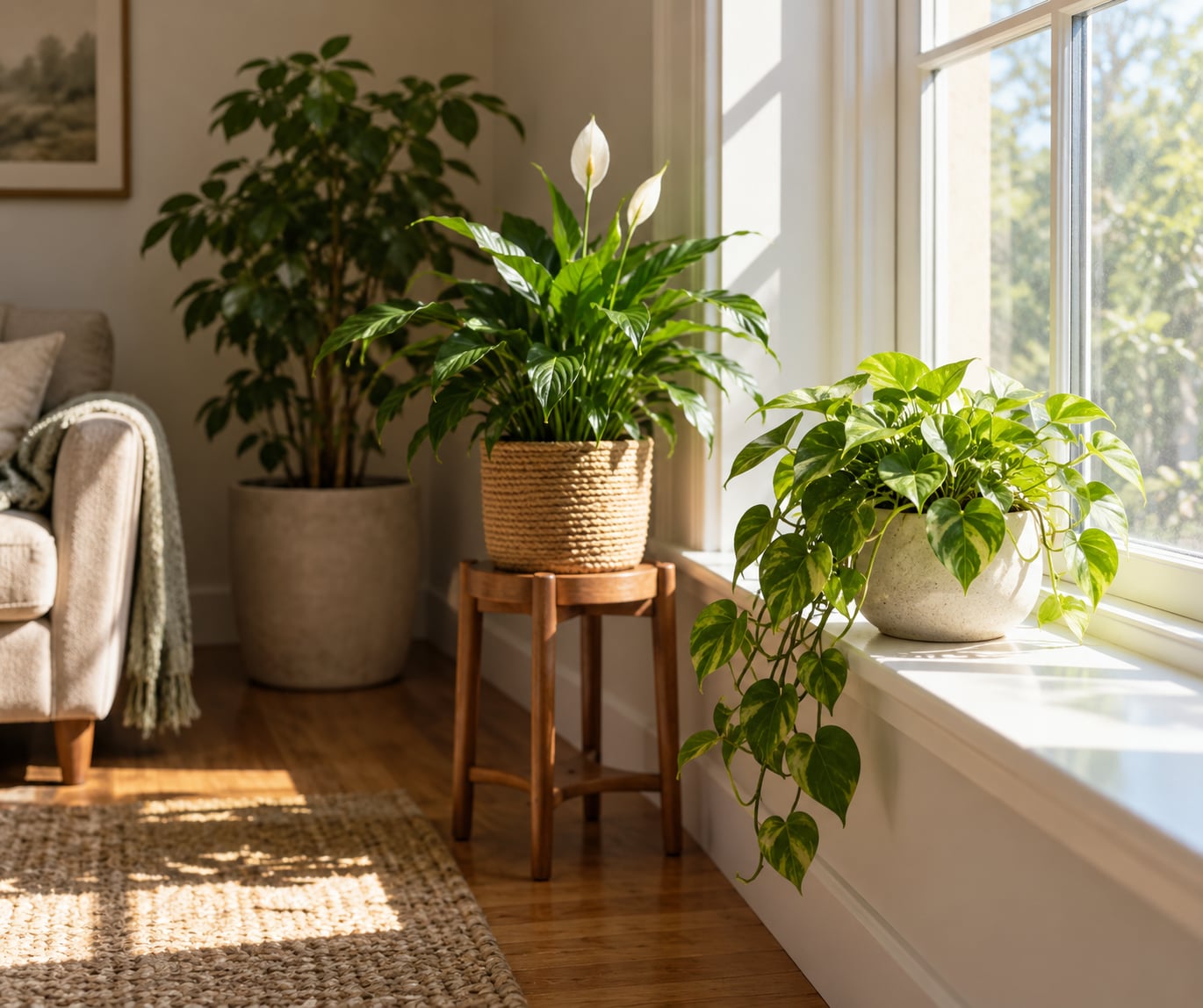
| Medium light | 10 to 14 hours | Peace lily, spider plant, rubber plant, Boston fern | A few feet from an east or west window, or a bright room corner |
| Bright indirect | 12 to 16 hours | Monstera, fiddle leaf fig, calathea, bird of paradise | Right beside a south or west window, behind a sheer curtain |
| Direct sun | 14 to 16 hours | Succulents, cacti, aloe, most culinary herbs | On the sill, with sun landing directly on the leaves for part of the day |
| Seedlings and cuttings | 16 to 18 hours | Tomato and pepper starts, propagated cuttings, young herbs | Under a grow light set 4 to 6 inches above the tray |
You will also see 6 to 12 hours quoted for houseplants on some garden retail sites, and 12 to 16 hours on grow light sites. Both are defensible, because they quietly assume different light levels. A dim corner delivering 12 hours is not the same light as a sunny sill delivering 12 hours, and the hour count only means something once you know what is hitting the leaves.
What Counts as Light? Duration, Intensity, and the Dark Period
Hours of light are not the same as hours of sun
Duration is the photoperiod, the number of hours of light in a 24-hour period. Intensity is how strong that light is, and a plant in bright indirect light may be getting several times more usable light per hour than one in a north-facing room. Hours tell you how long, intensity tells you how much, and growth depends mostly on the total light delivered across the day rather than on either number alone.
Why plants need hours of darkness
Plants do not only collect light during the day. The dark period is when they process that energy, respire, and reset the hormones that drive the next flush of growth. The Virginia Cooperative Extension Master Gardener Handbook puts a hard ceiling on it: indoor plants should be illuminated for no more than 16 hours because they require a period of darkness to develop properly.
That is also the most repeated warning in the r/houseplants and r/IndoorPlants threads I read on this: do not run lights around the clock. Several people reported plants looking stressed and bleached after about two weeks of continuous light, and the community consensus is firm that the plant sleeps rather than merely sitting in dim light.
How Many Hours of Light Do Different Plant Types Need?
Same hours, different plant, different answer. The University of Minnesota Extension schedule is the one I keep coming back to because it pairs hours with intensity rather than guessing.
| Plant type | Hours of light per day | What the hours are for |
|---|---|---|
| Foliage houseplants | 12 to 14 | Steady leaf production, kept just under the 16 hour ceiling |
| Flowering houseplants | 14 to 16 | Energy cost of making buds, and photoperiod triggers in some species |
| Succulents and cacti | 12 to 14 | Compacted growth and colour, but they need the strongest intensity of any houseplant group |
| Culinary herbs and leafy greens | 12 to 18 | Soft fast growth that is only worth harvesting if it is not stretched |
| Seedlings and cuttings | 16 to 18 | Maximum energy while the plant has no stored reserves at all |
How many hours of light do houseplants need a day?
For a typical foliage houseplant, 12 to 14 hours is the working number, and a timer set at 13 hours is a perfectly good round choice. If the plant is flowering, push toward 15 or 16. If it is a seedling with two true leaves and no root mass yet, 16 to 18 hours is reasonable precisely because a seedling has no stored energy to spend on recovery.
Succulents are the group people get wrong. They do not need more hours than a fern, they need far more intensity, and a fern in a sunny window is the one that suffers.
Light Requirements by Tier: Low, Medium, Bright Indirect, and Direct Sun
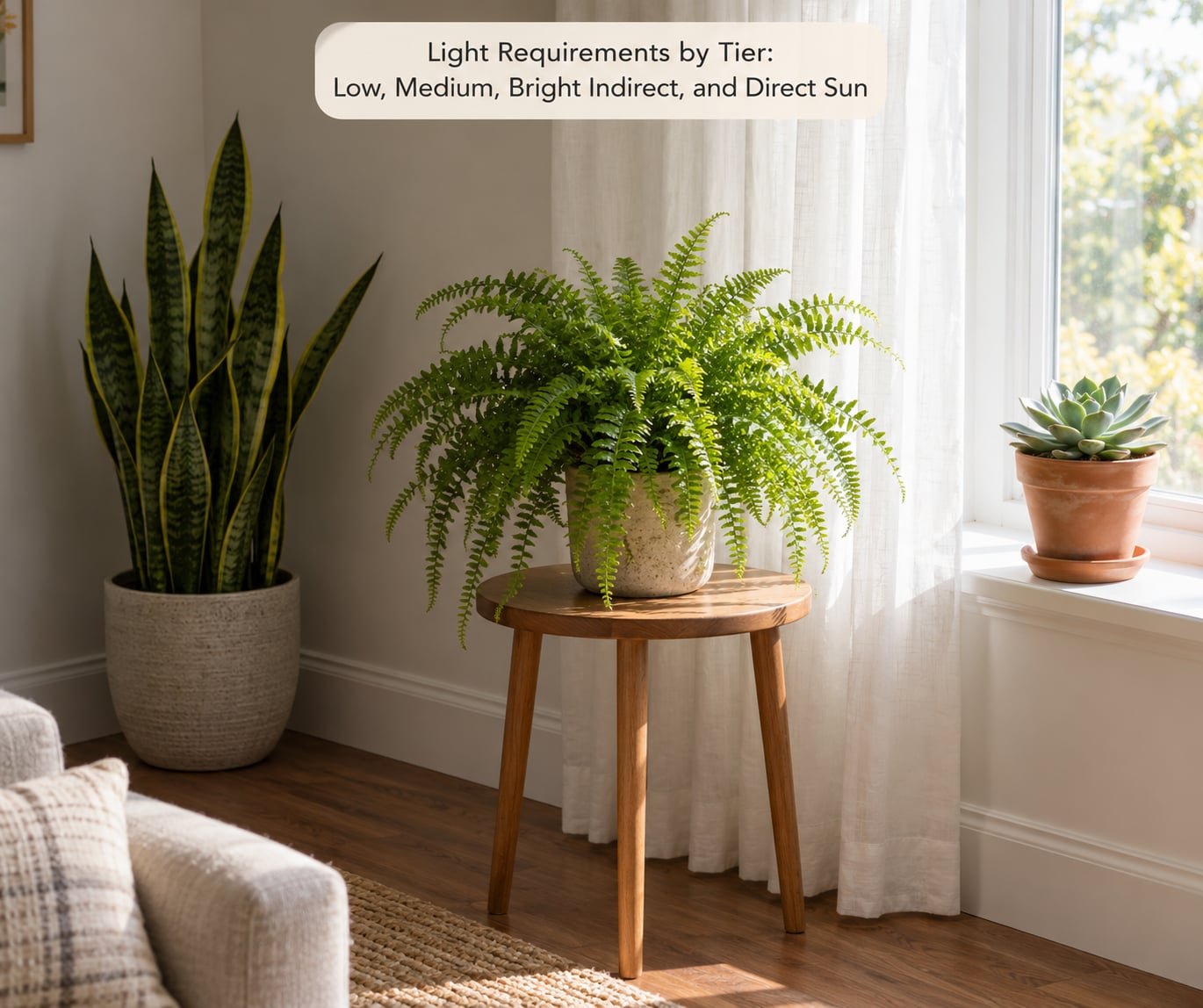
Low light plants have adapted to the understory, where light arrives filtered and indirect. They are slow, which is why they tolerate 8 to 12 hours in a dim spot and why they also sulk if you suddenly put them in a south window.
Medium light is the most forgiving tier and the right home for most first houseplants. Think 10 to 14 hours with no hard sun on the leaves, which is what you get a few feet back from an east or west window or in a room with two large windows.
Bright indirect means strong light with no beam falling straight on the plant, usually 12 to 16 hours beside a south window behind a sheer curtain. Monstera, fiddle leaf fig and calathea live here, and this is where a plant earns its growth in a year rather than a month.
Direct sun is unfiltered light landing on the leaves, and it is a winter condition in most of the country rather than an all-day one. Cacti, succulents, aloe and most herbs belong here, and even they prefer being stepped back a little once summer heat arrives.
Matching a plant to a tier matters more than the hour count. A pothos stretched across a bright windowsill every day is being handed a light level it cannot use, and it responds by growing long, thin internodes instead of leaves.
How Much Light Your Window Actually Provides
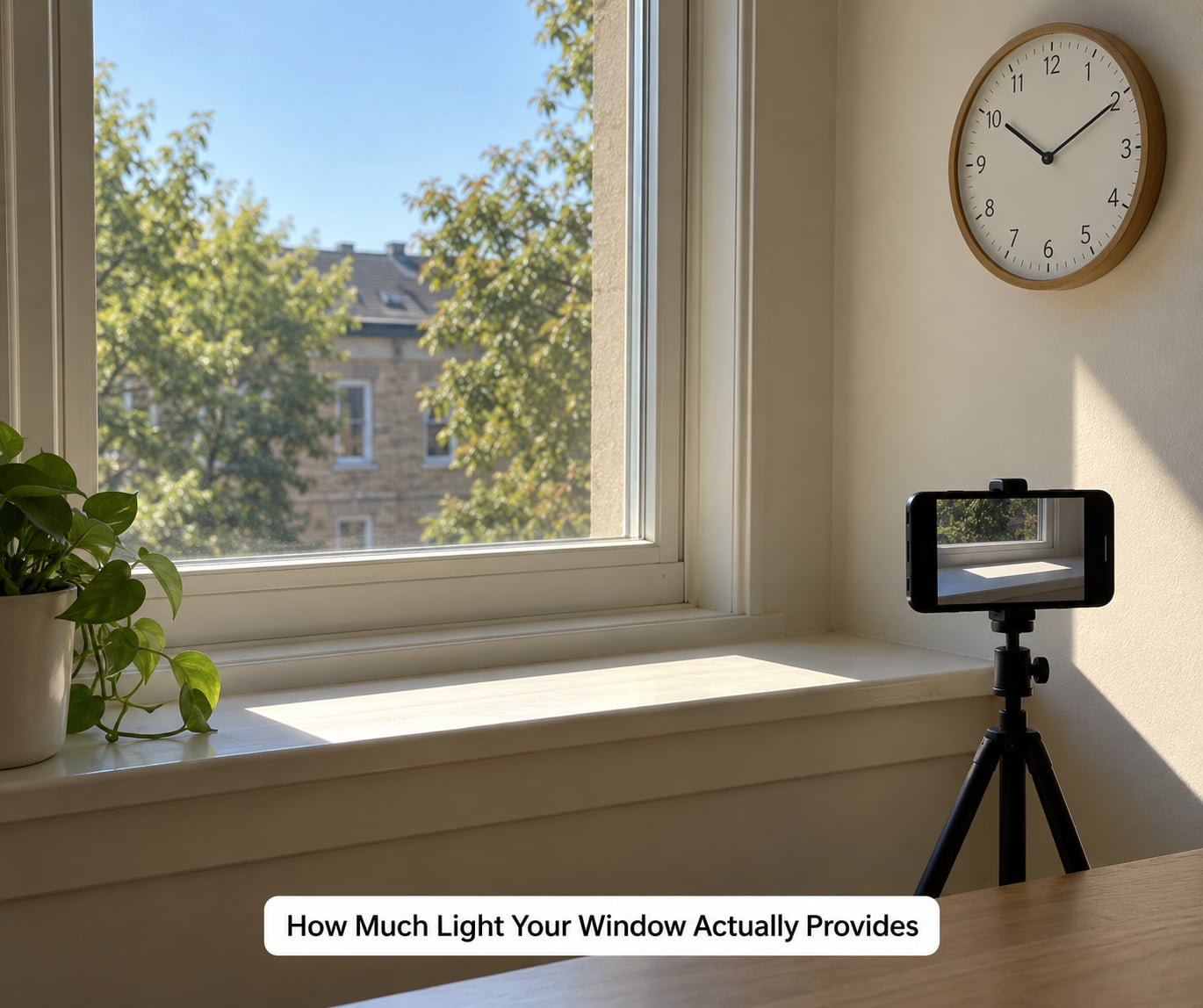
Window direction is the fastest way to estimate intensity before you buy anything. The Virginia Cooperative Extension handbook ranks a southern exposure as the most intense, with eastern and western windows delivering roughly 60 percent of that and northern windows about 20 percent.
Beyond direction, four things cut the light your plant receives. Glass filters out some of the useful wavelengths, and a single pane removes more than people expect. Curtains and blinds can halve the light reaching the sill. Depth into the room matters enormously, since light falls off fast within the first few feet. And the sun sits lower in the northern winter, so a windowsill that gets a hot patch in July may get a pale smear in January.
Here is a way to count your real hours without a light meter.
- Watch for one full day. Stand at the spot where the plant sits and note when direct sun first touches it and when it leaves. Do it in late spring or midsummer, when days are longest.
- Repeat on a second day. Cloud cover makes one observation unreliable, and you want a range rather than a single number.
- Add the bright ambient hours. Everything within roughly two feet of the glass, and the whole of a room with two windows, counts as useful light even when no beam lands on the plant.
- Subtract the losses. Halve the total for a permanent sheer curtain, and subtract more for blinds that are usually closed or a neighbouring building that blocks the lower half of the glass.
Write the number on a sticky note and stick it to the pot. You will need it again in January, and it is the fastest way to tell whether you are short of light or just impatient.
Too Little Light or Too Much Light? Signs and Fixes
Light problems look like every other plant problem until you know what to look for. The table below is the quick version, and it matters because the most common reaction to a struggling plant is to water it, which makes a light problem worse.
| Symptom | Usually means | Fix |
|---|---|---|
| Long thin stems with big gaps between leaves | Too little light | Move closer to the window or add hours of grow light |
| Leaves leaning hard toward the glass | Too little light | Rotate a quarter turn weekly and reposition permanently |
| Small new leaves, pale overall colour | Too little light | Raise intensity first, hours second |
| Few or no flower buds on a flowering species | Too little light, or wrong photoperiod | Check hours against the flowering range for that group |
| Green and cream variegation fading to solid green | Too little light | Brighter position, and accept that low light reverts some plants |
| Soil staying damp for days after watering | Too little light slowing growth | Water less often, and add light before adding water |
| Bleached, papery or crisp patches on leaves facing the window | Too much direct light | Sheer curtain, or step the plant back a few feet |
| Brown, dry leaf edges | Too much light, or heat and dry air | Check the distance to the glass and the room temperature at midday |
| Curling leaves and sudden drop after a hot day | Heat stress, sometimes with excess sun | Move out of the beam and watch whether it recovers over a week |
| Scorched patches right under a grow light | Light too close | Raise the light 4 to 12 inches |
Slow growth caused by low light is easy to confuse with watering problems, and the two feed each other. A plant in poor light uses less water, so the same weekly routine leaves the soil soggy, and soggy roots decline faster. If the soil is staying wet and the leaves are pale and stretched, fix the light first and let the watering frequency follow the growth.
Temperature and nutrients have their own fingerprints. Cold drafts and nutrient deficiency cause uniform yellowing of the oldest leaves with no stem stretching, which light never does.
How to Combine Window Light and Grow Light Into One Daily Budget
This is the bit almost nobody explains well, and it is the most common confusion in the grow light threads. Your plant does not care where the photons come from. It cares about the total.
- Total the window hours you counted. Use the direct sun hours plus your bright ambient estimate. Call it 10 for a typical sunny sill that gets four hours of beam and six hours of strong ambient.
- Add only the hours the window genuinely cannot supply. If your plant sits two feet into a north-facing room and needs 12 hours, it needs roughly 12 hours of lamp time, not 12 minus a guess.
- Set one timer for the total, not two competing ones. A cheap digital timer on a schedule such as 7am to 9pm gives you 14 hours regardless of what the sun is doing, and the sun simply adds on top of it. If the total lands above 16 hours for an established plant, shorten the lamp rather than the dark period.
The corollary matters as much. If a plant is stretching under a lamp set 12 inches above it, adding four more hours usually produces longer, weaker stems. Moving the light closer, or raising its intensity, buys more growth per hour than the clock does.
How Long to Leave Grow Lights On: Distance, Timer, and Running Cost
| Plant class | Typical distance from canopy | Hours to start with |
|---|---|---|
| Seedlings and cuttings | 4 to 6 inches | 16 to 18 |
| Flowering houseplants | 6 to 12 inches | 14 to 16 |
| Leafy greens and herbs | 6 to 12 inches | 12 to 14 |
| Foliage houseplants | 12 to 24 inches | 12 to 14 |
Setting a timer takes about five minutes and it is the difference between a plant that gets the same photoperiod every day and one that gets whatever you remember.
- Pick a window when you are home, ideally one that ends around your bedtime.
- Set the lamp on a mechanical or digital timer to switch on at that window and off 12, 14 or 16 hours later.
- Write the on and off times on the top of the timer housing.
- Check the plant after two weeks and adjust the total hours, not the distance, unless you are seeing leaf scorch.
- Recalculate in winter, when the window hours you counted in summer no longer apply.
A full spectrum LED in the 5000 to 6500 Kelvin range covers the red and blue end that plants use most heavily, and it avoids the pale stretchy look that comes from a lamp matched to a human rather than a plant. Ignore lumens when shopping for plant lighting, since lumens measure brightness as a human eye perceives it and say nothing useful about the photons a leaf can use.
On running cost, a 20 watt LED at 14 hours a day burns roughly 0.28 kilowatt-hours a day, so about 8 to 9 kilowatt-hours a week and 35 or so a month. Multiply by your own utility rate for the figure on your bill, and note that a lamp running 16 instead of 12 hours adds roughly a third to the total for a modest increase in daily light.
Do Seasons and Growth Stages Change the Hours?
Yes, and the hour count itself is what most guides skip. In northern winters the sun sits lower, daylight is shorter, and a south windowsill that delivered four hours of direct sun in July may deliver two. Rather than moving the plant every week, the simpler adjustment is to add an hour or two of lamp time in the darkest months and take it back off in spring.
Some plants respond to photoperiod itself rather than to light intensity, and these behave differently from the general rule. Short-day plants flower when days are short and the nights are genuinely long, so poinsettia, kalanchoe, chrysanthemum and the holiday cacti need an uninterrupted dark stretch. Long-day plants include African violet, gloxinia and tuberous begonia. Day-neutral plants such as Abutilon, Crossandra and gerbera ignore the calendar entirely.
Growth stage changes the target too. Germinating seeds and fresh cuttings do well on 14 to 16 hours, established vegetative growth is happy at 12 to 16, and a plant being pushed toward flowering often gets a fixed 14 hours rather than a long variable day. Watch the plant rather than the calendar; leaf size, stem thickness and bud production tell you sooner than any schedule does.
Terrariums, Vivariums, and Other Enclosed Setups
Enclosed plantings are the exception that needs its own rule, because the glass changes everything. Terrarium glass blocks a meaningful share of the light before it reaches the planting, and a covered jar in the middle of a room will not support a plant that a north window could. Start a planted terrarium or vivarium at around 12 hours a day and watch the glass itself: the first sign of insufficient light is algae rather than wilting, and it shows up as a green film on the glass before the plants complain.
For enclosed setups, hours are cheap and intensity is scarce, so the more useful move is usually a brighter, closer light source rather than four extra hours. Keep the lamp outside the enclosure, keep airflow in mind, and expect to trim and replant as the layer of growth nearest the glass thins out.
Frequently Asked Questions
Can plants tolerate 24 hour light?
No, and this is the one rule that holds across every reliable source. Plants need an uninterrupted dark block to process the energy they collected during the day, and the Virginia Cooperative Extension Master Gardener Handbook caps indoor illumination at 16 hours. Growers running lights around the clock report bleaching, leaf burn and stalled growth within a couple of weeks.
Do houseplants need periods of darkness?
They do, and the dark period is not just rest. Overnight, the plant converts stored sugars into new tissue, respires, and resets the hormones that drive the next round of growth. Community advice in r/houseplants treats 8 hours minimum and 8 to 10 hours ideal, and short-day flowering plants such as poinsettia and holiday cacti depend on a genuinely long, unbroken night to set buds at all.
Is 12 hours of light too much for plants?
Not at all. Twelve hours sits inside the recommended range for foliage houseplants, and the extension schedule most people rely on lists them at 12 to 14 hours. What does cause damage is 12 hours of very intense light from a lamp placed too close, which scorches leaves in a way that duration alone never does. Judge the combination of hours and distance rather than the hour figure by itself.
Do plants get enough light through windows?
It depends on direction and distance from the glass. A southern window is the strongest, eastern and western deliver roughly 60 percent of that, and northern windows about 20 percent, with light falling off sharply a few feet into the room. Single-pane glass and closed blinds cut it further. Count your real sun hours over a full day before deciding you need a grow light.
How to tell if my grow light is too close?
Watch the leaves facing the lamp. Bleached, papery, crisp or curled patches that appear in the shape of the light are scorch, and so is brown, dry edging on the newest growth. Widely used guidelines put seedlings at 4 to 6 inches, flowering houseplants at 6 to 12, and foliage houseplants at 12 to 24. When you raise the light, expect a short period of stretching as the plant adjusts.
Can plants survive 3 days without light?
Yes, almost always. Houseplants are adapted to periods of low light under a canopy, and three dark days will not harm an established plant in a bright spot. Watering is the real risk, since a plant in low light uses very little water and a holiday watering routine tends to drown it. Pause watering before you leave, and skip the fertilizer until growth resumes.
What to Do First
Watch your plant and its window for a full day and write down the direct sun hours, then place the plant according to its group: low light 8 to 12 hours, medium 10 to 14, bright indirect 12 to 16, flowering 14 to 16, seedlings 16 to 18. Most indoor plants need 12 to 16 hours of light and at least 8 hours of uninterrupted darkness, and never 24.
Adjust intensity before hours, and reach for a timer only when the window genuinely cannot meet the plant’s needs.