If you have never done it, learning how to grow herbs indoors under grow lights comes down to three numbers: light 6 to 12 inches above the leaves, run it 14 to 16 hours a day on a timer, and water only when the top inch of soil feels dry. A windowsill alone rarely delivers enough light for anything but the most forgiving herbs, so the lamp is doing the real work.
The whole setup is genuinely beginner sized. One lamp, a few nursery pots, a bag of potting mix, and about an hour between you and fresh basil on the counter.
Before the step-by-step, the short version most people need:
- Light hours: 14 to 16 hours of light, then 8 to 10 hours of complete dark.
- Light height: 1 to 3 inches above seedlings, raised to 6 to 12 inches as plants fill out.
- Easy herbs: basil, chives, mint, parsley, thyme, and oregano.
- Harder indoors: rosemary, lavender, and sage, which want stronger light and dry air.
- Watering: check the top inch of soil, do not run a fixed schedule.
- Color: white light around 4000K to 6500K looks better in a kitchen than purple-blue fixtures.
- Feeding: diluted liquid fertilizer once plants are actively putting out new leaves.
Table of Contents
- What You Need
- Step-by-Step: How to Grow Herbs Indoors Under Grow Lights
- 1. Choose Herbs That Suit Indoor Light
- 2. Prepare Pots and Drainage
- 3. Plant the Herbs at the Correct Depth
- 4. Position and Adjust the Grow Light
- 5. Water, Feed, and Watch for Growth
- Common Mistakes
- Frequently Asked Questions
- How long should grow lights be on for indoor herbs?
- Do indoor herbs need grow lights in winter?
- How close should a grow light be to herbs?
- Can I use a regular LED bulb to grow herbs indoors?
- What is the best way to tell if an herb needs more light?
- Conclusion
What You Need
Seven things, and most households already own three of them.
- A spot with power. An indoor growing shelf, a countertop under a cabinet, or a stand with room to hang a fixture. You need a grounded outlet within reach of where the plants will sit.
- A waterproof tray or cachepot. Herbs in terracotta or unglazed clay dry out fast under a lamp. A sealed inner pot or a saucer keeps the moisture where the roots can use it.
- Well-draining herb pots. Drainage holes are not optional. Small pots dry in a few days under a grow light; slightly larger pots buy you time between waterings.
- Potting mix formulated for container plants. Not garden soil. Potting mix is light and holds air around the roots, which is what a pot needs.
- A gentle watering method. A watering can with a fine rose, or a bottle with holes in the cap. Pours that hit the mix hard knock air out of it.
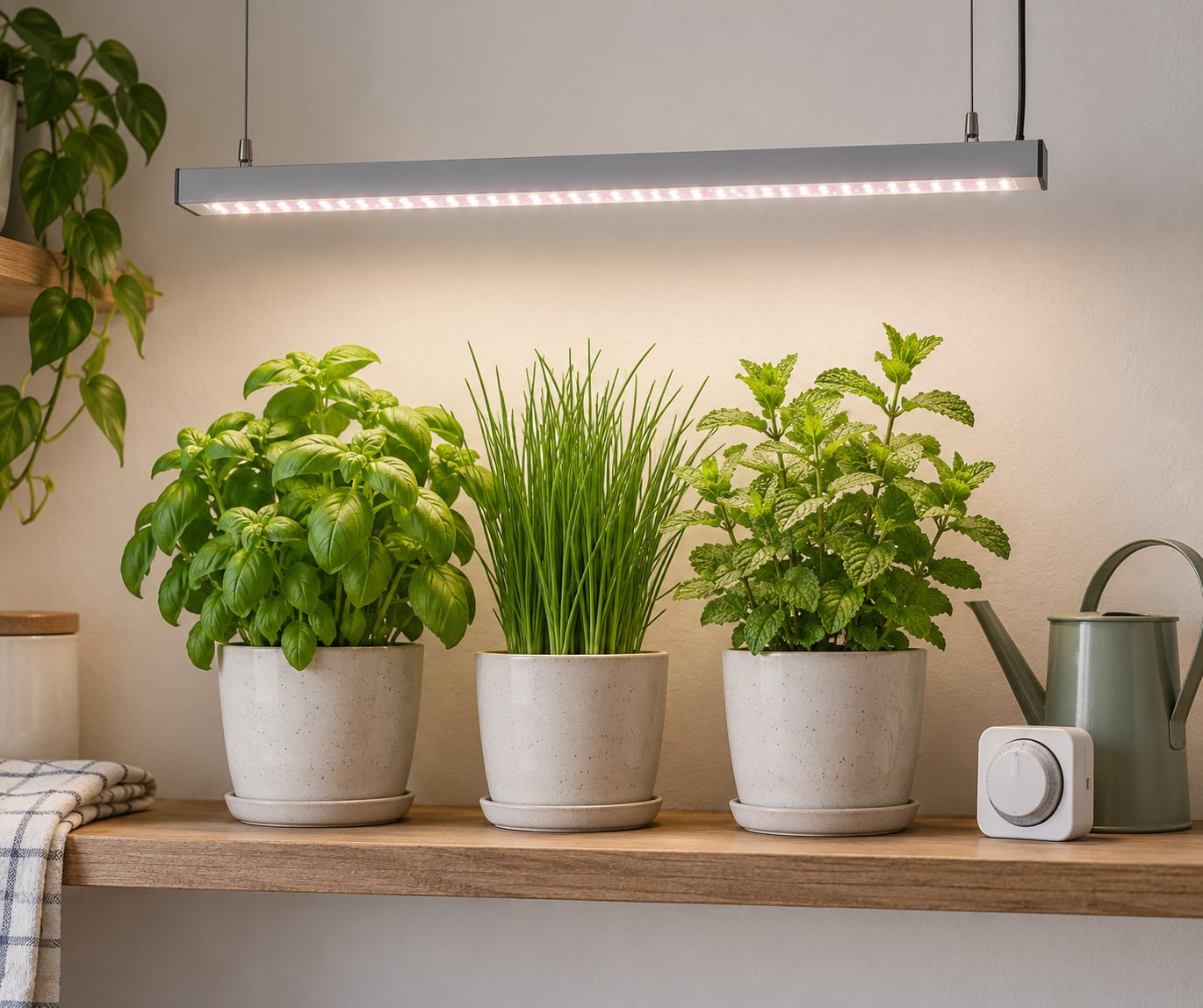
- A full-spectrum LED grow light with adjustable height. A bar or bulb on a chain, or a fixture you can raise. Adjustable is the feature that saves you money over a year.
One adjustable light can serve a whole row of herbs. Many people start with a single bulb over a two-pot shelf, then move to a bar light when the collection doubles.
Setup takes about 30 to 60 minutes. Most of it is filling pots and clipping a chain.
Step-by-Step: How to Grow Herbs Indoors Under Grow Lights
Five steps, in order. The first herb you plant will be in the ground within an hour, and after that the routine is a few minutes a week.
1. Choose Herbs That Suit Indoor Light
Start with herbs that stay compact and forgive imperfect conditions. Compact varieties matter more indoors than outdoors, because a plant that crowds its neighbor shades it out, and no amount of lamp wattage fixes a crowded shelf.
Herbs that handle indoor light well include basil, parsley, cilantro, chives, mint, thyme, and oregano. Mint in particular is almost unstoppable, which is why experienced growers keep it in its own pot.
Some herbs tolerate lower light better than others. Chives, parsley, thyme, and mint carry on with moderate light, even a bright room without a lamp. Basil, cilantro, and oregano want stronger and longer light, so give those the best position under the fixture.
Rosemary and lavender are the two most common disappointments. They are Mediterranean plants that like bright light, dry air, and soil that dries quickly between waterings, and a warm humid kitchen is the opposite of that. You can grow them indoors, but expect to work at it.
This step matters more than any other part of learning how to grow herbs indoors under grow lights. A lamp set up for shade-tolerant parsley will never push basil into dense, fast growth.
2. Prepare Pots and Drainage
Pick containers with drainage holes in the base. A pot without holes holds water until the mix turns sour and the roots start to rot, and that damage happens below the surface where you will not notice it for weeks.
Set each pot on a saucer or inside a waterproof tray. Under a grow light, the air is still and dry, so water evaporates slowly and any runoff sits where you poured it.
Fill with loose, well-draining potting mix. Do not use garden soil from outside: it compacts in a container, drains badly, and brings its own pests indoors with it. Leave a half-inch of space at the top for watering.
Pot size controls how often you water. A 3-inch pot dries in a couple of days under a lamp; a 6-inch pot holds enough moisture for a week. When in doubt, size up one pot rather than scheduling more waterings.
Do not use a layer of rocks at the bottom of a pot. It does not create drainage, it takes up root space, and it raises the water table so the bottom of the mix stays wet while the top dries.
3. Plant the Herbs at the Correct Depth
Nursery herbs are the fastest route, and starting from seed adds weeks and a light-height headache you do not need yet.
Slide the plant out of its starter pot and check the root ball. If roots circle the bottom or burst out the drainage holes, gently tease them apart with your fingers so they grow outward instead of in circles.
Set the root ball in the new pot at the same depth it was sitting before. Herbs planted too deep develop stem rot at the soil line; herbs set too high dry out at the roots within days. Firm the mix lightly around the edges, then water once to settle it.
Label each pot with a marker or a plant stake. Basil and parsley look identical as small seedlings, and mixing them up is an easy mistake to make three weeks in.
You will know it worked when stems stay upright and you see new growth within about a week. Leaves that droop immediately after transplanting usually mean the mix was too loose or the pot is holding water.
4. Position and Adjust the Grow Light
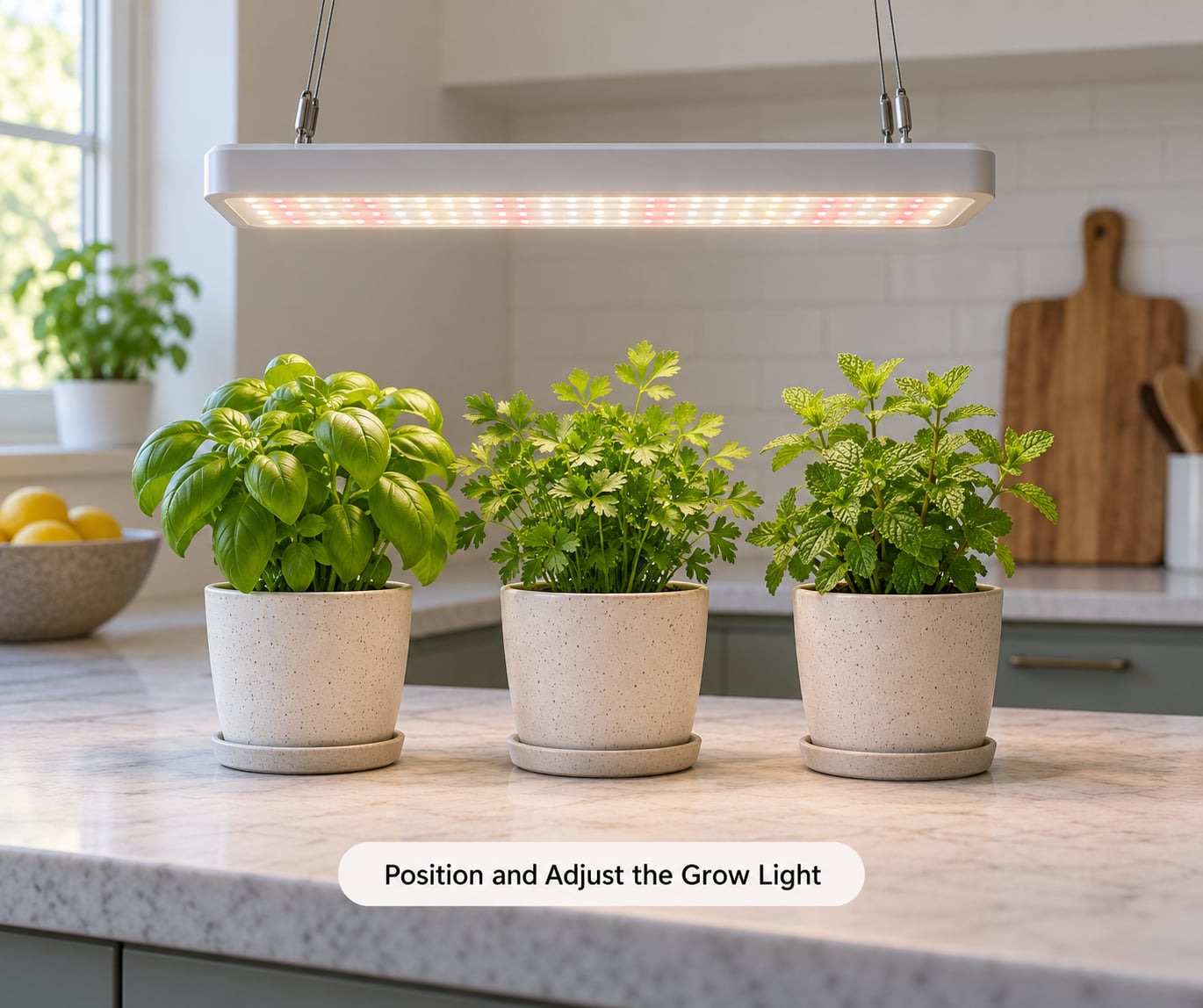
Hang the light so the beam covers every pot evenly. Fixtures are directional, and plants off to one side get a fraction of the intensity that plants directly underneath get. Turn the bar rather than crowding pots to one end.
Set leaves about 6 to 12 inches below the fixture for compact, mature herbs. Start closer for new transplants and seedlings, at 1 to 3 inches, and raise the light as growth pushes up into it. A plant touching a hot fixture gets scorched patches that look like a disease but are not.
Plug the light into a timer and let the timer do the remembering. Most foliage-type herbs do best on 14 to 16 hours of light a day, and the dark period matters as much as the light. Plants run around the clock produce thin growth and never flower properly.
Follow the light maker’s instructions for mounting and clearance. Keep every connection dry, keep water away from the fixture and cord, and never run an extension cord under a rug or through a door gap. If your outlet is far from the shelf, move the shelf.
You will know it worked when leaves stay flat and reasonably sized, and new growth comes in compact rather than stretched. Stems leaning hard toward the lamp mean it needs raising or a quarter-turn.
5. Water, Feed, and Watch for Growth
Press a finger about an inch into the mix before every watering. If it feels dry and light, water thoroughly until it runs out of the drainage holes, then empty the saucer after a few minutes. If it still feels damp, wait.
A fixed watering schedule is the single biggest cause of dead indoor herbs. Under a grow light, plants use water faster than a calendar assumes, and in a cool room they use it slower.
Rotate each pot a quarter turn every week or two. It keeps growth even, and it is also your regular chance to look at leaf color, new growth, and the underside of leaves where pests hide.
Feed only while plants are actively growing. A diluted liquid fertilizer applied every few weeks during spring and summer suits most herbs; skip it in midwinter when growth has slowed down, since a plant cannot use what it cannot grow with.
Healthy leaves under a grow light are firm, evenly colored, and a normal deeper green. Pale, soft, stretched growth means the light is too weak, too far away, or on for too few hours. Yellowing lower leaves with wet soil means water, not hunger.
Common Mistakes
Almost every failed herb shelf comes down to one of these.
- Light too close. Leaves curl, bleach, or develop crispy patches. Raise the fixture to 6 to 12 inches above mature herbs and let the plant cool before checking again.
- Light left on 24 hours. Continuous light shortens the day length in the plant’s own accounting and pushes weak, stretched growth. Set a timer for 14 to 16 hours and let it run dark.
- Overwatering. Constantly wet mix starves roots of air. Check the top inch instead of guessing, and empty the saucer.
- Garden soil in a pot. It compacts and drains badly. Use potting mix made for containers.
- Crowding. Leaves touch, airflow stops, and lower leaves stay damp. Give each pot its own space and rotate for even light.
- Ignoring leaf color. Pale and leggy means not enough light; bleached patches mean too much. Yellow leaves with wet soil mean too much water. Read the color before you change anything else.
- Keeping an aging light forever. LEDs dim slowly over years, and you will compensate by moving the fixture closer, which scorches the plant. Replace the fixture when growth slows across the whole shelf at once, even if one plant looks fine.
Make a habit of checking soil moisture and leaf color at least once a week, even when nothing seems wrong. Herbs under lights change fast between watering and wilting, and a ten-second look catches it early.
Frequently Asked Questions
How long should grow lights be on for indoor herbs?
Most leafy herbs do best on 14 to 16 hours of light a day, followed by 8 to 10 hours of complete darkness. Run the light on a timer so the schedule holds on weekends and holidays. Continuous 24-hour lighting causes stretched, pale growth in most herbs, because plants register the dark period as part of their daily cycle.
Do indoor herbs need grow lights in winter?
In winter, most windows deliver far less usable light than in summer, and herbs stretch toward the glass and go pale. A grow light solves that problem, which is why indoor herb setups are a winter hobby for a lot of people. In a bright, unobstructed south-facing window you can sometimes skip the lamp for a few months, but growth will be slower.
How close should a grow light be to herbs?
Keep leaves about 6 to 12 inches below the fixture for compact, mature herbs, and closer for new transplants and seedlings. Once you have the basics down, how to grow herbs indoors under grow lights comes down to watching the plant, not the manual. Pale, stretched growth means raise the light, while bleached or crispy patches mean lower it or let the fixture cool first.
Can I use a regular LED bulb to grow herbs indoors?
A plain household LED bulb works far better than nothing, because leaf growth is driven mainly by blue and red wavelengths that white LED already contains in fair amounts. Purple-blue grow bulbs concentrate those wavelengths and look poor in a living space. A white full-spectrum fixture between 4000K and 6500K gives you usable light and a shelf that still looks like part of your kitchen.
What is the best way to tell if an herb needs more light?
Look at shape before color. Herbs reaching toward the window or the lamp, with long gaps between leaves and thin stems, are stretching for light and need either closer, longer, or stronger illumination. Pale leaves with a soft texture confirm it. Slowing growth across the whole shelf at once, rather than in one pot, points to the fixture instead of the plant.
Conclusion
Pick one easy herb such as basil or chives, one pot with drainage holes and a saucer, and one adjustable-height full-spectrum light set to a timer. That is the whole kit.
Then build your routine on soil moisture rather than a calendar. Check the top inch before you water, glance at leaf color once a week, and raise the light as your herbs grow into it.