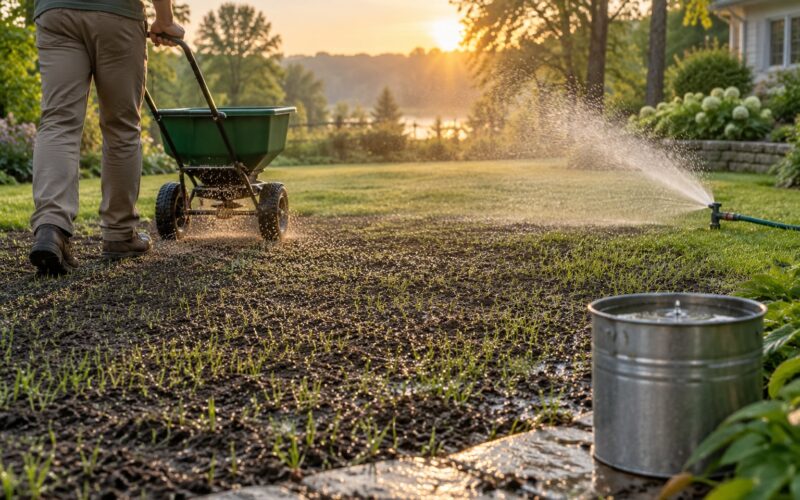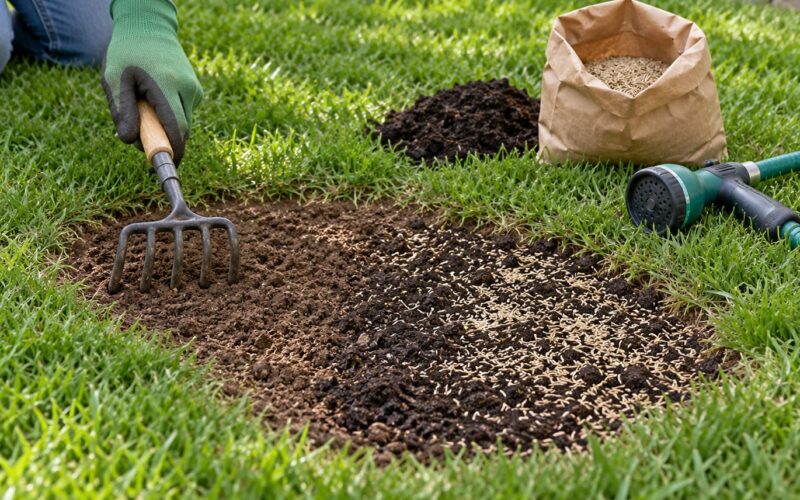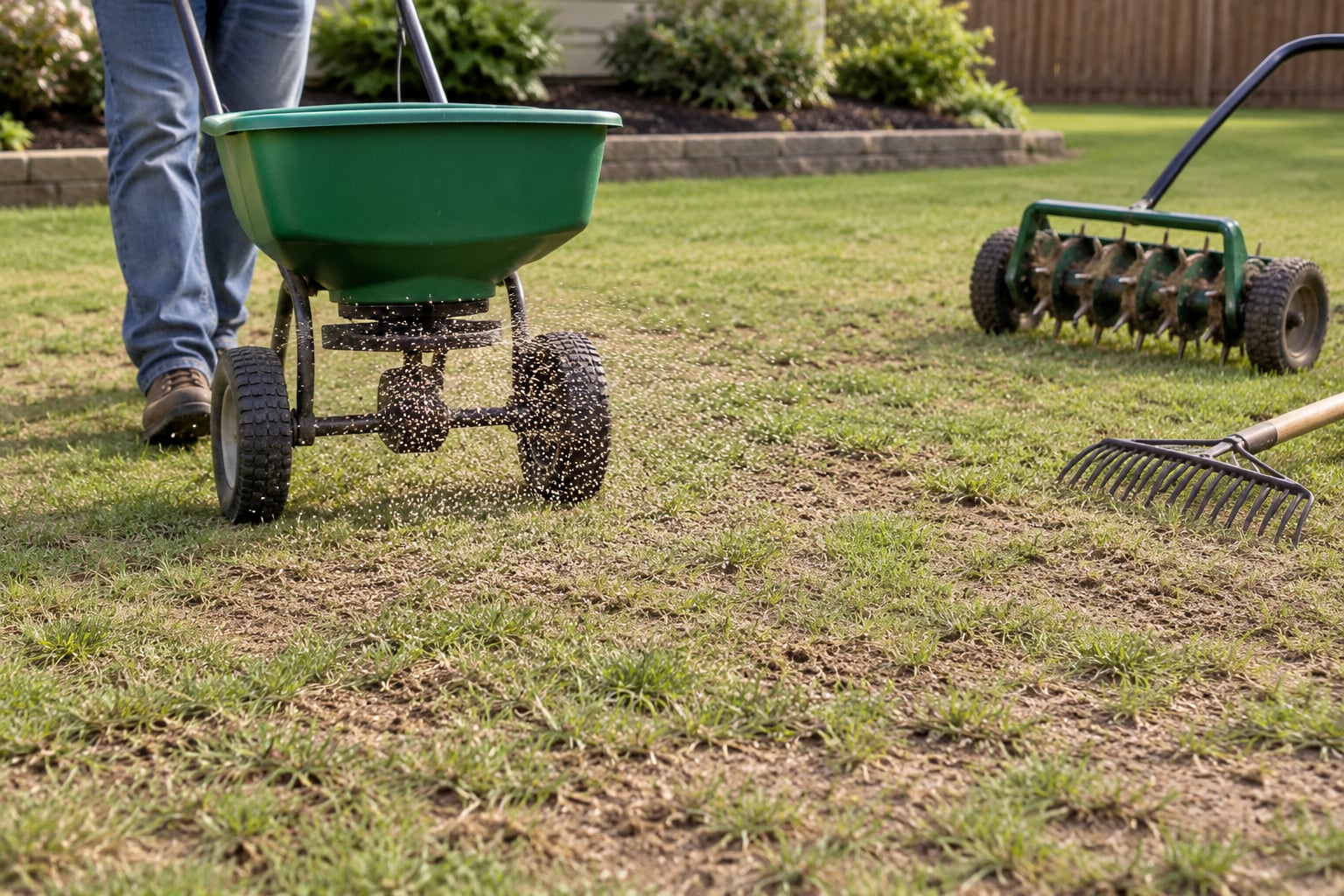
There are two separate answers to when to overseed Bermuda grass, and mixing them up is why so many seedings fail. For winter color you overseed a healthy Bermuda lawn with a cool-season grass in early to mid fall, once nighttime lows drop into the 50s but the soil is still warm. For repairing thin, patchy or bare turf you put Bermuda seed down in late spring through midsummer, when soil temperature holds above 70F.
Those two jobs never happen at the same time, and they use different seed at very different rates. Below is the timing, the tools, and the full process for each.
Table of Contents
- What You Need
- Step-by-Step: When to Overseed Bermuda Grass
- How to Know When to Overseed Bermuda Grass
- Prepare the Lawn for Better Seed Contact
- Choose and Apply the Right Bermuda Seed
- Water, Mulch, and Keep Foot Traffic Off
- Mow for Bermuda Growth, Not Before
- Common Mistakes
- Quick Tips for Better Germination
- Frequently Asked Questions
- Can I overseed Bermuda grass in early spring?
- What kind of Bermuda grass seed is best for overseeding?
- How much Bermuda seed do I need per 1,000 square feet?
- Should I put topsoil or mulch over the seed?
- Can I overseed Bermuda grass with fescue or ryegrass?
- How long does overseeded Bermuda grass take to fill in?
- Conclusion
What You Need
Gather everything before you pick a date. Rushing the prep stage is the reason seed washes away or never touches soil.
- Bermuda seed or a matching blend. For repair work, use the same cultivar family as your existing sod so the texture matches. For winter color, use perennial ryegrass, annual ryegrass, or a tall fescue blend.
- A core aerator or spike aerator. Hollow tines pull plugs and open the soil far better than spike tines, which only punch holes without removing material.
- A broadcast or drop spreader. Drop it over areas near fences, planters and driveways so seed does not land on hard surfaces.
- Soil amendment where the ground is thin. A light screened compost topdressing gives seed something to sit on. Skip fertilizer high in nitrogen until the seedlings are up.
- Mulch or a seed blanket only where needed. Slopes and bare soil benefit; an established canopy does not.
- A rake, a hose or irrigation system, and a mower with sharp blades. Dull blades tear new seedlings instead of cutting them cleanly.
Step-by-Step: When to Overseed Bermuda Grass
How to Know When to Overseed Bermuda Grass
Judge timing by soil temperature, not by the calendar. Warm-season Bermuda seed will sit in cold ground for weeks without germinating, and cool-season ryegrass sown too late will germinate right before the first freeze and die there.
Here is the useful split. Window one is winter color, window two is Bermuda patch repair, and each has its own thresholds.
| Goal | Calendar window | Soil temperature | Air temperature | Anchor event | Seed |
|---|---|---|---|---|---|
| Winter color | Early to mid fall, roughly 4 to 6 weeks before the average first fall frost | 65F to 72F | Daytime 70F to 80F, nights in the 50s | Bermunda growth slowing, nights dropping | Perennial ryegrass, annual ryegrass or fescue blend |
| Bermuda patch repair | Late spring through midsummer, after the last frost date has passed | 68F to 75F and holding | Daytime 70F to 80F or warmer | Full green-up and active stolon growth | Bermuda seed matching your existing turf |
Regional frost dates shift these windows, so use the average first-frost date for your county rather than a generic month.
| Region | Average first fall frost | Overseed for winter color | Overseed Bermuda for repair |
|---|---|---|---|
| Southwest and desert | Late October to mid November | Late September in higher elevation areas, mid October to early November in the low desert | Mid April through June, after nights stay above 60F |
| Texas | Early November in the far south to late November in the panhandle | Late September through mid October | Late April through early July |
| Deep South | Early to mid November | Late September through mid October | Late April through midsummer |
| Transition and Upper South | Mid October to early November | Early to late September | Mid May through midsummer |
| California lawns | Rarely frosts inland | October to November for winter color | May and June, when nights are mild and moisture is reliable |
You can check soil temperature yourself instead of guessing. Push a soil thermometer 4 inches into the ground in a shaded spot, take three readings in different places, and average them. Morning readings run lowest, so check before the day heats up. Green-up is the other cue: when Bermuda has fully greened and is producing runners, the repair window is open. On the winter-color side, if the bermuda has visibly slowed and you can feel the difference between afternoon and evening air, you are close.
One honest note. A healthy Bermuda lawn with stolons and rhizomes usually does not need overseeding at all, because it spreads on its own and fills thin areas. Repair overseeding earns its place after winter damage, drought stress, scalping, heavy traffic, or a herbicide mistake. If your lawn is dense and green, spend the effort on core aeration and fertilizer instead.
Prepare the Lawn for Better Seed Contact
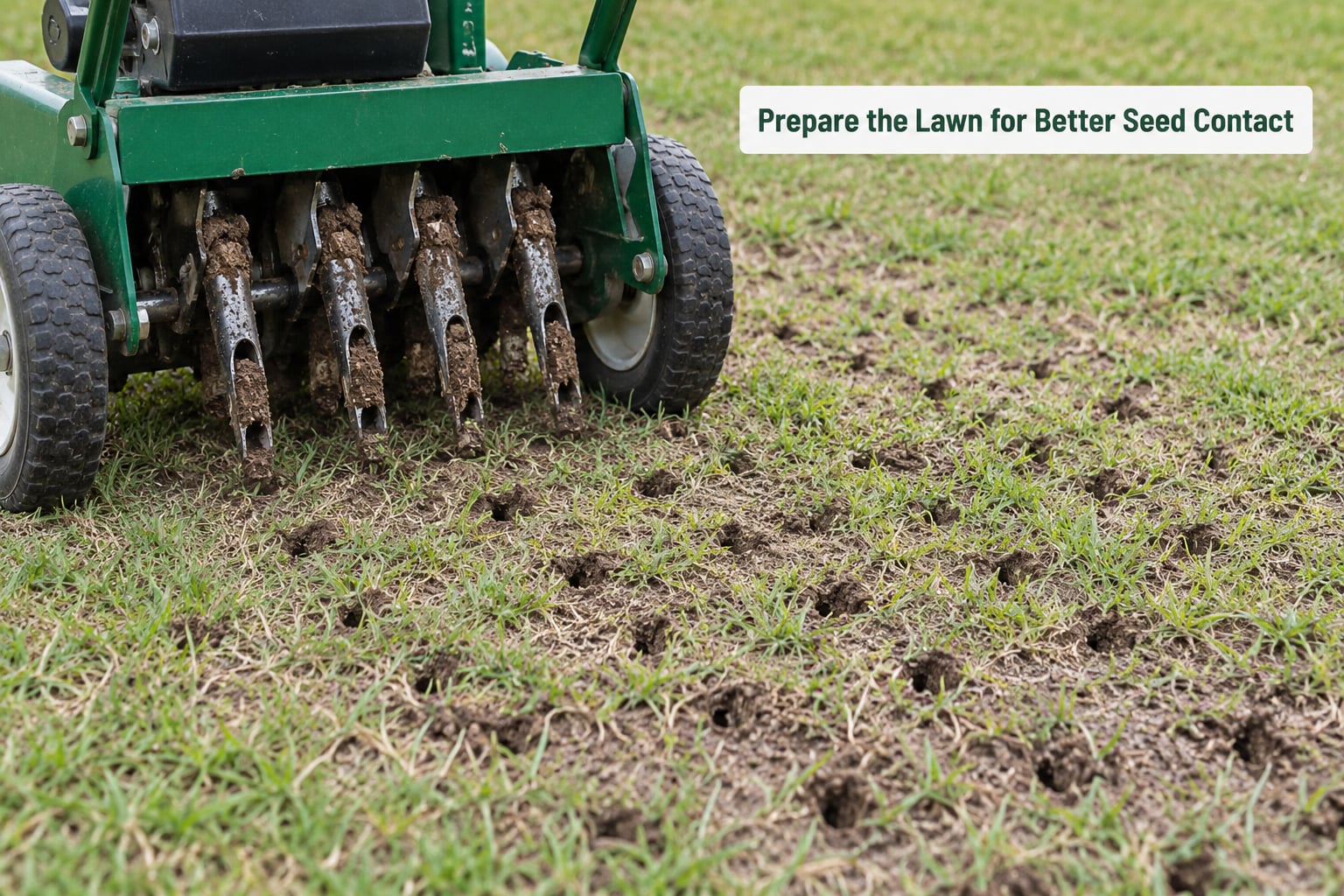
Mow first, at half the height you normally cut, and bag the clippings. That opens the canopy so light can reach the soil surface and seed can fall in rather than sitting on top of tangled stolons.
Clear leaves, sticks and dead thatch, then core aerate. Run the aerator in two directions if the ground is hard. The plugs you pull are evidence the soil is compact; break them up and work them back in so the holes stay open.
Where soil is thin or a patch is bare, topdress with screened compost before seeding. Do not roto-till an existing lawn. It tears up stolons and leaves you with bare dirt for weeks.
If the ground is dry, water it the day before so the seed lands on moist soil. Watering right before seeding only creates mud, and mud means crusting and poor contact.
Choose and Apply the Right Bermuda Seed
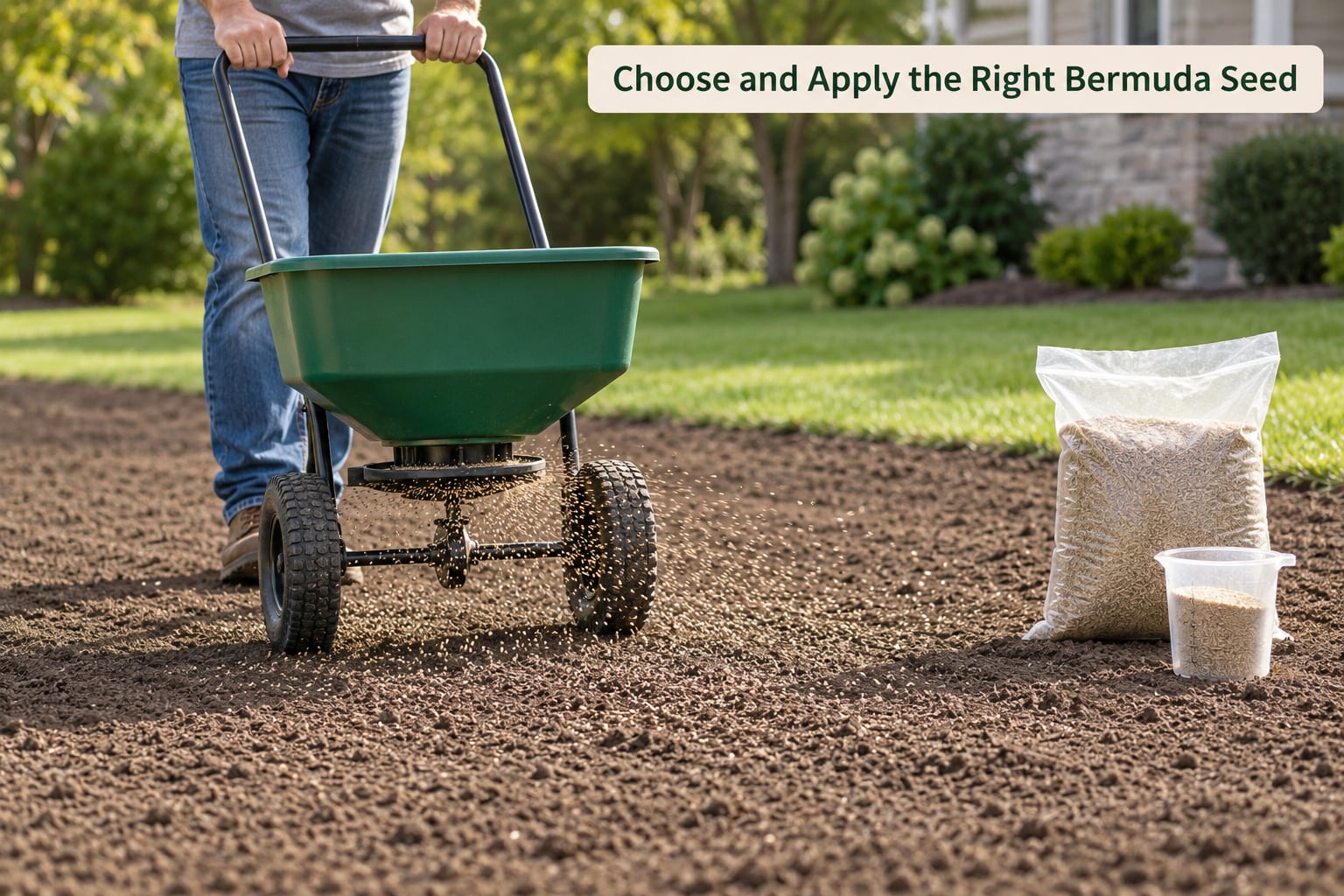
For repair work, match the cultivar family of your existing turf so blade width and color blend. For winter color, perennial ryegrass gives the darkest green and recovers from traffic, annual ryegrass germinates fastest and dies out on its own in spring heat, and tall fescue handles cold better but transitions more slowly.
Check the bag before you open it. You want a germination rate, a purity percentage and a planting rate per 1,000 square feet. The planting rate matters more than any brand claim, and the rates differ hugely by species.
| Seed type | Rate per 1,000 sq ft | 1,000 sq ft lawn | 5,000 sq ft lawn | 10,000 sq ft lawn |
|---|---|---|---|---|
| Bermuda on bare soil or thin repair areas | 2 to 4 lbs | 2 to 4 lbs | 10 to 20 lbs | 20 to 40 lbs |
| Bermuda on a thin existing canopy | 1 to 2 lbs | 1 to 2 lbs | 5 to 10 lbs | 10 to 20 lbs |
| Ryegrass or fescue winter blend | 8 to 12 lbs | 8 to 12 lbs | 40 to 60 lbs | 80 to 120 lbs |
Those ryegrass figures look high next to the Bermuda numbers, and that gap is exactly where confusion starts. Desert extension programs recommend roughly 12 to 15 lbs per 1,000 square feet for a ryegrass winter blend because the seed is fine, the seedlings are small and the goal is dense color. Bermuda repair seed is a large, coarse seed sown at a fraction of that weight.
Calibrate the spreader with a catch test over a tarp. Set it to half the bag rate, walk the lawn, then add a second pass at right angles to the first. Overlapping passes beat guessing, and two light passes will not produce the heavy ruts that one heavy pass creates.
Water, Mulch, and Keep Foot Traffic Off
Keep the top quarter inch of soil evenly moist until seedlings show. That means light, frequent watering rather than one soaking. If you can irrigate on a schedule, short cycles in the morning and early evening work well; a midday cycle is fine in hot weather because the water cools the seed rather than cooking it.
Water in two stages when rain is not in the forecast. Apply the first pass, let it soak in for an hour or two, then apply the second. That moves the seed into the soil instead of leaving it floating on a crust.
On slopes or bare ground, rake a light layer of mulch or a seed blanket over the top and pin the edges. Where the canopy is intact, mulch adds nothing and blocks light from the new growth, so leave it off.
Keep people and pets off the treated area until the grass is established enough to walk on, which usually takes two to three weeks. A muddy traffic path will not recover on its own the way a worn green path might.
Mow for Bermuda Growth, Not Before
Do not mow the seeded area until the tallest new blades reach roughly 3 inches. Mowing earlier pulls seedlings out by the crown before their roots are anchored, and you lose the stand you paid for.
After that, follow the one-third rule. Never remove more than a third of the blade height in a single pass. Cutting a lawn from 3 inches down to 1 inch strips off two thirds of the leaf, and Bermuda has no quick way to replace that tissue, so scalping sets the plant back rather than thickening it.
New Bermuda growth generally wants a 2 to 3 inch cut once it is established, and mature turf handles 1.5 to 2.5 inches. Ryegrass blends can be cut lower, around 2 to 3 inches, but only after they are rooted. Sharpen the blades first, because a torn leaf edge invites disease and looks worse than a clean cut.
Common Mistakes
- Overseeding too early. Seed on cold soil stays dormant for weeks and often rots or washes away. Wait for the temperature thresholds above.
- Overseeding too late. Seed sown within a few weeks of frost germinates and then dies. If you are past the window, wait for spring and repair then.
- Choosing incompatible seed. A different Bermuda cultivar can produce a coarser, lighter patch that never blends. For winter color, mixing ryegrass with fescue works; mixing two warm-season grasses rarely does.
- Seeding over weeds. Seed and weed seedlings compete for the same light and water. Treat the weeds first and wait the interval the herbicide label requires before seeding.
- Skipping preparation. Seed that lands on an unbroken mat or packed soil has no seed-to-soil contact, which is where most of the failures start.
- Applying too much seed. Heavy applications clump, waste seed and promote disease. Two lighter passes are better than one double pass.
- Letting the lawn dry out. The surface must stay moist, not soggy. Once the top layer dries and crusts, emergence drops sharply.
- Expecting ryegrass to replace Bermuda. Ryegrass is a seasonal overlay. In spring it declines on its own so Bermuda can recover, which is the whole point of the fall window.
Quick Tips for Better Germination
Check the 10-day forecast before you open the bag. You want a stretch of mild days with no heavy rain right after seeding, because a downpour on loose seed creates crusting and runoff before anything roots.
Know your watering restrictions before you commit. In many desert and Texas communities you have limited irrigation days in summer, so work the schedule backward and confirm that a short daily cycle is legally available to you.
Record the date, the seed type and the rate you used. Comparing that note with next spring tells you whether your window was early, late or right, and that is faster than reading a frost-date chart all over again.
Pull a few plugs or dig in a bare spot a week after seeding to check moisture at depth instead of judging from the surface, which can look wet while the root zone stays dry.
Stop nitrogen about six weeks before your average first fall frost. Late nitrogen pushes soft growth that is more vulnerable to cold and disease through the winter.
Frequently Asked Questions
Can I overseed Bermuda grass in early spring?
Not with Bermuda seed. Early spring soil is usually still too cool for reliable warm-season germination, so the seed sits and often rots. For patch repair, wait until nights stay above 60F and soil holds 68F to 75F, which is typically late April through June. If you want winter color instead, that work belongs in fall, not spring, because spring-planted ryegrass competes with Bermuda at exactly the moment Bermuda needs to green up.
What kind of Bermuda grass seed is best for overseeding?
Match the seed to your existing turf. If your lawn came from sod, look for a blend of the cultivars named on the label, such as Tifway, Tifgreen, Santa Ana or Midiron. For bare soil, a single named hulled or unhulled cultivar works fine. Check that the bag lists a germination rate and a planting rate per 1,000 square feet, and buy by rate rather than by brand name.
How much Bermuda seed do I need per 1,000 square feet?
Plan on 2 to 4 lbs per 1,000 square feet over bare soil, and closer to 1 to 2 lbs when you are spreading over a thin but intact canopy. Multiply by your lawn area in thousands. A 5,000 square foot lawn takes about 10 to 20 lbs over bare patches, and a 10,000 square foot lawn takes 20 to 40 lbs. Ryegrass winter blends need far more, usually 8 to 12 lbs per 1,000 square feet.
Should I put topsoil or mulch over the seed?
Only where the seed has nothing to hold it. On slopes, bare patches or along edges, a light rake of screened compost or a seed blanket keeps the seed in place and reduces erosion. Over an existing canopy, mulch blocks light from the new growth and can smother it, so skip it there. Keep any covering thin enough that you still see soil and seed underneath.
Can I overseed Bermuda grass with fescue or ryegrass?
Yes, and that is the standard fall job. Ryegrass and fescue germinate in cooler soil, carry green color through winter, then decline as heat arrives and Bermuda takes over in spring. Annual ryegrass transitions fastest and needs no spring cleanup, perennial ryegrass stays green longer and recovers from traffic, and tall fescue tolerates the coldest winters but lingers well into summer. Mix them if you want a blend.
How long does overseeded Bermuda grass take to fill in?
Bermuda repair seed usually shows green in 7 to 14 days when soil is warm and moisture is steady, with a noticeable thickening around three to four weeks and full coverage taking six to eight weeks. A fall ryegrass blend emerges in 7 to 10 days and is visible within two weeks. Judge progress by density rather than color, since both species pale slightly before they thicken.
Conclusion
To answer the question plainly: overseed with ryegrass or fescue in early to mid fall for winter color, and overseed with Bermuda seed in late spring through midsummer for bare spots and thin turf. Both jobs hinge on soil temperature rather than the date on the calendar.
Start by confirming three things this 2026: nighttime temperatures are back in the 50s for a fall planting or safely above 60F for a Bermuda repair planting, the lawn is past any frost risk, and you have several weeks of mild growing weather ahead. Then mow short, core aerate, seed at the rate on the bag, and keep the surface evenly moist until the seedlings are up.