Most hardwood floors are damaged by cleaning, not by wear. The finish that protects the wood is thin, and the wrong product or a too-wet mop strips it in a weekend. Here is the short version of how to clean hardwood floors without damaging them: vacuum or dust the grit away first, then mop with a pH-neutral hardwood cleaner and a microfiber pad wrung until it is barely damp, working along the grain and drying each section before you move on.
That whole routine takes about 25 minutes for a 500-square-foot floor. The hard part is restraint, not scrubbing. Wood is porous and finished wood is coated in a film a few microns thick, so anything acidic, soapy, oily or wet works its way under the finish and dulls the surface.
Before you buy anything, find out who made your floor and what finish is on it. Manufacturers publish care instructions for their specific sealer, and those instructions override anything on the internet, including this guide.
Table of Contents
- What You Need
- Step-by-Step: How to Clean Hardwood Floors Without Damaging Them
- 1. Identify the Finish and Check the Care Instructions
- 2. Vacuum or Dust Before Adding Moisture
- 3. Prepare a Lightly Damp Cleaning Solution
- 4. Clean Small Sections and Dry Them Promptly
- 5. Remove Residue and Inspect the Finish
- Common Mistakes That Can Damage Hardwood Floors
- How to Clean Hardwood Floors With Specific Finishes
- How Often Should You Clean Hardwood Floors?
- What to Do When a Cleaned Floor Looks Dull or Streaky
- Frequently Asked Questions
- Can I use vinegar to clean hardwood floors without damaging them?
- Is a steam mop safe for hardwood flooring?
- What is the best cleaner for sealed hardwood floors?
- How do I remove streaks or a dull film after mopping?
- How should I clean a hardwood floor after a pet accident?
- When do scratches or dull spots need professional refinishing?
- A Safe Cleaning Routine Protects the Finish
What You Need
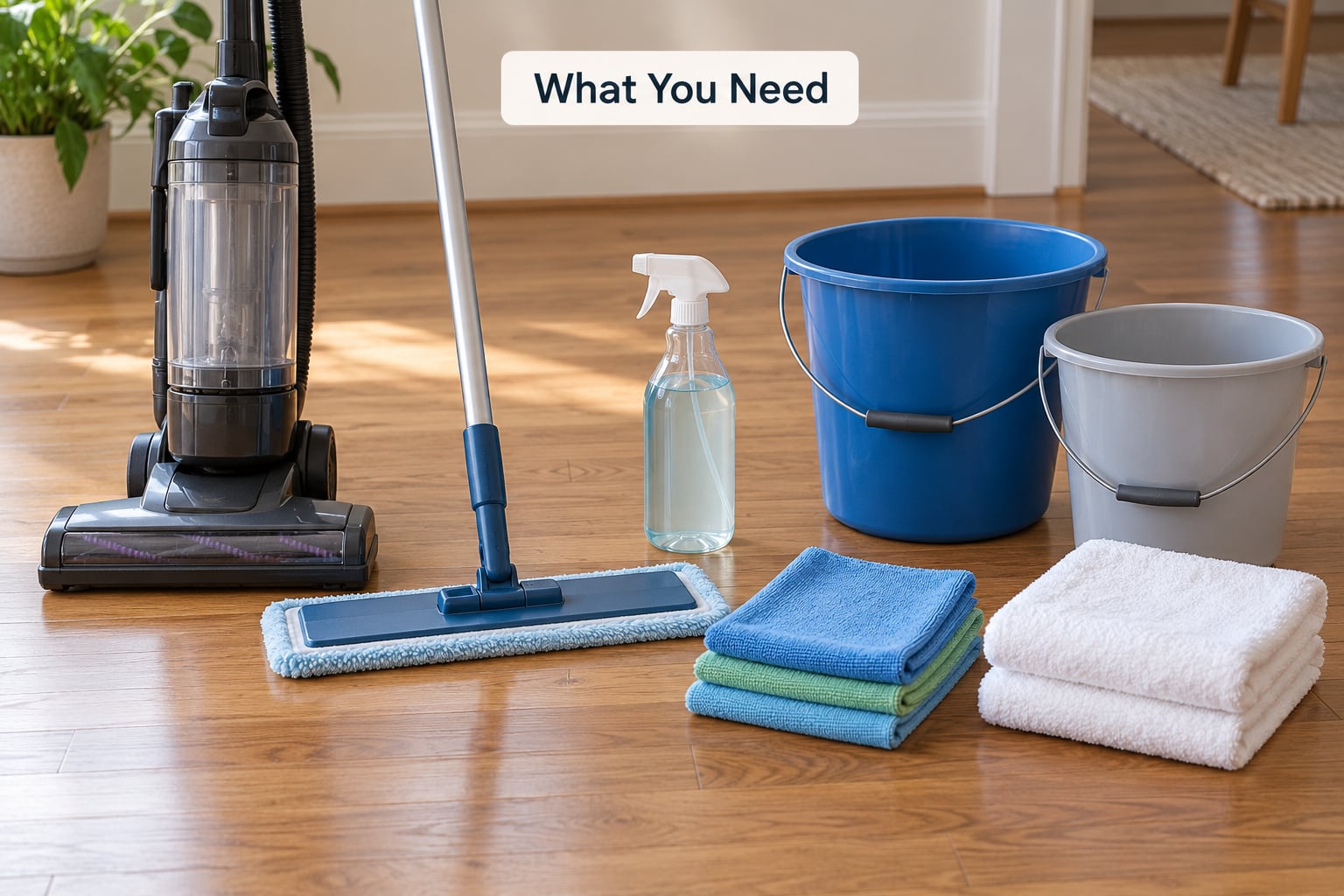
Keep the kit small. Everything on this list does one job, and every extra product is another chance to leave residue on the finish.
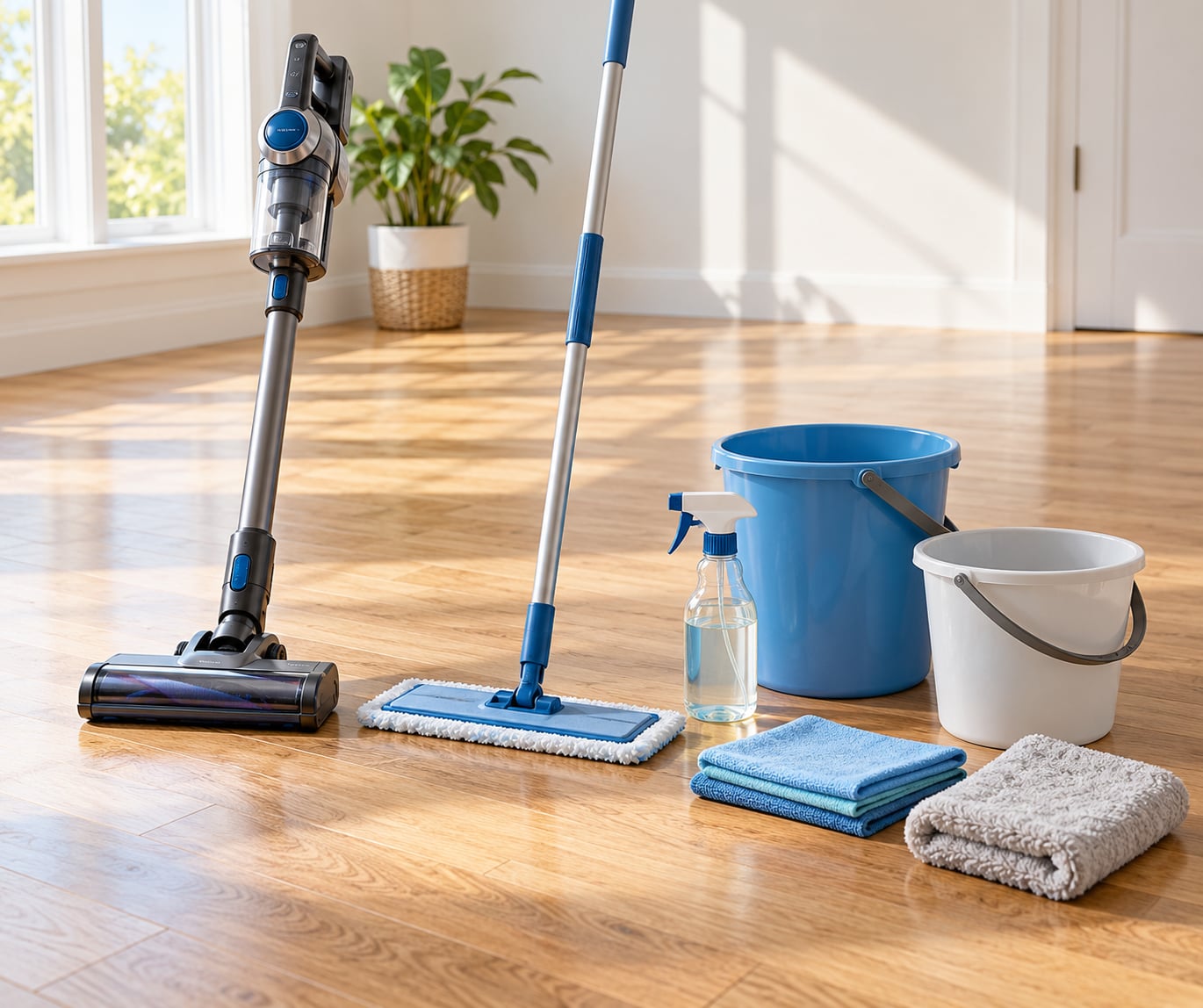
- A vacuum with a hard-floor setting and a soft roller head
- A flat microfiber mop, or a spray mop with washable pads
- A pH-neutral cleaner made for wood floors
- Two buckets, one for solution and one for rinsing the pad
- Plain-water microfiber cloths and old cotton towels for drying
The two-bucket habit matters more than it sounds. Wringing a dirty pad into the same solution you just cleaned with puts the grit back on the floor in a thin film, and that film is what people later mistake for a dull finish.
What counts as the safest cleaner depends on your floor’s finish, so check the label for the words wood floor, engineered wood or water-based finish before you buy. If the label says all-purpose only and mentions bleach, ammonia or acids, leave it on the shelf.
Step-by-Step: How to Clean Hardwood Floors Without Damaging Them
1. Identify the Finish and Check the Care Instructions
Start by finding out what you are cleaning. A factory-finished floor is usually sealed with polyurethane or a factory acrylic finish, and it is the most forgiving type. Waxed floors have a soft, buffable coating that strips back if you use anything oily. Oiled floors have no film at all, just saturated wood, so water sits on the surface and lingers. Engineered hardwood has a thin wear layer over a softer core, so standing water can swell the layers and cause cupping.
Two spot tests narrow it down in a minute. A drop of water on an out-of-the-way spot either beads up on a film finish or soaks in on a wax or oil finish. A firm rub with a crayon leaves a waxy mark on an unwaxed floor and wipes away on a sealed one. Test under a sofa, never in the middle of the room.
Then look up the flooring brand and finish on the manufacturer’s site. If your floor came with documentation from the builder or the seller, that is the source that counts.
2. Vacuum or Dust Before Adding Moisture
Dry cleaning comes first, every time. Grit under a mop pad acts exactly like sandpaper, and one pass with grit on the floor can scratch a finish that took twenty years of foot traffic to dull.
Set the vacuum to its hard-floor setting so the beater bar stays off, and use a soft roller head or the brush attachment with the beater bar disengaged. A beater bar spinning against finished wood leaves a dotted scratch pattern that is miserable to repair. If you have pets, pass the vacuum over the floor twice; hair hides grit.
A microfiber dust mop works about as well and is quieter. Make overlapping passes until the floor stops shedding dust on the cloth.
3. Prepare a Lightly Damp Cleaning Solution
Dilute the cleaner in warm, not hot, water according to the label. Warm water dissolves dried film better, and hot water can push moisture into the seams. Over-concentrating the solution is the most common way people cause the hazy floor they are trying to clean away, so measure rather than pour.
Then the part that decides the outcome: wring the mop until it is barely damp. The pad should feel cool and slightly heavy, not wet. The test is simple. Touch the pad to a bare section of floor and drag it a foot. If it leaves a visible water trail, it is too wet. Squeeze it again.
Some people go further and skip the bucket entirely, spraying a fine mist onto the floor and mopping it immediately before it dries. That works well on sealed floors, and it is easier on anyone with a bad back.
4. Clean Small Sections and Dry Them Promptly
Work in sections about 10 by 10 feet, following the direction of the grain. Grain is the natural break in the wood fibers, and mopping across it leaves visible streaks.
Keep the pad moving and rinse and wring it after every section. Stay a couple of inches away from baseboards and cabinets, where water collects and lingers, and never let a wet pad sit in one spot. Around kitchen spills, dab rather than scrub; scrubbing grinds the spill into the grain.
Follow the mop with a clean, dry, absorbent towel while the section is still damp. You are not trying to buff it to a shine. You are removing the moisture that the pad left behind so nothing soaks into the seams.
5. Remove Residue and Inspect the Finish
Finish with a plain-water microfiber cloth that is barely damp, using one section of the cloth per room. Then make a second pass with a dry towel. This two-cloth routine is what clears cleaner haze, and most floors that look cloudy after mopping simply need it repeated rather than a stronger product.
Walk the floor in daylight and look for dull patches, sticky residue, discoloration, or a change in sheen along the traffic path. Those are the early signs of finish damage, and they are worth catching now. If a spot feels tacky no matter what you do, stop treating it and find out what the finish is before you try again.
Common Mistakes That Can Damage Hardwood Floors
Every one of these shows up in hardwood forums, usually as an apology after the fact. Steam mops are the most regretted purchase, because superheated steam forces moisture into seams and lifts the finish, cupping the boards along the way. Owners on r/HardWoodFloors describe the repair as refinishing an entire floor because of one afternoon with a steam mop.
Vinegar is the second big one. A little vinegar in a gallon of water is a common DIY recipe, and the acid slowly strips polyurethane, leaving the floor dull and pale. If you have been using it, dilute water-only until the finish is recoated. Dish soap is gentler but leaves a film with repeated use, and dish soap plus vinegar doubles the problem.
Oil soaps are the third. Homeowners on r/CleaningTips describe the film that Murphy’s-style products leave as attracting dirt faster than the bare floor, and that film also has to be stripped before the floor can ever be refinished. Silicone-based products are worse, because silicone is nearly impossible to remove and can permanently interfere with a future recoat.
Other damage comes from abrasive pads, stiff nylon brushes, missing felt pads under furniture, dragging heavy furniture without lifting it, and letting grit sit for a week in a busy entryway. The fix for all of them is the same, and it is boring: less water, softer tools, more frequent dry cleaning.
One more caution about homemade mixtures. If you cannot name every ingredient in a bottle and say why it is safe on a film finish, do not put it on your floor. The cost of a professional strip and refinish is many times what a bottle of proper wood cleaner costs.
How to Clean Hardwood Floors With Specific Finishes
For sealed wood, the common polyurethane or factory finish, a pH-neutral cleaner and a barely damp microfiber mop is the whole method. These floors tolerate the most moisture of any type, and a quick dry with a towel is usually enough. Stay away from anything acidic or silicone based, and expect to screen and recoat the surface every three to five years in traffic areas.
Waxed floors want almost no water at all. Any water-based cleaner can soften or lift the wax, and the result is patchy. Dust them, spot clean with a barely damp cloth, and if they need refreshing, use a product made for waxed wood and buff it, never mop it.
Oil-finished floors, including hard wax oil, are the most sensitive. There is no film to protect the wood, so dirt and water sit on the surface. Use a cleaner approved for oiled wood, keep the mop barely damp, dry promptly, and expect to re-oil high-traffic areas every year or two.
Engineered hardwood behaves like sealed wood on the surface, but the thin wear layer and soft core punish standing water. Never let a wet pad sit on it, and check for cupping, which shows up as raised board edges after a spill. When care instructions from the flooring manufacturer conflict with any general guide, including this one, go with the manufacturer.
How Often Should You Clean Hardwood Floors?
A workable schedule has three tiers. Dry clean two or three times a week, more often with pets or a busy entry. Damp mop weekly, or any time the floor shows footprints. Deep clean monthly with extra attention to corners, along baseboards, and under furniture.
Beyond that, the rhythm slows down. Recoat, which is a light abrasion of the existing finish under a new coat, usually comes due every three to five years. A full sand and refinish takes the floor back to bare wood and is typically a ten to twenty year job.
Wet mopping is not on the list. The more water a floor sees, the more the wood moves with seasonal humidity, and cupping, crowning and gaps all follow. If someone offers you a routine built around a soaking wet mop, that routine is doing more harm than good.
If energy or mobility is the reason cleaning gets skipped, the fix is to shrink the job rather than do it harder. A cordless stick vacuum with a hard-floor head and a spray mop lets you clean one room in a few minutes, and it removes the mopping step entirely. Low effort is not an excuse to skip cleaning; it is the reason to pick equipment you will actually use.
What to Do When a Cleaned Floor Looks Dull or Streaky
Start with the most likely cause, which is cleaner left behind. Wipe the area with a plain microfiber cloth dampened with water only, then dry it. A hazy floor that clears with water and a cloth was hazed by film, not damaged.
Streaks running along the grain usually mean the mop pad was dirty, the solution was too concentrated, or the floor was not dried. All three are fixed the same way, and the fix is a full repeat of the section with a fresh pad and a proper dilution.
Sticky patches that never go away are usually a soap or silicone film. Stop adding product, keep using water only, and give it several passes over a few days. Persistent film needs a cleaner formulated to strip it, and you should confirm the finish type first.
Dark or bleached areas are different. That is finish or wood damage, not dirt, and no amount of cleaning will bring it back. Worn finish in a traffic path that no longer beads water is a recoat job. Boards that are cupped, cracked or lifting at the seam are past cleaning and need a sanding professional, and r/HardWoodFloors regulars generally recommend getting quotes before touching them yourself.
Frequently Asked Questions
Can I use vinegar to clean hardwood floors without damaging them?
Dilute vinegar is the most debated DIY cleaner for hardwood floors, and the honest answer is that it works for a while and then costs you. The acid strips polyurethane slowly, so the floor looks clean and gradually goes dull and pale. Use water with a pH-neutral wood cleaner instead. If you have already used vinegar regularly, keep using plain water and plan on a screen and recoat.
Is a steam mop safe for hardwood flooring?
No. A steam mop forces superheated moisture into the seams and under the finish, and it lifts the top layer, leaving the boards cupped and the finish clouded. Homeowners regularly report needing to refinish an entire floor after a single session. If you want the convenience of a spray mop, use a flat microfiber pad instead and keep it barely damp.
What is the best cleaner for sealed hardwood floors?
A pH-neutral cleaner made for wood floors, diluted exactly as the label says and applied with a barely damp microfiber pad, is the safest choice for sealed hardwood. Brands such as Bona and Method sell wood-specific formulas, and the flooring manufacturer’s own guidance beats both. Avoid anything with bleach, ammonia, vinegar, wax or silicone in the ingredient list.
How do I remove streaks or a dull film after mopping?
Repeat the section with a clean, barely damp microfiber cloth and plain water, then follow with a dry towel. A haze that disappears with a water-only pass is cleaner film, not damage, and it should clear in one or two attempts. Persistent streaks usually mean the solution was too concentrated or the pad was dirty, so change both before moving on.
How should I clean a hardwood floor after a pet accident?
Blot the accident immediately with a dry paper towel, then apply an enzymatic cleaner designed for wood floors and let it sit as the label directs. Enzymes break down urine proteins instead of sealing them under the finish. Keep the mop out of it and wipe the area with a barely damp cloth, then dry. Odor that returns after cleaning means the padding underneath needs attention.
When do scratches or dull spots need professional refinishing?
Light surface scratches in the finish are usually not worth a contractor, since a screen and recoat handles them. Call a professional when the wood is exposed, when a traffic path no longer beads water, or when boards are cupped, cracked or lifting at the seam. Those are wood movement problems, and no cleaning product fixes them.
A Safe Cleaning Routine Protects the Finish
If you are ready to clean today, do four things in this order. Find out what finish you have. Vacuum or dust the grit away with the beater bar off. Mop with a pH-neutral cleaner and a microfiber pad wrung until it is barely damp, following the grain. Dry each section with a clean towel before you move on.
That routine is not exciting, which is the point. Wood floors do not get damaged by careful cleaning, they get damaged by enthusiasm, so keep the water down, skip the steam, and let the finish do its job.