To clean a showerhead with vinegar, mix equal parts plain white vinegar and warm water, then soak the nozzles for 30 minutes to several hours depending on the finish. A removable head goes in a bowl; a fixed one gets a bag of solution tied over it. Expect 20 minutes of hands-on work plus soak time.
The crusty white ring around your nozzles and the weak spray that comes with it are almost always limescale, not soap scum. Vinegar is roughly 5% acetic acid, and that acid reacts with the alkaline calcium carbonate hard water leaves behind, loosening the scale so the nozzle holes open back up.
Two things worth knowing up front. Start by rubbing the nozzles with your fingernail — flexible silicone jets often pop straight back open and skip the whole job. And vinegar is a weak acid, which is exactly why it is safer on chrome and brushed finishes than the commercial limescale removers people reach for first.
Table of Contents
- What You Need
- How to Clean a Showerhead with Vinegar Step by Step
- Check the Showerhead and Manufacturer Instructions
- Turn Off the Water and Let the Showerhead Cool
- Remove the Showerhead if It Is Removable
- How to Clean a Showerhead with Vinegar: Mix the Solution
- Soak the Nozzles and Break Up Mineral Buildup
- Scrub, Rinse, Reinstall, and Test the Water Flow
- Common Mistakes
- Frequently Asked Questions
- Can I use apple cider vinegar instead of white vinegar?
- How often should I clean a showerhead with vinegar?
- Why is only some of the water coming out?
- Can I clean a fixed showerhead without taking it apart?
- When does a showerhead need cleaning rather than a plumber?
- Does vinegar remove mold inside a showerhead?
- Conclusion
What You Need
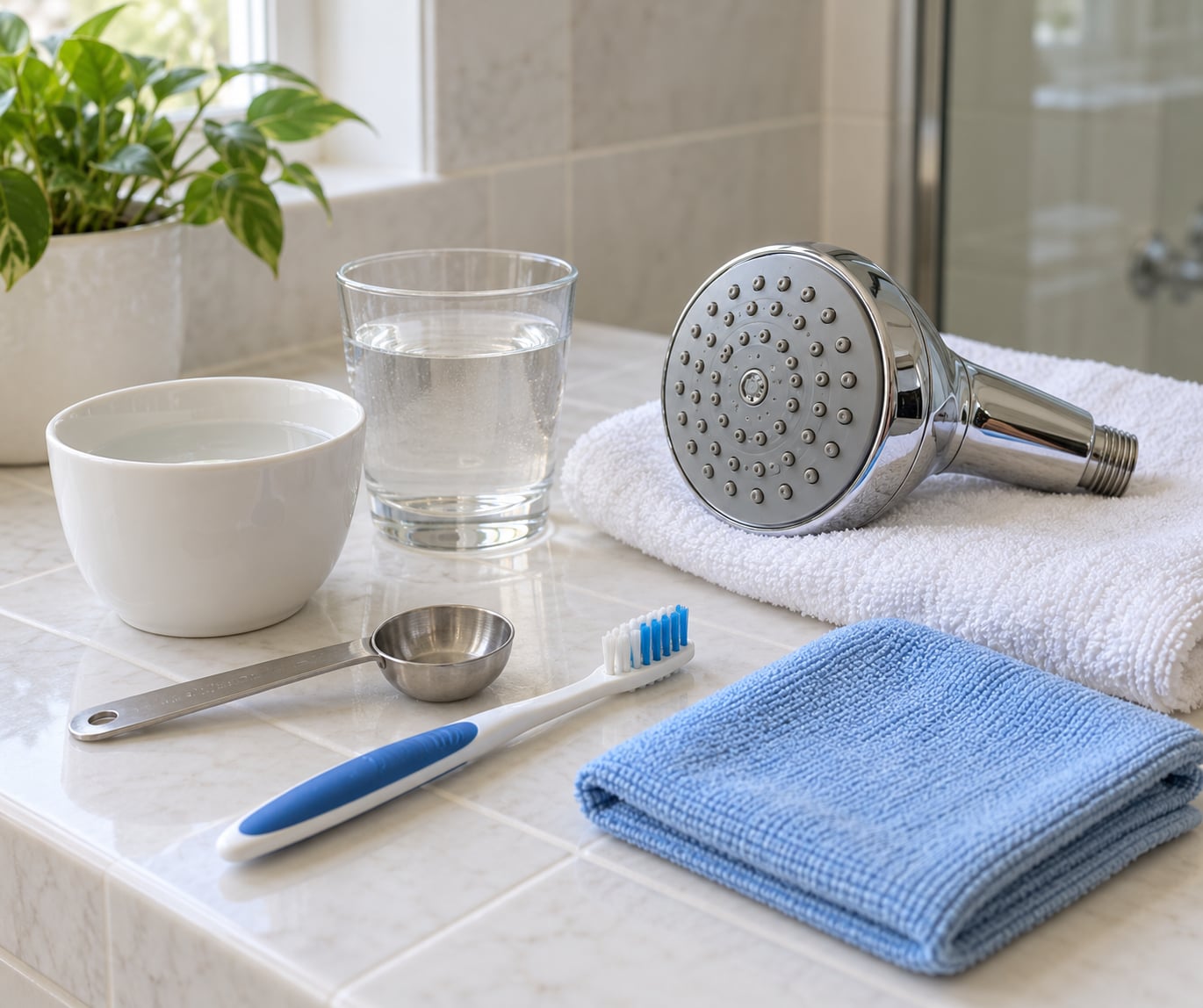
- Plain white vinegar. Distilled is nicest because it leaves no smell and no film, but drinking-grade white vinegar works fine. Avoid apple cider vinegar and any seasoned product.
- Warm water. Not boiling, just comfortably warm. It speeds up the reaction and helps the solution reach the nozzle face.
- A container. A bowl or large measuring container if the head comes off. A spray bottle for a fixed head, or a plastic bag and a rubber band if you want the solution to sit against the nozzles without dripping down the wall.
- A soft brush or microfiber cloth. An old toothbrush works well. Nothing abrasive.
- Adjustable pliers with a cloth around the jaws, for loosening a stuck threaded connection on a removable head.
- A flat-head screwdriver, only if the fixture uses one to release the head.
How to Clean a Showerhead with Vinegar Step by Step
Check the Showerhead and Manufacturer Instructions
Start by figuring out whether the head comes off. A handheld head unscrews from the hose, a wall-mounted head unscrews from the arm, and a fixed or ceiling-mounted head stays where it is. That single fact decides which version of step three you do.
Look at the finish while you are there. Chrome, brushed nickel, brass, gold, and matte black are plated or coated surfaces and they tolerate a shorter soak. White or clear plastic bodies and silicone nozzles are more tolerant of a long soak. Most brands print care limits on the manual or the tag, and those numbers beat anything written online, including this.
Turn Off the Water and Let the Showerhead Cool
Shut off the water either at the fixture’s own valve or at the main if there isn’t one. Then run the shower briefly to bleed off pressure and let the metal cool. Hot metal plus warm vinegar is how people burn a forearm and drop a head into a sink.
You will know the pressure is off when the spray stops entirely. With the water still on, spray will find its way into every seam you are about to open.
Remove the Showerhead if It Is Removable
Wrap a cloth around the threads, hold the arm or hose with one hand, and turn the head counterclockwise with pliers. Hand-tight is the goal. If it takes real force, something else is stuck and you are better off stopping.
Skip this step for a fixed or ceiling-mounted head. Those stay mounted, and step four covers them instead. Have a towel under the work area, because a rainfall head holds a surprising amount of water and it will all come out at once when you tip it.
How to Clean a Showerhead with Vinegar: Mix the Solution
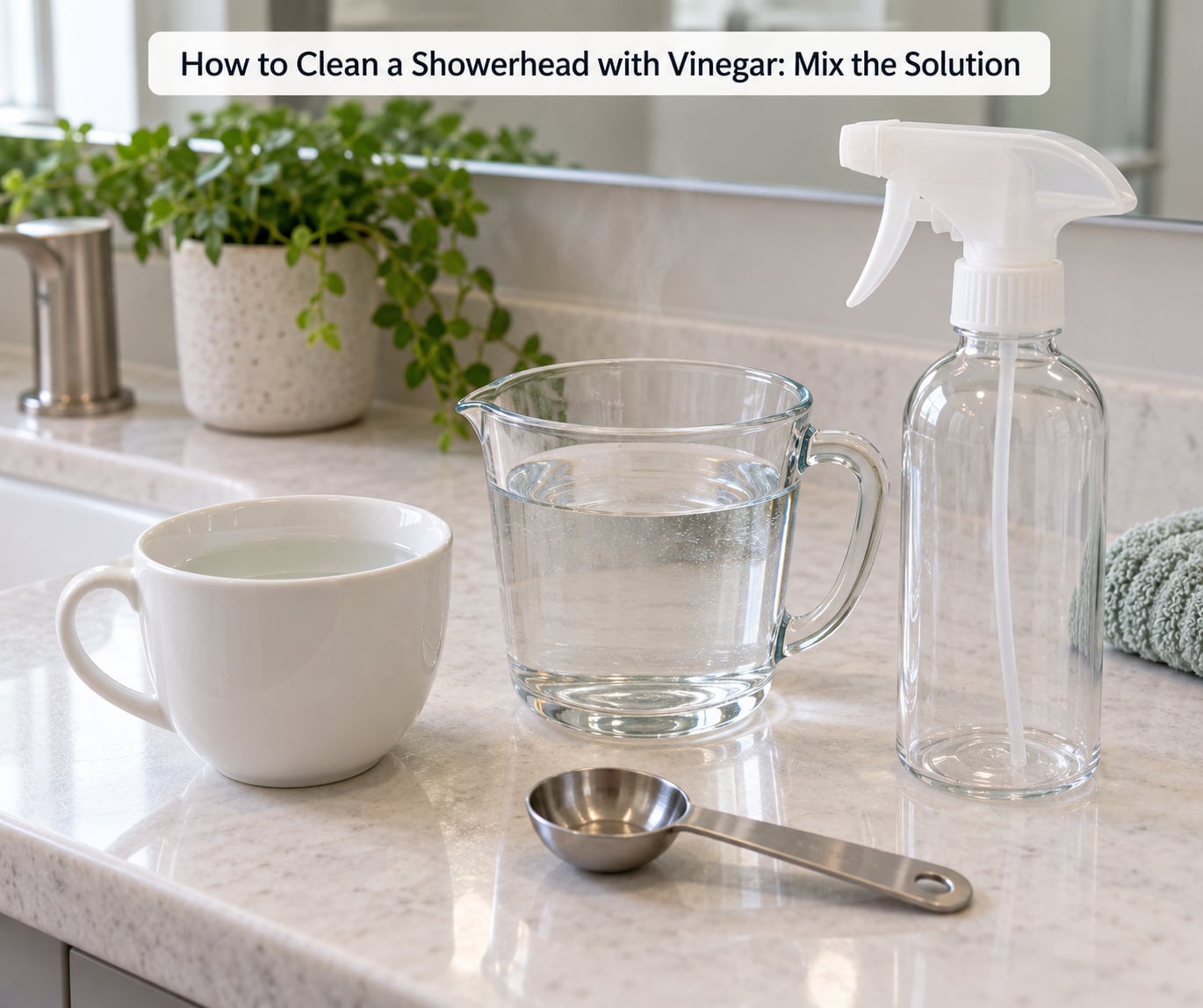
Mix one part plain white vinegar with one part warm water. That 50/50 split handles light buildup and is the right starting point for most showerheads.
For heavy scale, go stronger. Straight vinegar works, and pouring a 30% vinegar solution over the nozzles and soaking for a shorter time can shift stubborn deposits faster. Keep the strong acid off tile, grout, natural stone, and sealed surfaces, and keep soak times short when you use it.
Never mix vinegar with bleach or with a toilet bowl cleaner. Vinegar plus bleach releases chlorine gas, which is genuinely dangerous in an enclosed bathroom. If you use bleach on your shower, rinse the surfaces thoroughly and let them dry before any vinegar goes near them.
Soak the Nozzles and Break Up Mineral Buildup
Submerge a removable head in the bowl with the spray face under the solution, or soak it hose-end up if the nozzles point sideways. Then brush the solution across the nozzle face with a soft toothbrush to push it into every hole.
For a fixed head, spray or dab the solution onto the nozzles, or fill a plastic bag, set the head inside, and secure it with a rubber band. The bag method is messy and it hangs real weight on the shower arm, so keep the fill volume modest, especially on a large rainfall head.
Soak time depends on the finish and the severity. Chrome, brass, nickel, gold, and matte black stay in for 30 to 60 minutes. Plastic bodies and silicone nozzles can take six to eight hours or overnight. Some people add a tablespoon of baking soda for a fizz, but the reaction cancels out most of the acid, so it adds very little.
Scrub, Rinse, Reinstall, and Test the Water Flow
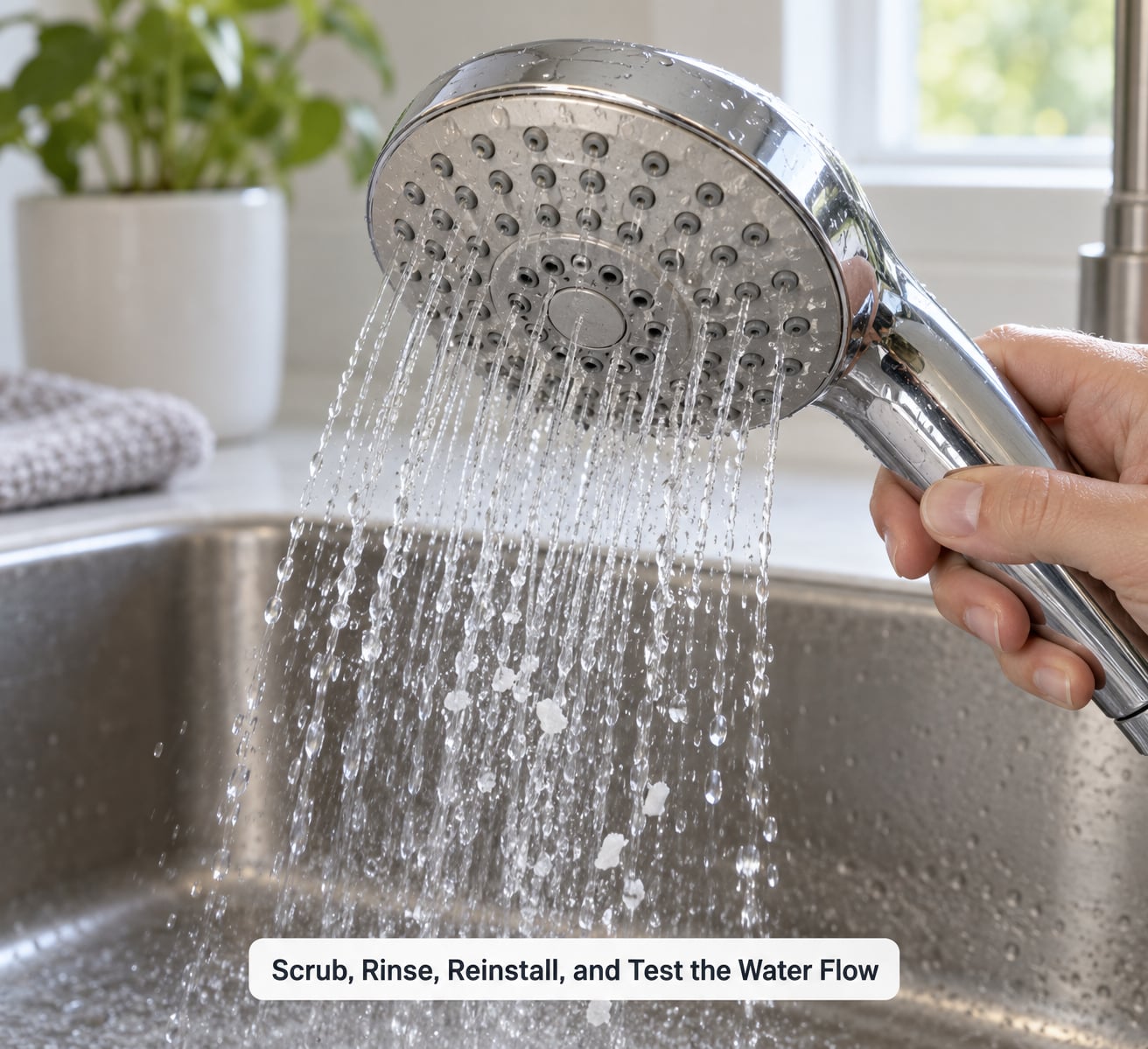
After soaking, work the scale loose with the soft brush or a microfiber cloth. Wipe silicone nozzles between two fingers or pull them gently back and forth to clear them. A toothpick works on stubborn holes once the scale has softened.
Rinse every part under running water until the acid is fully gone and the nozzle holes are visibly open. Do this thoroughly — leftover vinegar keeps working on plated surfaces long after you put the head back.
Reinstall hand-tight, wrapping the threads with plumber’s tape if the original had it. Check the rubber gasket and the screen or flow restrictor while you are there, since both trap debris and both come out easily once the head is apart. Those little parts are usually the reason mold keeps coming back.
Turn the water back on slowly and watch the spray. Even flow across the whole face means the nozzles are clear. If only the outer ring sprays, the center jets are still blocked, so repeat the soak or use the toothpick.
Common Mistakes
- Mixing vinegar with bleach. This produces chlorine gas. If your routine involves both, separate them completely in time and rinse and dry in between.
- Boiling water. It etches glass and dulls plating instantly, and it puts you at risk of a steam burn. Warm tap water does the same job.
- Acid on natural stone or grout. Vinegar eats marble, travertine, and some grout. Keep solution off those surfaces and use a pH-neutral stone cleaner instead. Sealed tile and glazed ceramic are fine if you rinse promptly.
- Leaving diluted vinegar sitting on a surface. Wipe down any tile or counter the solution splashes onto rather than letting it air-dry.
- Forcing threaded parts. If a head will not come off by hand with cloth-wrapped pliers, the threads are probably damaged or seized. Stop and replace rather than strip it.
- Using a hard brush or abrasive pad. A Magic Eraser or scouring pad will scratch a chrome-finish plastic head in a few swipes, and the scratches make the next buildup worse.
Frequently Asked Questions
Can I use apple cider vinegar instead of white vinegar?
Apple cider vinegar works, but it is the weaker and slower option. Its color tints the nozzles amber and its sugars leave a film you have to rinse twice. Plain white vinegar at about 5% acidity is the standard choice, and distilled white vinegar is cleanest. Save cider vinegar for the fridge.
How often should I clean a showerhead with vinegar?
Every three months on soft water, every month or two on hard water. If you already notice a white ring forming at the nozzles, clean now rather than waiting for a schedule. In hard-water areas, keep a spray bottle of 1 part vinegar to 3 parts water on the shower wall and mist the nozzles after each use.
Why is only some of the water coming out?
The open nozzles are drawing all the flow, which starves the clogged ones. Clear them first and the rest follow. Run the toothbrush over the spray face under running water, then work each blocked hole with a toothpick or a fingernail, especially on flexible silicone jets. If the whole face is weak at the same time, the problem is upstream pressure rather than the head.
Can I clean a fixed showerhead without taking it apart?
Yes. Spray or dab the 50/50 vinegar and water solution directly onto the nozzles, keep it wet for 30 to 60 minutes, and reapply as it dries. For a longer soak, set the head inside a plastic bag and secure it with a rubber band. Keep the bag fill modest so the weight does not strain the shower arm.
When does a showerhead need cleaning rather than a plumber?
Clean it when the spray is weak at one shower only, when nozzles are visibly crusted, or when water splatters instead of falling straight. Call a plumber when pressure is low in every fixture in the house, when a valve or the pressure-balancing cartridge is stuck, or when nozzles stay blocked after two soaks. That pattern points to supply or a valve, not scale.
Does vinegar remove mold inside a showerhead?
Vinegar clears mineral scale well but it does little to mold. For black or dark speckling around the nozzles, soak the head in diluted bleach instead, following the manufacturer’s ratio, and never combine the two solutions in the same bath. Remove the screen and flow restrictor separately, since trapped debris there is the usual reason mold returns within weeks.
Conclusion
Start by rubbing the nozzles with your fingernail and rinsing the head under running water. If that does not clear them, mix equal parts plain white vinegar and warm water and soak for 30 to 60 minutes on plated finishes, then scrub with a soft brush and rinse completely before putting it back.