For mild steel, use a cobalt high-speed steel jobber-length twist bit. Stainless steel or hardened plate needs a TiN-coated cobalt bit or a carbide insert. Aluminum wants a 135-degree HSS bit, and thin sheet metal is best handled with a step bit. Getting this match right is what separates a clean hole from a snapped bit and a ruined part.
The bit is the only part of the job that touches the metal, so it takes the punishment. Everything else you can adjust on the fly, but a bit that is too soft or shaped wrong is already finished before it enters the workpiece.
Most of the problems people describe on metalworking forums come down to one of four things: wrong material for the metal, wrong point angle, too much speed, or no lubricant. Fix any one of those and a bit that seemed useless starts behaving. Most bits that snap after two or three holes in 1/8-inch steel were running too fast with nothing on the cutting edge.
Table of Contents
- What Drill Bit Is Best for Different Types of Metal?
- HSS, Cobalt, Carbide, and Other Drill Bit Materials
- How to spot the bit you need in the store
- Which Bit Shape or Point Geometry Should You Use?
- How to choose the right drill bit for metal by geometry
- How to Choose the Right Drill Bit for Metal by Size
- Checking the Drill and Chuck Compatibility
- How to Drill Metal Safely and Without Ruining the Bit
- Common Drill Bit Mistakes and How to Fix Them
- Frequently Asked Questions
- Can you use a wood drill bit on metal?
- Is a cobalt drill bit better than HSS for metal?
- Do I need a cobalt or carbide bit to drill stainless steel?
- Why does my drill bit burn instead of cutting metal?
- Can I use a hammer drill bit in a regular drill?
- Conclusion
What Drill Bit Is Best for Different Types of Metal?
The short version: match the bit to the hardness and the heat behaviour of the metal, not to the job’s importance.
Mild steel and carbon steel are the everyday case for a homeowner. They cut easily at moderate speed and tolerate a little abuse, so a cobalt HSS jobber-length bit handles plate, studs, angles and door frames without drama.
Stainless steel is a different animal. It is gummy, it work-hardens fast, and it will grab a bit and stall it in a few seconds if you lean on the trigger. This is where a 135-degree point, a slower speed and constant lubrication stop mattering more than the brand of bit.
Cast iron is hard but brittle. It cuts fine at speed with a cobalt or carbide bit, yet it produces razor-sharp graphite flakes that will cut your hands. Eye protection and gloves are not optional here.
Aluminum is soft and gummy at the same time. A 135-degree HSS bit keeps the load spread out so the edge does not grab, and a big 50-degree helix angle clears chips quickly so the hole walls do not gum up.
Thin sheet metal grabs, tears and dimples before it drills. A step bit, a punch, or a short stub-length bit in a low-speed drill gives far more control than a full-length jobber bit.
Hardened steel — tool steel, old bolts, track hardware — will destroy an HSS bit regardless of technique. This is the case for a carbide-tipped bit or an indexable insert in a magnetic drill, if your chuck can hold them.
HSS, Cobalt, Carbide, and Other Drill Bit Materials
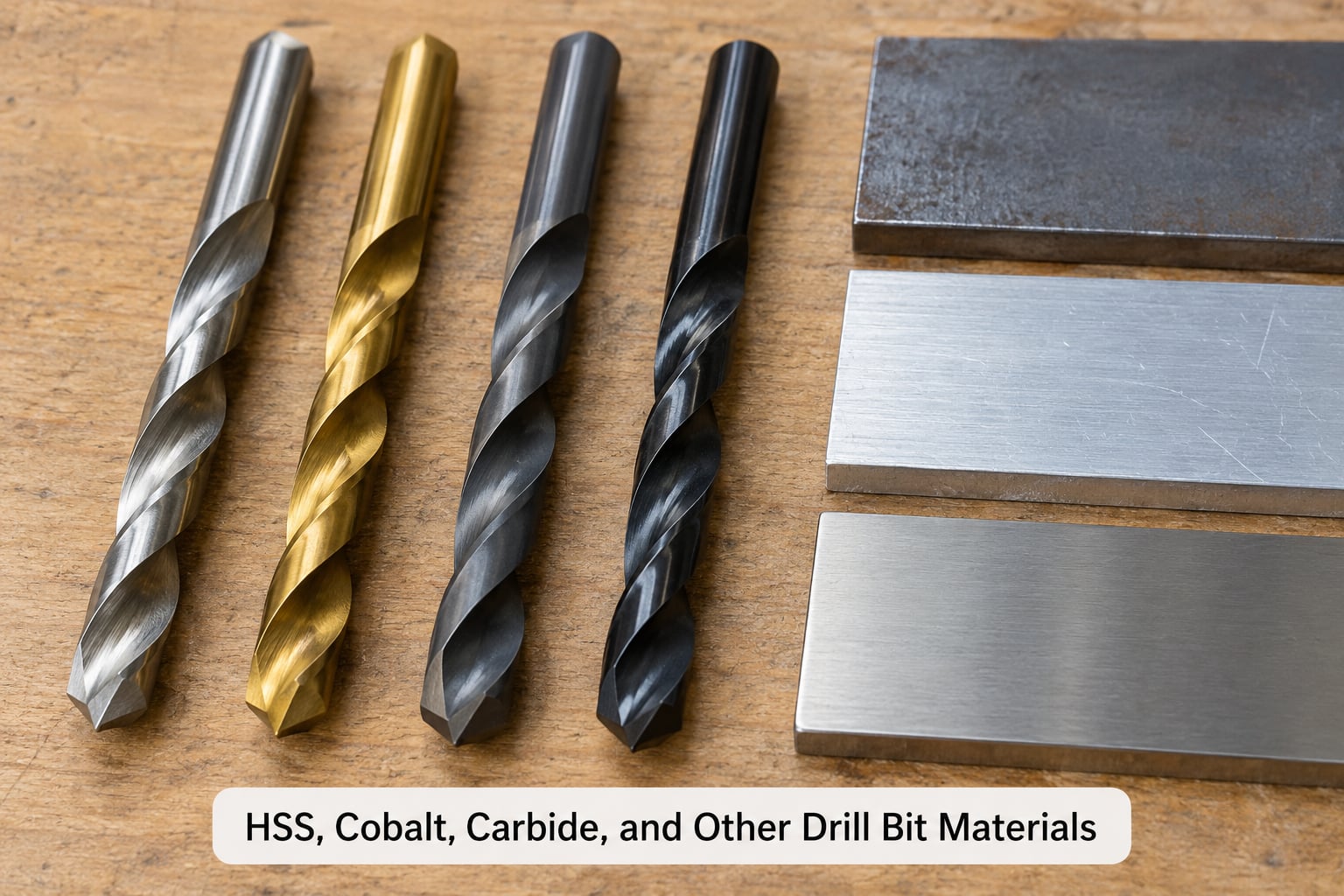
HSS is the baseline: high-speed steel, tough and cheap, and perfectly adequate for mild steel. Cobalt is the same steel with roughly 5 to 10 percent cobalt added by weight, which buys heat resistance at the cutting edge. That extra hardness is the whole reason cobalt bits survive stainless and hardened metal.
The differences you can see in the hardware store: black oxide HSS has a dark grey or black finish, cobalt is a distinctly brighter silver, and titanium-coated bits are gold. That colour check is more reliable than most packaging.
How to spot the bit you need in the store
- Black or plain silver finish, no marking: HSS. Fine for mild steel, wood, plastic.
- Bright silver or bronze-toned, usually stamped with the number: cobalt. The default choice for metal work.
- Gold: titanium nitride or titanium aluminium nitride coating. Better wear and lower friction on stainless and high-carbon steel.
- Black with a silver cutting tip: masonry or carbide-tipped masonry. Never for metal.
- Hex shank with a visibly thicker head: an insert bit. Needs a hex chuck or a hex shank adapter.
| Bit material | Best uses | Limitations | Drill compatibility |
|---|---|---|---|
| HSS | Mild steel plate, aluminium, brass, wood, plastic | Dulls quickly on stainless or hardened steel; poor heat resistance | Any corded or cordless drill, keyed or keyless chuck |
| Cobalt HSS | Mild steel, stainless, cast iron, hardened fasteners | Costs more and still loses to carbide on very hard material | Any standard drill |
| TiN / TiAlN coated HSS | Stainless, high-carbon steel, production drilling | Coating wears off; poor for very large holes in thick stock | Any standard drill |
| Bi-metal HSS | Wood screws and sheet metal with a hardened tip | Body is still mild steel, so it dulls on hardened metal | Any standard drill |
| Solid carbide | Hardened steel, cast iron, aluminium with a coolant | Brittle, expensive, and needs correct speed to avoid chipping | Rigid high-speed drill or drill press |
| Indexable carbide insert | Large holes, production work, hardened plate | Needs a magnet-base drill; broken inserts wreck the hole | Magnetic drill only |
Which Bit Shape or Point Geometry Should You Use?
Point angle is the number that actually changes how a bit behaves in metal. It sets how many outer cutting edges there are and how hard each one has to work.
How to choose the right drill bit for metal by geometry
A 118-degree point has two cutting edges working at once, so each one carries half the load and cuts more gently. That makes it the right choice for mild steel, where the metal chips cleanly and the priority is controlling the walk rather than forcing the cut. A 135-degree point adds a third edge and spreads the load over a wider arc, which is what you want on aluminum and stainless where grabbing is the real risk. A 90-degree point is short and stubby, built for very hard material and for drilling into hardened surfaces with a hammer action.
Flutes matter just as much. Long flutes, seen on jobber-length bits, give you more chip-holding capacity and reach for deep holes. Short stub-length flutes are stiffer and less likely to wander, which is why they are the standard for thin material and high-carbon steel.
Helix angle changes chip evacuation. Bits around 30 degrees handle tough steel; bits around 40 degrees lift chips out of soft, gummy aluminum faster. Shorter bits for spot drilling have short flutes on purpose, so they only kiss the surface and then get out of the way.
One more shape worth knowing: screw-machine length bits have a shortened flute and a stubby body, and they handle thin, hard material where a jobber bit would chatter.
How to Choose the Right Drill Bit for Metal by Size
Size is where jobs get ruined silently, because a hole that is a sixteenth too small still lets the bolt in and still fails later. Measure twice.
For a bolt, the drill equals the bolt diameter for a snug hole, or add a sixteenth for a fastener with a washer. For a screw into metal, use the screw’s core diameter as the pilot, then step up for a clearance hole where the fastener passes through a plate. Standard twist drill bits come in numbered sizes up to a quarter inch, then in thirty-seconds and sixty-fourths of an inch, so buy the numbered set rather than guessing.
Tolerances matter in metal because steel does not compress the way wood does. A bit stamped as 1/4 inch drills close to 1/4 inch, and the fit is predictable. If your hole must be exact for a threaded insert or a press fit, test-drill a scrap piece of the same material and thickness first.
| Fastener | Clearance hole | Pilot hole into metal |
|---|---|---|
| #8 wood screw | 5/32 inch | 7/64 inch |
| #10 wood screw | 3/16 inch | 1/8 inch |
| 1/4-20 bolt | 1/4 inch | 7/32 inch for tapping |
| 1/4-20 bolt with washer | 5/16 inch | 7/32 inch for tapping |
| 3/8-16 bolt | 3/8 inch | 5/16 inch for tapping |
| 1/2-13 bolt | 1/2 inch | 7/16 inch for tapping |
| 3/4-10 bolt | 3/4 inch | 21/32 inch for tapping |
For several diameters in thin sheet, a step bit cuts stepped holes in one pass and makes each size a flat-bottomed hole, which is what you want for a shelf bracket or a conduit pass-through.
Checking the Drill and Chuck Compatibility
Most home metal jobs need less tool than people assume. A cordless drill with a variable speed trigger and a keyless chuck will do everything on this page, provided the chuck is big enough for the shank.
Shank diameter has to fit the chuck capacity, and that is the whole compatibility check. Standard twist drill bits have a 1/4-inch round shank; 3/8-inch bits need a 3/8-inch chuck or larger, and a 1/2-inch chuck covers everything most shops need. A keyed chuck with a tapered back end takes bits with a tapered shank, while a keyless chuck usually grips a 1/4-inch hex adapter if you have one.
Hammer mode is a red herring here. The hammering action on a hammer drill is there to break up concrete and masonry; running it on metal just rattles the bit against the work. A hammer drill in rotary-only mode is fine, and the variable speed trigger on a normal drill is genuinely useful because metal wants the low end.
If you are drilling large holes or hardened material, the answer is a magnetic drill. The magnet holds the tool on the steel, so the cutting force goes into the bit instead of the handle, and you can run a proper cutting fluid. That is the setup where carbide inserts become practical.
Checking drill and chuck compatibility before you start is how to choose the right drill bit for metal without wasting one on the first hole.
How to Drill Metal Safely and Without Ruining the Bit
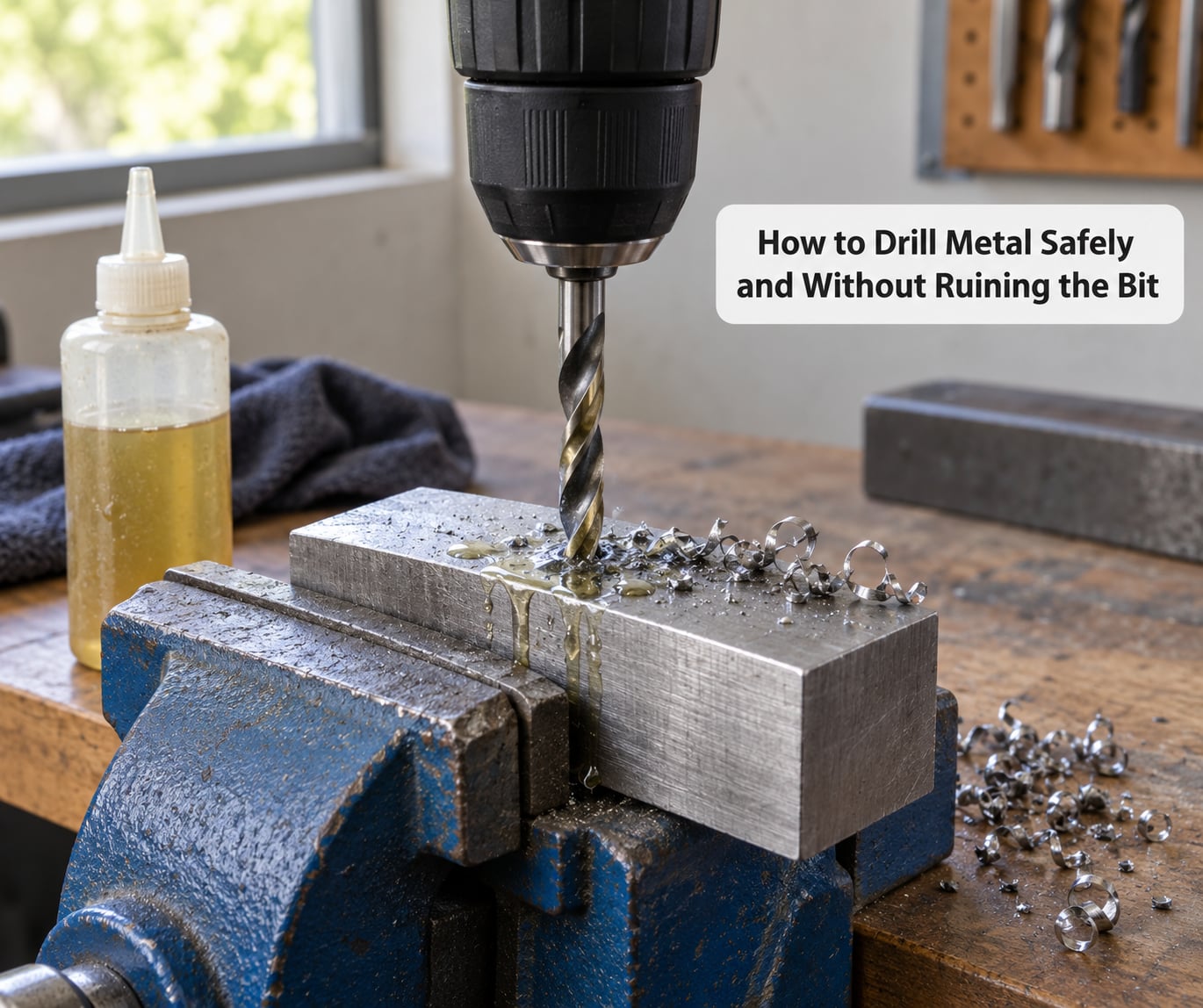
Work in this order, and stop if anything feels wrong rather than pushing through it.
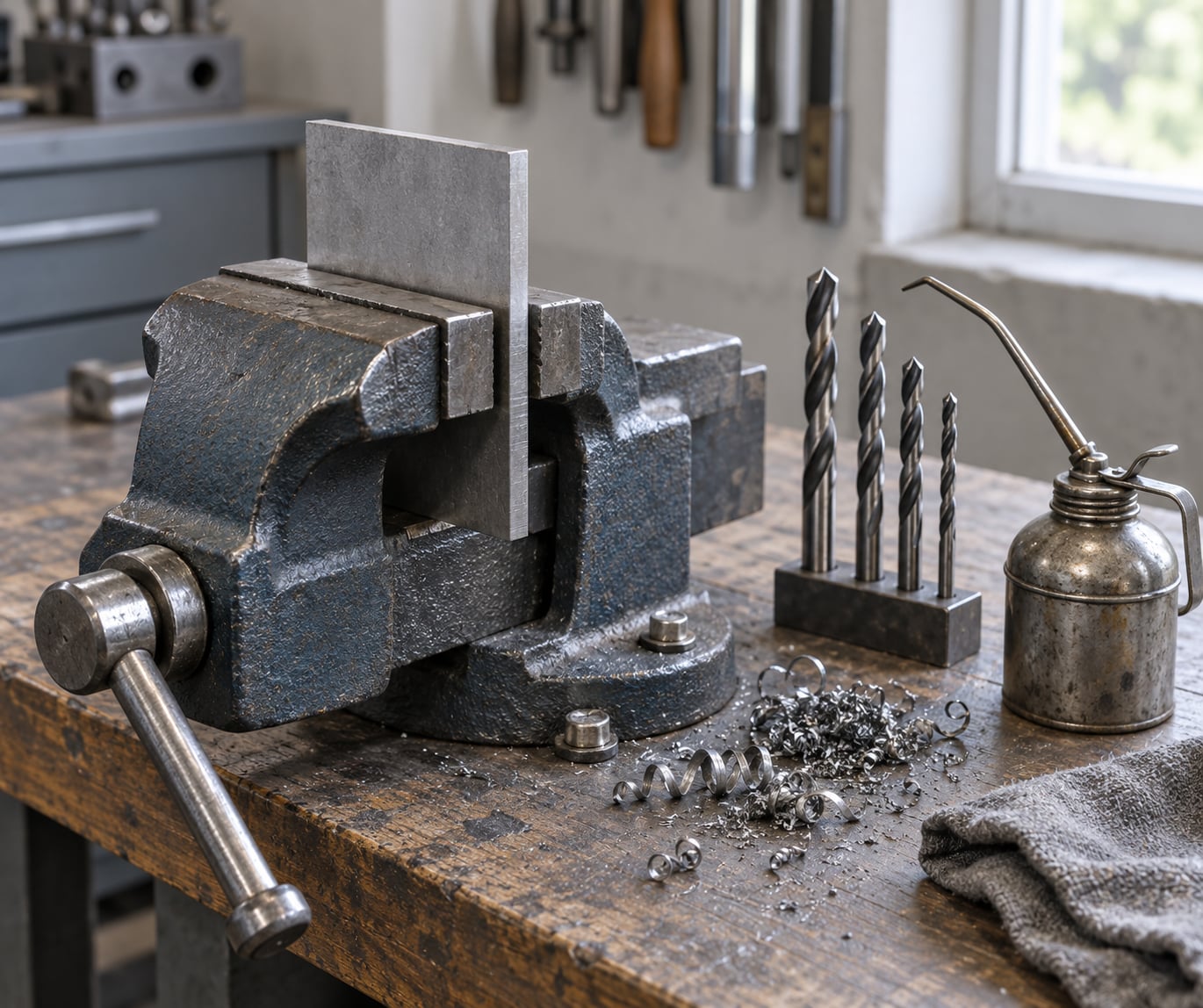
- Clamp the work. A piece held by hand will move, and a moving piece is a snapped bit. A bench vise or two clamps on solid ground, with the metal supported so it cannot ring.
- Mark the centre. A centre punch or spot drill gives the bit a place to start. If you have neither, the rag trick from the metalworking forums works: fold a small rag, lay it over the surface and start the bit through it, then ease off onto the metal once the hole is started.
- Add cutting fluid. A thin stream of oil on the bit or the workpiece cools the edge and carries chips away. Dry drilling is the fastest way to turn a good bit into a lump of useless steel.
- Run the drill slow. Start at the low end of the trigger for small bits and step up for larger ones. The pitch mark on the flute should advance slowly and evenly.
- Peck through deep holes. Drill about a quarter inch, pull the bit out fully to clear chips and let it cool, then re-enter. This is what stops stainless steel work-hardening around the bit and seizing it.
- Back the hole with wood. A scrap of soft wood or MDF clamped behind the work turns an exit-side burr into a clean break-out.
- Back the drill off the work and let it cool before you change bits. A hot bit grabs gloves and dulls faster than a cool one.
Success looks like evenly curled chips coming off the flutes, an even colour on the hole wall instead of blue or brown, and no sparking at the edge. If you see sparks, you are too fast or too dry. Follow the manufacturer’s speed and bit guidance where it exists; it takes priority over any general rule of thumb, including this one.
Common Drill Bit Mistakes and How to Fix Them
| What went wrong | Why it happened | Fix |
|---|---|---|
| Bit burns and stops cutting | Too fast, too dry, or too much feed pressure | Halve the speed, back off the trigger, add cutting fluid |
| Bit walks off centre | Hard slick surface with no centre mark | Centre punch first, or use the rag method to start |
| Bit snags and grabs | Work hardening on stainless, or too much downward force | Peck drill, drop pressure, switch to a 135-degree point |
| Bit snaps partway through | Dull edge, too much pressure, or an HSS bit on hardened steel | Change the bit, ease the pressure, step up to cobalt or carbide |
| Hole comes out oversized or oval | Worn bit, or the work moved while drilling | Replace the bit and clamp the work properly |
| Chips jam and do not clear | Too few flutes for the chip size, or no fluid | Add fluid, peck more often, match flute count to the material |
| Screw will not hold in metal | Pilot hole too large, or none drilled | Drill a pilot at the fastener’s core diameter |
| Bit dulls within minutes | Grinding altered the original geometry, or an HSS bit on hard steel | Buy the correct bit rather than reshaping a wood or masonry bit |
One habit worth adding: keep a small oil can and a centre punch next to the drill. Most of the failures above trace back to skipping one of those two steps.
Frequently Asked Questions
Can you use a wood drill bit on metal?
A wood bit will technically scratch a hole in thin aluminium or a soft screw head, but it has no flute design or point angle for cutting metal. It will wander, tear and snap. If you own no metal bits at all, a cobalt HSS jobber-length set is the cheapest sensible fix and it also drills wood, so it replaces the wood bits rather than adding to them.
Is a cobalt drill bit better than HSS for metal?
For most metals, yes. Cobalt is high-speed steel with a small percentage of cobalt alloyed in, and that extra hardness holds an edge at the temperatures metal drilling generates. Plain HSS is fine on mild steel and aluminium, dulls quickly on stainless, and has no chance on hardened steel. How to choose the right drill bit for metal comes down to that heat question more than anything else.
Do I need a cobalt or carbide bit to drill stainless steel?
Cobalt is the minimum for stainless, and titanium-coated cobalt is better still because the coating cuts faster and resists work hardening on the hole wall. Carbide is only necessary for very hard stainless grades or production work, and it demands a rigid high-speed tool. The more common stainless failure is not the bit material at all, it is drilling too fast without fluid.
Why does my drill bit burn instead of cutting metal?
Heat is the usual culprit. Too much speed, no lubricant, and too much downward pressure all pile heat onto the cutting edges, and a hot edge loses its hardness and dulls in seconds. A dried-out bit that stops cutting is often a burn, not a break. Drop the speed, ease the trigger, and add cutting fluid before you replace anything.
Can I use a hammer drill bit in a regular drill?
Masonry and carbide-tipped masonry bits are for concrete and brick. Their carbide head is brittle and their head shape is meant to chip stone, so they will crumble on steel or aluminium. A regular variable-speed drill is all you need for metal, just in rotary mode with no hammering engaged.
Conclusion
Identify the metal first, then pick the bit to match it: cobalt HSS with a 118-degree point for mild steel, a 135-degree TiN-coated cobalt bit for stainless, 135-degree HSS for aluminum, a step bit for thin sheet, and carbide for anything hardened.
Before you drill, check that the shank fits the chuck, mark and clamp the work, set the speed low, and put cutting fluid on the edge. The bit is a consumable, but a good one used properly on the right material at the right speed should last through the whole job rather than two holes. When the manufacturer publishes speed or bit guidance for your specific tool, follow it.