To attract pollinators to a small yard, plant a succession of single-petalled flowers that bloom from early spring to frost, keep one patch of bare soil and a bundle of hollow stems standing, set out a shallow dish of water with pebbles for landing, and skip insecticides entirely. Six by ten feet is plenty. Most of the work is choosing plants that overlap rather than picking one impressive variety.
A pollinator is any animal that moves pollen between flowers: bees, butterflies, moths, wasps, beetles, hover flies, and hummingbirds. A pollinator garden is simply a space planted to give them nectar and pollen for energy and protein, water, shelter, and somewhere to nest or overwinter. Nothing about that definition requires acreage.
Pollinators are responsible for fertilising roughly 75% of the flowering plants on earth and around 35% of the food crops people eat, which is why the small patch of flowers beside a fence matters as much as a hedgerow.
The three questions worth answering before you buy anything: how many hours of direct sun does the space actually get, where does water already collect, and have you mapped which months currently have nothing in bloom.
Table of Contents
- What You Need
- Step-by-Step: How to Attract Pollinators to a Small Yard in 8 Steps
- Step 1: Choose the right flowers for your space
- Step 2: Create a continuous bloom sequence
- Step 3: Add nectar and pollen plants for different visitors
- Step 4: Build a tiny habitat with more than flowers
- Step 5: Provide shallow water without creating a mosquito problem
- Step 6: Avoid pesticides and simplify lawn care
- Step 7: Maintain plants through the growing season
- Step 8: Check whether your small yard is working
- Common Mistakes
- Frequently Asked Questions
- What are the best plants for attracting pollinators in a small yard?
- Do pollinators need a large yard to survive?
- How long does it take for a new pollinator garden to attract visitors?
- Can I attract pollinators with containers or a balcony?
- How do I provide water for pollinators without creating stagnant water?
- What should I do with garden stems and leaves in the fall?
- Conclusion
What You Need
The materials list for this project is short, and most of it already exists in a garage.
- A sun map. Note which spots get six hours or more of direct sun, which get three to five, and which stay in shade. Most flowering plants sold for pollinators want full sun, and a balcony behind a tall building needs a different list than an open south-facing border.
- Basic soil information. A home test kit or a jar test tells you whether drainage is the problem. Pollinator plants often want lean, well-drained soil, so rich clay is not automatically better.
- A regional plant list. Your county or state extension office publishes native plant lists for your exact zone. Ask them for the nectar and pollinator handout, which is free and far more specific than a generic catalogue.
- A small water source. A shallow dish, a saucer, a birdbath rim, or a leaking drip head all work. Depth matters more than volume.
- Mulch or leaf litter for the paths only. Thick mulch across the whole bed smothers the bare ground that ground-nesting bees need.
- Hand tools and untreated timber scraps. If you want nesting cavities, a drill with a bit, and a plank of untreated wood are enough to build a small bee block.
- A maintenance plan you will actually keep. Ten minutes twice a week for water and observation is realistic for a small yard.
Step-by-Step: How to Attract Pollinators to a Small Yard in 8 Steps
Step 1: Choose the right flowers for your space
Pick flowers that match your light conditions, then group them in clusters of three to five rather than scattering single plants.
That grouping rule does more work than any other single habit. A bee flying a foraging route does not zigzag over an empty patio to find one lone salvia. Once it learns a clump of bee balm is productive, it returns, and repeated visits are the signal you are aiming for.
Two other filters matter when you shop. Check that the plant is single-petalled, because double-flowered and pollenless hybrids have been bred for looks and often carry little nectar or pollen. And check the bloom window on the label, because a plant listed as “summer” that flowers for ten days in July will not carry a colony through August.
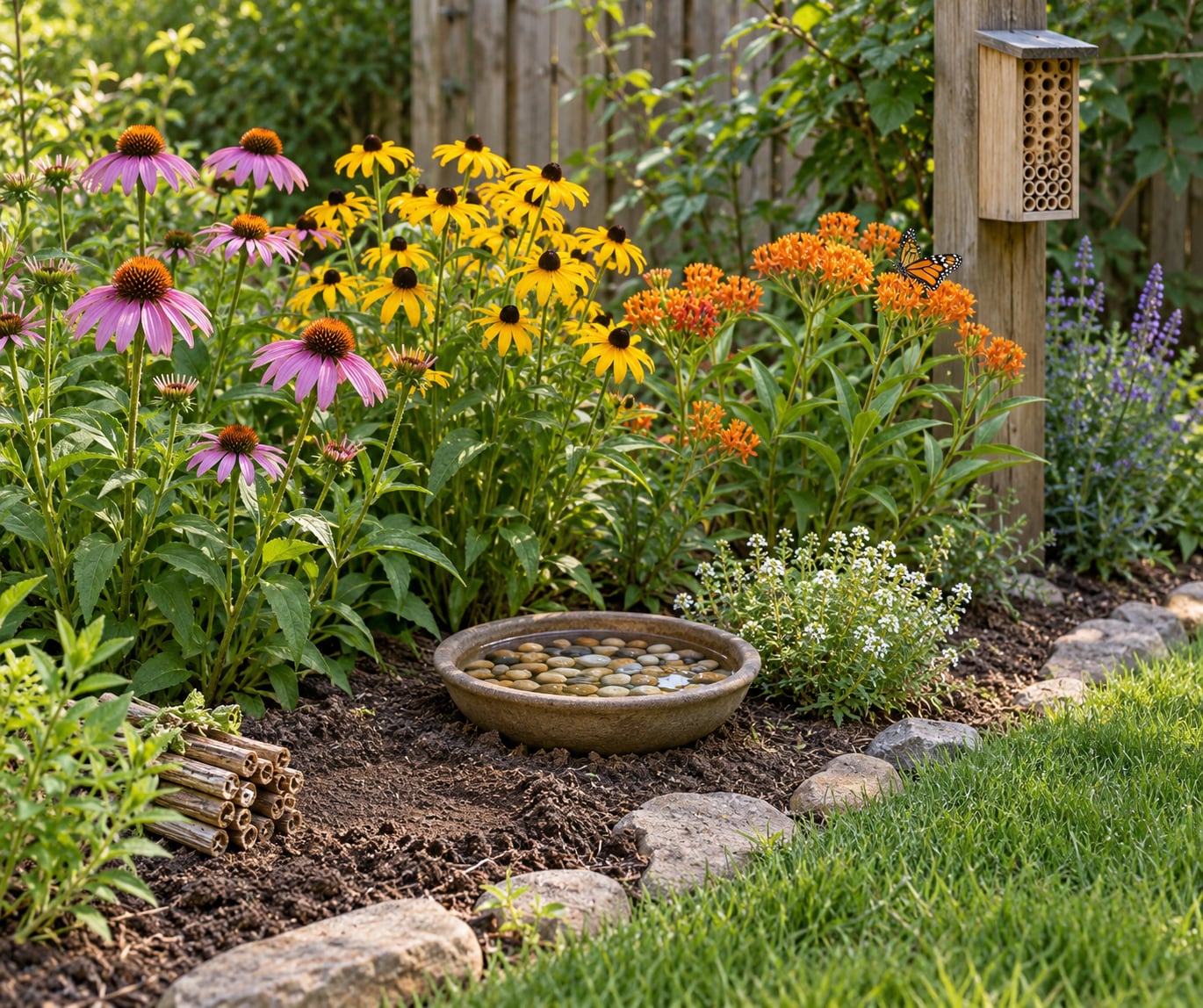
Examples that repeat well in compact US gardens include coneflower (Echinacea purpurea), bee balm (Monarda didyma), black-eyed Susan (Rudbeckia hirta), and swamp milkweed (Asclepias incarnata), which is far better behaved in a small yard than the common milkweed. Confirm suitability for your own region and hardiness zone before buying, since a native in one state is invasive in the next.
Step 2: Create a continuous bloom sequence
Pollinators need something open every week from early spring until frost, and the gap between early spring and the first summer flowers is where most small gardens fail.
Plan the calendar backwards. Frost date tells you the finish. Work back month by month and fill every empty block. A compact example for a temperate US yard looks like this:
| Window | Flowers to lean on | What it feeds |
|---|---|---|
| Early spring | Native crocus, lungwort (Pulmonaria), witch hazel (Hamamelis) | First queen bumble bees, early bees |
| Late spring | Catmint (Nepeta), woodland geranium (Geranium maculatum), yarrow (Achillea millefolium) | Bees, syrphid flies, first butterflies |
| Early summer | Bee balm (Monarda), coneflower (Echinacea), milkweed (Asclepias) | Everything, including monarch caterpillars |
| High summer | Black-eyed Susan (Rudbeckia), blazing star (Liatris), oregano, thyme | Bees at peak activity, small butterflies |
| Late summer | Goldenrod (Solidago), asters (Symphyotrichum), borage | Migrating monarchs, hover flies, wasps |
| Autumn | Aster left standing, sedum seed heads, ivy bloom | Last forage before hibernation |
You do not need every plant on that list. Eight to ten well-chosen perennials and grasses covering those windows is a realistic budget for a small border, and a few annuals sown in spring cover gaps you did not plan for.
Step 3: Add nectar and pollen plants for different visitors
Match flower shape and colour to the visitor, because no single bloom feeds every pollinator equally.
| Visitor | Colours it finds most | Flower shape | Depth it can reach |
|---|---|---|---|
| Bees | Blue, purple, yellow, white | Open and flat, or tubular with a landing lip | Short to medium |
| Butterflies | Red, orange, purple, deep blue | Flat and open, or long tubes for long tongues | Long |
| Hummingbirds | Red and pink, sometimes orange | Long tubular | Very long, with a long bill |
| Moths | White, pale pink, very fragrant | Deep tubular, opening at dusk | Long proboscis |
| Beetles and hover flies | Usually any colour, scent matters less | Broad, sturdy, pollen-heavy | Short |
The practical read on that table: bees work blues and purples best, which is why catmint, borage, and lavender earn their space. Butterflies and hummingbirds want reds and tubes, so bee balm, red hot poker, and native fuchsia fill a different niche rather than duplicating the bee plants. And white, fragrant evening flowers such as four o’clock (Mirabilis jalapa) or evening primrose quietly cover the night shift after the sun goes down.
Add at least one larval host plant if you have the room. Monarch caterpillars eat nothing but milkweed, swallowtail larvae eat the carrot and parsley family, and a yard without host plants is a rest stop rather than a nursery.
Step 4: Build a tiny habitat with more than flowers
Flowers feed pollinators. Habitat is what lets them live there, and a small yard can hold several useful pieces of it.
Bare, well-drained soil. More than two thirds of native bee species nest in the ground. Rake back mulch or move stone away from one square foot near your flowers and leave it exposed. Keep it a bit damp and a little sandy; mason bees also need a mud source, which is often sitting beside your house already.
Hollow stems and drilled wood. Cut dead bamboo, or drill a row of holes in an untreated timber block, and mount it in a dry, sheltered, sunny spot about waist height with the openings facing south or east. A 2 mm hole suits small solitary bees, 4 mm suits larger ones, and 6 mm suits carpenter bees. Clean the holes out every year and replace cardboard or bamboo inserts when they turn soggy.
Standing dead stems and leaf litter. Leave a bundle of hollow stalks standing through winter, and let some leaves stay in a corner or under a shrub. Edge them so the yard still reads as tidy while the wildlife space stays untouched.
Step 5: Provide shallow water without creating a mosquito problem
Give pollinators a shallow water source with a landing surface and refresh it regularly, and you remove both the drowning problem and the stagnant-water problem.
A birdbath or dish with more than an inch or two of water is a death trap for small bees and flies that fall in and cannot climb out. Fill the bottom with pebbles or a few flat stones so they rise to the surface. A sloping rock edge helps too, because it gives an exit ramp at the waterline.
Empty it and refill every few days in warm weather, and scrub it occasionally, since algae and biofilm in a small dish fill the only clean surface available. Perfectly clear water gets used less than slightly mineral water, so a pinch of sea salt or a little wood ash on a stone nearby is a reasonable thing to offer. If mosquitoes become a concern in hot weather, refill daily or let the dish dry out completely between uses.
A slow drip from an irrigation head or a shallow puddle in a flat stone works as well as anything you can buy, and both last longer between cleanings.
Step 6: Avoid pesticides and simplify lawn care
Skip insecticides and fungicides on the plants pollinators are using, cut back on mowing, and your yard becomes dramatically more attractive within a single season.
Insecticides, including the neonicotinoids that have run off so many treated plants, harm pollinators while they are foraging on a flower that looks harmless. If you need to control aphids or mildew, use a targeted method on one plant rather than a broad treatment over the whole bed, and spray in the evening when pollinators are not flying. Selective control of pests beats blanket spraying every time.
On mowing, you do not need to abandon a small lawn. Instead of letting the whole thing go, leave one strip uncut along a fence or a hard edge for the season, raise the blade height, and let clover and dandelions stay in the turf. Clover fixes nitrogen, blooms through the hottest weeks when your perennials are slowing, and turns a lawn into a food source without making it look abandoned.
Also skip the mulch over your bare soil patch and avoid a heavy tidy-up in spring. Insects that overwintered in hollow stems and leaf litter need those stems left standing until they emerge.
Step 7: Maintain plants through the growing season
New perennials need steady watering while their roots establish, and most small yards only fail later, when nobody waters in August.
Water deeply twice a week in heat for the first season of a new planting, less often once established. Containers and window boxes dry out daily in summer and need checking every morning; use potting mix with drainage holes and a saucer that you empty, because waterlogging kills more balcony plants than drought does.
Deadhead what has finished blooming if it keeps flowering, but skip it on anything that sets seed and feeds birds, such as coneflower, black-eyed Susan, and asters. Leave those stalks standing into winter and cut them back in late winter rather than autumn.
Cut back perennials at the right height, not to the ground. Leaving eight inches of stem gives overwintering insects a sheltered place to hibernate. Replace anything that failed in its first year; a swap costs a few dollars and saves a season of waiting.
Step 8: Check whether your small yard is working
Judge your yard on repeated activity from several kinds of visitor over several weeks, not on a single sighting.
Spend ten minutes twice a week at the same spot and at the same time of day. Write down which flowers have active visitors, how many kinds you can identify, and whether bees return to the same clump more than once in the session. One bumble bee on a dandelion in May tells you almost nothing. Bees working two or three different plants on a warm July morning tells you the patch is functioning.
Run through this checklist if results are thin:
- Are your flowers actually in bloom, or are you only counting buds? Buds do nothing for anyone.
- Is the spot getting six hours of direct sun, or is a building or tree cutting it to two?
- Are the blooms double-flowered or a pollenless hybrid variety?
- Has a neighbour, a landlord, or a municipal crew treated the adjoining lawn or the hedge?
- Is your bare soil covered in mulch or packed down by foot traffic?
- Did the plants go in this season? Container plantings often need a full year before they sustain much traffic.
Shade is the failure mode gardeners least expect. A top-floor patio surrounded by taller buildings can genuinely be too dim for most flowering plants, and no amount of watering changes that. Shade-tolerant native woodland plants such as foamflower, bloodroot, and native violets will flower there, but expect hover flies and moths rather than honey bees.
Common Mistakes
Most disappointing pollinator gardens fail on one of six specific habits, and every one has a straightforward fix.
Planting only double-flowered ornamentals. Breeders selected those for long-lasting petals, and the stamens went with them. Fix: check the label for single-petalled varieties, and swap in one or two open-faced blooms per group.
Matching plants to the wrong light. A sun-loving coneflower in three hours of shade will not bloom, and a shady plant in blazing sun scorches. Fix: measure sun hours honestly with a note on your phone over a day, then group plants by light rather than by wishful thinking.
Treating the whole yard or bed. A weedkiller applied along the fence kills the flowering weeds bees depend on when nothing else is open. Fix: spot-treat, use mulch or hand removal on paths, and ask neighbours before their routine spray.
Leaving water sitting too long. A neglected dish turns into stagnant water and a mosquito risk, and bees that fall in rarely recover. Fix: refresh every few days in warm weather and keep pebbles in the base.
Cutting everything to the ground in autumn. That is exactly where many bees and hover flies overwinter. Fix: leave stems eight inches or so tall through winter and tidy in late winter instead.
Expecting results in the first fortnight. Established plants bloom, and bees find a source and then keep coming back. Fix: give any new planting a full season before you judge it, and sow annuals early so they flower the same year.
The small-space tip: keep a crisp edge along your path and a straight line on the lawn, and let one defined corner go wild. A tidy yard with one deliberate habitat patch satisfies both your neighbours and the insects. If a bee allergy in the house is the worry, single-petalled nectar flowers still bring visitors without nesting cavities at eye level, and you never need a hive to see pollinators.
One more myth worth retiring: sugar water and bee feed do not attract wild pollinators to a garden. Wild bees are not looking for a feed station; they are looking for a nest and a flower supply.
Frequently Asked Questions
What are the best plants for attracting pollinators in a small yard?
Coneflower, bee balm, black-eyed Susan, catmint, borage, thyme, goldenrod, and native asters are reliable in most temperate US gardens. Choose single-petalled varieties, cluster them in groups of three to five, and mix bloom windows from early spring to frost. Match them to your sun: six hours for coneflower and goldenrod, three to five for catmint and woodland geranium, and shade for violets and foamflower.
Do pollinators need a large yard to survive?
No. A six-by-ten-foot border, a few containers on a balcony, or a single strip along a fence can support honey bees, solitary bees, hover flies, butterflies, and moths, because most of what they need is a flower supply, shallow water, and a small patch of bare soil or hollow stems. What a small space cannot offer is the range of a meadow, so visitors may be seasonal rather than constant.
How long does it take for a new pollinator garden to attract visitors?
Allow one full growing season for new perennials to establish and for bees to learn where the flowers are. Established plants bought in flower may show traffic within a couple of weeks. Annual flowers sown directly in spring can work within weeks but rarely sustain heavy activity. Keep the surface features, water, and pesticide-free care steady, and most gardens report a noticeable jump in the second season.
Can I attract pollinators with containers or a balcony?
Yes, with the right scale and depth. Use pots at least eight inches wide with drainage holes, fill them only two thirds, and choose compact bloomers such as catmint, thyme, oregano, borage, and compact coneflower. Group several pots together rather than spacing them apart, keep them watered daily in summer, and add a shallow dish of water with pebbles. High balconies attract moths and hover flies especially well.
How do I provide water for pollinators without creating stagnant water?
Use a shallow dish or birdbath with a pebble-filled base and gently sloped stones so insects can climb out. Change the water every few days in warm weather and scrub the surface periodically, since a thin film of algae covers the only clean landing spot. If mosquitoes become a problem, empty the dish between days or let it dry out completely rather than adding chemicals to it.
What should I do with garden stems and leaves in the fall?
Leave most of them. Hollow stems are where mason bees, carpenter bees, and many solitary species overwinter, and leaf litter shelters beetles, spiders, and ladybirds. Cut perennial stalks back to about eight inches rather than to the ground, and delay the tidy-up until late winter so nothing is removed before the insects have emerged. Rake paths clear if you like, and keep one corner deliberately undisturbed.
Conclusion
Start with the flowers, because they are the whole job. Replace one square metre of lawn or one tired container with a group of single-petalled bloomers that run from early spring to frost, then layer in a shallow water dish, one square foot of bare soil, and a bundle of hollow stems left standing through winter.
Pick one corner you can manage this month and leave it undisturbed for a full season. Watch it twice a week, keep the water fresh, and keep the sprays off. Anyone who learns how to attract pollinators to a small yard that way sees the difference inside a year, and the space stays neat enough to live in.