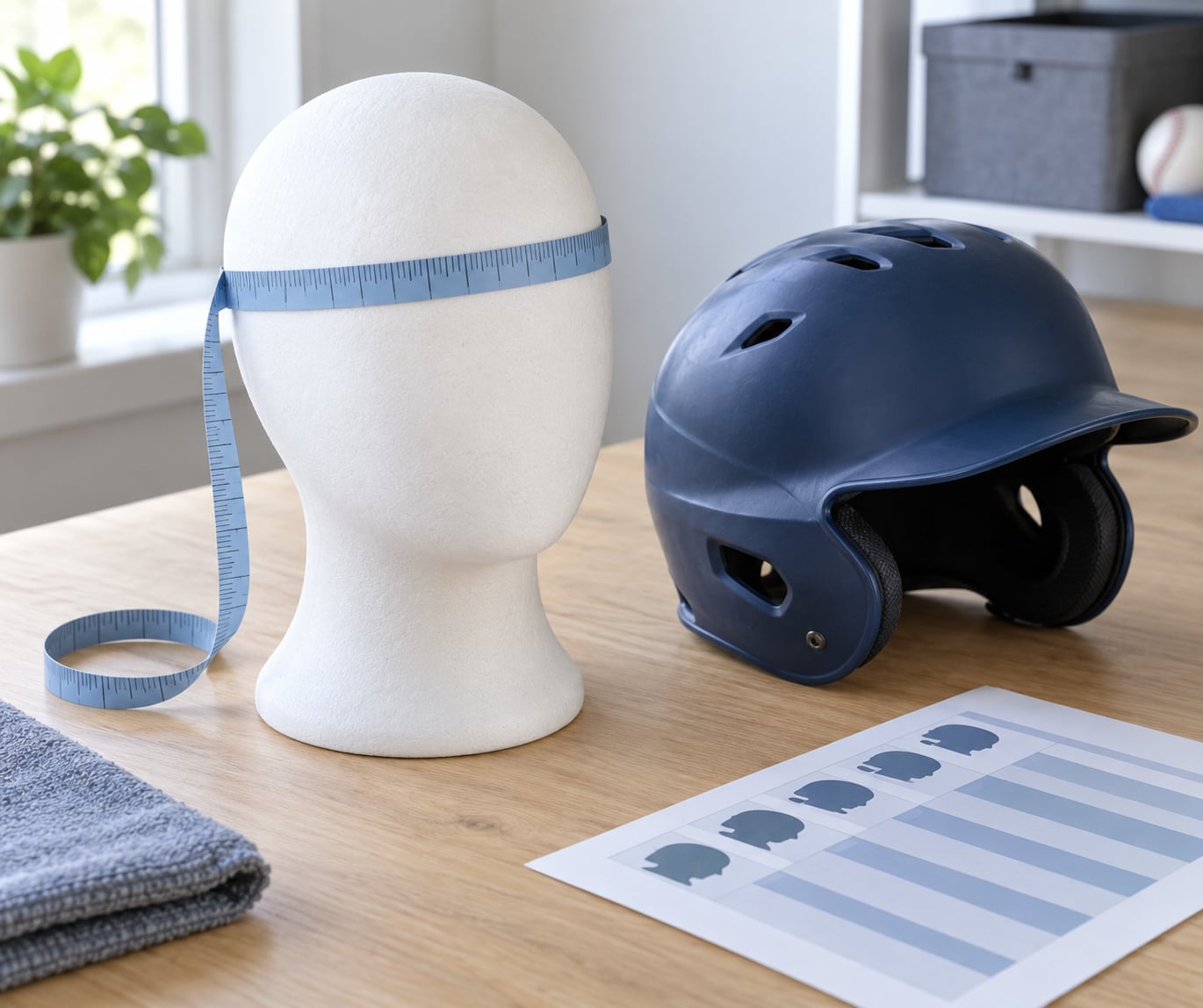
To size a batting helmet for a child, wrap a soft tape measure around the widest part of the head, about an inch above the eyebrows and level with the top of the ears, then match that number to the size range printed on that specific helmet. Finish by putting it on: two fingers should fit under the chin strap, and the helmet should not shift when the child nods. Most parents get the number right in under five minutes and then argue with the fit for ten.
A kid’s head grows fast enough that a helmet that fit in April can feel loose by July, and the wrong fit fails in both directions. Too tight and you get pressure points behind the ears and a headache after two innings. Too loose and the shell can rotate or lift off during a swing or a slide into second. The measurement gets you into the right range; only the fit check tells you the helmet is actually right.
One more thing worth saying up front: age labels on the box are marketing, not measurement. Two kids who are both seven can be three full hat sizes apart, and a helmet chosen for “the 7-year-old size” is a coin flip.
Table of Contents
- What You Need
- Step-by-Step
- Measure the Child’s Head Circumference
- Match the Measurement to the Youth Batting Helmet Size Chart
- Check the Helmet’s Coverage and Comfort
- Confirm Safety Standards and Final Fit
- Common Mistakes
- Frequently Asked Questions
- What is the correct head measurement for a batting helmet?
- How many inches should a child’s batting helmet fit?
- Should a child’s batting helmet fit snugly or have extra room?
- How do I know if a batting helmet is the right size?
- Can a child wear a baseball helmet for softball?
- When should a child replace a batting helmet?
- Conclusion
What You Need
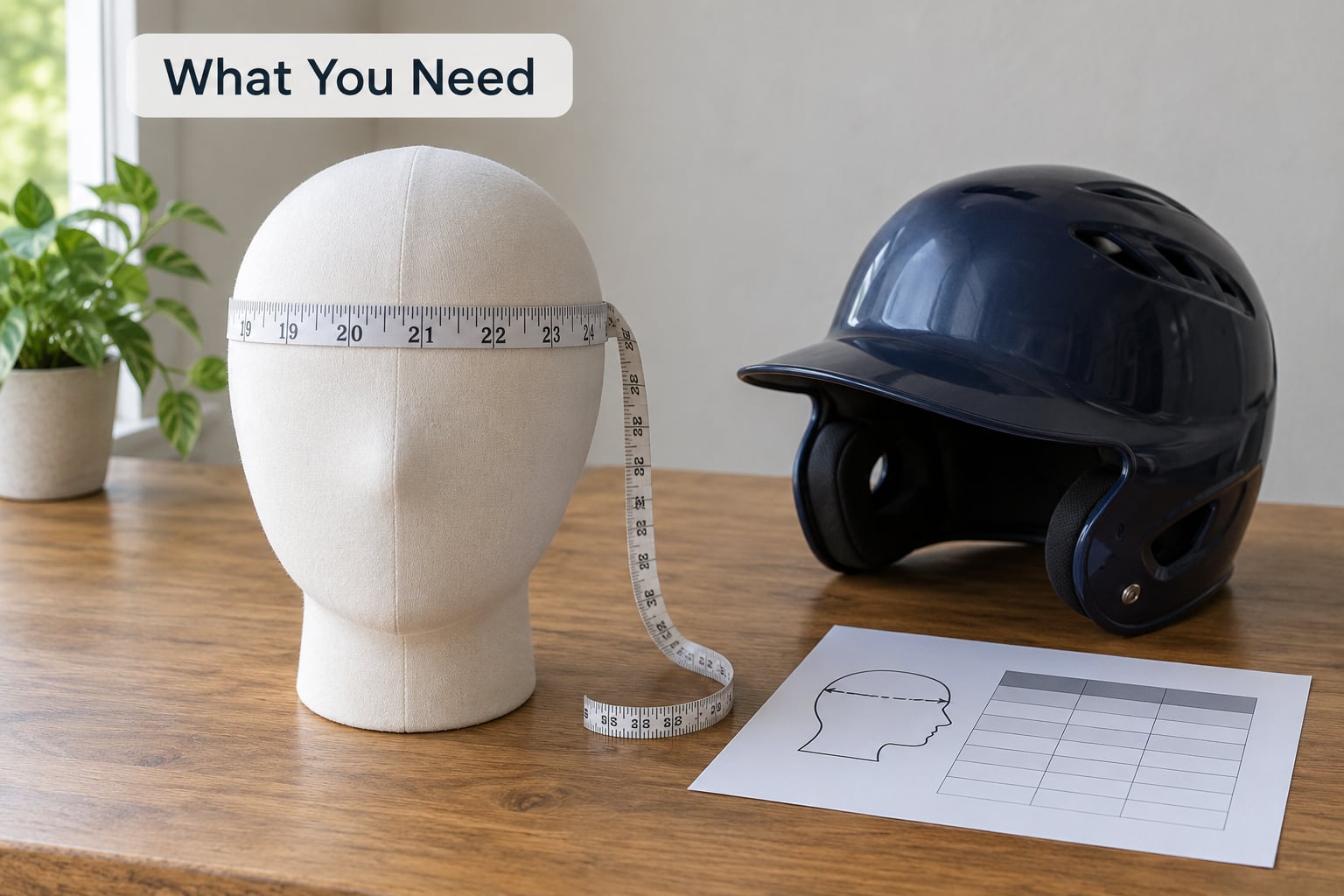
You do not need much, and all of it is cheap or free.
- A soft cloth tape measure. The kind a tailor uses, flexible enough to follow the curve of the skull. A stiff plastic tape gives a tighter, less accurate reading.
- The manufacturer’s size chart for the exact helmet. Search the model number, not the brand name. Every brand has its own ranges, and the letter labels mean different things on different models.
- A string and a ruler for the no-tape-measure method described below.
- Something to write on. Write the number down before the child takes the helmet off. You will do this twice a year.
- A mirror or a phone camera for the back-of-the-head check, where most of the padding problems hide.
If the helmet will be used for travel ball or a competitive fastpitch season, also check that the shell carries a NOCSE seal. That is the certification mark for baseball and softball batter’s helmets, and it means the model was tested to the standard rather than just tested once.
Step-by-Step
Measure the Child’s Head Circumference
This is the part almost everyone gets slightly wrong, so get the placement right: wrap a soft tape measure around the head just above the eyebrows and ears, on the widest part, and keep it level all the way around.
Four details that change the number:
- Start at the front. Put the tape across the forehead about an inch above the eyebrows, not across the brows themselves.
- Stay level. Run the tape across the top of the ears and the back of the head at the same height. If it dips at the back, you will get a short reading and a helmet that feels tight on the forehead.
- Snug, not tight. The tape should touch the skin with no slack and no pinching. You should not be able to slide a finger under it, but you also should not see the tape indent the skin.
- Measure twice. Kids tilt their heads and hold their breath. Take a second reading a minute later and write down the larger one.
If you have no tape measure, use a piece of string. Wrap it at the correct spot, pinch the overlap, lay it flat against a ruler, and read the length. Then measure the string’s loop with the tape measure or mark it on the ruler next time.
Head circumference converts to hat size with a simple division: divide the inches by 3.14. A 20 1/2 inch head is roughly a 6-1/2 hat. Plenty of youth size charts list both, but many list only one, so knowing both axes saves an argument at the store.
Match the Measurement to the Youth Batting Helmet Size Chart
Most youth helmets fall into two to four shells labelled Toddler, Junior, Senior, or XL. Below is a general conversion to orient you, but treat it as a starting point only. The chart on the helmet in your hands always wins.
| Hat size | Head circumference | CM | Common youth label | Rough age |
|---|---|---|---|---|
| 6-1/8 | 19 1/4 in | 49 | Toddler / XSmall | 3 to 4 |
| 6-1/4 | 19 5/8 in | 50 | T-Ball / Small | 4 to 5 |
| 6-3/8 | 20 in | 51 | Small / Junior | 5 to 6 |
| 6-1/2 | 20 1/2 in | 52 | Junior | 6 to 7 |
| 6-5/8 | 20 7/8 in | 53 | Junior | 7 to 8 |
| 6-3/4 | 21 1/4 in | 54 | Junior / Medium | 8 to 9 |
| 6-7/8 | 21 5/8 in | 55 | Medium / Junior | 9 to 10 |
| 7 | 22 in | 56 | Senior | 10 to 11 |
| 7-1/8 | 22 3/8 in | 57 | Senior | 11 to 12 |
| 7-1/4 | 22 7/8 in | 58 | Senior / Large | 12 to 13 |
| 7-1/2 | 23 1/2 in | 60 | XL | 13 and up |
| 7-5/8 | 24 in | 61 | XL | Teen |
Two things the table cannot tell you. Head shape matters: a child with a rounder or longer skull can measure dead centre of a range and still not fit, because the padding is shaped for an average oval. And hair adds real bulk, which is why many parents sizing a daughter up one notch is common advice rather than bad practice.
Brand differences are the second trap. A Junior shell from one manufacturer can span a different band than a Junior from another, and some brands use S/M/L while others use numeric hat sizes or model codes like RCFH or CFTB. Read the range on the chart, not the label.
Check the Helmet’s Coverage and Comfort
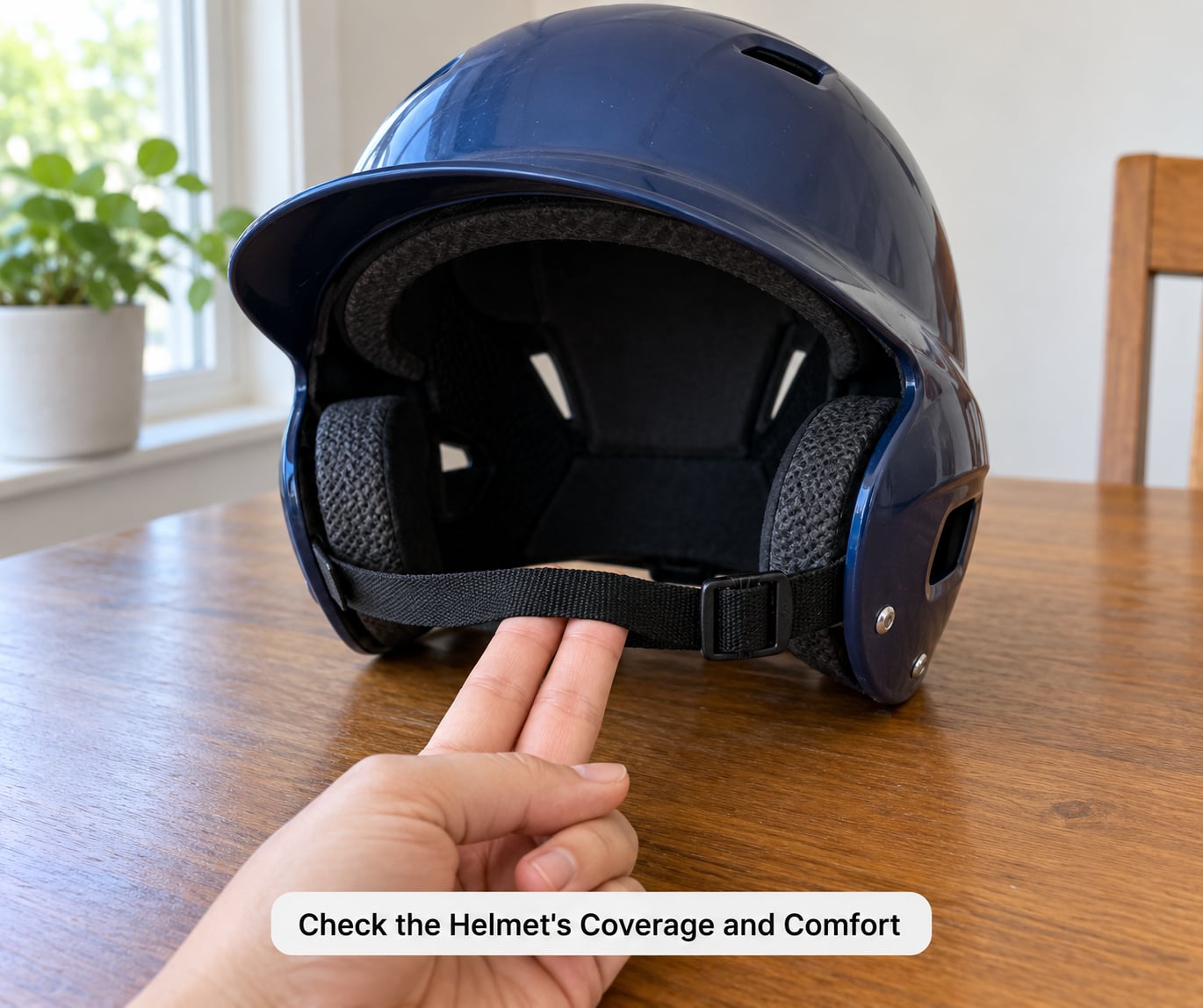
Three field tests tell you more than any chart. Parents in the softball forums describe exactly these, and they work on a helmet still in the store.
The two-finger chin test. Buckle the chin strap, then slide two fingers underneath it. If you cannot get two fingers in, the helmet is too small. If you can get three or four without pressing, it is too large. Adjust the strap so it sits snug under the chin, not back toward the ear.
The nod test. Have the child look down at the ground, then up at the ceiling. The shell should stay put. If it slides back on the upward nod or rocks side to side when the child shakes their head, the fit is not snug enough, and no amount of strap tightening will fix it.
The pressure check. Wear it for a full five minutes, not ten seconds. Pressure points show up behind the ears, across the forehead, and at the back of the skull where the occipital pad sits. Sore spots mean the shell is squeezing instead of cradling.
Coverage should look like this: the shell sits level, about an inch above the eyebrows, level with the top of the ears, with the ear openings aligned so the ears are not folded forward. Turn the helmet around and check the back, because the retention pads do most of the work there and they are where an oversized helmet first fails.
If the child wears glasses, put them on before trying the helmet. The temple arms need clearance with the pads, and a tight temple area will push the frames forward over the child’s eyes within a few minutes of play. For hearing aids or a cochlear implant, ask the child’s audiologist or the manufacturer’s fit specialists before modifying any padding, because the magnet and coil routing matters more than it looks.
Confirm Safety Standards and Final Fit
Before you pay, look for the NOCSE seal inside the helmet or on the packaging. Uncertified novelty helmets exist, and they are not built to the same impact standard as a certified model.
Inspect the shell for cracks, the ear flaps for cracks around the rivets, and the padding for compression. Padding that has been flattened by months of use will not hold the child’s head in place, which is why a helmet can measure correctly and still fail the nod test.
Then look at what sits between two sizes. Sizing up and hoping is the worst option, because a loose shell does nothing in a collision. The better move is the manufacturer’s fit kit, which is extra foam padding that sits over the existing liner and takes the slack out without changing the shell size.
Ask how often the child will need a new one. Most kids grow about half an inch to an inch in head circumference a year through the youth years, so a helmet sized at seven is usually due for a re-measure before the following spring season.
Common Mistakes
Buying by age. Age tells you nothing about head size, and it is the single most common error. Two children in the same Little League division can be a full hat size apart. Measure.
Measuring too tightly. A tape pulled snug like a blood-pressure cuff compresses the soft tissue and gives you a number half a size small. The tape should touch, not squeeze.
Sizing up to grow into. It sounds thrifty and it is not. The shell has to absorb an impact, and a shell with an inch of movement in it is a shell that can rotate off the head. Buy the fit kit instead.
Trusting one chart across brands. Size labels are not standardised. Junior on one model can overlap Small on another. Pull up the chart for the exact model number every time.
Skipping the fit test. A helmet can measure perfectly and still sit wrong because of head shape, hair, or glasses. The nod test takes five seconds and catches what the number cannot.
Keeping a hand-me-down that has taken a hit. A helmet that has been struck hard, or has a cracked shell, a crushed liner, or a strap that frayed, is done. Liners also compress over time even without an impact, so a used helmet that no longer passes the nod test has to go. Replace it rather than hunting for the model number to buy a fresh liner.
Forgetting the coach and the league. Some leagues issue helmets in adult sizes and expect parents to buy their own. Others require matching team gear. Check before shopping so you are not returning a perfectly good helmet on day one.
Frequently Asked Questions
What is the correct head measurement for a batting helmet?
Measure the circumference of the head with a soft cloth tape measure, wrapping it just above the eyebrows and level with the top of the ears. Keep it snug but not tight, level all the way around the back, and take a second reading to confirm. Write down the number in inches and, if you like, divide by 3.14 to convert it to a hat size.
How many inches should a child’s batting helmet fit?
Youth helmets usually cover head circumferences from about 19 inches for a toddler shell up to 24 inches for an XL. A child between 6 and 8 usually falls around 20 to 21 inches, and a 9 to 11 year old is commonly 21 to 22 inches. Those are ranges, not targets, so always check the chart printed on the specific helmet.
Should a child’s batting helmet fit snugly or have extra room?
Snug. You should fit two fingers under the chin strap and nothing more, and the shell should not rock or slide when the child nods up and down. A helmet with visible slack can shift during a swing or a slide, which defeats the purpose of wearing it. If it feels loose, the shell is the wrong size and a strap adjustment will not fix it.
How do I know if a batting helmet is the right size?
Run three tests after putting it on: two fingers should fit under the chin strap, the shell should stay still through a full nod up and down, and there should be no sore spots after five minutes of wear. If any of those fail, the size is wrong even if the measurement matched the chart. Those three checks catch head shape and hair issues that numbers cannot.
Can a child wear a baseball helmet for softball?
For slowpitch and recreational play, a baseball helmet often works if the child plays both. For fastpitch, get a softball helmet, because those shells are built a little larger to clear facemasks and they carry their own NOCSE certification. If your league requires a facemask, the helmet must be one designed for it, and that narrows the size options further.
When should a child replace a batting helmet?
Replace it after any hard impact, even if the shell looks fine, since liners absorb and compress and cannot be reset reliably. Replace it when the nod test starts failing, when the fit no longer matches the current measurement, or when the chin strap no longer holds two fingers. Most youth players need a new helmet every one to two seasons as their heads grow.
Conclusion
Start by measuring the head just above the eyebrows and ears, then find the size chart for that exact model and read the range, not the age on the box. Before you leave with it, run the two-finger chin test and the nod test. That is the whole method, and it takes longer to read than it does to do.