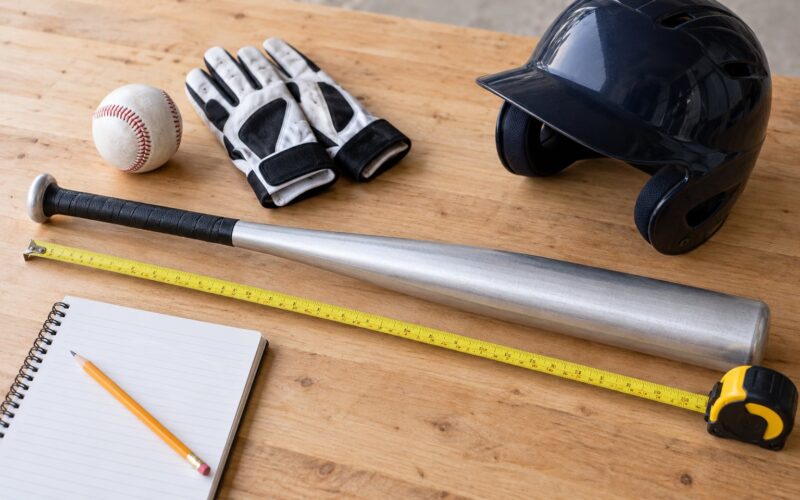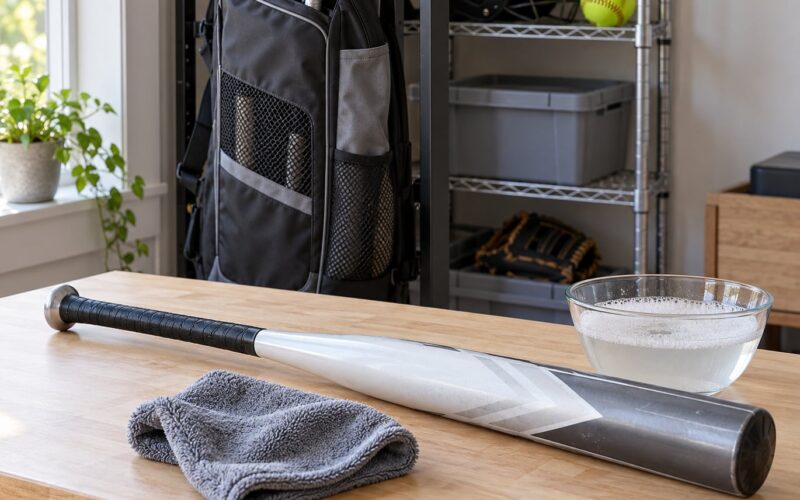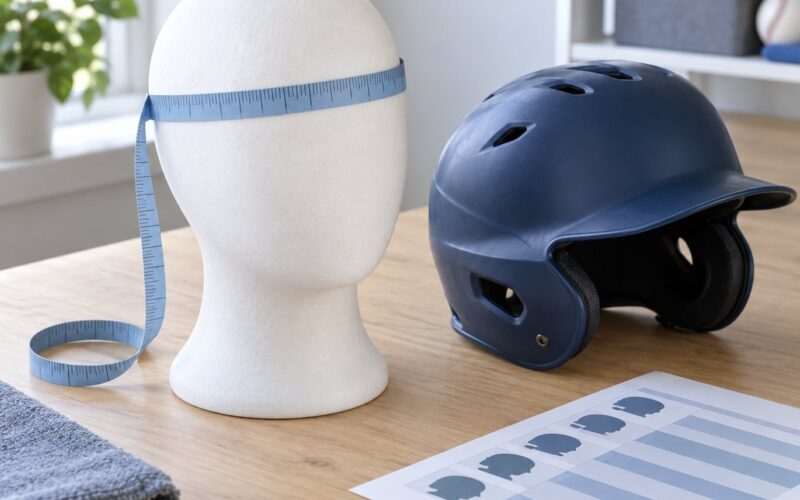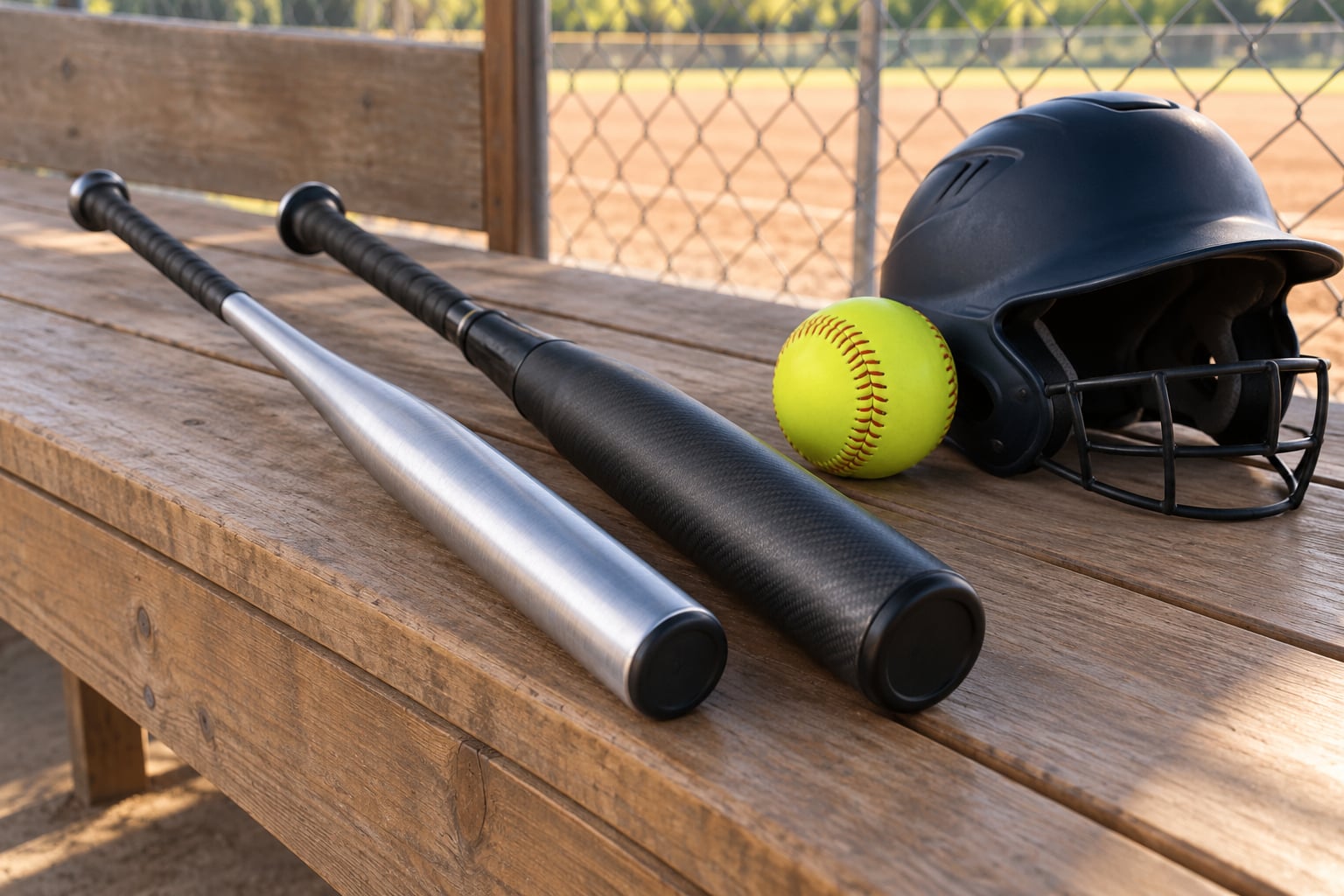
A fastpitch bat and a slowpitch bat are built for two different games. Fastpitch bats are short, light and balanced to handle hard, low pitches thrown from 43 feet. Slowpitch bats are almost always 34 inches, heavier, and end-loaded to drive a high-arcing ball out of the park.
That single sentence explains most of what you see printed on the barrel. Everything else — drop weight, barrel diameter, one-piece or two-piece construction, the certification stamp on the handle — flows from those two facts.
It also explains the argument that runs forever on softball forums: whether a fastpitch bat is legal in slowpitch, and which type of bat actually hits farther. Both questions get answered further down, with no brand names and no wishful thinking.
Table of Contents
- Fastpitch vs Slowpitch Bats: At a Glance
- How Pitch Speed Changes Bat Performance
- Why a hard, low pitch punishes a heavy bat
- Why a high arc rewards mass in the barrel
- Barrel Size, Weight, and Bat Design
- Barrel diameter and barrel length
- One-piece alloy versus two-piece composite
- Double-wall versus single-wall slowpitch bats
- Handle Feel, Drop Weight, and Swing Speed
- What drop weight actually means
- Swing weight is the number your hands feel
- Handle length and taper
- Which Bat Fits Fastpitch and Slowpitch Rules?
- The certification stamps, and who checks them
- How to tell what kind of bat you already own
- What happens when the umpire pulls the bat
- Which Should You Choose?
- Frequently Asked Questions
- Are fastpitch bats legal in slow pitch?
- What happens if you use a fastpitch bat in slowpitch?
- Why do slowpitch bats hit farther than fastpitch bats?
- Can I use a slowpitch bat in fast pitch?
- Which bat is better for a beginner?
- How do I check whether a bat is legal for my league?
Fastpitch vs Slowpitch Bats: At a Glance
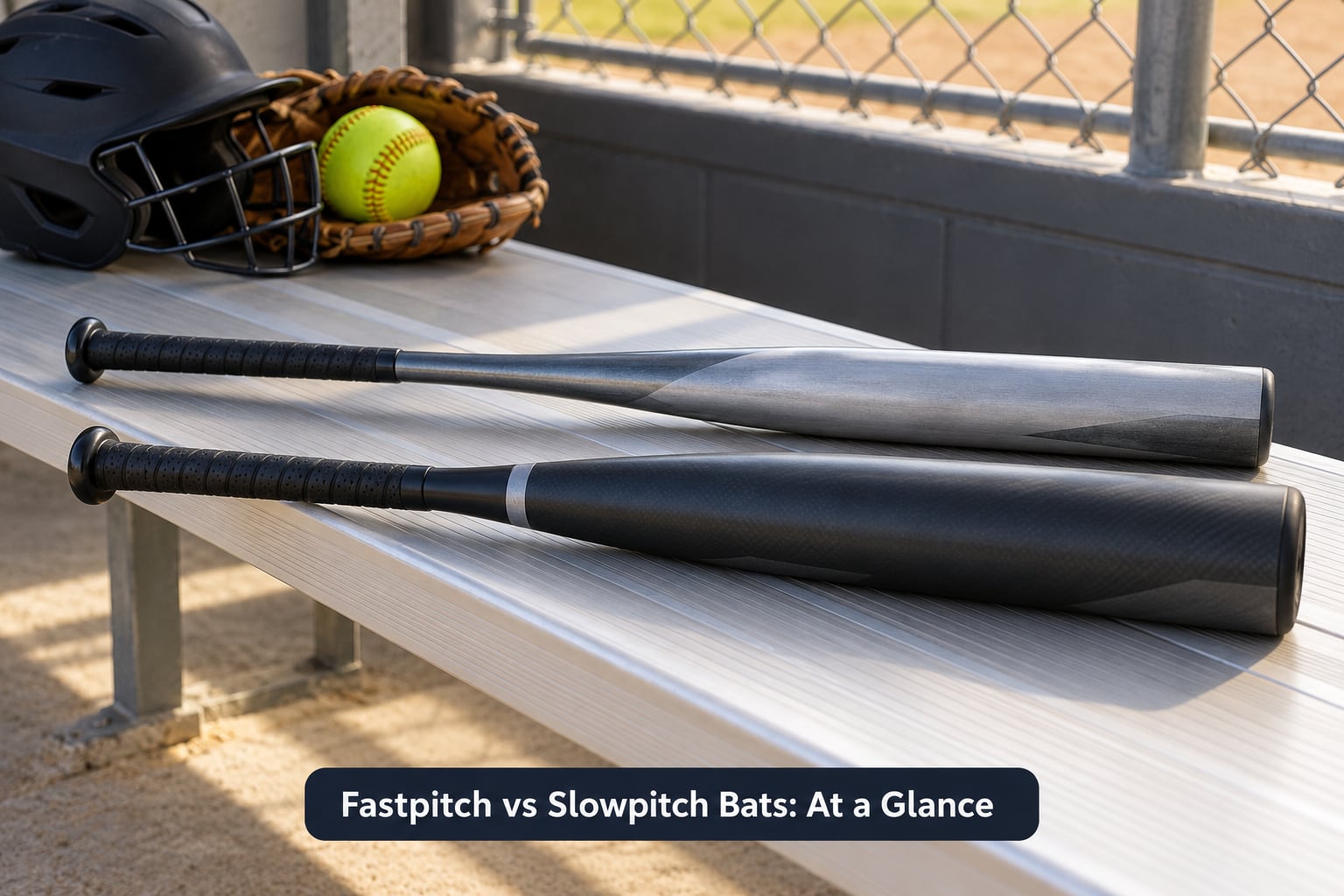
| Feature | Fastpitch bat | Slowpitch bat |
|---|---|---|
| Bat length | 33 inches typical, some leagues allow 32 or 34 | 34 inches, effectively standard |
| Drop weight range | Roughly -8 to -13 | Roughly -7 to -9 |
| Barrel diameter | 2-1/4 inch | 2-1/4 inch |
| Barrel length | Typically shorter, around 12 inches | Typically longer, often 13 to 13.5 inches |
| Construction | Often one-piece alloy; many two-piece composite | Almost always two-piece composite |
| Weight distribution | Balanced or light end load | Balanced, mid load, end load or max load |
| Typical swing weight | Lighter feel, faster through the zone | Heavier feel, slower through the zone |
| Typical use | Travel, high school, college | Rec, USSSA tournament, senior slowpitch |
| Stamp to check | USSSA 1.20 BPF, USA Softball, NFHS | USA Softball, USSSA, SSUSA, NSA, ISA, ISF |
One caution about that table: ranges, not rules. Plenty of leagues restrict specific lengths or weights, and the certification stamp on your bat, not this chart, decides what you can legally swing.
How Pitch Speed Changes Bat Performance
Why a hard, low pitch punishes a heavy bat
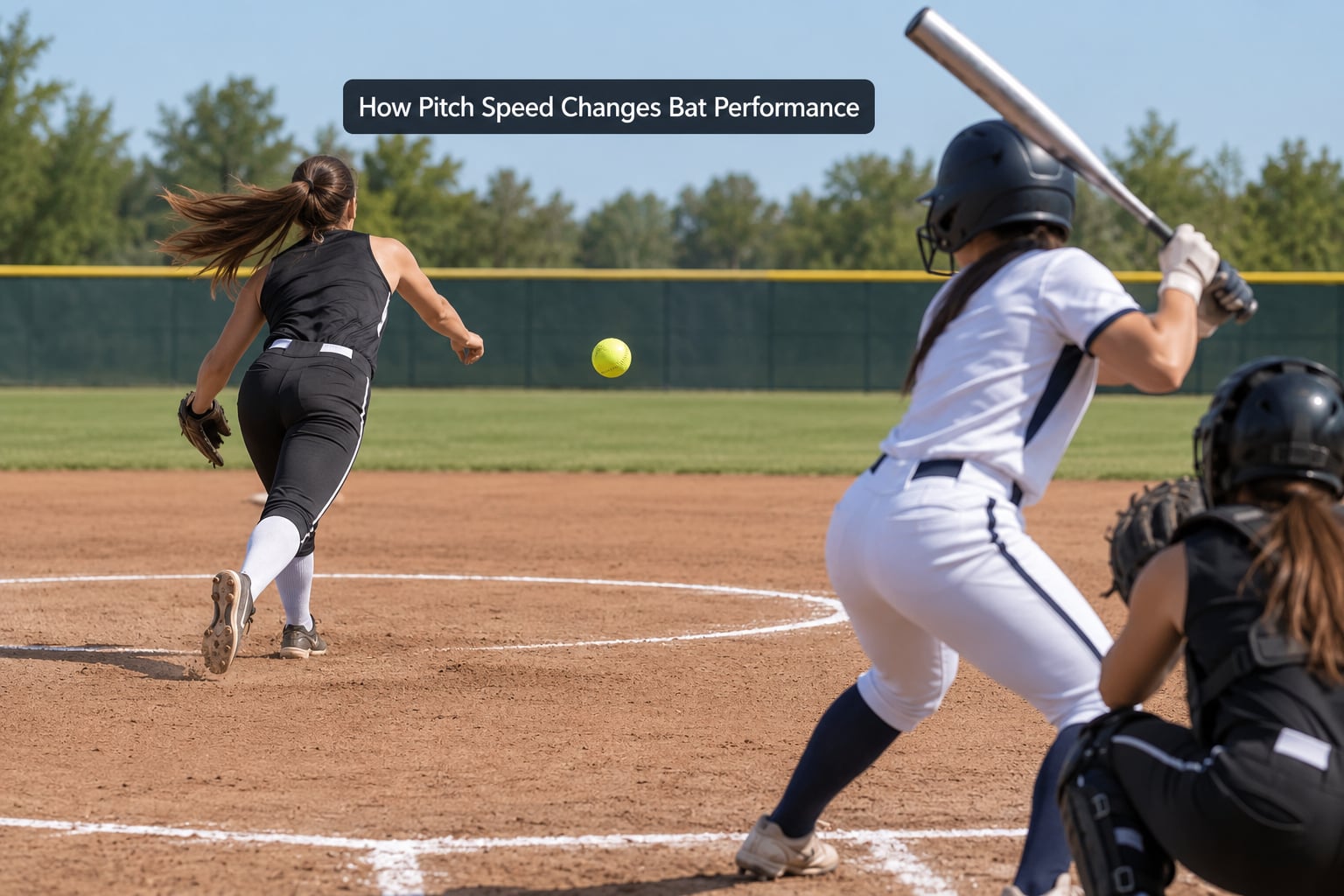
Fastpitch pitchers deliver with a windmill motion and commonly throw in the 60 to 70 mph range. The hitter has roughly a third of a second to track a ball that is moving down and away, so the bat has to be light enough to start and finish inside that window.
A heavier bat takes longer to load and slower to reverse direction. Miss the barrel, or brush the outside edge, and the bat’s weight works against the swing instead of for it. That is why fastpitch bats lean toward balanced weight distribution and lighter swing weights.
Why a high arc rewards mass in the barrel
Slowpitch pitching is underhand or sidearm with a much slower ball, thrown with pronounced backspin so it climbs and then drops steeply into the outfield. The hitter is hitting a ball that is descending, not one that is still rising.
Descending balls give you something a rising fastball does not: time. Extra mass concentrated past the center of the barrel adds energy at contact, and the steep launch angle that carries a slowpitch ball carries it further than the same hit off a fastpitch ball.
This is where the online debate gets settled. Players on r/slowpitch report less distance with a fastpitch bat and attribute it to there usually being more mass in a slowpitch bat. That is the right read. Mass in the barrel plus a high arc equals carry.
Barrel Size, Weight, and Bat Design
Barrel diameter and barrel length
Both games use a 2-1/4 inch barrel, so diameter is not a differentiator even though retailers list it first. Barrel length is the number that matters: fastpitch barrels run closer to 12 inches, while slowpitch barrels stretch to 13 inches or more.
A longer barrel moves the center of gravity away from your hands, enlarges the sweet spot, and slows the swing slightly. Shorten the bat and you gain bat speed at the cost of forgiveness on off-center contact.
One-piece alloy versus two-piece composite
A one-piece bat is pressed or machined as a single unit, most often from an alloy. It is stiff, it takes abuse, and it does not flex. Two-piece composite uses a separate handle bonded to a barrel, giving the barrel a trampoline effect that flexes on contact and returns energy.
Fastpitch bats lean toward one-piece alloy for a simple reason: a 12U tournament season involves a lot of dropped bats and a limited budget. Composite bats cost more and need break-in time before they reach full trampoline flex. Forum players returning to the game after 20 years point out the same tradeoff — one-piece bats are typically more durable but often cheaper than two-piece.
Slowpitch bats go the other way. Nearly every competitive slowpitch bat is two-piece composite, because the game rewards a big, flexible sweet spot and nobody is worried about the bat absorbing a 200-foot line drive into a wall.
Double-wall versus single-wall slowpitch bats
Some slowpitch barrels carry two walls rather than one. The outer wall adds durability and a firmer, more solid feel at contact, at the cost of a little trampoline flex. Single-wall barrels are lighter, livelier and cheaper. Neither is illegal; both are common in rec and senior leagues.
Handle Feel, Drop Weight, and Swing Speed
What drop weight actually means
Drop weight is the difference between a bat’s length in inches and its weight in ounces. A 34 inch bat weighing 27 ounces has a -7 drop. A 33 inch bat weighing 24 ounces has a -9 drop.
That number tells you how fast the bat accelerates through the zone, which is why a 10-year-old can swing a -13 bat comfortably and a grown adult often struggles with one. The rule of thumb most coaches use: pick the lightest drop weight you can put good contact on, then drop one more pound if you are breezing through fastpitch pitching.
Swing weight is the number your hands feel
Bat weight is the number stamped on the barrel. Swing weight is how the bat actually behaves when you swing it, and the difference is entirely about where the mass sits. Two bats with identical length and drop weight can feel like different clubs depending on loading.
If you can push the bat straight out in front of you without it tipping over, it is balanced. If the barrel wants to drop, it is end-loaded. Slowpitch lines from balanced through mid load, one-ounce end load and max load. Fastpitch has far less of that range, and the swing-weight column on a retailer’s spec sheet is the honest number to compare.
Handle length and taper
The taper is the gradual thinning of the handle toward the knob, and the overall handle length changes how much barrel you have on the end of the bat. A flared grip fits the hand more quickly at the plate; an ergonomic or bat-shaped handle fits a round palm. Fastpitch hitters often prefer a longer handle for more barrel, slowpitch hitters a slightly shorter one for control.
Which Bat Fits Fastpitch and Slowpitch Rules?
The certification stamps, and who checks them
Legality comes down to the stamp. The governing body for your league approves bats against a performance limit measured as the Bat Performance Factor, and BPF thresholds differ between organizations — 1.20 under USSSA and NSA rules, 1.21 under SSUSA. A bat that clears one threshold can fail the other.
| Organization | What it governs | Performance standard |
|---|---|---|
| USSSA | Travel and tournament fastpitch, USSSA slowpitch | BPF 1.20 |
| USA Softball (ASA) | USA Softball sanctioned slowpitch and fastpitch | ASA standards, 1.20 BPF |
| SSUSA | Senior slowpitch, age 50 and up | BPF 1.21 |
| NSA | National Senior Association slowpitch | BPF 1.20 |
| ISA and ISF | Independent slowpitch leagues | Varies by association |
| NFHS and NCAA | High school and college fastpitch | NFHS 1.20 BPF, NCAA standards |
So, plainly: a fastpitch bat is not legal in a slowpitch league unless it carries a stamp your league has approved for slowpitch play. Most fastpitch-only bats do not. A dual-stamped bat approved by both USSSA and USA Softball can cover both games, which is worth checking before you buy.
The reverse also holds. A senior slowpitch bat is almost never stamped for high school or college fastpitch, and a heavy max-loaded slowpitch bat will feel awful against a 65 mph windmill delivery.
How to tell what kind of bat you already own
If you already own a bat and cannot remember what it is, four checks settle it in under a minute.
- Read the drop marking. The handle or barrel usually prints something like 34/27 or 33/24. Those two numbers give you the length and weight, and the difference is your drop weight.
- Measure the barrel. Roughly 12 inches points fastpitch; 13 inches or longer points slowpitch.
- Look for the certification stamp. It sits on the handle or the barrel. The stamped name tells you which organizations approved it and, in many cases, which season that approval covers.
- Read the model name. Fastpitch lines are named for speed and power, slowpitch lines for load and distance. This is the weakest clue of the four, so trust the stamp over it.
What happens when the umpire pulls the bat
The process is rarely dramatic, which is part of why it stings. An umpire inspects the bat before the game or at the plate, notices it lacks an approved stamp, and removes it from play. You get a substitution and either bat out or forfeit. In tournament play the forfeit can end your day.
That is the frustration players describe on softballfans.com, where threads about bats being pulled without explanation come up repeatedly. Check your league’s rulebook before the season, not at the plate.
Which Should You Choose?
Start with your league, because that decision is not negotiable. Everything after it is a preference.
- Travel or high school fastpitch player: buy a fastpitch bat stamped for your league, at the lightest drop weight you can handle, and keep the barrel reasonably short for bat speed.
- College or elite fastpitch player: a two-piece composite fastpitch bat gives you a bigger sweet spot once your swing speed is high enough to use it.
- Adult rec, church or city league player: a balanced or mid-load slowpitch bat feels best when you are not chasing a specific number. You will get most of the distance without giving up control.
- Senior slowpitch player on SSUSA: check the BPF 1.21 threshold before buying, then end load as much as your swing can handle.
- Pure power hitters: max-loaded slowpitch bats add carry for players who can keep the barrel through the zone. They are punishing on mishits, so they are a bad match for beginners.
- Beginners and younger players: go balanced and light. The bat should feel like it is already moving before you swing. Players returning to the game after decades often ask for the same thing — a reasonable drop for their height and weight.
- Players in more than one league: look for a dual-stamped bat rather than owning two. Verify the approval dates, because a stamp can expire between seasons.
One more thing buyers ask about constantly: slowpitch bats usually cost more than comparable fastpitch bats. That gap comes from the composite construction, the larger barrel and the engineering behind the load, not from the bat being a different sport.
Frequently Asked Questions
Are fastpitch bats legal in slow pitch?
Usually not. Most fastpitch bats carry a stamp approved only for fastplay, so a slowpitch umpire can remove them before the game. You need a bat stamped for slowpitch by the organization that governs your league, such as USA Softball, USSSA or SSUSA. A dual-stamped bat approved by both bodies is the simplest way to cover both games.
What happens if you use a fastpitch bat in slowpitch?
The umpire asks you to take it out of play. You can borrow or substitute a legal bat if your league allows it. If no legal bat is available, the rules may require a forfeit, and in tournament play that can end your day. Check your league rulebook before the season so you know the substitution rules in advance.
Why do slowpitch bats hit farther than fastpitch bats?
Two reasons. Slowpitch balls arrive on a steep descending arc, and a descending ball is easier to hit with upward launch angle than a rising fastball. Slowpitch bats also carry more mass past the center of the barrel, so contact transfers more energy. Mass plus arc equals carry.
Can I use a slowpitch bat in fast pitch?
Almost never. Senior and tournament slowpitch bats are not stamped for fastplay, and their heavy end-loaded design makes them hard to control against 60 to 70 mph windmill pitches. College and high school fastpitch also require bats meeting NFHS or NCAA standards. Check your league’s approved bat list before you buy.
Which bat is better for a beginner?
A balanced bat at a light drop weight, in the length you can control through the zone. Beginners generate bat speed faster when the bat is not heavy or end-loaded. Start there, move to a lighter drop weight if you are breezing through pitching, and only then consider a loaded bat. In slowpitch, one-ounce end load is a reasonable later step.
How do I check whether a bat is legal for my league?
Find the certification stamp on the handle or barrel and read the organization name, then compare it with your league’s approved list. Confirm the performance standard too, because BPF thresholds differ between organizations. Approval dates matter as well, since a stamp can expire between seasons. When in doubt, ask your league official before the season starts.
Find your league’s certification stamp before you shop, then pick a bat built for that game. Competitive fastpitch means a lighter, balanced bat for bat speed. Rec and senior slowpitch means a heavier, end-loaded two-piece composite for distance on a high arc.
Last reviewed for 2026 softball bat rules. Always confirm current certification and BPF requirements with your league or governing body, since standards and approval dates change.