To store ammunition safely at home, keep it sealed in a moisture-resistant container with desiccant inside, stored in a cool, dry room below roughly 60 percent relative humidity, locked where children and thieves cannot reach it, and kept separate from your firearms.
That is the whole method. Ammunition is not perishable in the way food is, and it does not need a climate-controlled vault. If a cartridge stays dry and reasonably stable in temperature, it can sit for decades and still fire reliably.
Most of the work is picking a room that does not swing wildly between humid and dry, and using a container that actually seals. Get those two things right and the rest is habit. Skip them and you will find corrosion streaks, dead primers, and loose powder eventually.
Table of Contents
- What You Need
- Step-by-Step
- 1. Choose a Secure Location
- 2. Use a Purpose-Built Lock or Safe
- 3. Keep Ammunition Separate From Firearms
- 4. Organize Containers and Check for Damage
- 5. Control Moisture and Temperature
- 6. Limit Access and Maintain the Storage Area
- 7. Handle Transport and Disposal Safely
- Common Mistakes
- Storing it in an unlocked drawer or an open shelf
- Choosing a garage, attic, or shed out of convenience
- Leaving ammunition accessible to children
- Assuming a safe is fireproof and theft-resistant without checking
- Believing ammunition will level a building in a house fire
- Vacuum sealing loose ammunition
- Storing ammunition in a vehicle
- Mixing damaged and usable rounds
- Legal and Household Safety Considerations
- Frequently Asked Questions
- What is the best way to store ammo at home?
- How long can ammo be stored before it goes bad?
- Is it safe to store ammo in a hot garage?
- Is it okay to store ammo in Ziploc bags?
- What is the ideal humidity level for storing ammunition?
- Does ammunition explode in a house fire?
- Conclusion: Build a Two-Layer Storage System
What You Need
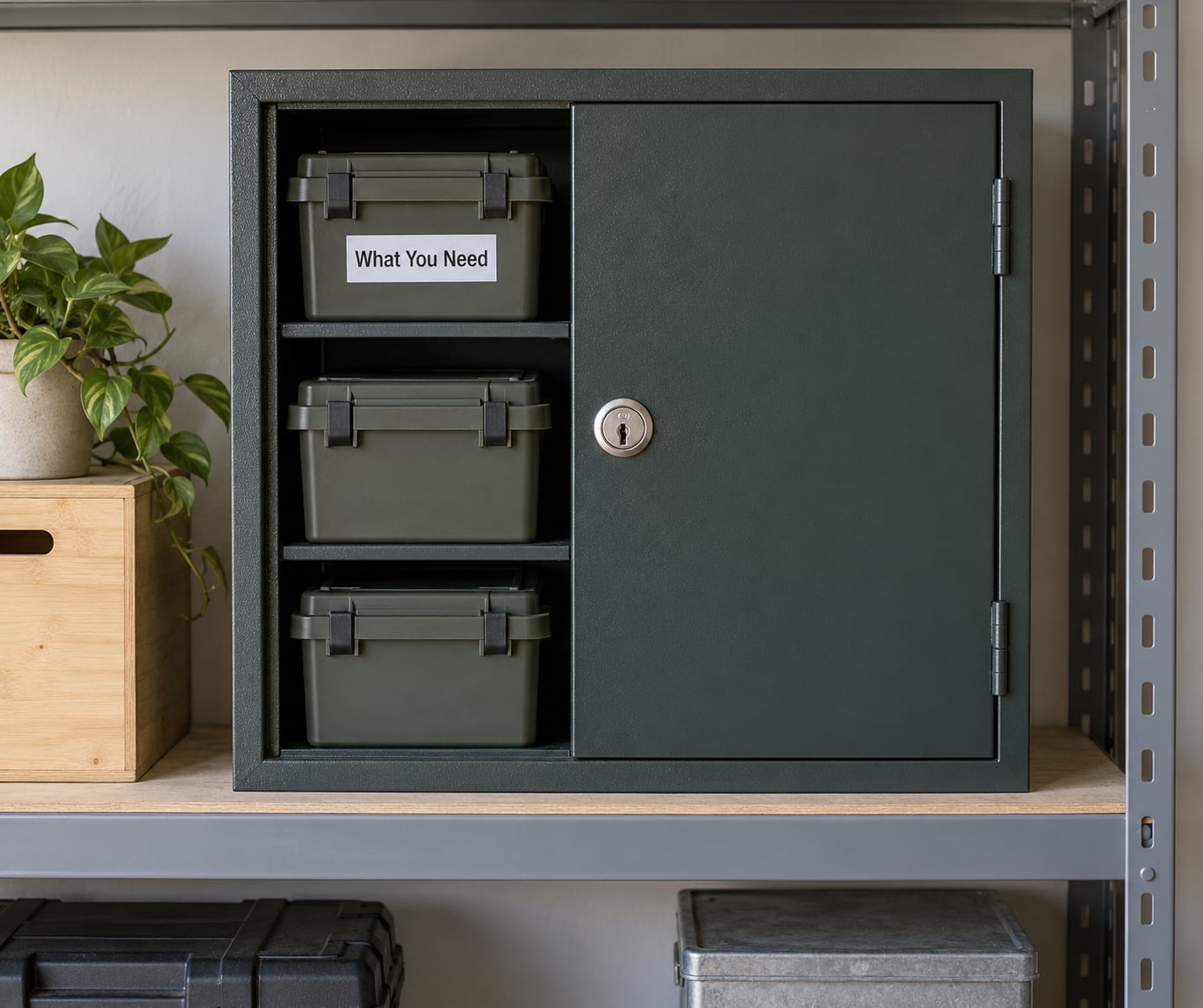
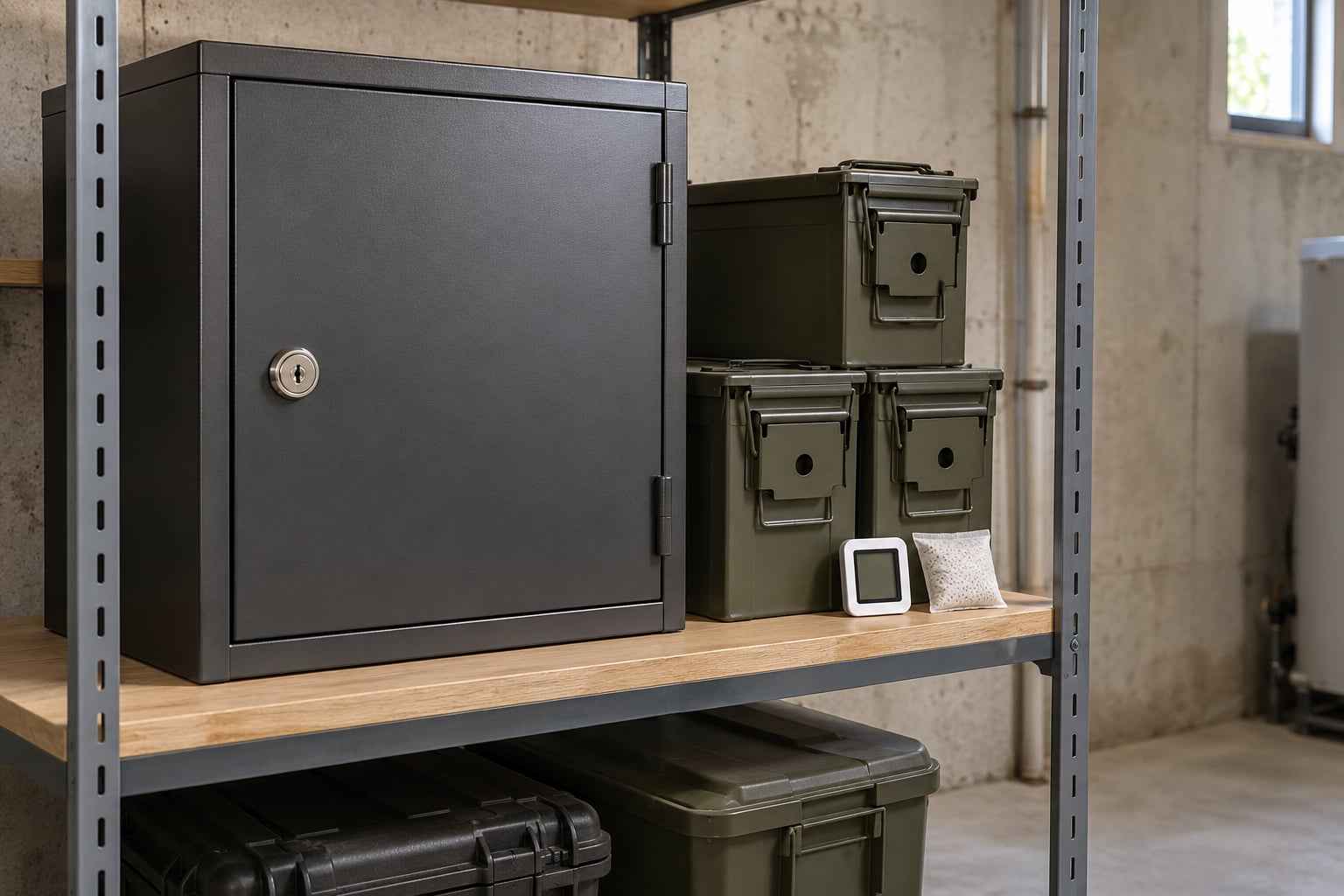
A purpose-built locked safe or lockable metal cabinet is the one item worth spending money on. It handles theft deterrence and child access in a single stroke, which no improvised container manages as well.
On top of that, you want a handful of simple supplies:
- Sealed containers. Gasketed plastic ammo cans or mil-surp steel cans for bulk storage, plus small airtight boxes or jars for partial quantities.
- Desiccant. Silica gel packs or a rechargeable indicator desiccant, one per container sized to its volume.
- A hygrometer. A cheap digital relative humidity meter so you can check the room instead of guessing.
- Dehumidification, if needed. A small dehumidifier for basements and garages, or a passive option like DampRid for closets and cabinets.
- Labels and dividers. A label maker or waterproof tape, plus small bins so you can find one caliber without dumping ten cans.
- A short inventory list. A notebook, spreadsheet, or phone photo of each container’s contents and count.
- A soft brush and clean dry surface. For inspecting rounds without scratching cases or transferring oils from your hands.
A gun safe is generally preferable to improvised storage, and any safe heavy enough to matter should be anchored where local requirements ask for it. A lidded plastic tote on a closet shelf is a perfectly reasonable setup for someone who stores one or two boxes of target ammunition, and pretending otherwise does not help anyone.
Step-by-Step
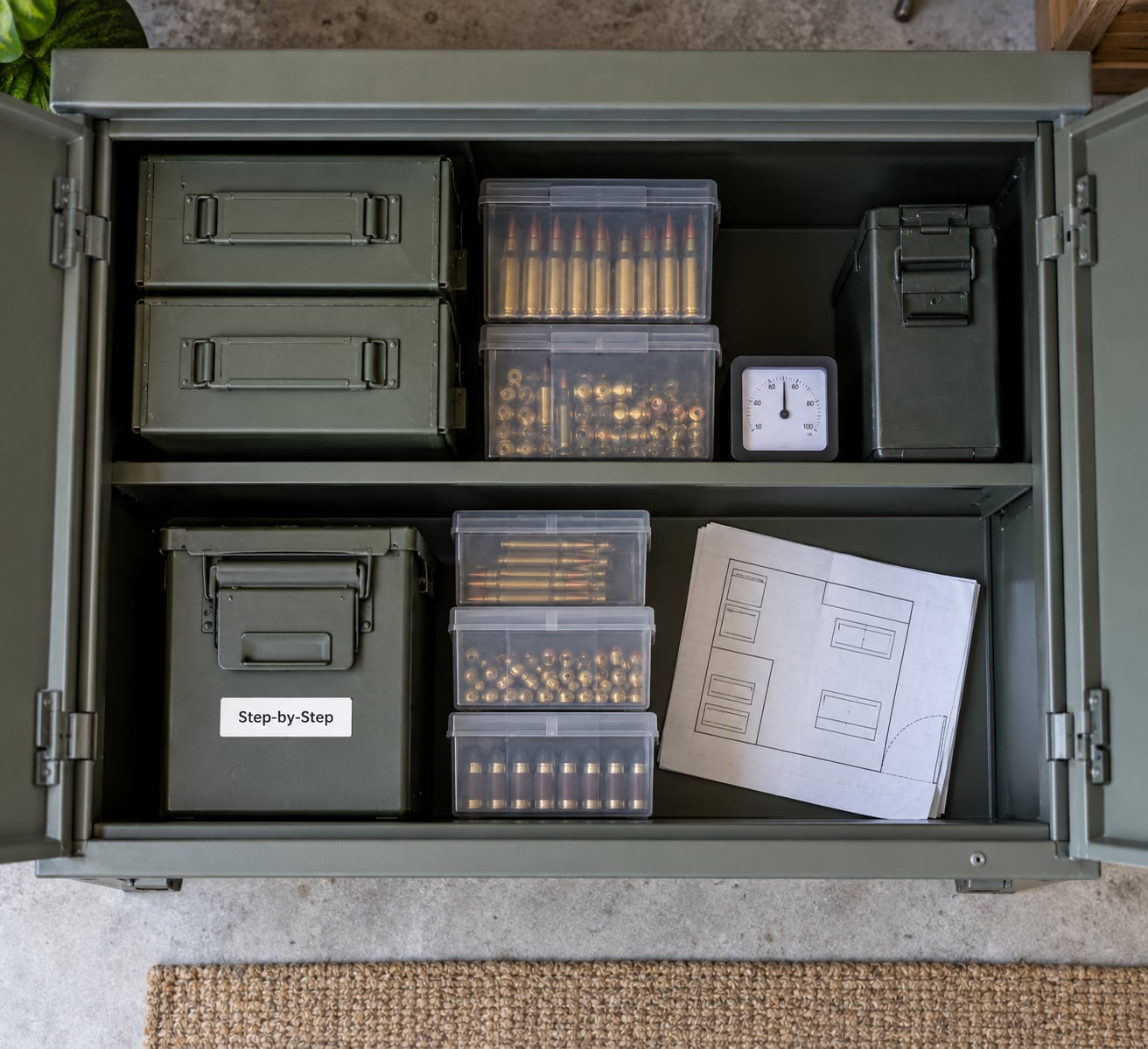
1. Choose a Secure Location
Pick an interior room that stays cool, dry, and out of sight, and that children, guests, and a burglar working through the house would all miss. A finished basement shelf, an interior closet, or a mud room cabinet usually beats a garage, an attic, or an outdoor shed.
Avoid the bedroom closet, a kitchen drawer, and any improvised hiding place such as a hollowed-out book or a false container. Concealed spots fail because people forget them, then discover them while cleaning, moving, or looking for the thing they actually hid.
How to verify it worked: put the hygrometer in the chosen spot for a week and read it. You want readings that stay under about 60 percent relative humidity, ideally between 40 and 55 percent, and a room where the reading does not climb sharply after a rainstorm.
Users on r/ammo and r/guns commonly settle on a climate-controlled closet inside the house rather than the detached shed, largely for the same reason: stable humidity beats cheap space.
2. Use a Purpose-Built Lock or Safe
Use a lock built for the job: an ammunition can with a hasp and padlock, a lockable steel cabinet, or a safe rated for ammunition and, if you store firearms nearby, fire-resistant.
A basic cabinet lock, an unlocked footlocker, or a document box does not provide real security. It keeps out honest curiosity and nothing else, and it signals to anyone casing the house that the contents are worth taking.
For firearms stored in the same home, the widely recommended pattern is a two-layer setup: a small locked quantity you can reach quickly, and a larger bulk quantity locked separately. That keeps your bulk ammunition out of one single bag that a single theft removes.
How to verify it worked: walk up to the container as a guest who knows nothing about it and see whether you can open it or work the lock. Then check the hinges, the door gap, and the hasp seating. Anything that needs tools to defeat is doing its job.
3. Keep Ammunition Separate From Firearms
Store ammunition apart from the guns themselves wherever your layout allows it, so that unauthorized access to one does not immediately give someone both.
Separation also simplifies household practice. You can hand a sitter, a housecleaner, or a guest clear instructions about the ammunition location and the firearms location independently, rather than describing one locked room that holds everything.
There is one genuine tension here. Many owners keep ammunition inside the same safe as their firearms so the lock and the anchor only need to work once. That is a reasonable choice for a controlled household, and a worse one if you are worried about a fire or a child who has already found the safe combination.
How to verify it worked: stand in the room where you are most likely to need the gun quickly, and confirm you can reach a defensive quantity without unlocking a second container in the dark.
4. Organize Containers and Check for Damage
Inspect each round before it goes into storage. Look for green or white powdery residue on the primer, rust or staining on the case, dents, cracks, or any sign that packaging has been wet. Pull anything with visible corrosion out of the same container as good ammunition.
Keep original factory cardboard boxes when you can. They already carry the caliber, bullet weight, and lot information, and they fit neatly into standard ammo cans without repacking. Cardboard alone is a poor long-term moisture barrier, but cardboard inside a sealed can is fine.
Label every container with caliber, bullet type, and count, and do not mix calibers or incompatible ammunition in one container where a grab could produce a chambering error.
How to verify it worked: open any container at random and you should be able to state the caliber and quantity without emptying it onto a table.
5. Control Moisture and Temperature
Moisture is the only failure mode that really matters. A cartridge that stays dry is fine, whatever the thermometer reads, so keep ammunition below roughly 60 percent relative humidity and away from big temperature swings.
Put a desiccant pack in each container and replace or recharge it on a schedule. A rechargeable indicator pack that changes color is easier to read than a plain packet that gives you no feedback.
A dehumidifier earns its place in a basement or a garage that regularly reads above the threshold. In a conditioned interior closet, passive desiccant and a hygrometer are usually enough.
How to verify it worked: close the container, wait a day, reopen it and check whether the indicator pack has changed color or whether the inside of the lid shows moisture. Then re-read the hygrometer in the room.
6. Limit Access and Maintain the Storage Area
Control the key, the combination, and the number of people who know both. That is the whole access system: fewer keys, fewer known codes, fewer ways in.
On a schedule, check that locks still throw, hinges are tight, the door closes fully, and the anchor has not shifted. Re-read the hygrometer while you are there, since seasonal humidity changes are easy to miss in a room you walk past every day.
Explain the rules to everyone in the household who handles ammunition, including where it lives and who is allowed to open it. Visitors and house-sitters need that explanation, and they need it before the first range trip, not after.
How to verify it worked: ask someone in the household to state where the ammunition is stored and what the rules are. If they cannot, the system has failed regardless of how good the container is.
7. Handle Transport and Disposal Safely
Move ammunition inside the home in its original container or a sealed can, in a bag you control, and never loose in a pocket. Put it away before you pick up the firearms, not after.
For vehicle transport, keep it secured and out of reach in the cabin or in a locked container rather than loose in the bed, and never leave ammunition unattended in a vehicle, where heat can reach the cook-off range and where a break-in is easier.
For air travel, check the current airline and TSA rules directly. Ammunition in checked baggage has specific packaging requirements and quantity limits, and both carriers and agencies update them.
Disposal goes through a licensed recycler, a law-enforcement agency that accepts it, or a documented local hazardous waste program. Do not bury, burn, or pour it down a drain.
How to verify it worked: every time you move the ammunition, the container closes fully, the label is readable, and the destination is the locked storage spot, not a temporary pile on a workbench.
Common Mistakes
Most storage problems I hear about come down to the same handful of habits. Each one has a simple correction.
Storing it in an unlocked drawer or an open shelf
This is the single most common failure. It fails against thieves first, but the bigger everyday risk is a curious child or a guest who opens it without asking. Use a locking container and put it somewhere out of sight.
Choosing a garage, attic, or shed out of convenience
These are the worst thermal rooms in most houses. Attics hit extreme heat in summer and can drop below freezing in winter, and garages swing with the weather and often sit humid. If it is the only space available, use a sealed can with desiccant, keep it off the floor away from exterior walls, and check the hygrometer every month.
Leaving ammunition accessible to children
Ammunition is a choking hazard, and a cartridge small enough to be a choking hazard is also small enough to be a curiosity. Locked storage solves this, and a conversation with older children about what is in the house matters just as much.
Assuming a safe is fireproof and theft-resistant without checking
Read the specifications. A lockable steel cabinet resists casual theft very differently from a certified fire-resistant safe, and a bolt-work door resists a pry bar very differently from a simple key lock. Know what you actually bought.
Believing ammunition will level a building in a house fire
This fear is common and mostly overstated. SAAMI has published burn testing, including a test burning 250,000 rounds in a semi-trailer, and footage of those tests is widely circulated in gun forums. The account that comes out of that testing is that ammunition does not mass-detonate in a level-building fire. The brass case is the primary hazard, and case fragments are what dent drywall, mostly at close range.
The correct takeaway is not that a fire is harmless. It is that ammunition stored in a fire-resistant safe is not the thing that destroys the house, and that separating ammunition from firearms is still sensible practice.
Vacuum sealing loose ammunition
Advice here is genuinely mixed. Pointed bullets can pierce a standard bag during evacuation, and several users report torn vacuum bags after the fact, while others report years of success with heavy-gauge bags, and canning jars work fine. If you vacuum seal, use double bags in a food vacuum sealer and inspect them annually. If you do not own one, a sealed can with desiccant does the same job with no failure mode to worry about.
Storing ammunition in a vehicle
A parked car can exceed the temperatures that degrade ammunition, and a car break-in is a routine event. Transport it, then move it to your locked indoor storage. Keeping it in the trunk as a permanent home defeats every other step on this list.
Mixing damaged and usable rounds
One corroded cartridge tells you the container got wet at some point. Separate anything with visible corrosion or staining, mark the container, and check the desiccant and the room humidity before you add more to it.
Legal and Household Safety Considerations
This article is general information, not legal advice. Storage rules for ammunition in the United States vary by state, city, and county, and they change, so verify the specifics where you live before you buy in bulk or change how you store what you already have.
Most states place no general restriction on owning ammunition at home, and many states require proof of age or a background check at purchase rather than at storage. Some jurisdictions regulate where ammunition may be stored, limit magazine capacity, restrict bulk purchases, or impose specific rules on dealers. A few states and localities treat ammunition more restrictively than the firearm itself. Check your state firearms or attorney general’s office for the current text, and your local police department if you want a plain-language answer.
For renters and apartment residents, read your lease before you store anything. Many leases prohibit firearms and ammunition outright, and a violation gives a landlord grounds to begin an eviction process, which is far more disruptive than finding another storage spot.
For households with children, the practical guidance is unchanged and undated: locked storage, out of sight, out of reach, with the key or combination held by an adult. Tell any adult who has been in your home recently that ammunition is present so they can brief their own children.
For guests and visitors, the same idea applies in reverse. Anyone staying in your home deserves to know that firearms and ammunition are present before they arrive, not after someone opens a closet.
Frequently Asked Questions
What is the best way to store ammo at home?
Seal it in a moisture-resistant container with a desiccant pack, and place that container in a locked, dry indoor room that stays under about 60 percent relative humidity. Keep it away from temperature swings, out of reach of children, and separate from your firearms where your layout allows. Check the room with a hygrometer rather than assuming it is dry. Label every container with caliber and count so nothing gets mixed.
How long can ammo be stored before it goes bad?
Dry, sealed ammunition can last for decades, and the shelf life printed on modern boxes is a legal liability figure rather than a technical limit. Users on shooting forums report 1943 and 1944 military ammunition still firing after 40 to 60 years. The number that actually matters is your storage conditions: below roughly 60 percent relative humidity, in a sealed container, cartridges will outlast most owners.
Is it safe to store ammo in a hot garage?
A hot garage is workable but not ideal. Extreme heat can degrade propellant and, above very high temperatures, cause cook-off, and garages also swing humid. If it is your only option, use a sealed gasketed can with desiccant, keep the can off the floor and away from exterior walls, and check the hygrometer monthly. An interior closet or basement is better whenever one is available.
Is it okay to store ammo in Ziploc bags?
For short-term storage of a partial quantity, a plain zipper bag in a sealed tub is fine. For long-term storage, bags alone are weak. Pointed bullets can pierce standard bags, and forum reports describe vacuum-sealed bags tearing later on. Heavy-gauge double bags in a food vacuum sealer work reasonably well if you inspect them yearly. A gasketed can with desiccant is the simpler answer.
What is the ideal humidity level for storing ammunition?
Below roughly 60 percent relative humidity is the widely used target, and somewhere between 40 and 55 percent is comfortable. Above that threshold, moisture reaches the primer pocket and the case neck and corrosion becomes likely. A cheap digital hygrometer in the storage room tells you where you actually stand. If readings stay high, add a dehumidifier or switch to passive desiccant.
Does ammunition explode in a house fire?
Mostly no. SAAMI has published burn testing, including 250,000 rounds burned in a semi-trailer, and the footage is widely circulated in shooting forums. It shows no level-building mass detonation. The brass case is the main hazard, and fragments are what dent drywall, mostly at close range. Fire-resistant storage is still worth having, but ammunition is rarely what destroys the building.
Conclusion: Build a Two-Layer Storage System
Choose a purpose-built locked container and anchor it if the weight calls for it. Put it in the driest, most stable indoor room you control, and confirm that room with a hygrometer rather than a guess.
Keep a small quick-access quantity separate from your bulk, seal every container with desiccant inside, label it with caliber and count, and keep ammunition apart from firearms wherever your layout allows.
Inspect the containers a few times a year, replace the desiccant when the indicator changes, and confirm what your local rules require before you change how or where you store it. That is the whole system, and it costs one afternoon to set up.