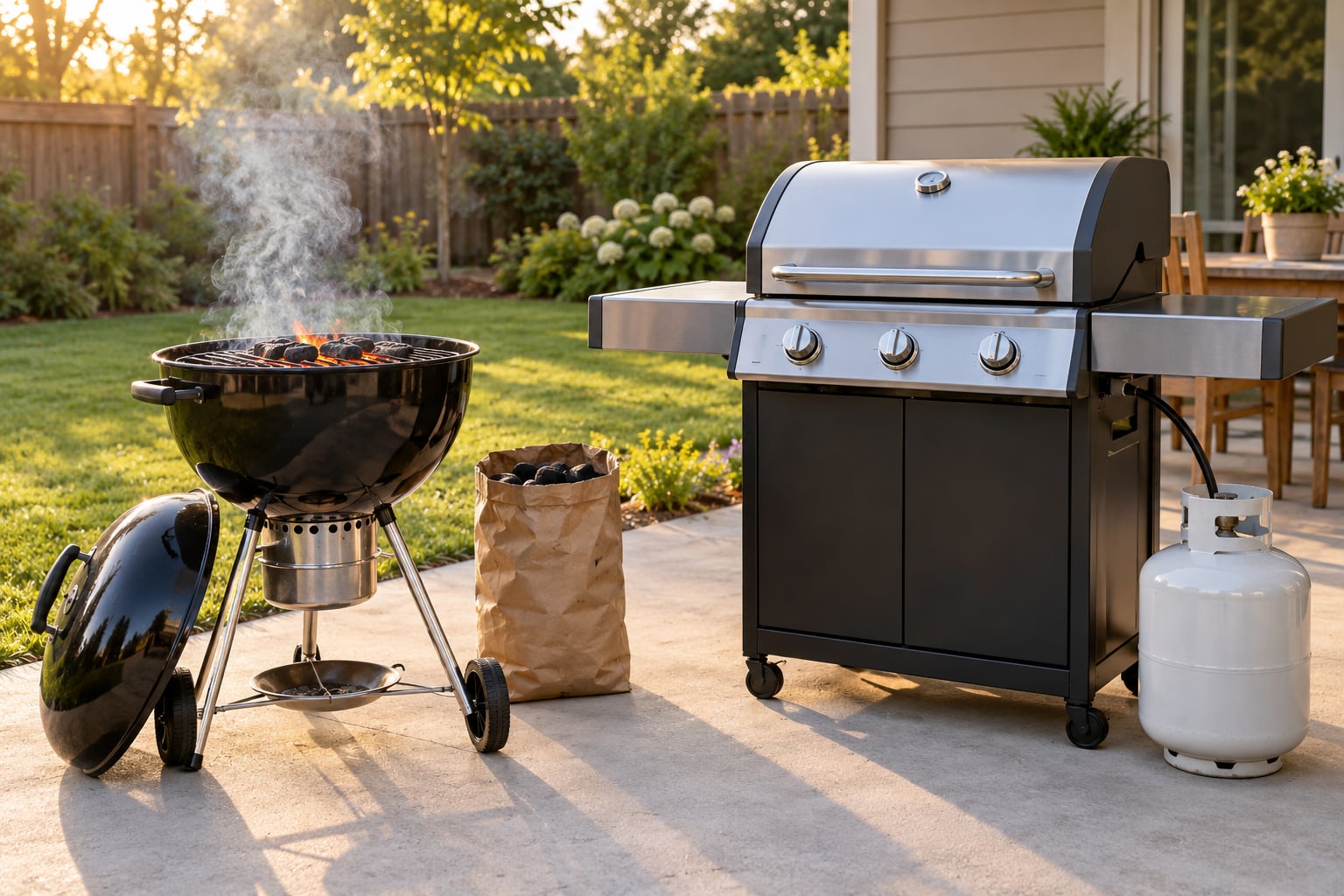
Charcoal wins on flavor, propane wins on convenience, and almost nothing else separates them. The charcoal vs propane grill pros and cons debate is really a question about how much ritual you want in a weeknight cook: charcoal gives you smoke and a searing hot spot you have to manage by hand, propane gives you a knob, a fast preheat and a cleanup that takes minutes.
Most people do not need a winner. You need to know which losses you can live with. Updated for 2026, here is how the two fuels actually compare on taste, control, cleanup, cost and safety, and who each one suits.
Table of Contents
- Charcoal vs Propane Grill Pros and Cons at a Glance
- Flavor and Cooking Style
- Convenience and Learning Curve
- Charcoal vs Propane Grill Pros and Cons for Heat Control
- How airflow changes the temperature on both fuels
- Why coal placement beats a knob for two-zone cooking
- How lid design and geometry shape results
- Startup and Operating Costs
- Cleanup and Maintenance
- Safety, Smoke, and Portability
- Which Should You Choose?
- Frequently Asked Questions
- Which grill produces better flavor, charcoal or propane?
- Is a charcoal grill harder to use than a propane grill?
- Is charcoal grilling safer than propane grilling?
- Are charcoal grills cheaper to run than propane grills?
- Can a propane grill cook with a smoky flavor?
- Conclusion
Charcoal vs Propane Grill Pros and Cons at a Glance
This table is the short version. Read the row you argued about last time.
| Factor | Charcoal Grill | Propane Grill |
|---|---|---|
| Flavor | Smoky, deep, with char notes from dripping fat | Clean and consistent, closer to roasted than smoked |
| Heat-up time | Usually 15 to 25 minutes with a chimney starter | Often 10 to 15 minutes to cooking temperature |
| Ignition | Matches, a lighter, or a chimney and newspaper | A button or a key, then you wait a moment |
| Temperature control | By hand: coal placement and vent openings | By knob, with steady recovery after the lid opens |
| Low and slow smoking | Excellent with practice and a lid that holds heat | Good with a smoker box and an indirect zone |
| Cleanup | Ash, soot and grate work before and after each cook | Grease tray, grates and a quick wipe-down |
| Smoke output | Noticeable, especially during the first minutes | Minimal once preheated |
| Portability | Light, no fuel hookup, but ash rides along | Bulky, and propane cylinders need a place to be stored |
| Learning curve | Real, and it takes a season or two to relax | Short enough to figure out on the first cook |
| Best fit | Slow cooking, smoke flavor, a hands-on ritual | Fast weeknight cooking, beginners, small cleanups |
Flavor and Cooking Style
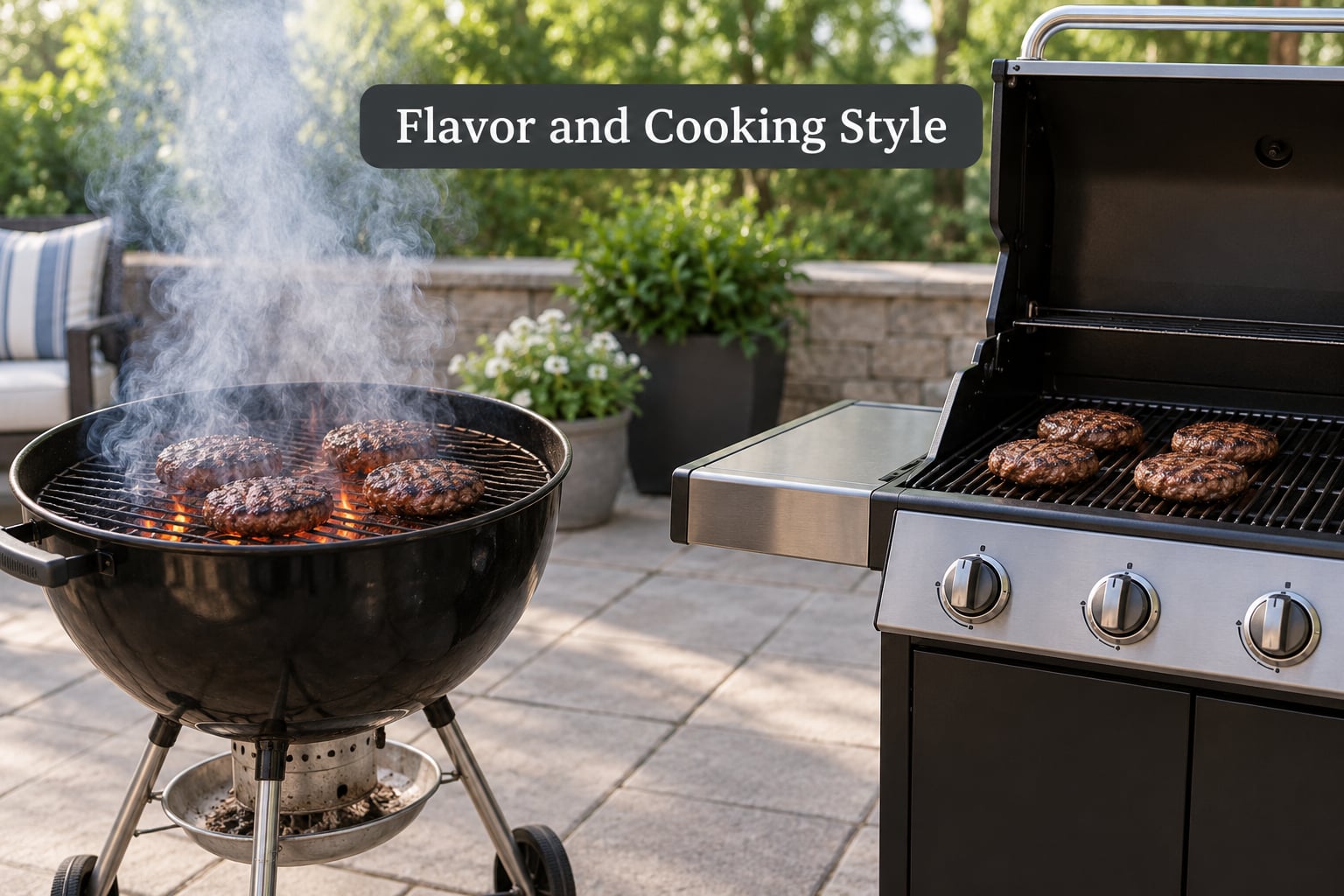
Charcoal tastes different for two reasons, and only one of them is smoke. Briquettes and lump charcoal burn at a higher temperature than a typical gas burner, so drippings hit hot metal and crisp instead of merely cooking, which is where the char and roasted edges come from. The smoke flavor rides along on top of that, and it is genuine: combustion gases and vaporized wood lipids carry through to the food.
That is why a well-run charcoal grill works so well for brisket, ribs and pork shoulder. High heat for the bark, then indirect heat and smoke for hours, all on one grill. A propane grill does that job competently with a smoker box, but you are adding smoke rather than cooking over a burning fuel bed.
Where charcoal is overkill: weeknight chicken thighs, sliced vegetables, shrimp, a hot dog for the kids. The flavor difference narrows sharply when nothing drips and nothing needs to sear hard. Forum users say this constantly, and the recurring counter-argument in grill threads is that the flavor edge is overstated for a Tuesday night cook.
The type of charcoal changes the verdict more than most comparisons admit. Briquettes are uniform, easy to light and burn steadily, which makes them forgiving but a little flat. Lump charcoal is hardwood, lights faster, burns hotter and gives you a more uneven fire to manage. Binchotan burns nearly smokeless and very clean, so it is closer to gas with a charcoal bowl, and it costs noticeably more.
If you want more smoke from propane, three things help. A smoker box filled with soaked wood chips sits beside the burner rather than under the food, so it smokes without flattening the heat. A foil pan of wood chips is a cheaper version of the same idea. And a cast iron griddle or a heavy griddle plate gives you the searing surface that most people miss most on a gas grill.
Convenience and Learning Curve
Propane is faster at every step. A press of the igniter, a short warm-up, and the grate is at cooking temperature. You can be cooking while your coffee brews, and when the food rests you have already started cleaning.
Charcoal asks for more sequence. You fill the chimney, light the bottom, wait for the coals to ash over, pour them out, spread them, and then wait again. A chimney start cuts that down and removes the lighter fluid taste that turns people off from charcoal permanently. It is the single cheapest improvement to the charcoal experience.
The learning curve is not about learning to cook. It is about reading a fire: where the coals are, how much air is moving through the vents, and what happens to temperature when you open the lid. A week of attentive cooks fixes most of it.
Gas has its own planning tax. Tanks have to be exchanged, weighed and stored somewhere sensible, and a grill on natural gas needs a line and a permit in some areas. Grills sized for a family cookout are heavy, so moving one around a small patio is its own chore. That is the trade most people underweight: propane saves time at the grill and spends it somewhere else.
Charcoal vs Propane Grill Pros and Cons for Heat Control
Neither fuel has better temperature control by itself. The grill decides more than the fuel does, and a well-built kettle or a sturdy cabinet grill will hold a set temperature on either fuel.
How airflow changes the temperature on both fuels
Vents are the shared control. On a charcoal grill, opening the intake below the fire and the lid damper above it lets you raise or drop the burn rate without touching the food. On a propane grill, the same movement of air matters less, because the burner output is fixed by the knob rather than by convection. A gas grill still breathes through its lid, and closing it too early on a windy day will cook the fire down.
Why coal placement beats a knob for two-zone cooking
A charcoal grill can hold a screaming hot zone on one side and a gentle one on the other just by moving coals. Gas can do it too, by turning one burner off and banking the other, but then the coolest spot is much larger and less even. Serious barbecue cooks often add a charcoal ring or a heat emitter to a gas grill to close that gap.
How lid design and geometry shape results
A domed lid circulates heat and stabilizes temperature. A flat lid on a small grill gives you a shorter, hotter chamber where a small amount of fuel goes a long way. This is why tabletop charcoal grills are praised for searing and criticized for low and slow cooking, and why propane table-top burners behave the same way. Grates matter too: cast iron stores and radiates heat, while thin porcelain-coated rods give food less contact and less browning.
Recovery is the practical test. When you put a cold pan of burgers down, a gas grill usually comes back to temperature faster. Charcoal recovers if you did not build a fire that is only just big enough.
Startup and Operating Costs
Hardware cost is not a clean differentiator. The two grills sit in overlapping price categories, and a well-made charcoal kettle can cost more than a modest gas grill while a premium gas grill with a side burner and rotisserie can cost more than a premium charcoal. Side burners, storage cabinets, infrared burners and griddles push gas hardware up; kettle construction, cast iron and heavy-gauge steel push charcoal up.
Fuel is where the two diverge, and the shape of the purchase is what confuses people. Charcoal is a consumable you buy by the bag or by the weight, and a hard-working bag can cost more than a small cylinder. Lumping that cost across many cooks, the fuel itself is usually the cheaper side of the ledger, though lump and binchotan carry a higher price per pound than briquettes.
Propane is measured differently: by the weight of the cylinder you exchange, by the fill on a tank at a refill station, or by the delivered amount. You buy it in discrete blocks of roughly 20 pounds on the standard cylinder, so the effective cost per cook depends on how many cooks you get out of one exchange. A grill that heats in 12 minutes burns noticeably less fuel than one that heats in 25 and then idles while you prep.
Forum buyers regularly notice the same thing: comparable gas grills usually cost more to buy and less to run. Over five years of regular cooking, fuel and maintenance tend to favor charcoal, while the hardware gap can flip that in the first year.
Cleanup and Maintenance
Propane simplifies everything after the food is served. The grease tray pulls out, the grates lift off or brush clean, and there is no ash to carry. Soot still shows up on the underside of a gas grill lid and the burner tubes, and owners report that grills need a deeper scrub than the marketing suggests, but it is a scrubbing job, not a disposal job.
Charcoal adds two chores that gas never has. You empty the ash catcher and dispose of cooled ash properly, never into a trash bin while it is warm and never into a compost pile. And spent fuel has to go before the next cook, because old ash blocks vents and dulls airflow.
The maintenance list for a charcoal grill is longer but simple: clear ash from the vents and the underside of the grate, brush the grate after each cook, keep the fire bowl dry, and cover the grill so moisture does not sit on the steel. Rinse with water when cool, dry it, and touch up any rust on the fire bowl and grate. Season cast iron grates with a thin layer of oil and let them heat.
Gas needs its own routine: clean the burner tubes, check the igniter, and confirm hose and regulator connections feel sound. Follow the manufacturer’s instructions for both, and use a grill brush meant for your grate material so you do not strip the coating.
Safety, Smoke, and Portability
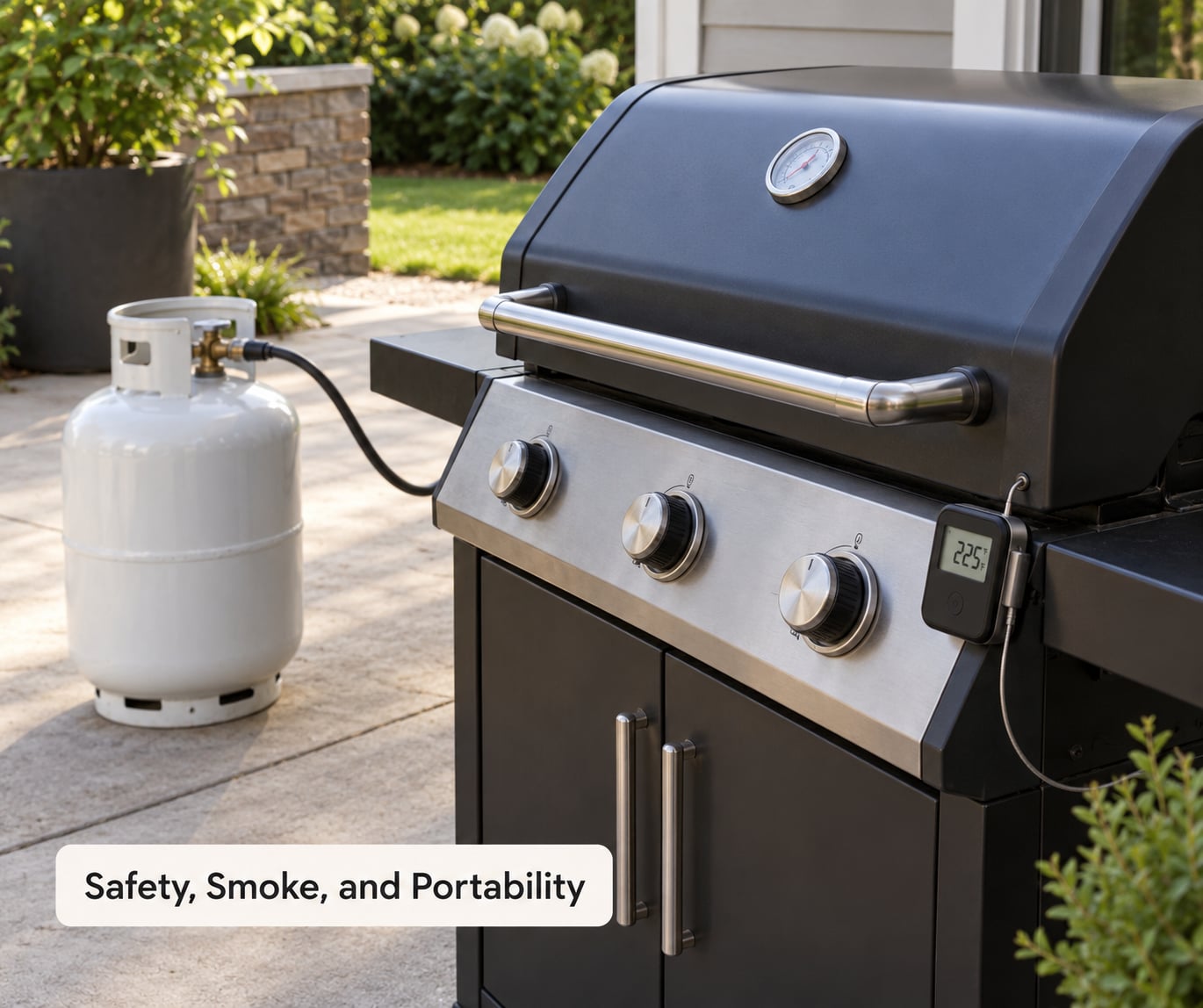
Both grill types belong outdoors, on a stable surface, well away from structures and dry vegetation. Read the owner’s manual before the first cook, not after a problem. Neither grill goes under a wooden pergola, in a garage, or in an enclosed balcony, and many housing associations and apartment rules ban open-flame cooking outright, so check your lease and local rules before you buy.
For propane, check the connection with soapy water before lighting and smell for gas at the burners afterward. Store cylinders upright, outdoors or in a ventilated shed, with the valve closed and the cap on. Never refill a hot cylinder, and never grill with a cylinder in the cooking chamber, the cart cabinet, or a few inches from a hot burner.
For charcoal, light with a chimney and dry newspaper or a torch rather than lighter fluid, which burns off and can flare back into the bowl. Do not use an old charcoal lighter fluid that has been stored past its best-by date. Let ashes cool for at least a couple of days in a metal container with a lid before disposal, and keep water nearby.
Flare-ups come from fat hitting a hot zone, and both fuels cause them. Move the food to the cooler side, close the lid to starve the flame of oxygen, and keep the vents partly open so the coals do not smother. For a grease fire in the pan or the fire bowl, turn off the burners or coals and close the lid. Never put water on burning cooking oil, and never use water on a grease fire.
Cook to safe internal temperatures. Poultry reaches 165°F / 74°C, ground meat 160°F / 71°C, and whole cuts of beef, pork and lamb along with fish reach 145°F / 63°C. Those numbers matter more than the fuel, and a probe thermometer is the cheapest safety tool in the shed.
On smoke: charcoal produces much of its smoke in the first ten minutes as the fats and binders in new briquettes burn off. That is why experienced charcoal cooks wait for the grate to stop smoking before laying food down. The main indoor hazard on either fuel is carbon monoxide, so grill outside and never in a garage or enclosed porch.
Portability splits cleanly. A small charcoal grill needs no power and no fuel hookup, which is why it turns up for camping, hunting trips and tailgating. Propane is easier to control but heavier, and portable gas models need a cylinder carried or mounted deliberately. If you grill from a balcony, a compact electric or small gas grill may be the only option your building permits at all.
Which Should You Choose?
Choose charcoal if most of your cooking is ribs, brisket, shoulder, or whole birds, if you enjoy the process, and if you have somewhere to deal with ash. Choose propane if you cook most weeks, want to be eating within fifteen minutes of deciding, dislike cleanup, or are feeding people who would rather not wait for a fire to get going.
A few specific cases. Beginners usually do better with propane for a season, then move to charcoal once they want the smoke. Renters and balcony cooks should check their rules first, because smoke and open flame are often banned where a small electric grill is allowed. Cold-weather weeknights favor propane, since it recovers to temperature fast in the cold. If you only ever buy one grill and you already know low and slow is your thing, take the charcoal and get a chimney starter at the same time.
Conversion kits exist in both directions, so you are not permanently locked in. A propane grill with a charcoal tray and a cast iron grate covers both jobs in one box, and it is a reasonable compromise if a renter, an HOA or a shared patio is in the picture. Just check the manufacturer notes on clearance, ventilation and warranty before modifying a grill.
Frequently Asked Questions
Which grill produces better flavor, charcoal or propane?
Charcoal, for most people and most foods. It burns hotter, so drippings crisp instead of just cooking, and smoke flavor comes from the fuel itself. Propane gives you clean, repeatable results that suit weeknight cooking, and wood chips in a smoker box narrow the gap without closing it. On fish, shrimp and vegetables the difference gets much smaller.
Is a charcoal grill harder to use than a propane grill?
Yes, especially for the first few cooks. A propane grill lights with a button and holds temperature through a knob. Charcoal asks you to judge fire by eye, arrange coals into hot and cool zones, and manage vents. A chimney starter removes most of the awkward part, so many people are comfortable after two or three cooks rather than two seasons.
Is charcoal grilling safer than propane grilling?
Neither is inherently safer. Both must be used outdoors, away from structures, with a lid and a fire extinguisher within reach. Charcoal carries a carbon monoxide and open-fire-burn risk, and propane carries a leak and stored-cylinder risk. Handling each one exactly as the manual describes is what keeps you safe.
Are charcoal grills cheaper to run than propane grills?
Usually, yes, but hardware cost runs the other way. Comparable gas grills often cost more to buy, while charcoal bought by the bag usually works out cheaper per cook over years of regular use. A propane grill that preheats in twelve minutes also burns far less fuel than a charcoal grill that heats in twenty-five and then idles.
Can a propane grill cook with a smoky flavor?
It can get partway there. A smoker box or a foil pan of soaked wood chips adds real smoke flavor, and chips soaked in water last longer and delay ignition. Add cast iron for searing and use a two-zone layout, and the result is good. It will not match cooking over hardwood charcoal, which burns hotter and seasons the food differently.
Conclusion
Pick propane when you want to be eating fifteen minutes after you decide, when cleanup is a real consideration on a weeknight, or when you are cooking mostly vegetables, fish and quick cuts. Pick charcoal when smoke flavor and hard sear are the point, when most of your cooking takes hours, and when the ritual of fire management is something you enjoy rather than tolerate.
Before you buy anything, write down the two or three dishes you cook most and look at the space you have. Most people who go wrong are not choosing the wrong fuel, they are choosing for an imagined cookout instead of their actual Tuesday dinner. Start from the menu, check your patio or lease rules, and pick the grill that suits the cooking you already do.