A dryer takes too long when the wet air it pulls off your clothes cannot escape, when the heat is weaker than it should be, or when the sensor that decides the load is dry stops reading. That is the short answer to why does my dryer take so long to dry clothes: the leading cause in most homes is a restricted exhaust vent, followed by a dirty lint screen. Both are ten-minute jobs with a vacuum, not a technician call.
The reason those two come first is physics. A dryer lifts moisture off fabric with warm moving air, then pushes that moisture out through a duct to the outdoors. If the duct, screen, or drum seal leaks or restricts that path, the moisture has nowhere to go and the load cannot dry no matter how many cycles you run.
Work through the steps below in order and stop when the times drop back to normal. Most people find the problem in the first twenty minutes.
Table of Contents
- What You Need
- Why Does My Dryer Take So Long? Step-by-Step Troubleshooting
- 1. Confirm the load is the problem
- 2. Clean the lint screen and lint trap
- 3. Check the dryer vent and exhaust path
- 4. Why does my dryer take so long on towels and heavy bedding?
- 5. Test whether the dryer is heating correctly
- 6. Check door, belt, drum, and control issues
- Common Mistakes That Make Drying Take Longer
- Frequently Asked Questions
- How long should a dryer take to dry a normal load?
- Why is my dryer hot but clothes stay wet?
- Can a clogged dryer vent cause a fire?
- Should I clean the lint screen after every load?
- Is it normal for a dryer to take two or three cycles for towels?
- How do I know if the dryer heating element needs replacement?
- Start With the Simplest Fix First
What You Need

You do not need much to start. Grab the dryer’s owner’s manual and the model number from the door frame or the back panel first, because every part name and test procedure below is model-specific.
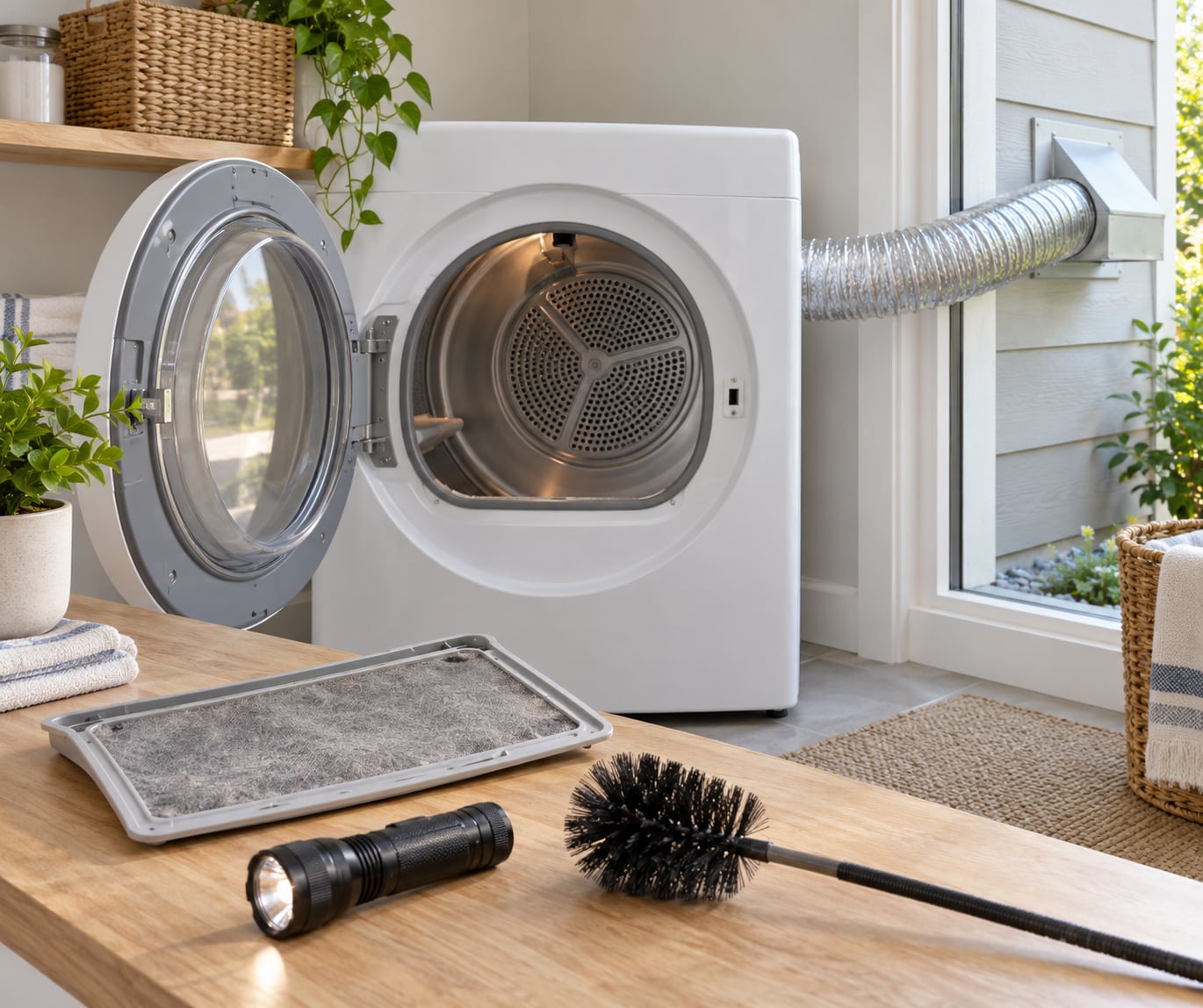
- A flashlight, for the back of the dryer and the duct connection
- A vacuum with a hose attachment, plus a dryer vent brush or flexible vent-cleaning tool
- Warm water, dish soap, and a soft brush or toothbrush
- A screwdriver, a socket set, and pliers for removing a back or lower access panel
- Work gloves
- A multimeter, only if you already have electrical experience and the manual calls for a continuity check
- A spare lint screen, and a replacement heating element, thermal fuse, or igniter if you already know which one your model uses
Set the dryer on a hard floor or protect the floor with a towel before you pull it out, and unplug it before you open any panel. For a gas dryer, know where the gas shut-off valve is before you start.
Why Does My Dryer Take So Long? Step-by-Step Troubleshooting
Start with the easiest checks and work down the list. Each step costs a few minutes, and stopping at the first fix is how most slow dryers get resolved.
1. Confirm the load is the problem
A dryer cannot dry what it cannot move. If the drum is packed solid, clothes sit in a clump and the hot air has no path through the pile.
Fill the drum roughly two-thirds full, no more. Anything above that line is an overload, even if it feels like it fits. Splitting one stuffed load into two loose loads usually beats one very long cycle.
Then check the settings. Mixed cottons need a normal or heavy cycle, not permanent press or delicates, which run cool. If your machine has a dryness level control, move it toward “more dry” for one test cycle and see whether the load changes. An air-fluff or no-heat cycle dries nothing at all.
Two habits cut real minutes off a load. Spin the clothes an extra rinse cycle in the washer so they enter the dryer less wet, and toss one clean, dry towel in with the load — that towel gives the wet fabric more surface to touch, and people on laundry forums report it makes a noticeable difference.
How do you tell a normal finish from a fault? Take the load out, hold a towel to the drum vent while the machine is running, and feel for moving air. Airflow you can feel means the machine is moving air; a cold vent with a running blower usually points to a blocked duct.
2. Clean the lint screen and lint trap
Pull the lint screen out of the top of the drum opening and hold it up to a light. If you cannot see light through the mesh, air is being pushed through a screen that is mostly lint.
Wash it in warm soapy water, scrub the mesh with a soft brush, and let it dry completely on a towel. A screen that goes back in damp traps fresh lint immediately, which is the opposite of what you want.
Clean the whole housing, not just the screen. Lint packs into the chamber around the screen and around the door frame, and that buildup is invisible until you pull the screen out and look behind it. Use gloves; that lint is fine and it goes straight into the air.
Here is a quick test for a blocked path: hold the clean screen up in front of a strong light or blow into it. If airflow feels weak, the duct behind it is likely restricted too, which is the next step.
3. Check the dryer vent and exhaust path
The restricted exhaust vent is the single most common cause of long dry times, and it is the one most homeowners never check. Warm, humid air with nowhere to go means every load takes longer.
Follow the duct from the back of the dryer to the outside wall. You are looking for three things: kinked or crushed flexible duct, a connector that came loose, and the exterior hood where lint and debris collect.
Go outside, open the vent hood, and look in. Insert the vent brush and work it in and out several times to break up packed debris, then vacuum the hood and the first few feet of duct. Run a vacuum hose into each end of the duct run from inside and outside — a shop vac is better if you have one.
Check the exterior flap. A flap that is stuck shut or jammed by debris restricts airflow, and a screen or mesh guard installed over the hood is a common culprit in newer homes.
If the duct runs through a wall, attic, or roof and you cannot reach it, stop there. That stretch is not a homeowner job, and pushing debris further in with a broom handle or a garden hose is how a slow dryer gets worse. A vent cleaning service or a technician with the right tools is the right call.
4. Why does my dryer take so long on towels and heavy bedding?
Towels and comforters are the usual suspects when a dryer is fine on synthetics and hopeless on cotton. They hold far more water, and once the outer layer dries, moisture has to migrate from the inside of the fabric outward.
A full towel load, several blankets, and a humid laundry room all stack up. In summer, or in a basement with no window, the incoming air already carries moisture, so the machine is fighting the whole room.
Check that the drum is actually tumbling. Turn it by hand with the door open and the machine off. It should roll smoothly with a little resistance. A machine that turns stiffly and freely, or that grinds and squeals as it turns, points to a stretched belt, a seized idler pulley, worn drum glides, or a bearing going out — all of which reduce tumble and stretch every cycle.
If you own a condenser or ventless dryer, the coil and the reservoir that collects condensed water need cleaning on the schedule in your manual, usually monthly. A clogged condenser coil or an empty water reservoir slows drying badly, and no vent clean will touch it.
One automatic-cycle behaviour confuses people constantly: the machine runs the full timed length, you restart it, and it stops after one minute. That is the moisture sensor working as designed once the load is dry. If the clothes are still soaking wet, the sensor bars are coated with softener film, detergent residue, or dryer sheet coating.
5. Test whether the dryer is heating correctly
Sort your symptom before you test anything, because the three slow-heat complaints have different causes.
No heat at all, on an electric dryer, points to the heating element, the thermal fuse, the high-limit thermostat, or a tripped breaker. Intermittent heat, where the load dries sometimes and not others, often means a heating element with a weakened section or a failing thermostat cycling erratically. Heat that works but dries slowly usually means airflow, not heat.
On a gas dryer the equivalent parts are the igniter, the thermal fuse, and the gas valve solenoids. No heat here can also come from a burner that lights and goes out, which is a common gas valve failure rather than a heating element problem.
Check the power side. Electric dryers run on a 240V dedicated circuit, and an extension cord is a frequent cause of a machine that heats weakly or trips. A gas dryer still needs 120V for the board, the igniter circuit, and the timer. If the dryer does nothing at all, start at the breaker and the cord, not at the motor.
Read the model-specific manual before testing or replacing any of these parts. Continuity tests on a live circuit are for people who already work on appliances — for everything past the lint screen, the vent, and the load, a technician is the safer call.
6. Check door, belt, drum, and control issues
Start at the door. A door switch that no longer latches properly can make the machine run a short, cool cycle and never finish, and a worn door gasket that lets room air in changes how the whole load behaves.
Look at the drum seals and glides. Torn seals let heated air escape before it has done its work, and missing glides let the drum ride over the rear rollers instead of turning on the drive belt.
The last group is the electronics: the moisture sensor bars and their wiring, the timer or control board, and the heating circuit’s safety switches. These are the parts people try to bypass, and bypassing a thermal fuse or high-limit thermostat is a good way to turn a slow dryer into a fire. If you get here, note down the brand, model, serial number, the cycle you selected, the load type, the approximate time on the first cycle, and whether the drum is hot. That list saves a technician twenty minutes and saves you a second service fee.
Common Mistakes That Make Drying Take Longer

Most slow dryers get worse because of a well-intentioned fix. Here is what to stop doing.
- Putting the lint screen back in while it is still damp. A wet screen grabs new lint within one load and starts the buildup again.
- Pushing debris deeper into the duct. A broom handle, a garden hose, or a long pole compacts the clog deeper and makes a proper clean more expensive.
- Running the dryer with the vent disconnected to “test” it. This fills the room with hot lint-laden air, and on a gas dryer it can push combustion gases back into the house. Fix the vent, then test the dryer.
- Bypassing a thermal fuse, high-limit thermostat, or door switch. Those switches exist because the machine has already overheated or the door was open. A dryer that is tripping them has a real fault underneath.
- Replacing parts before identifying the fault. A new heating element in a machine with a clogged vent changes nothing except the receipt.
- Overloading and then blaming the dryer. Packed loads are the most common cause of long dry times and the easiest one to fix.
One more worth knowing: lint trapped in a restricted vent is highly flammable, and lint-packed dryers are a leading cause of residential laundry fires. A blocked vent on a gas dryer can also push carbon monoxide into the home, so if your laundry room gets noticeably hot and humid while a load runs, treat that as a reason to stop and fix the exhaust path rather than to run one more cycle.
If you want more speed before you reach for any tools, three habits do most of the work: split dense loads into two looser ones, choose the cycle and heat level that match the fabric instead of a cool or air-only setting, and clean the lint screen every single load. Users on appliance forums consistently land on the same order of triage — lint trap first, then vent, then heat — and it is the order that saves money.
Frequently Asked Questions
How long should a dryer take to dry a normal load?
A full load of mixed cottons on a medium heat cycle usually takes 40 to 60 minutes. Small loads finish in 20 to 30, and an all-towel load on an older machine can run past an hour. There is no single number to judge by, because load size, fabric, humidity, and machine age all matter. If your dryer recently got much slower than this, treat the change as the signal and work through the steps above.
Why is my dryer hot but clothes stay wet?
Because the heat is reaching the fabric but the moisture is not leaving. The usual causes are a restricted exhaust duct, a lint-packed screen, or an overfilled drum that cannot tumble. If the load is only slightly damp, check whether the machine is on a cool or air-only setting. If a restart finishes in one minute while the clothes are soaked, the moisture sensor bars are likely coated and need cleaning.
Can a clogged dryer vent cause a fire?
Yes. Lint is highly flammable, and a blocked exhaust duct lets that lint build up where the heating element can reach it. Lint-packed dryers are a leading cause of residential laundry fires. On a gas dryer, a restricted vent can also push combustion gases back into the home, so treat a hot, humid laundry room during a cycle as a sign to stop running loads until the exhaust path is clear.
Should I clean the lint screen after every load?
Yes, after every load. It takes under a minute and it is the cheapest maintenance a dryer gets. Wash the screen in warm soapy water, scrub the mesh, and let it dry fully before reinstalling. While it is out, wipe the chamber around it, because lint packs in behind the screen where most people never look.
Is it normal for a dryer to take two or three cycles for towels?
Not on a healthy machine. A dryer that needs repeated cycles for towels is usually telling you something: a restricted vent, a packed lint screen, a load that came out of the washer too wet, or a heater that is not reaching full temperature. Towels are a fair test load because they are hard and uniform. If towels need three cycles, dry something light and cotton instead and see whether that comes out crisp in one.
How do I know if the dryer heating element needs replacement?
On an electric dryer, the signs are a cold drum with the breaker held, or a drum that heats briefly and goes cool, which points to the heating element, the thermal fuse, or the high-limit thermostat. Check the breaker and the 240V circuit first, and rule out the vent and the settings, because a slow dryer that is already weak on power will fool you. Testing the element for continuity is a technician job on a live appliance.
Start With the Simplest Fix First
Why does my dryer take so long to dry clothes? Almost always because air is being blocked, heat is not being delivered, or the sensor is not reading — and the blockage is nearly always at the lint screen or the exhaust vent. Clean the screen, clean the duct you can reach, and run a properly sized load on the right cycle.
If the times are still long after that, the answer is in the heating circuit or the control electronics, and that is where a technician earns their visit. Bring them the model number, the cycle time, and whether the drum is hot, and you will get a faster and cheaper diagnosis than the person who has to guess.