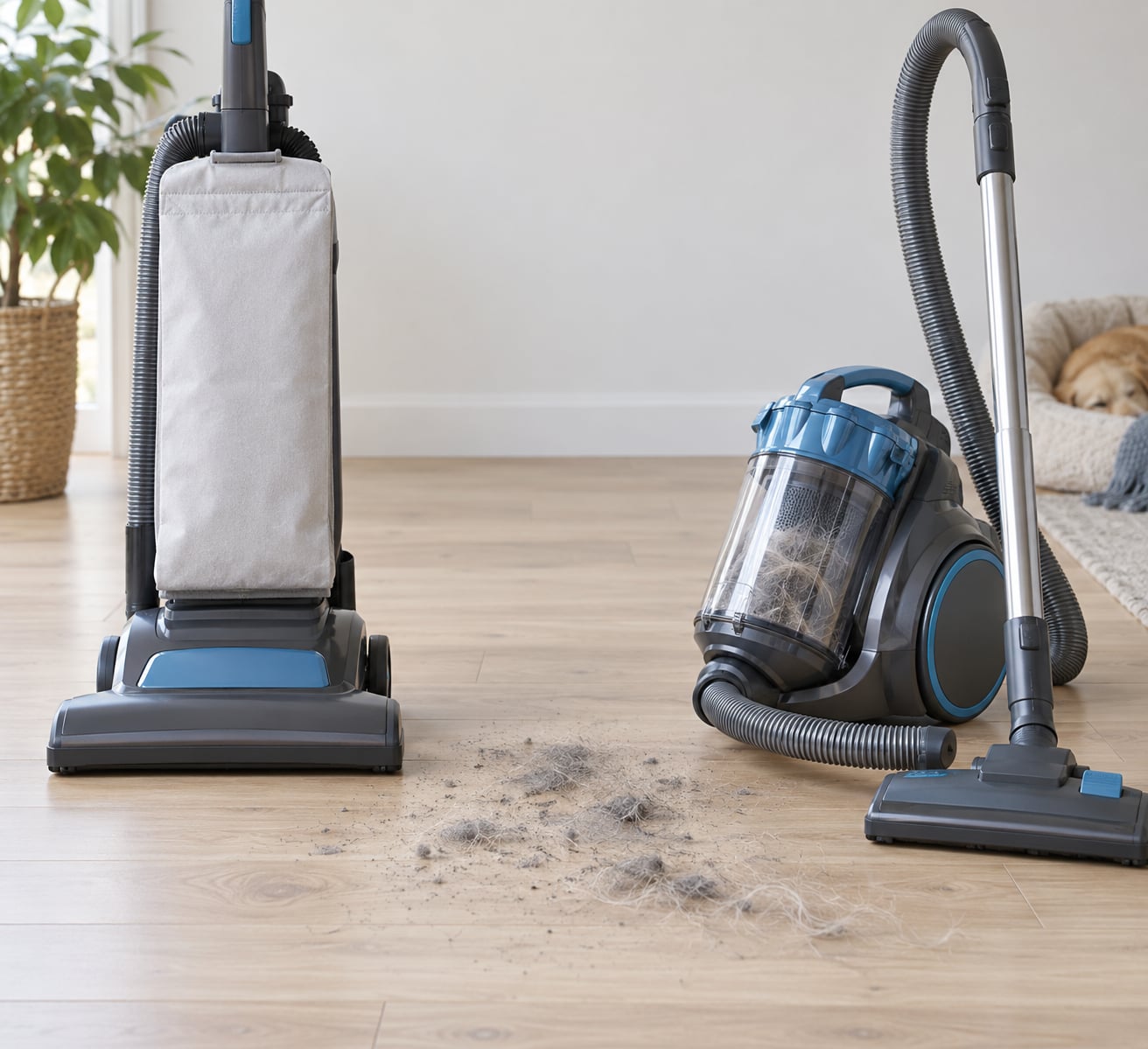
A bagged vacuum is the better pick for allergy sufferers, because the sealed bag holds all that collected dust until you throw it away closed. A bagless vacuum works well only when its filter housing is genuinely airtight and you empty the bin outdoors.
That emptying step is the whole argument. While the machine runs, both formats pull allergens off the floor and into an airflow path that filters them. The difference shows up ten minutes later, when the debris comes back out.
Everything below is about indoor air quality and dust exposure. It is not medical advice, and a vacuum is one piece of a larger plan that usually includes humidity control, mattress covers and time spent away from dust. If your symptoms are persistent or severe, talk to a doctor about the full picture.
Last updated: October 2026
Table of Contents
- Bagged vs Bagless Vacuum Which Is Better for Allergies at a Glance
- Allergen Capture and Filtered Airflow
- The bag is a pre-filter, not a HEPA filter
- What sealed HEPA system actually means
- How bagless machines separate debris
- Bag formats vary more than most shoppers realize
- Bagged vs Bagless Vacuum Which Is Better for Allergies by Test Results
- Carpet versus hard flooring
- Fine dust retention and pile-up
- A five-minute test on your own machine
- Dust Containment and Maintenance
- Emptying a bagless vacuum without a dust cloud
- Bagged machines fail in their own way
- Operating Costs and Replacement Filters
- Noise, Odors and Everyday Convenience
- Which Should You Choose?
- Exceptions worth knowing
- A seven-point checklist for any vacuum, either format
- Frequently Asked Questions
- Are bagless vacuums bad for people with allergies?
- Does a bagged vacuum need a HEPA filter to help with allergies?
- How often should I empty a bagless vacuum if I have allergies?
- Can a vacuum make allergy symptoms worse?
- Which type is better for removing pet hair and dander?
- How do I keep dust from escaping when emptying a bagless vacuum?
- The Short Version
Bagged vs Bagless Vacuum Which Is Better for Allergies at a Glance
| What matters | Bagged | Bagless |
|---|---|---|
| Dust exposure when emptying | Low, debris stays sealed in the bag | High unless you empty outdoors and slowly |
| Filtration stages | Bag pre-filter plus exhaust filter | Cyclone separation plus post-motor filter |
| Sealed system | Depends on collar gasket quality | Varies widely; verify the housing seals |
| Best bag or bin design | Self-sealing bag | Bottom-emptying bin with a slow-release flap |
| Maintenance | Swap bag, wash or replace filter | Empty bin, clean cyclone, wash filters |
| Running cost | Recurring bags and liners | Filters plus disposal liners or bags |
| Odor control | Sealed bag hides smell in the debris | Open bin releases odor every emptying |
| Best fit | Allergy, asthma and pet households | Mild allergies, rentals, zero-consumable shoppers |
Read the first row and most of the decision is already made. The rows below it decide whether the format you picked is built well.
Allergen Capture and Filtered Airflow
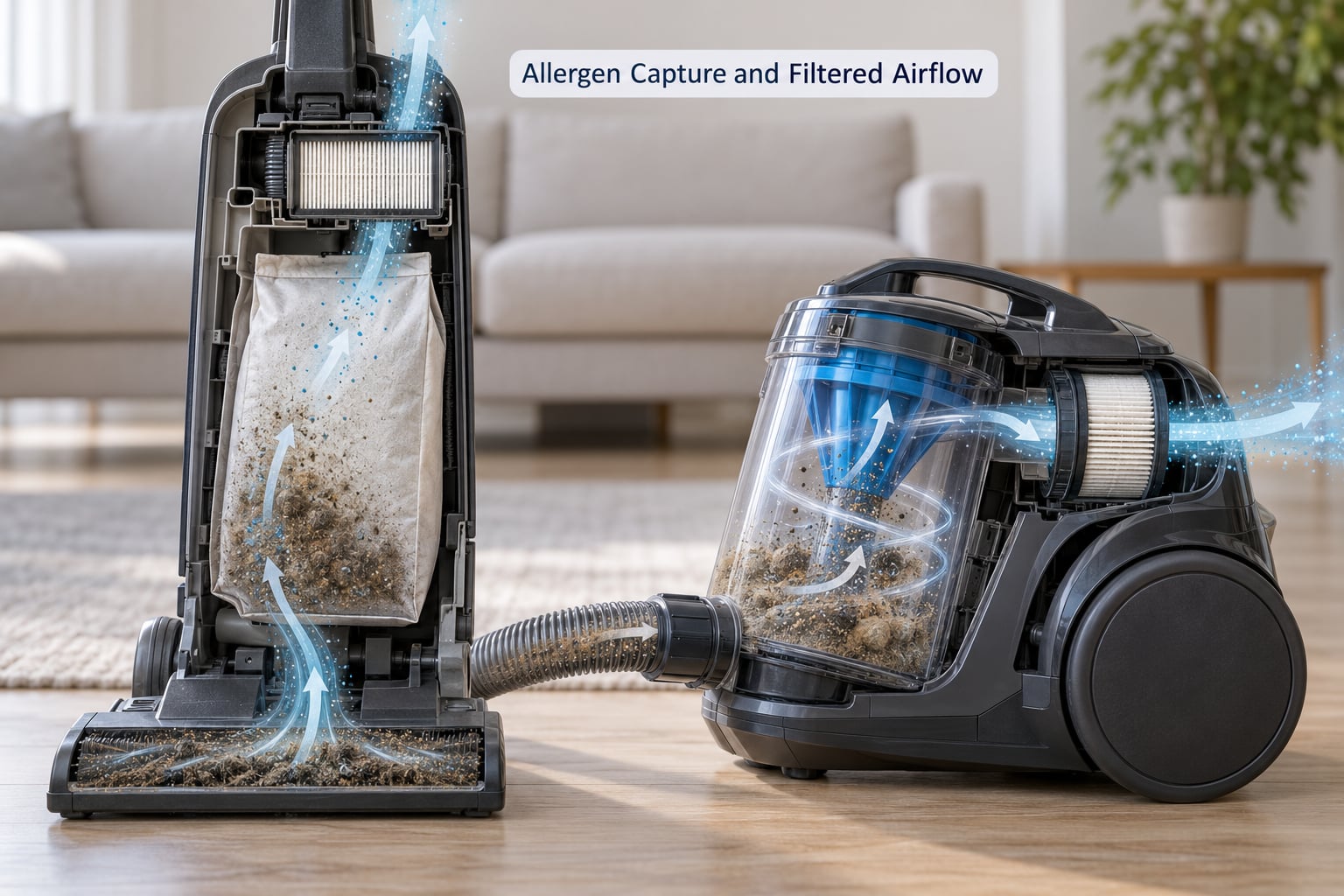
Both machines run the same basic loop. Air and debris enter through the floor head, travel past a brush or agitator, get separated somehow, and exit through a filter. Fine particles such as dust mite debris, pollen, dander and flour-like household dust are small enough to stay suspended, which is why they follow the airflow instead of falling out early.
The bag is a pre-filter, not a HEPA filter
The most common mix-up is assuming the bag does the fine-particle filtering. It does not. In a bagged vacuum the multi-layer bag is the first filtration stage: it catches coarse grit, hair and larger dust while letting air continue through, so it protects the machine and keeps the debris contained. The fine-particle work is done by the exhaust filter downstream, and on many machines that filter is a separate cartridge or bag liner rather than a true HEPA element.
Which means a bagged vacuum only earns an allergy claim if it has real fine filtration at the exhaust stage, or an allergen-grade bag rated for it. Ask for the rating, not the marketing.
What sealed HEPA system actually means
A HEPA filter is rated at 0.3 microns, meaning it captures a stated share of particles at that size when air passes through it under test conditions. A sealed HEPA system is a different claim about the whole machine: every bit of air that leaves the vacuum has to pass through that filter, because the housing around it does not leak.
The distinction matters more than the label. A HEPA cartridge fitted into a housing with a gap beside it delivers exactly nothing, because dirty air simply bypasses the media. Look for gasket construction around the filter frame, a sealed motor housing, and a filter that is a genuine part of the design rather than an add-on.
How bagless machines separate debris
Bagless vacuums use a cyclone. Debris spins around the inside of a cone, larger particles are flung outward and drop into the bin, and air continues to the post-motor filter. That arrangement is genuinely good engineering, and a clean cyclone holds airflow well.
The trade-off is that the separated fine dust stays loose in an open bin. It is not contained in any way, and it is sitting right there waiting for you to lift a lid.
Bag formats vary more than most shoppers realize
Not every bagged vacuum contains dust equally well. Format families you will run into include:
- Standard paper bags, cheap and common. They tear if you let one run past full.
- Microfibre bags, which hold more and survive a larger load before risking a tear.
- Self-sealing bags, which pinch closed as you pull them off the collar so debris cannot spill. Brands built around this format include Miele, Oreck, Air-Way and Kirby-style cloth systems.
- Allergen liner bags, multi-layer bags marketed for fine-particle retention. Useful, though they still need a sealed collar to do their job.
For an allergy household the third category is the one worth shopping for. Confirm the bag part number for your specific machine is still produced before you buy, because a bagged vacuum with no available bag is an expensive bin.
Bagged vs Bagless Vacuum Which Is Better for Allergies by Test Results
Independent allergen capture testing is rare and expensive, and published comparisons disagree in ways that mostly reflect whose machine was in the lab. So rather than pretend there is a clean number, here is what pickup behaviour actually looks like, plus a home test you can run yourself in five minutes.
Carpet versus hard flooring
On carpet, both formats pick up embedded grit effectively when the brush is spinning and the head moves slowly. Bagless machines have a slight edge in holding capacity here, since a large bin delays the emptying that triggers exposure. On hard flooring the gap closes, because debris does not embed and both machines rely on airflow and brush contact.
Pet hair is its own category. A rotating brush with a strip or comb picks hair out of carpet nap, and a hair that stays wound around the brush roll keeps working against you. Several bagged uprights include a brush roll off switch for that reason, which is a practical point in the bagged column.
Fine dust retention and pile-up
Here is where bagged machines have a hidden weakness. As a bag fills, the porous media packs down and airflow drops. Some owners notice suction falling sharply with fine dust and sand, and some report it levels off partway through. The practical fix is simple: change the bag at two-thirds full rather than waiting for the indicator or for the machine to sound different.
Bagless machines have the mirror-image failure. Fine dust and sand coat the cyclone cone and the post-motor filter over a few years, and a neglected filter quietly erodes the performance the machine was rated for. Washing filters on schedule is what keeps a bagless machine performing like its spec sheet.
A five-minute test on your own machine
Lay a dark sheet of paper or a black fabric scrap on the floor and vacuum it. Now check the paper under a bright lamp: the speckling you see is what escaped capture and settled back down.
Then run the same pass again immediately and vacuum the same patch a third time. Little dust on the third pass means good retention. Then empty the machine the way you normally would, indoors, and look at the surface underneath your bin or bag collar afterwards. That residue is the real measure of how much your routine puts back into the room.
Dust Containment and Maintenance
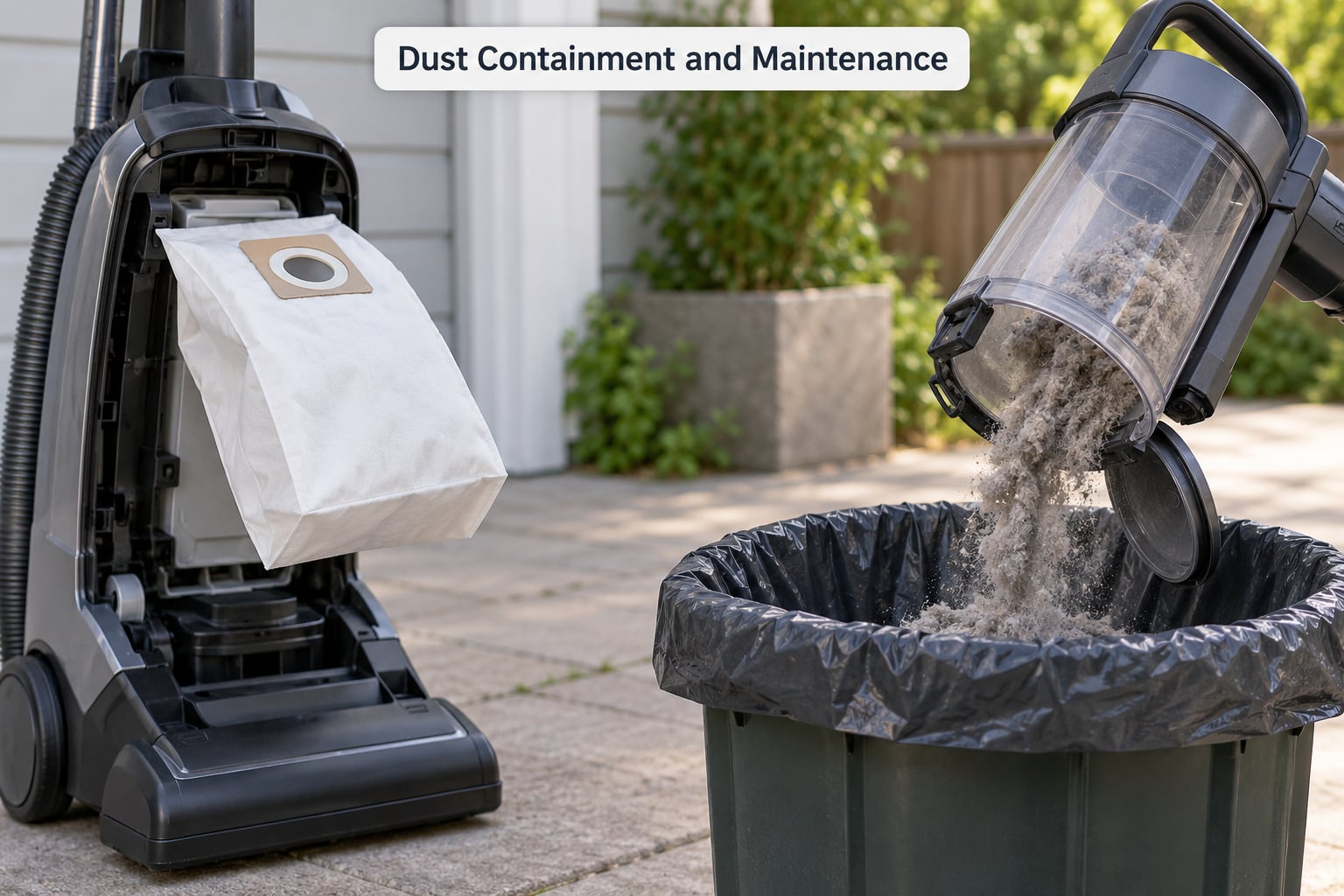
A well-seated self-sealing bag contains everything the machine collected until the bag reaches your bin. Nothing airborne, nothing to breathe, and the mess is a small hard lump rather than a loose cloud. That is the whole advantage, and it is a bigger advantage than any spec sheet suggests.
A bagless bin reverses that. The moment you unlatch or lift the lid, loose fine dust is exposed to the room air, and dumping it fast turns it into a plume. Users on vacuum forums describe exactly this, including one whose dust cloud was visible in low sunlight after emptying carefully in a garage. Their conclusion matches mine: care helps, but no technique makes an open bin as clean as a closed bag.
Emptying a bagless vacuum without a dust cloud
If you already own one, this routine makes a real difference.
- Take the machine outside, to a garage or an open porch. If that is impossible, do it in a bathroom with the door shut and a window open.
- Line the outdoor bin first, so the contents land in a bag rather than a bare bucket.
- Open the bottom flap and let debris drop by gravity. Do not tip the canister over and dump it in one motion.
- Dampen the bin rim or the liner with a cloth first, so airborne fine dust sticks instead of drifting.
- Wear a mask for the first few empties of an unfamiliar machine, then leave the space for a few minutes before going back inside.
Two habits help more than the rest. Empty before the bin is packed rather than after, and keep spare liners and spare filters on hand so maintenance never gets skipped.
Bagged machines fail in their own way
Containment is not automatic inside a bagged format either. A bag that is only half seated on its collar lets debris leak around the gasket and into the housing, and one VacuumLand poster described half the dirt going into the bin instead of the bag, followed by a bad sneezing fit. A worn or hardened collar gasket does the same thing gradually, without anyone noticing.
Push the bag fully home until it seats, check the collar gasket when you change bags, and change at two-thirds full. That is the whole maintenance routine for a healthy bagged machine, plus occasional filter cleaning.
Operating Costs and Replacement Filters
Prices move around, so compare the structure of the cost rather than any single figure. A bagged machine carries a purchase price plus recurring bags, and bag cost scales directly with how much you clean. Households that vacuum a bedroom twice a week buy far more bags than households that run one machine over hard floors on a schedule.
Bagless machines carry a purchase price plus filter replacements and disposal. The catch is that most people still empty the bin into a plastic liner or a bag, so the consumable you were promised you would avoid still shows up on your receipt, just in smaller amounts. Forum users have noticed this for years, and it is worth naming: the money-saving argument mostly applies when the bin is emptied straight into an outdoor bin without a liner.
One more asymmetry. Bagless owners accumulate filters, cyclones and liners over a decade, and the post-motor filter is the piece most often ignored until it clogs. A bagged owner accumulates bags and liners, nothing else that matters. When you weigh the recurring cost of bags against cleaner containment, the calculation is not really about money at all.
Filter replacements follow the manual rather than the calendar in most cases. Washable pre-motor filters should be washed and fully dried; a wet filter blocks airflow and can damage the motor over time. Post-motor HEPA cartridges are usually not washable and get replaced on schedule or when airflow drops.
Noise, Odors and Everyday Convenience
Motor noise is roughly comparable between formats at similar power, and the larger difference usually comes from the motor itself and from cordless versus corded. That decision tends to matter more for allergy households than bag versus bin, because a cordless stick vacuum is almost always bagless and gives you nowhere outdoors to empty it.
Emptying frequency favors bagless on raw convenience. A large bin can hold two rooms of carpet debris before anyone has to think about it, whereas small bagged canisters fill in one room. For allergy households that convenience is worth less than it appears, because frequency is exactly the variable that determines how much fine dust gets back into the air.
Storage is similar. A canister and an upright both need floor space, and neither solves the problem of finding a discreet place for the machine in a small apartment.
Odor deserves a note because it matters more than people expect. A sealed bag holds kitchen crumbs, pet debris and damp lint behind multi-layer material that most people never smell. An open bin releases those smells every single time you empty it, which for some households is the deciding factor on its own. Neither design eliminates odor: a bagged machine with a full bag still leaks odor through the collar, and a bagless machine that smells usually has a filter or bin that needs attention.
Which Should You Choose?
Choose a bagged vacuum if anyone in the house has dust mite allergy, asthma, dander sensitivity or general respiratory sensitivity, if you have more than one pet, if you clean a carpeted bedroom or nursery, or if you simply do not want a step in your routine that puts collected dust back into the air. Prioritize a self-sealing bag and a fine-particle exhaust filter over every other feature.
Choose a bagless vacuum if your allergies are mild, you are renting or replacing machines often, you can genuinely empty outdoors, and you are willing to wash filters and clean the cyclone on a schedule. Verify the housing around the filter is sealed, not just that the filter is labelled HEPA.
Exceptions worth knowing
Strong suction on heavy wet debris favors a large-capacity machine with a powered brush, and both formats make them. If your main problem is large debris rather than fine dust, bag versus bin matters much less than bin size or bag size.
Pet hair on carpet favors a brush roll you can clean, and a switch that disengages it for hard floors. Format is secondary there too.
A central vacuum carries its debris to a remote canister, usually far from the room you are cleaning, which genuinely reduces in-room dust. How well that canister seals is still the question that matters for allergies. Robot self-empty docks are bagged by nature, so they fall on the contained side of this comparison, though their bags are small and the dock is another opening event.
A seven-point checklist for any vacuum, either format
- Sealed filter housing. No visible gap around the filter frame or motor housing.
- A real filtration stage. HEPA or allergen-rated at the exhaust, not just a washable pre-motor screen.
- Containment at removal. Self-sealing bag, or a bottom-emptying bin with a slow-release flap.
- Filter care that is cheap and easy. Washable pre-motor filter, reasonably priced post-motor cartridges.
- Consumable supply. Confirm bags and filters for your exact model are still made and easy to order.
- Capacity that matches your home. Small bin or tiny bag means emptying often, and often is the exposure.
- A cleaning tool that suits your floors. A brush roll you can remove and clear saves you from working around wrapped hair.
If a machine fails points one or three, it will not protect anyone with allergies no matter what the label says. Start there when you shop.
Frequently Asked Questions
Are bagless vacuums bad for people with allergies?
Not inherently. A bagless vacuum with a genuinely sealed filter housing can filter well while you use it. The problem is the emptying step, when collected fine dust becomes exposed to the room. If you empty the bin outdoors, slowly, into a lined bin, and wash the filters on schedule, a bagless machine is a workable choice for mild allergies.
Does a bagged vacuum need a HEPA filter to help with allergies?
Yes, in the sense that the bag alone rarely handles fine particles well. In a bagged vacuum the bag is usually a pre-filter that traps coarse debris and protects the machine, while a separate exhaust filter does the fine-particle work. What helps allergies most is a combination: an allergen-grade or self-sealing bag for containment plus a rated fine-particle filter at the exhaust.
How often should I empty a bagless vacuum if I have allergies?
Empty before the bin reaches full rather than after. Once debris packs down, emptying gets messier and the fine dust that lifts is larger in volume. If you can reach an outdoor bin, do it there every time. If you must empty indoors, use a liner and open the bottom flap slowly instead of tipping the canister over and dumping it.
Can a vacuum make allergy symptoms worse?
Yes, and it is the reason the emptying step is the focus of this comparison. Vacuuming stirs settled dust and allergens into the air, and dumping an open bin puts the largest collected amount of that material back into the room. Sealed bagged systems remove that exposure entirely, and sealed filter housings reduce what escapes during use. Persistent symptoms deserve a doctor’s opinion, not a vacuum choice alone.
Which type is better for removing pet hair and dander?
For hair on carpet and rugs, either format works if the brush roll actually lifts the hair and you clear it regularly. For dander and fine dust, the bagged format wins at disposal, since sealed bags keep the collected debris out of the room. Look for a brush roll off switch for hard floors, and treat a brush that wraps with hair as a lost cleaning tool.
How do I keep dust from escaping when emptying a bagless vacuum?
Empty outdoors or in a garage, and line the bin with a plastic bag before you start. Let the debris fall through the bottom flap by gravity rather than tipping the canister over fast, and dampen the bin rim or the liner with a cloth first so floating fine dust sticks. Wear a mask for the first few empties of an unfamiliar machine, then give the space a few minutes to settle.
The Short Version
Buy a bagged vacuum with a self-sealing bag and a rated exhaust filter if allergies drive the decision, because it removes the one step that puts collected dust back into your air. Stay bagless if you can empty outside and keep filters clean. Either way, judge the sealed system and the removal step before you judge anything else on the label.