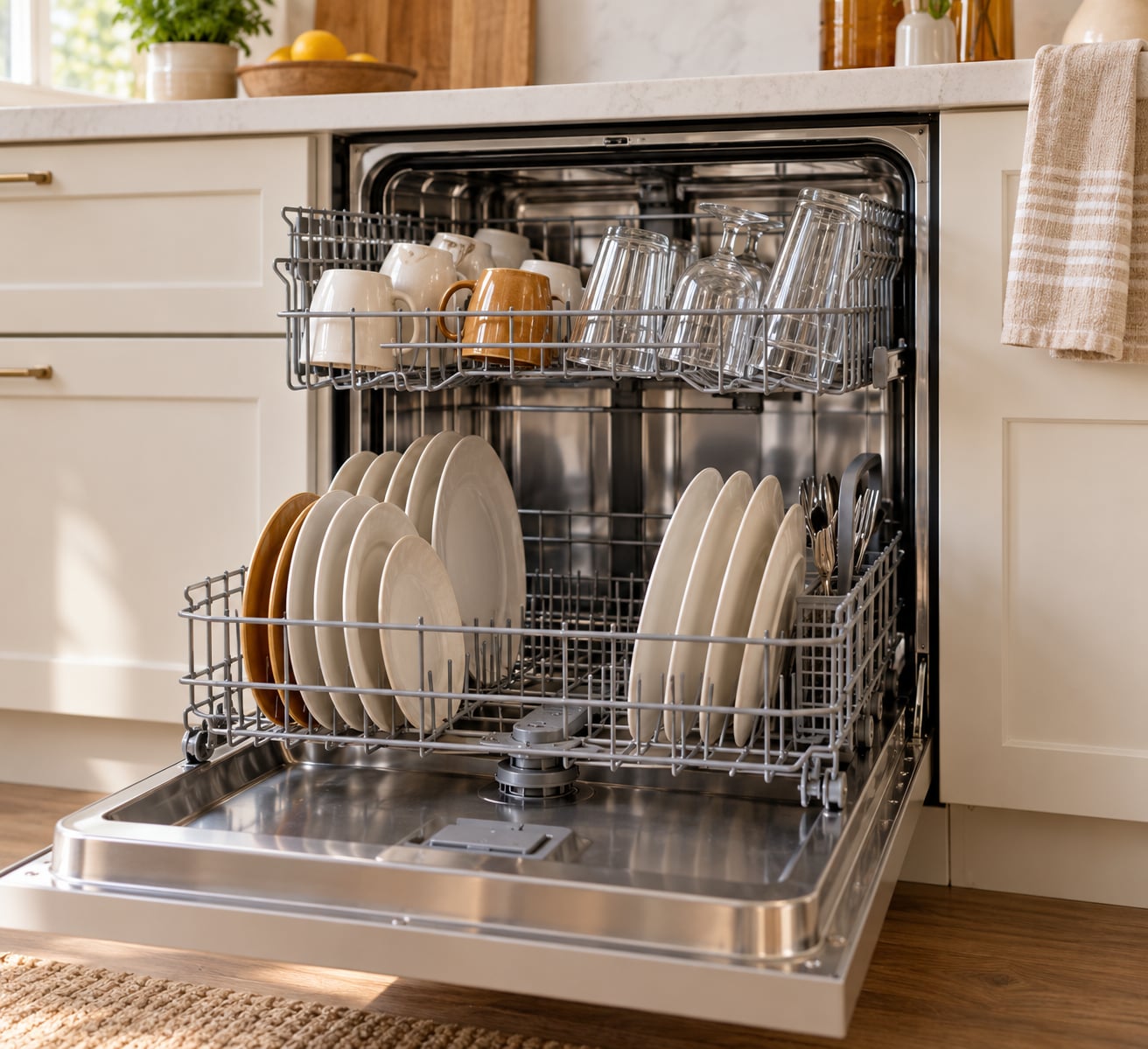
Loading a dishwasher correctly takes about five minutes and decides whether your dishes come out clean, dry and intact. The whole method comes down to four things: scrape instead of rinsing, put large and heavily soiled items on the bottom rack angled toward the center, put glasses, cups and plastics on the top rack angled downward, and load silverware handles-down with knives kept out.
So is there a wrong way to load the dishwasher? Yes, and it usually looks like a full, tidy rack. The wrong load blocks a spray arm, traps detergent in its dispenser, nests bowls inside bowls, or puts a mixing bowl over the small items beneath it. Nothing looks obviously wrong until you open the door and find dried-on food, spots on every glass and one sad fork at the bottom.
What confuses most people is that the arrangement barely changes the result. Forum readers across r/dishwashers and r/AskReddit keep landing on the same three rules: don’t block the spray arms, don’t cram the rack solid, and scrape rather than rinse. Get those right and the rest is preference. This guide, updated for 2026, gives you the specific placements anyway, plus a cheat sheet you can tape inside the door.
Table of Contents
- What You Need
- How to Load a Dishwasher Correctly Step by Step
- How to Load a Dishwasher Correctly: Prepare the Empty Dishwasher
- Place Large Items in the Lower Rack
- Load Plates and Bowls Facing the Center
- Load Cups, Mugs, and Small Items in the Upper Rack
- Place Forks, Spoons, and Knives Safely
- Add Detergent and Choose the Right Cycle
- Start the Dishwasher and Check the Result
- Common Mistakes
- Frequently Asked Questions
- Do you have to rinse dishes before putting them in the dishwasher?
- What should go on the top rack of a dishwasher?
- How do you properly load silverware in a dishwasher?
- Why would a dishwasher not clean dishes?
- How full should the dishwasher be before you run it?
- How much water should sit in the bottom of a dishwasher?
- Conclusion
What You Need
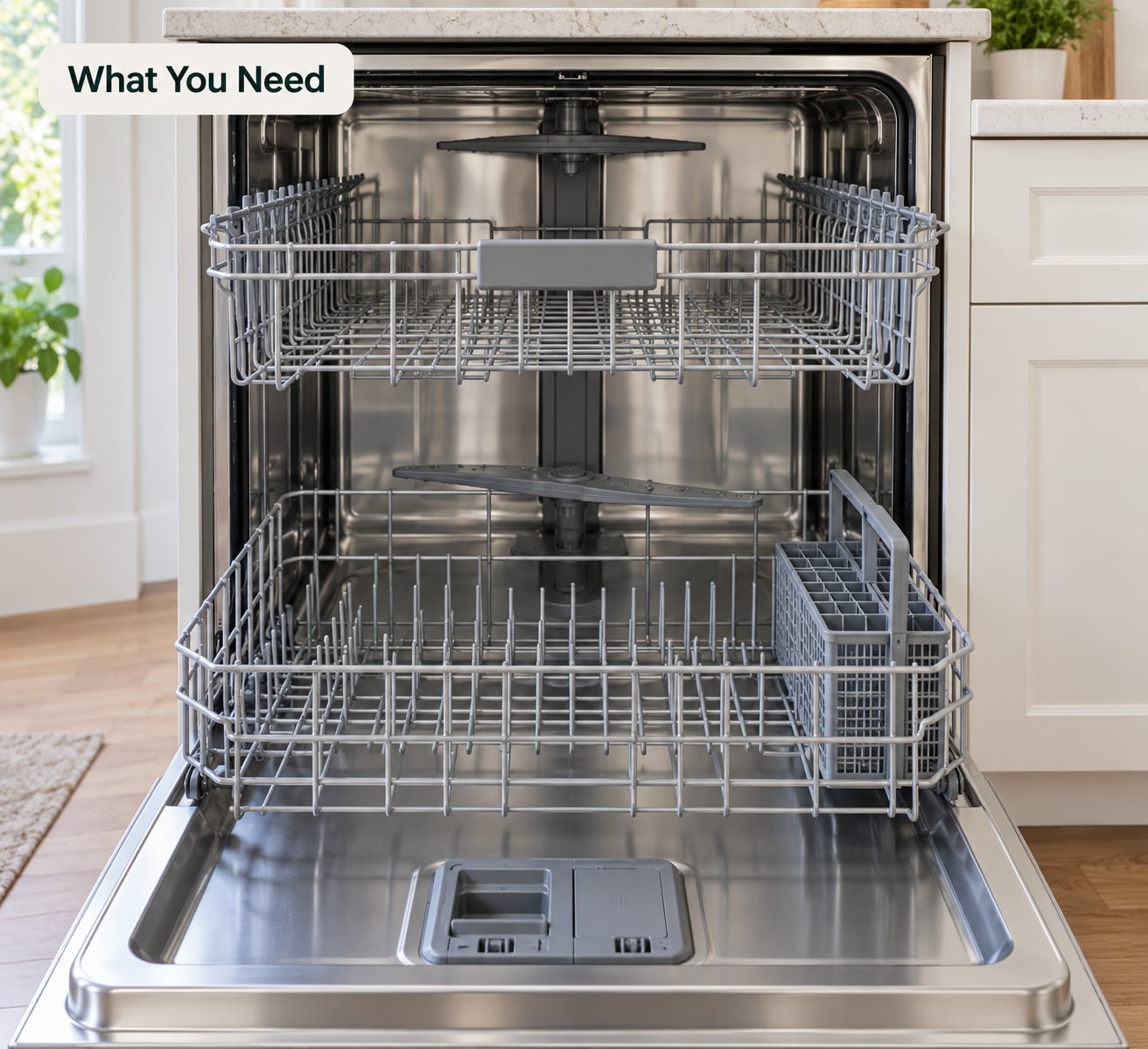
You don’t need any special equipment, and that’s the good news. What you need is a working knowledge of four parts, plus your own owner’s manual, which settles almost every model-specific question in about thirty seconds.
Lower rack and upper rack. The lower rack sits directly over the spray arm and takes the large, heavy, dirty items. The upper rack takes the lighter, more delicate ones and, on many machines, has its own small spray arm underneath it.
Spray arms. These are the rotating arms that fire pressurized water at your dishes. Most machines have one below the lower rack, and many have a second under the upper rack. They have to spin freely in both directions. If a fork handle or a pot handle is stopping an arm, half the load is quietly not getting washed.
Detergent dispenser. That latched cup on the inside of the door is where detergent enters the water. Nothing may lean against it or block the door from snapping shut. A tall bottle or a baking sheet resting on the door is the single most common reason detergent never washes dishes.
Rinse aid. Optional, but it is what stops water spots. Its sheeting action makes water bead and roll off glass and stainless instead of evaporating into a haze of mineral deposits. Fill it only when the indicator says it is low.
Also worth identifying before you start: your cutlery basket or third rack, and the filter at the bottom of the tub. Here is the cheat sheet. Print it, screenshot it, or tape it inside the cabinet door next to the machine.
| Item | Where it goes | Which way it faces | Why |
|---|---|---|---|
| Dinner plates | Lower rack, between the tines | Angled toward the center, tilted slightly down | Water hits the dirty surface and drains off |
| Large bowls, mixing bowls | Lower rack, back and sides | Opening facing down and inward | Holds water and food where spray can reach it |
| Pots and pans | Lower rack, face-down at an angle | Open side toward the center | Heavy items stay put; spray reaches the inside |
| Sheet pans and platters | Lower rack along the sides | Angled down, resting on the tine edge | They fit flat without blocking the arm |
| Cutting boards | Lower rack, standing on edge between tines | Firmly upright, both faces exposed | Water reaches both sides; nothing nests |
| Glasses and stemware | Upper rack, between the tines | Angled down, never upright | Drains instead of pooling |
| Mugs and cups | Upper rack, spaced apart | Handles between the tines, opening down | No water trapped inside a cup |
| Small bowls | Upper rack, back corners | Opening facing down | Spray reaches the interior |
| Plastics and storage lids | Upper rack | Angled down, lids propped like a tent | Heat and water reach every surface |
| Tall bottles and tumblers | Upper rack or third rack | Straight up in a slot, never over other items | They fall over otherwise |
| Forks, spoons, knives | Cutlery basket or third rack | Handles down, knives in their own section | Spray reaches the business end |
How to Load a Dishwasher Correctly Step by Step
How to Load a Dishwasher Correctly: Prepare the Empty Dishwasher
Start with an empty machine, not a full one. Pull both racks out and scrape every dish over the bin or the compost caddy. Do not rinse under the tap, and this is the part most people argue about. Modern detergent uses enzymes, and enzymes need food residue to cling to in order to break it down. Rinse the food away and you hand the detergent nothing to work on, which is how you end up with a film of orange powder on mugs.
Skim the top of your glasses and bowls too, since a single stuck-on scrap of rice is the most common source of a spot. Fill a bowl with warm water and let heavily encrusted items soak while you load the rest.
Next, spin the spray arms by hand. Push the lower arm and confirm it rotates in both directions without hitting anything. Reach underneath and feel for a fork handle, a plastic lid or a bottle cap that jammed it in place. Repeat with the upper spray arm if your machine has one. Push the filter while you are down there; if the mesh filter twists, food and glass particles are closing the drain, and no loading technique can outrun a blocked filter.
Finally, open your manual and look up the loading diagram. Third racks, utensil drawers, tine clips and fold-down sections all vary by model, and the manual diagram beats anything you have read online, including this page.
Place Large Items in the Lower Rack
Heavy cookware goes in first, along with anything that holds food or heat. Pots, pans, baking sheets, mixing bowls and platters all belong on the bottom rack, and the reason is physics as much as cleaning: water pressure reaches the bottom of the tub more forcefully, and a heavy item will not shift and break things when the arm hits it.
Set pans and platters along the sides of the rack with their open side facing the center. Nothing should lie flat across the whole rack, because that blocks spray from reaching everything underneath. Baking sheets rest at a shallow angle, leaning on a tine edge, so runoff slides to the middle.
Place mixing bowls and deep pots toward the back and corners where they are least likely to tip, angled downward so dirty water drains rather than pooling in the base. Give each piece its own space. If you are stacking a big pot inside a smaller pot to save room, the pot inside gets no water at all, so it comes out exactly as dirty as it went in.
Load Plates and Bowls Facing the Center
Slide plates down between the rows of tines with the dirty face toward the center of the tub, tilted a few degrees so gravity pulls the water down rather than letting it pool on the surface. Every plate should have a little space between it and the next. If they are packed tight enough to rattle, you have a clean problem that a dirty load will solve badly.
Most people use one plate per tine gap, which wastes the rack. You can double up by staggering plates between two gaps and leaning the second plate into the first at an angle. The tines do the holding; the angle lets water run through.
Bowls go on the lower rack too, opening facing down toward the center, unless the bowl is small enough for the upper rack. There is a real disagreement about this one, and the answer is the shape of the bowl. A big bowl with a foot goes low because spray reaches it better and it is too heavy for the top rack. A small cereal bowl goes up top where it will not rattle around.
Nothing goes upside down over a row of tines. A colander or a deep bowl laid face down over plates blocks spray to everything beneath it, and that is the classic “why are my dishes still dirty” cause.
Load Cups, Mugs, and Small Items in the Upper Rack
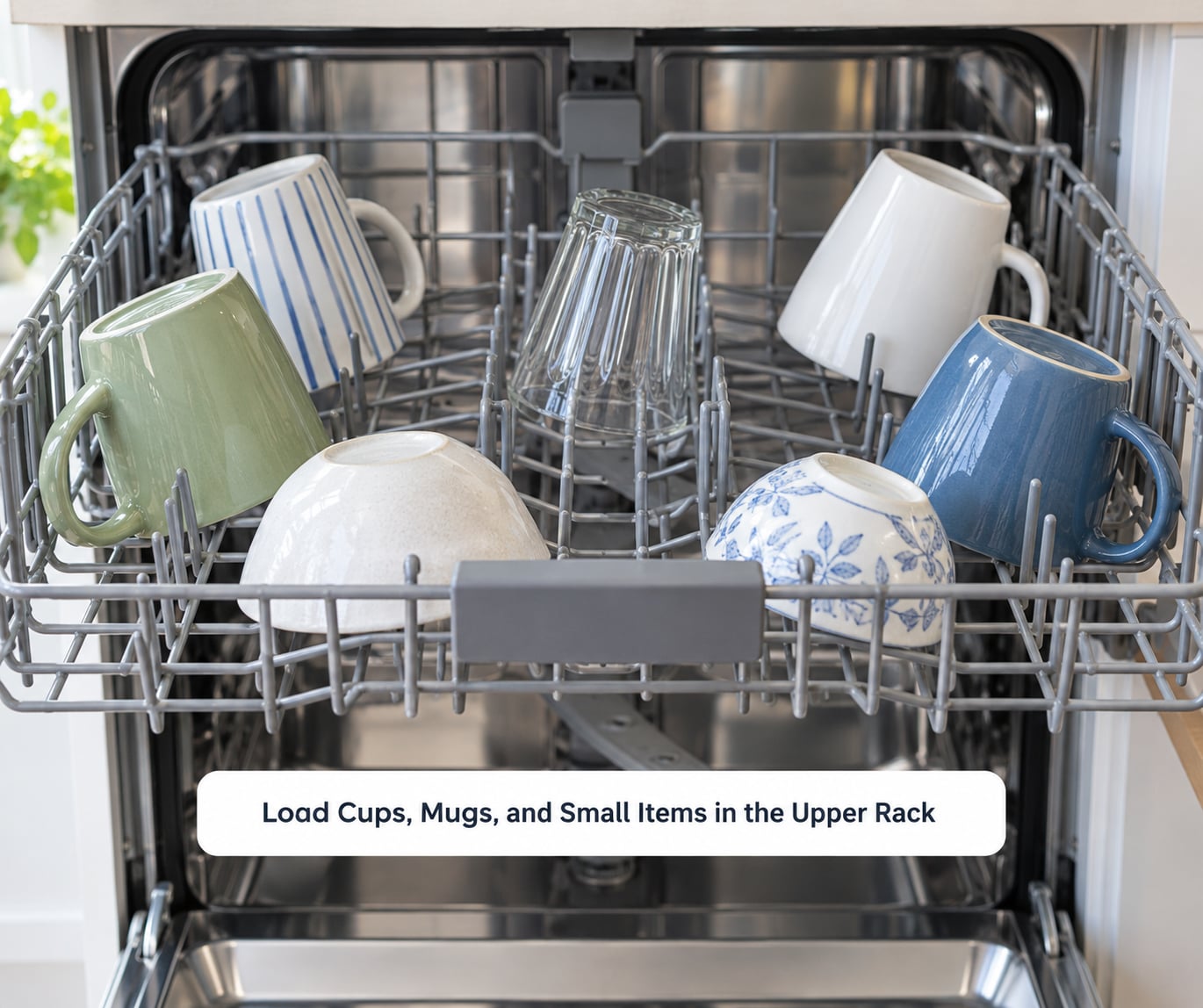
What should go on the top rack of a dishwasher? Glasses, mugs, cups, small bowls, plastic containers, lids, and anything lightweight or breakable. The upper rack gets gentler water pressure, which is why fine china and stemware live up there rather than next to a cast iron skillet.
Angle glasses and mugs downward. Resting a glass upside down on a tine row leaves a puddle of dirty water trapped inside that never gets rinsed, and that is where a chalky ring comes from. Slotting each glass between tines at a slant lets it drain almost dry, and it also stops glasses from rattling into each other and chipping.
Leave gaps. Widely spaced glasses dry faster and get cleaner in one pass; a solid block of stemware on the top rack is why a party’s worth of champagne flutes come out spotted. If the rack is nearly full and you have nowhere to put a glass, you have overpacked it.
Handle any mug or cup by the body and set it so the handle drops between two tines, which keeps it from swinging into its neighbor. For storage lids, prop them at a tent angle against a cup or a bowl rather than laying them flat, so water reaches the inside face.
Place Forks, Spoons, and Knives Safely
Silverware goes in the cutlery basket, the removable utensil tray or the third rack, depending on your model. The part people get wrong is direction. Forks and spoons go handles-down, with the business end pointing up toward the spray. A fork pointing down into the basket gets its tines shadowed by the handle, and it is the one piece that still comes out needing a second pass.
Fill the basket in layers rather than one solid column, and mix spoon types and fork sizes together. Mixed utensils keep each other from nesting, and nesting is how cutlery emerges as one welded lump of steel. Avoid overfilling any one section.
Knives go in their own section, and where the basket has one, blades down and handles up. Knives handle-up and sharp side down in a basket you reach into blindly is the single most avoidable way to hurt yourself. Sharpened chef’s knives, honing steels and any blade you would be annoyed to lose do not go in the dishwasher at all; the heat cycle dulls a good edge and the blade can dull or pit against other metal.
If you hand-wash a knife, dry it immediately. Standing water on a steel blade is what causes the speckled corrosion spots.
Add Detergent and Choose the Right Cycle
Detergent goes in the dispenser cup, and the pod or tablet sits in the main compartment with the lid snapped shut. Never sprinkle loose powder into an empty tub or a wet cup. When the wash starts, the dispenser opens and the water washes detergent down into the tub; if the door is blocked by a leaning tray, the detergent sits there and your dishes come out with no soap on them at all.
Use the amount on the label. Modern detergents are concentrated, and too much leaves a gritty or filmy residue rather than cleaning harder. Tablespoons and scoops sized for old powders are the reason so many mugs end up with an orange coating.
Rinse aid is optional but helps drying. Check the indicator on the door and refill only when it shows empty.
On cycle choice, match the cycle to the soil and to how long you can wait. A heavy or auto cycle with heated dry suits pots and heavily soiled plates. Normal covers most mixed loads. Quick cycles use less water and less heat, which is fine for lightly soiled dishes run soon after a meal but poor for anything dried on. The eco and earth-friendly cycles run longer at lower heat, and they do not dry as well unless you leave the door open. Whenever you can, use the heated dry option; it finishes the job that leaving the door ajar is otherwise doing for you.
Start the Dishwasher and Check the Result
Push both racks in until they click, then check that nothing is sticking above the door line. Start the machine and stay nearby for the first thirty seconds, mainly so you can hear it. A grinding or spinning sound that stops means something is jammed against the pump or the spray arm. A loud sloshing that goes on much longer than usual is usually fine.
Most machines give you some indication it began: a light, a tone, or the sound of water filling. No water at all after a minute usually means the door latch did not catch, so open the machine and push it firmly until it clicks.
When the cycle ends, unload the lower rack first and the upper rack second, so nothing drips onto clean dishes. Check the things that would show a problem fastest: a glass for spots, a plate for film, a fork for the business end. If the same item fails twice running, you have found your starting point for the next section.
Common Mistakes
Overpacking to avoid running a half load. People cram the rack because running a machine half empty feels wasteful. In practice a crowded rack washes worse, dries worse and takes twice as long to unload as a scrape of leftovers. If the rack is only two-thirds full, run it. If you run loads constantly, keep the machine full by scraping as you cook rather than by stacking.
Blocking a spray arm. A pot handle or a tall bottle leaning on the lower arm stops it, and half the load quietly goes unwashed. Spin every arm by hand before you close the door. It is a five-second check that solves a problem people spend money on a repair visit to solve.
Nesting glasses and bowls. Stacked bowls block the water meant for the bowl underneath, and upright glasses hold dirty water inside. One item per gap, angled downward, is the fix.
Loading items upside down over other items. A colander or a deep bowl face down over a row of plates starves everything below it. Large items go low, small items go on top, and the direction of the opening matters less than leaving the surface underneath reachable.
Using too much detergent. More is not more here. Overdosing leaves a filmy, gritty residue that looks like the machine failed to clean. Measure the label amount, and if residue shows up again, cut back by a third before you do anything else.
Putting sharp utensils where someone can grab them. Knives handle-up in a cutlery basket, knives loose on the upper rack, or a knife wedged between plates are all injury risks. Keep blades in a dedicated section, blades down, or wash them by hand.
A couple more worth naming: putting wood, cast iron, non-stick cookware, fine china and crystal in the machine can warp, rust, dull a coating or etch the glaze, and running the kitchen sponge through a heated dry cycle is a decent sanitation habit if you want to do it.
Frequently Asked Questions
Do you have to rinse dishes before putting them in the dishwasher?
No, and rinsing usually makes the result worse. Modern dishwasher detergent relies on enzymes that need food residue to cling to in order to break it down, so rinsing away the leftovers hands the soap nothing to work on. Scrape solids into the bin or compost caddy, skim the top of glasses and bowls, and let anything heavily encrusted soak in warm water while the rest loads.
What should go on the top rack of a dishwasher?
Glasses, stemware, mugs, cups, small bowls, plastic containers, lids, and anything lightweight or breakable. The upper rack gets gentler water pressure, so fine china belongs there rather than beside a cast iron skillet. Angle glasses and mugs downward so they drain instead of holding water, leave space between them so spray reaches every surface, and slot handles between the tines to stop things knocking together.
How do you properly load silverware in a dishwasher?
Put forks and spoons handles-down in the cutlery basket, utensil tray or third rack, with the working ends facing up toward the spray. Mix spoon and fork types in each section and fill in layers so pieces cannot nest together, since nesting is what welds cutlery into one lump. Keep knives in a separate section with blades down and handles up, or hand-wash any good knife.
Why would a dishwasher not clean dishes?
Work down this list in order. Spin both spray arms by hand and free anything jamming them, then push the filter to see if it rotates freely. Confirm the detergent dispenser door is not blocked by a leaning tray or tall bottle. Check you used the label amount of detergent, not more. Look for an upside-down bowl covering smaller items, then switch to a longer, hotter cycle.
How full should the dishwasher be before you run it?
Full enough that the spray arms move freely and the detergent door closes, not full enough that dishes touch. A completely full rack cannot rinse, so items come out with a film. A two-thirds full rack is fine if it is spread out, and better than a crammed one. If you do not want to run a half load, top off the racks as you cook rather than stacking everything in at night.
How much water should sit in the bottom of a dishwasher?
Almost none. After a cycle finishes you should see a small puddle at the bottom of the tub, often no more than a cup, because the filter catches the rest of the water during draining. Standing water an inch or more deep after a cycle means the drain is slow or the filter is clogged, which is worth checking. A similar amount during the cycle is completely normal.
Conclusion
Start by clearing the racks and confirming every spray arm spins freely. Put large, heavy and dirty items on the bottom rack angled toward the center, put glasses, cups and plastics on the top rack angled downward, load silverware handles-down with knives kept separate, and add detergent last so nothing blocks the dispenser. Everything else on this page is a variation on those five moves, and if you get them right the dishes come out clean on the first try.