If you have ever wondered why do my towels smell musty after washing, the answer is usually simpler than it looks: moisture stays trapped in the fibers, and bacteria and mold feed on the detergent, fabric softener and body oils held there. The towel can look perfectly clean and still smell like a damp basement, because the smell is not on the surface. It is living in the pile.
The good news is that nearly every case comes down to four things: how you dose detergent, how completely the towel dries, how clean the washing machine is, and how the bathroom air moves. Fix those and the smell usually goes. This guide walks through how to tell which one is causing yours, how to strip the smell out of an existing towel set, and what to change so it does not come back in a week.
Table of Contents
- Why Do My Towels Smell Musty After Washing?
- Why do my towels smell musty the second they get wet
- Quick answer: the six most common causes
- What Causes the Musty Smell in Towels?
- Damp towels never fully drying
- Detergent and fabric softener residue
- Towels reused too many times between washes
- A dirty washing machine
- Cold water and underdosed detergent
- A bathroom that dries towels badly
- Thick, old or shedding towels
- Match the symptom to the cause
- What each smell is telling you
- How to Remove Musty Smell from Towels
- Water temperature and dryer heat by towel type
- What to do with no dryer and no direct sunlight
- Can Baking Soda or Vinegar Get Rid of Musty Towel Odor?
- How to Stop Towels From Smelling Musty Again
- When Is a Musty Towel Problem More Than Just Odor?
- Frequently Asked Questions
- Is white vinegar safe to wash towels with?
- Can I wash my towels in hot water without ruining them?
- Why does the musty smell come back after washing?
- How often should I wash bath towels?
- Does my washing machine need cleaning if the towels smell?
- Should I throw away towels that smell like mildew?
- Start With the Machine, Not the Towels
Why Do My Towels Smell Musty After Washing?

Towels smell musty after washing because a damp, coated fiber is an ideal place for bacteria and mold to grow. Every shower you take adds body oils, soap scum and dead skin. Detergent and fabric softener add their own film on top. Cotton holds all of it deep in the pile, and if the towel does not dry all the way through before it gets folded or washed again, that film becomes food.
A standard cycle rinses detergent out of the surface of fabric. It does not strip a built-up coating from thousands of tiny cotton loops. That coating does two bad things at once: it gives microbes something to feed on, and it makes the towel less absorbent, so the towel stays wet longer and dries slower. It is a loop that keeps feeding itself.
Why do my towels smell musty the second they get wet
This is the part that frustrates people most. The towel comes out of the dryer bone dry and smells fine. You use it, it touches water, and within ten seconds the stale smell is back.
Wet cotton releases far more volatile compounds than dry cotton does. Odor molecules that were trapped and invisible in the dry fabric dissolve into the water film on contact and reach your nose immediately. It is the same reason a damp towel in a bag smells so much stronger than a dry one. Nothing new has grown in those ten seconds. The smell was already there, and the water just let it out.
That re-wetting behavior is also the useful clue. If a towel reeks the moment it gets damp but is fine when dry, the residue is in the towel and the machine. If it smells even dry, you are also looking at storage or the bathroom itself.
Quick answer: the six most common causes
- Towels left damp — a hamper, a closed washer door or a folded towel that never fully dried gives bacteria hours of exactly what they need.
- Detergent and softener buildup — repeated use leaves an oily residue that coats the fibers and cuts absorbency.
- A dirty washing machine — mold in the drum, door gasket and detergent drawer re-infects every load you wash.
- Cold water and too little detergent — a cool wash with an underdosed scoop cleans far less than the label implies.
- A slow-drying bathroom — no extractor fan and a closed door means the towel dries in humid air.
- Thick or worn towels — heavy pile and old fiber take far longer to dry and hold more residue.
What Causes the Musty Smell in Towels?
Work through these in order of how often they turn out to be the culprit. Start with what happens after the towel is used, because moisture is behind most musty smells.
Damp towels never fully drying
A towel thrown into a hamper while still damp is folded against itself, so the middle stays wet. That is the worst case. Same story with a full washer left closed overnight, or towels stacked in a cupboard the moment the dryer stops.
There is a rough window worth knowing: a damp towel left at room temperature can go from fresh to noticeably musty within a day, and the smell gets worse the longer it sits. In a warm, humid bathroom it happens faster.
Detergent and fabric softener residue
Softener and dryer sheets are the most widely blamed and the least explained. They deposit a thin waxy coating on the fiber to make it feel soft. That coating fills the spaces between cotton loops, so the towel holds less water and dries more slowly. Slower drying plus an oily film is the whole problem in two sentences.
Overdosed detergent leaves the same kind of film, and so does hard water, where soap precipitates into a gray scum that builds up over months. The residue is what the bacteria are eating, which is why smell can persist through cycle after cycle of normal washing.
Towels reused too many times between washes
Rotating a towel for three or four days between washes is a common habit that quietly causes this. Each reuse adds another layer of oil and moisture, and the towel never gets a chance to dry out fully in between. People on home cleaning forums repeatedly describe one towel in the household smelling while the rest stay fine, usually because it is the one that gets reused most.
A dirty washing machine
The machine is the most overlooked cause because the towels get blamed instead. Front loaders collect water and detergent in the rubber door gasket, and the same grime builds in the detergent drawer where the machine runs water over it at the start of every cycle. Top loaders have their own version, usually a residue ring and lint layer around the agitator and a grimy drain hose.
Signs of a machine-side problem: the smell is on everything you wash, not just towels, or towels smell musty straight out of the dryer while clothes come out fine.
Cold water and underdosed detergent
This one surprises people. A wash is mostly a dilution process. Too little detergent, especially in cold water, means the water never gets enough active cleaning agent to lift oils out of the fibers, so it rinses them deeper instead.
For a high-efficiency machine, the drum holds much less water than a standard top loader, so it needs far less detergent. Many people use the same scoop by habit. A useful starting point is about two tablespoons of HE detergent per load of towels, then adjust from there.
A bathroom that dries towels badly
If your bathroom has no extractor fan and the door stays shut, a towel on the rail is sitting in warm, humid air that has nowhere to go. One reader described a bathroom with no fan where a towel hung with the door open smelled rotten within ten minutes, because the towel was drying in the source of the problem.
A heated towel rail is the simplest structural upgrade here, because it keeps air moving over the fabric instead of letting it sit.
Thick, old or shedding towels
Deep-pile luxury towels hold more water than a standard terry towel and take far longer to dry. As fiber breaks down with age it also holds onto residue differently, and a towel that stops shedding can be past the point where detergent rinses cleanly out of it.
Match the symptom to the cause
| What you notice | Most likely cause | What fixes it |
|---|---|---|
| Smells the instant it gets wet, fine when dry | Residue in the towel and machine | Vinegar rescue wash, correct detergent dose, machine clean |
| Smells straight out of the dryer | Machine buildup or bathroom humidity | Clean gasket, drawer and drum; ventilate the bathroom |
| Only one or two towels smell | Reuse habits on those specific towels | Hang each towel fully dry; reduce reuse to one or two days |
| Smells even after two washes | Residue plus a mold source in the machine | Washing soda or hot empty cycle, then repeat with vinegar |
| Everything in the wash smells, not just towels | Machine is the source | Monthly drum, gasket and drawer clean |
| Gray or slimy residue on the towel | Soap scum and hard water build-up | Washing soda wash, then vinegar rinse |
What each smell is telling you
- Musty — damp fibers and trapped residue, the version most people mean.
- Sour — usually underdosed detergent rather than too much of it.
- Mildewy — mold has taken hold, often in the machine or in storage.
- Wet dog — a different problem: trapped moisture in thick pile or a machine vent issue, and it needs air and heat, not more detergent.
How to Remove Musty Smell from Towels
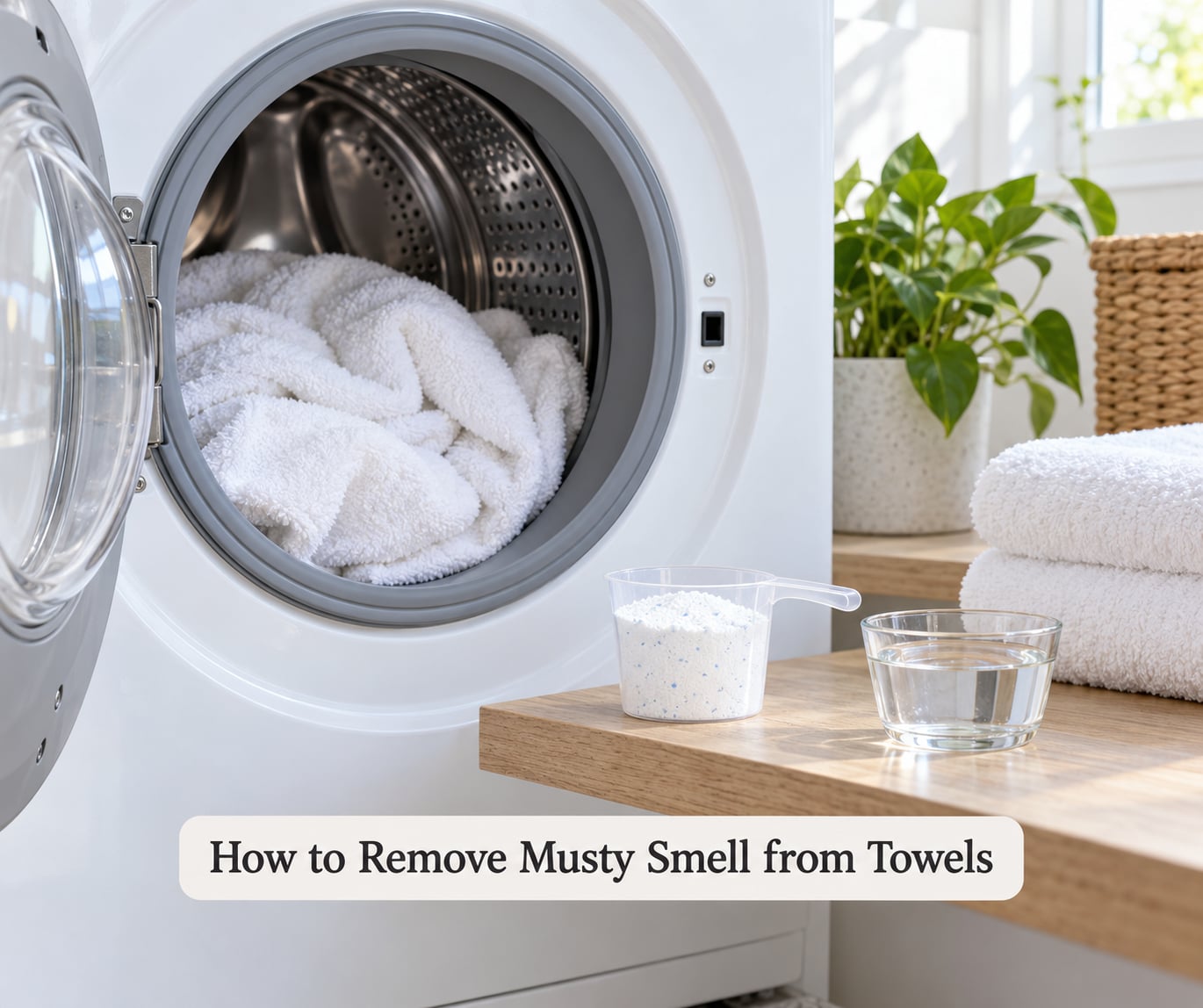
Work in this order. Each step assumes the one before it, and skipping the machine clean usually means doing it all again in a month.
- Clean the washing machine first. Empty and wipe the detergent drawer, scrub the door gasket with a damp cloth, and run the drum hot and empty for one full cycle. Skip this and you are re-soaking the towels in whatever caused the smell.
- Wash towels on their own in hot water. Use the longest cycle your machine offers and the hottest water the care label allows. Do not overload, because a crammed drum is exactly why those towels never dried in the first place.
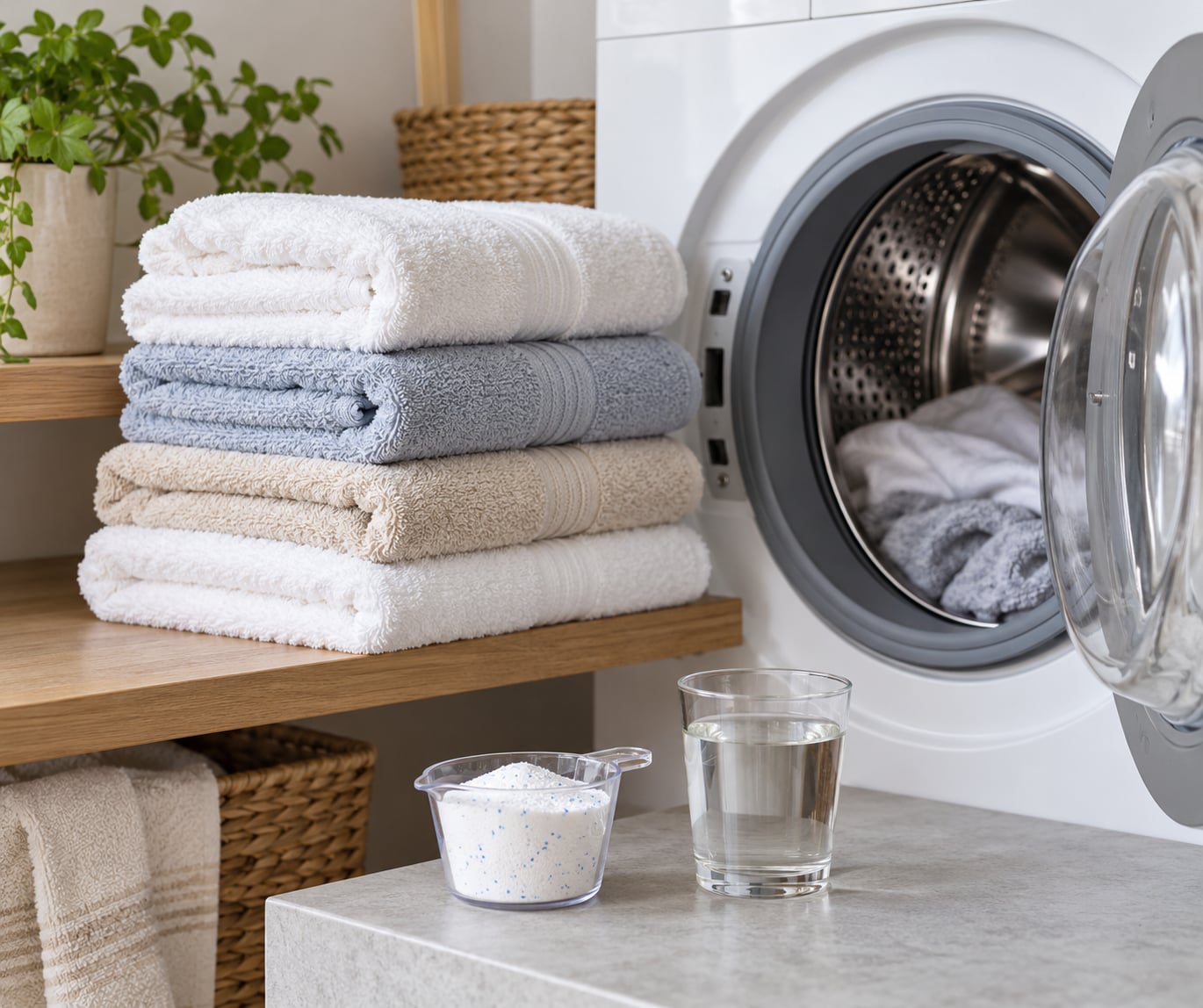
- Use less detergent, not more. Measure it. Roughly two tablespoons of HE detergent or one normal scoop for a full towel load, and skip fabric softener entirely.
- Add vinegar during the wash or the rinse. One to two cups of white vinegar in the drum with the towels works on residue, and half a cup in the rinse softens what is left. It is mild enough for most cotton.
- Add an extra rinse. This is what carries the loosened residue out instead of back into the fibers.
- Dry them completely. Medium to high heat, and take them out while they are still slightly damp so they finish drying on the rack rather than over-drying in the drum.
- Repeat once without anything else. If the smell is stubborn, a second hot cycle with a cup of washing soda and no detergent, followed by a vinegar rinse, usually settles it.
Check the care label before the hot wash, and never mix bleach with vinegar or with any other cleaner. If you use chlorine bleach, run it in its own load with the machine door and window open, and do not add vinegar to that cycle.
Water temperature and dryer heat by towel type
| Towel type | Wash | Dry |
|---|---|---|
| Standard cotton terry | Hot, 140F, if the label allows | Medium to high heat |
| Colored or patterned cotton | Warm, around 120F | Low to medium heat |
| Deep-pile luxury terry | Hot, but on their own | High heat, longest cycle |
| Microfiber | Warm, no softener ever | Low heat, extra cycles |
| Linen | Warm | Medium heat, line dry preferred |
What to do with no dryer and no direct sunlight
This comes up constantly and almost nobody addresses it. If you have neither, air drying still works, but airflow is everything. Hang towels across a rail or over a chair rather than folding them over a line, so both sides get air. Turn them every couple of hours, and space them out so nothing is touching.
Indoor air dries them slowly, so compensate by washing smaller loads and running the extractor fan or opening a window in the drying room. A fan pointed at the towels helps more than almost anything else.
Can Baking Soda or Vinegar Get Rid of Musty Towel Odor?
If the answer to why do my towels smell musty after washing is residue, vinegar handles that residue and baking soda handles the odor itself. Washing soda does the scrubbing. They work on different problems, which is why guessing between them usually means guessing wrong.
| Product | What it does | When to use it |
|---|---|---|
| White vinegar | Acidic, dissolves alkaline residue and soap scum | In the wash or the rinse, 1 to 2 cups |
| Baking soda | Neutralizes odors, mild abrasive | Half a cup in the wash or a soak |
| Washing soda | Higher alkalinity, loosens grease and residue | One cup in a hot cycle |
| Oxygen bleach | Releases peroxide, kills mold without chlorine | When the residue needs disinfecting |
Do not combine vinegar and baking soda in the same cycle. They meet in the water, neutralize each other, and you end up with plain salt water and a wasted load.
Skip heavily scented laundry products, dryer sheets and room sprays while you are cleaning. Fragrance covers an odor temporarily and does nothing to the bacteria, and the artificial scent is what often leads people to think the towels are clean when they are not.
None of these replace cleaning the machine or fixing a damp storage habit. If the source stays in the drum, your clean towels will pick the smell back up within a week.
How to Stop Towels From Smelling Musty Again
A handful of habits does most of the work. None of them is complicated, they just have to be consistent.
- Skip softener and dryer sheets on bath towels. This is the single biggest change most people make, and the one most often named in home cleaning forums as the thing that finally fixed it.
- Measure your detergent and start lower than the bottle suggests, especially on HE machines.
- Hang towels out fully between uses instead of returning them to a basket or a hook over a radiator.
- Wash them every two or three uses at most. If a towel is used once and left to dry properly, it rarely needs more.
- Do not leave the washer door shut. Leave it open after every load so the drum and gasket dry out.
- Clean the machine monthly with a hot empty cycle, and wipe the gasket and drawer as part of it.
- Dry the bathroom too. Run the extractor fan during and for 20 minutes after a shower, and keep the door open.
- Fold towels only when they are fully dry and store them somewhere with airflow rather than in a sealed cupboard.
Replace towels that are worn past absorbency. They dry slower, hold more, and there is a limit to what any wash can pull out of them. Old towels make excellent cleaning rags, which also keeps them out of the bathroom rotation.
When Is a Musty Towel Problem More Than Just Odor?
Most of the time this is a laundry problem. A few signals mean it is not.
- Visible mold — black, green or orange spotting on the fabric, the gasket or the dispenser drawer.
- Gray slime in the machine, often with a smell that returns within a day of cleaning.
- The smell survives a vinegar and hot-wash cycle with no softener and a clean machine.
- Towels that stay wet for hours on a rack in a ventilated room.
- A wet-dog smell that no wash touches, which often points to a dryer vent rather than the towels.
When you see those, stop using the affected towels on skin and switch to a clean set while you deal with it. A blocked dryer vent is worth sorting out promptly, since restricted airflow makes a dryer run hotter than it should.
If the smell is coming from a machine you cannot clean yourself, or from plumbing, get an appliance technician or plumber involved. For visible mold on a porous surface that does not lift after cleaning, a professional remediation service is the sensible call.
Frequently Asked Questions
Is white vinegar safe to wash towels with?
For cotton and most standard towel fabrics, yes. One to two cups of white vinegar in the wash or half a cup in the rinse is mild enough for repeated use and will not damage fibers. Check your care label first, and skip it on silk, wool or anything marked dry clean only. Never combine vinegar with bleach in the same cycle, and add it to the drum rather than the dispenser.
Can I wash my towels in hot water without ruining them?
Usually, yes. Most cotton terry towels tolerate 140F, and heat is one of the most effective tools against the bacteria behind musty smells. Colored towels do better at warm temperatures, and microfiber should stay on low to protect its fibers. If the towel is shedding or the label warns against heat, drop the temperature and lean more on vinegar and an extra rinse instead.
Why does the musty smell come back after washing?
Because you are almost always treating the towel and not the source. The machine holds the same mold in its drum, gasket and detergent drawer, and it re-deposits onto every load. Residue also survives a normal cycle if it has built up over months, and any towel returned to a damp hamper picks the smell up again within a day. Clean the machine, correct the detergent dose, and dry towels fully.
How often should I wash bath towels?
Every two or three uses is a sensible rule for most households. If a towel has been used once and then hung somewhere with good airflow until completely dry, it usually does not need another wash yet. In humid bathrooms, a family of four, or after gym or swimming, wash sooner. Leaving damp towels in a closed hamper is what turns two days of use into a problem.
Does my washing machine need cleaning if the towels smell?
Yes, and it should be cleaned about once a month even when nothing smells. Wipe the door gasket, rinse the detergent drawer and run the drum hot and empty. If every load you wash smells rather than just towels, the machine is almost certainly the source. Leaving the door open after each use keeps the gasket from staying wet, which prevents most of the buildup in the first place.
Should I throw away towels that smell like mildew?
Not automatically. Start with the rescue routine: hot wash alone, a cup of washing soda, an extra rinse, a cup of vinegar in the next rinse, and a full dry. If the smell returns within a day of that, or you can see mold spotting on the fabric, replace them and keep them away from skin meanwhile. Worn towels past their absorbency are better off as cleaning rags than in the bathroom.
Start With the Machine, Not the Towels
Open the detergent drawer and look at it before you do anything else. If you have been searching for why do my towels smell musty after washing, this is the first place to look. A visible film there means you run the machine clean before touching the towels, because that one step decides whether the rest of the work sticks.
After that, work in order: measure less detergent, skip the softener, wash towels on their own in the hottest water the label allows, add an extra rinse with vinegar, and dry them until they are completely dry. Then hang each one out between uses, leave the washer door open, and clean the machine once a month. Do those five things and the same problem will not come back in 2026, or any year after.