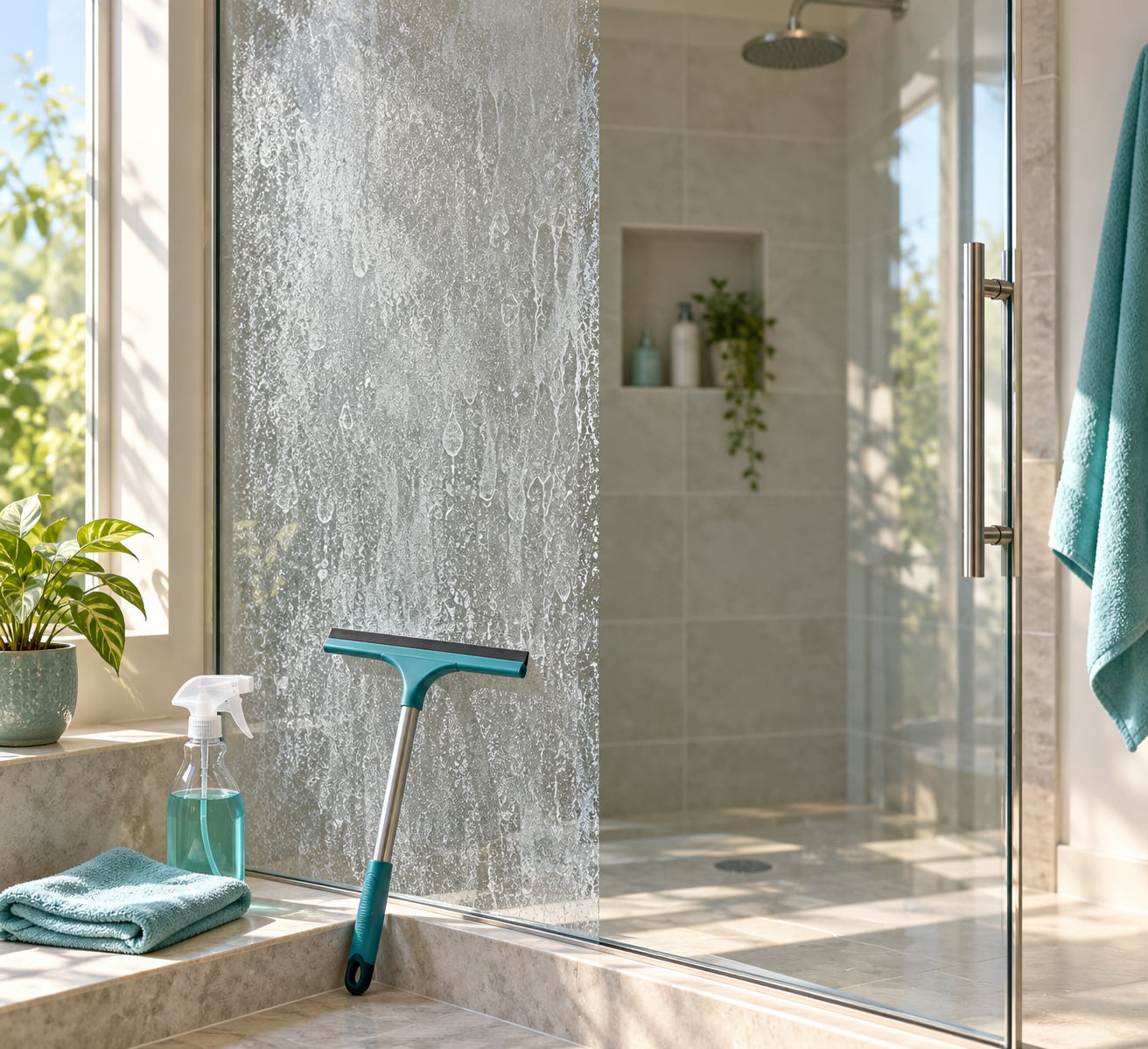
Most hard water stains on glass come off with a mild acid, given enough dwell time. To remove hard water stains from glass, start with diluted white vinegar or citric acid on the affected pane, let it sit 15 to 30 minutes, then scrub with a non-abrasive pad and rinse with distilled water. A shower door with a decade of buildup needs more than a spray and a wipe.
The reason so many attempts fail is speed. Mineral deposits are calcium carbonate crystals bonded to the glass surface, and they need time to dissolve before any amount of scrubbing will move them. Scrubbing first, wiping immediately, and rinsing with hard tap water all lead to the same disappointing result: cloudy glass that looks spotted again within a day.
Here is the method I would follow, in the order I would follow it. Ten minutes of patience with a weak solution beats twenty minutes of scrubbing with a strong one.
Table of Contents
- What You Need
- Step-by-Step: How to Remove Hard Water Stains from Glass
- Step 1: Identify the surface and the stain
- Step 2: Test the cleaner on a small area
- Step 3: Soak the deposit to loosen it
- Step 4: Scrub gently, in straight lines
- What to do when vinegar does not work
- Step 5: Finish the glass without streaks
- Common Mistakes
- Frequently Asked Questions
- What is the safest way to remove hard water stains from glass?
- Does white vinegar damage glass?
- Will baking soda scratch windows or shower doors?
- How do I remove hard water stains from glass shower doors?
- What removes permanent mineral stains that vinegar will not lift?
- How can I prevent hard water stains from coming back?
- Conclusion
What You Need
The job needs less gear than most people expect. Almost everything comes out of a kitchen cupboard, and the one item worth buying is a squeegee.
- Clear spray bottle for diluting and applying solution evenly
- White microfiber cloths, at least two, kept separate for glass versus general cleaning
- Soft-bristle brush or non-abrasive pad for the actual deposit removal
- White vinegar or citric acid powder
- Mild dish soap for cutting grease and soap scum film
- Baking soda for a gentle paste when the deposit is thin but cloudy
- Rubber gloves, since concentrated acid solutions irritate skin over time
- Distilled water for the final rinse on heavily scaled panes
- Squeegee, the single best prevention tool in any bathroom
- Old towel or newspaper to catch drips and protect the frame
Optional items earn their place in specific situations. A razor scraper handles crusty rings that no liquid will shift, and a pH-neutral stone cleaner is needed if the glass is framed by travertine or marble, which acid dulls permanently. Bar Keepers Friend or a calcium-lime remover is worth having on hand for glass you cannot reach with a brush.
Before you spray anything, protect what surrounds the glass. Lay towels along the frame, the sill, and the shower track, because acidic solution running down onto grout, aluminum frames, or natural stone causes damage that is far harder to fix than the stain you started with. On frameless shower doors, the bottom seal and silicone are usually the weak point. Acid etches silicone and dulls polished metal finishes.
One more thing before starting. If the glass is low-E coated, tinted, mirrored, or part of a double-pane sealed unit, work extra carefully and keep dwell times short. Those surfaces are covered by a treatment that acid and abrasives can strip off, and a stripped low-E coating looks permanently hazy no matter how much you polish afterwards.
Step-by-Step: How to Remove Hard Water Stains from Glass
The sequence below works on shower doors, windows, glass doors, car glass, and glassware. The one variable that changes across surfaces is how long you can safely leave the acid sitting.
| Surface | Best starting method | Dwell time | Tool |
|---|---|---|---|
| Shower door | Straight vinegar or citric acid | 15 to 30 minutes | Soft brush, then squeegee |
| Interior window | Vinegar and water, 1:1 | 10 to 15 minutes | Microfiber cloth |
| Exterior window glass | Commercial calcium-lime remover | 5 to 10 minutes | Non-abrasive pad |
| Car glass | Vinegar and water, 1:1 | 5 minutes | Microfiber cloth only |
| Glassware and tumblers | Soap and warm water soak | 15 minutes or overnight | Soft brush |
| Shower door track | Dish soap and dish brush | 10 minutes | Old toothbrush |
Interior windows get the gentlest treatment because overshooting with acid on a pane you cannot easily reach is a bad trade. Exterior glass and shower doors take the longest dwell because the deposits there are oldest and thickest. Car glass sits in the middle: mildly acidic, but the glass is curved, coated, and easy to scratch, so keep the pad soft and the pressure light.
Step 1: Identify the surface and the stain
Look at the deposit before you touch it. A white, chalky, gritty film that feels rough to a fingertip is calcium carbonate, and acid will dissolve it. A thin greasy haze that wipes away with a finger and feels slippery is soap scum, which needs dish soap and a surfactant rather than more acid. Rust-orange spotting means iron in the water rather than hardness, and acid alone will only lighten it slightly.
Also check for etching. Etched glass feels permanently rough, like fine sandpaper under the fingernail, and light scatters through it instead of reflecting cleanly. Etching is a chemical change to the glass itself, not a deposit sitting on top, so no cleaner will restore it. Distinguishing the two in advance saves a lot of wasted effort.
Step 2: Test the cleaner on a small area
Apply your solution to a hidden corner, ideally a lower edge behind the frame or a spot under the handle. Wait the full dwell time you plan to use on the whole surface, then rinse and dry it completely.
Look for three warning signs. A rainbow or hazy bloom means the coating is reacting and you should stop. Dull spots in the tint mean the dye is lifting. A rough-feeling patch means etching is starting, which happens when acid sits too long or too concentrated. Any of those and you rinse immediately, switch to a weaker solution, and shorten the dwell time.
If the product is not compatible with your glass, the fallback is mechanical removal: a squeegee on each wet pass with a microfiber cloth, repeated while the surface is still wet. It is slower and less complete, but it never damages the surface. On coated or tinted glass, that is the right default rather than a failure.
Step 3: Soak the deposit to loosen it
For light haze and fresh deposits, mix one part white vinegar with one part water in a spray bottle and mist the glass evenly. A few drops of dish soap per cup helps the solution spread and cling instead of running straight down. Then leave it. Fifteen minutes is a reasonable minimum, and 30 minutes is better for anything you can feel with your fingertip.
For older buildup, go stronger. Users on cleaning forums report that straight 5 to 9 percent vinegar works noticeably better than a 1:1 dilution, and that is consistent with how the chemistry works: a diluted solution has to work harder to hold enough acidity for the full dwell period, especially on a cool glass surface. If the frame is silicone, natural stone, or grout, keep the straight vinegar on the glass itself and blot the edges before it runs.
Citric acid powder dissolved in warm water is the other reliable option. Use roughly one tablespoon per cup of warm water, let it dissolve fully, and expect a slightly longer dissolve time than vinegar. Lemon juice works the same way and is easier to find, but it costs more per glass and smells more strongly.
You will know it is working when the deposit stops feeling gritty and the glass under the haze becomes visible while you are still scrubbing.
Step 4: Scrub gently, in straight lines
Use a soft-bristle brush or a microfiber cloth folded into a pad. Work in short straight strokes, top to bottom, following the drip pattern. Circular scrubbing is what creates swirl marks on a cleaned surface, and those marks show up strongly the moment the glass is dry.
Pressure matters less than passes. A firm hand with a soft pad at moderate pressure beats a light hand with a stiff one every time. Keep the glass wet while you work so the acid stays active, and go over any area you skipped on the second pass while the solution is still wet and the deposit is half-dissolved.
Stop when the glass feels slippery under a clean fingertip rather than gritty. If it is still rough after a second pass, the deposit has hardened into something an acid needs more time on rather than a stiffer tool.
At that point, escalate to a mild abrasive. Mix baking soda with just enough water to form a soft paste and spread it in straight lines, or use a Bar Keepers Friend powder slurry for heavier calcified rings. Give it five minutes, work it with light pressure, and rinse often so you can see what the glass underneath actually looks like.
The real risk is not the abrasive itself but the grit that earlier acid passes have loosened. Grind that into the surface and you get scratches that stay permanently, so rinse thoroughly between every pass rather than scrubbing a dulled, gritty patch repeatedly. Rub the glass with a clean fingertip between passes; slippery means stop, gritty means keep going.
For glass that is not scratch-resistant, meaning no low-E or tinted coating but also a surface you know marks easily, skip abrasives entirely. Give the acid a longer dwell instead: 30 minutes, then a second application. Slower, but nothing to fix afterward.
What to do when vinegar does not work
This is the most common point of failure, so it is worth planning for. Forum threads on shower glass keep repeating the same sequence: vinegar, then baking soda, then more vinegar, then surrender. Each round is a stronger acid hoping the last one was too weak.
Escalate deliberately instead. Move from 1:1 vinegar to straight vinegar, then to citric acid dissolved in warm water, then to a commercial calcium-lime remover following the label dwell time. Each step is meaningfully stronger than the last, and stopping at the first one that works keeps your glass in better shape than jumping straight to the strongest option.
If the deposit is a defined ring or crusty patch rather than an even haze, mechanical removal works better than more soaking. A razor scraper held nearly flat against wet glass, pulled in the direction of the drip pattern, lifts calcified crust that soaking alone will not shift. Use a fresh blade for every stroke and keep the glass wet, and never do this on coated, tinted, or non-tempered glass where a slip means a scratch.
If the bottom seal on a frameless shower door has gone hard and yellow, no cleaner restores it. The silicone has to be cut out and replaced once the glass is clean, otherwise it keeps seeding new deposits in the same place.
Step 5: Finish the glass without streaks
Most streaking happens because the surface is dried with whatever minerals are still in the rinse water. On a house with hard water, a thorough rinse with tap water leaves new spots as the water evaporates, which is why glass seems to spot again hours after it was cleaned.
Rinse with distilled water where the stains have been worst, especially shower doors. Then pull the water off with a clean squeegee, top to bottom in one continuous pass per strip, overlapping each strip slightly and holding the blade at a slight angle. Wipe the blade with a microfiber cloth every few passes.
On windows, dry in an S-pattern: start at the top corner, draw the cloth diagonally to the opposite side, then work back along the bottom, repeating down the pane. Always overlap, never re-wipe a dry stripe, and change the cloth face when it starts dragging rather than when it looks dirty.
Then reduce the chance of new spots right away. After the last shower, squeegee the door from top to bottom and wipe the lower edge where water collects. Run an open fan for twenty minutes. That single habit does more for a shower door than any sealer, and it takes fifteen seconds.
Longer term, a water-repellent sealer applied to clean dry glass buys a few months before deposits start bonding again. It does not stop spotting, it just buys you time between cleanings, and it needs reapplying whenever the glass gets wet enough to wash it off.
If you are on a well or the whole house suffers, a water softener is the only fix that addresses the cause rather than the symptom. Everything above is maintenance. Softened water means less to clean, not more effort to clean it.
Common Mistakes
Scrubbing a dry deposit. Rubbing a dry chalky deposit is just sanding the glass with dirt. Always keep the surface wet and the acid active before the pad touches it. The fix is simple: re-wet, wait five minutes, then scrub.
Using steel wool or a scouring pad. Even fine #0000 steel wool leaves permanent micro-scratches that catch light and make the glass look permanently hazy. On shower glass that is the single most common self-inflicted damage. Use #0000 only as a last resort on thick calcified rings on an uncoated pane, and only with the surface soaking wet and the pad lubricated.
Leaving acid to dry on the glass. When an acid solution evaporates, its concentration rises and it can etch. If the glass is hot from a steamy shower, that risk goes up. Mist the solution again rather than letting it dry, and rinse before the surface goes dry.
Skipping or rushing the rinse. A thin film of dissolved calcium still on the surface will re-crystallize as white haze within hours. Rinse longer than you think necessary, and use distilled water on the worst areas.
Mixing cleaners. Bleach plus ammonia makes toxic gas. Never combine any bathroom cleaner with another, and never mix bleach with vinegar. If you are unsure what has been sprayed on a surface previously, rinse it thoroughly with plain water first.
Cleaning hot glass with cold water. Thermal shock cracks tempered glass. Let the pane return to room temperature before you spray, and open a window or run the fan so you are not working in a steamy enclosure.
Stopping too early. More than one person has given up on vinegar after ten minutes and declared the stain permanent. Give the acid a full 30 minutes, or escalate to citric acid or a calcium-lime remover before concluding the deposit is unremovable.
Frequently Asked Questions
What is the safest way to remove hard water stains from glass?
The safest method is diluted white vinegar or citric acid, applied after a patch test in a hidden corner. Mist it on, wait 15 to 30 minutes so the acid dissolves the calcium carbonate, then scrub with a soft brush in straight strokes and rinse with distilled water. Vinegar is safe for tempered, coated, and tinted glass used as directed, though very long dwell times can dull some mirror backing and sealants.
Does white vinegar damage glass?
White vinegar is mild enough for routine glass cleaning and will not etch ordinary glass in normal use. The risk comes from concentration and time, not from vinegar itself. Never let it dry on the surface, keep it off natural stone, grout, and aluminium frames, and check first that the acid is not eating a coating. Straight vinegar works better on heavy buildup, so protect the frame and blot the edges.
Will baking soda scratch windows or shower doors?
Baking soda is a mild abrasive, so a light hand with straight strokes is safe on standard shower glass and windows. It will not scratch properly tempered glass on its own. The scratches people attribute to baking soda are usually grit loosened by an earlier acid treatment and then ground into the surface, or a stiff pad used with real pressure. Rinse thoroughly between passes and stop as soon as the glass feels slippery rather than gritty.
How do I remove hard water stains from glass shower doors?
Soak the door with straight white vinegar or a citric acid solution and leave it for 15 to 30 minutes. Scrub with a soft brush in straight strokes, rinse with distilled water, then pull the water off with a squeegee. For crusty rings that stay put, use a baking soda or Bar Keepers Friend paste in short straight passes, rinsing between each. Squeegee the door after every shower to stop the buildup returning.
What removes permanent mineral stains that vinegar will not lift?
Escalate before you give up. Move from vinegar to citric acid, then to a commercial calcium-lime remover such as CLR, allowing the label dwell time. After that, a razor scraper held nearly flat on wet glass can lift calcified rings that no liquid will shift. If the surface feels rough rather than gritty under a fingertip, the glass is etched and the deposit is gone; only polishing or replacement restores clarity.
How can I prevent hard water stains from coming back?
Squeegee shower glass after every use and wipe the lower edge where water pools. Run an exhaust fan for twenty minutes after a shower so the glass dries rather than evaporating. Wash glassware immediately instead of letting it air dry, and rinse cleaned glass with distilled water so no fresh minerals are left behind. On the plumbing side, a water softener removes the cause, and a water-repellent sealer gives a few extra months between cleanings.
Conclusion
Start by telling a deposit from a surface: chalky and gritty means acid will work, slippery and greasy means you need soap, and rough like sandpaper means the glass itself is etched. Patch test in a corner, apply your mildest solution, and give it a real 15 to 30 minute soak before you scrub. Rinse with distilled water and squeegee dry, and the pane will stay clear past 2026 and beyond.
If it comes back within a week, the water is the problem, not the cleaning. A squeegee after every shower and a fan running for twenty minutes afterwards will cut the buildup more than any product you can buy.