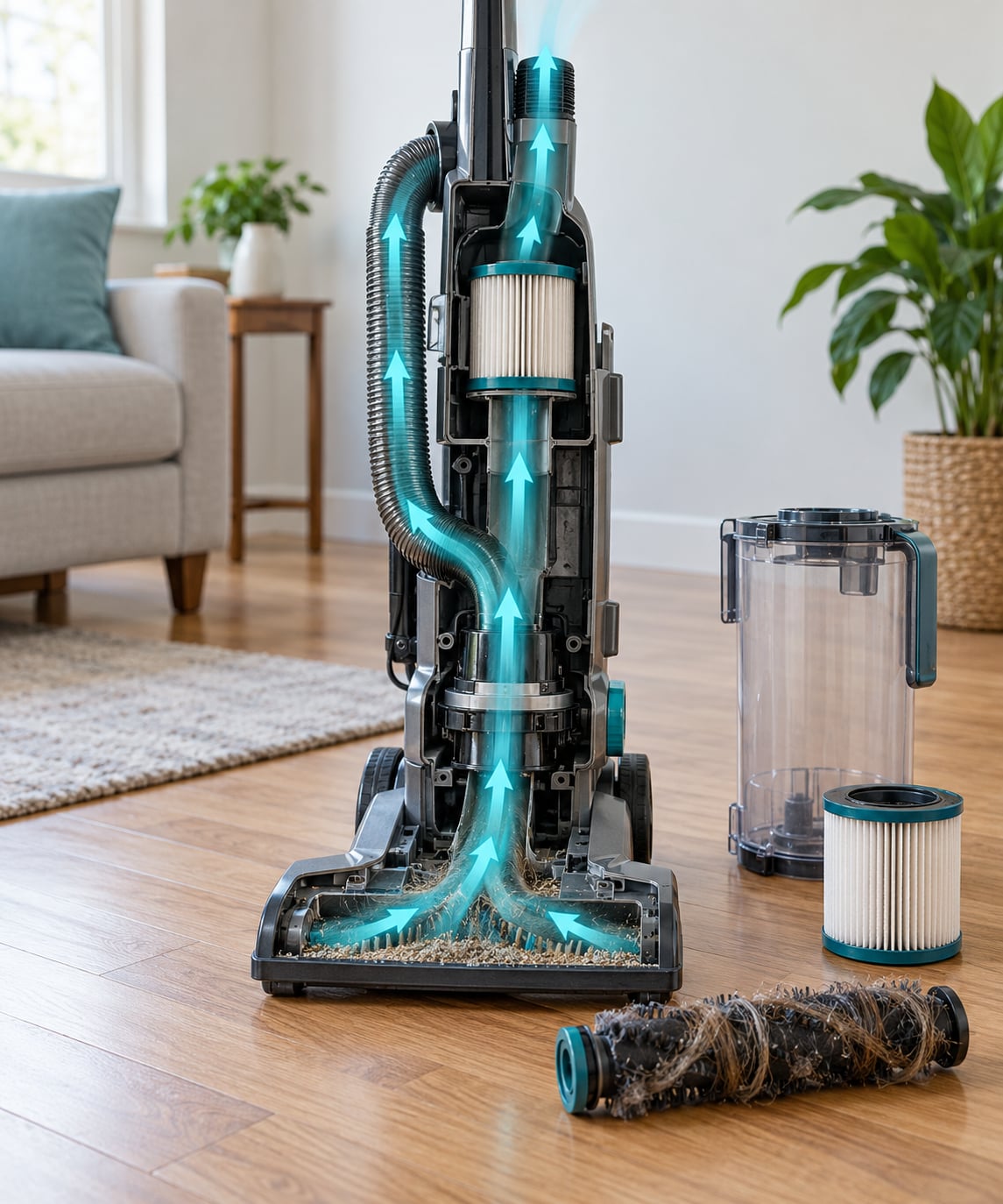
A vacuum makes suction by pulling air through a sealed path, from the floor head through the hose and wand, past the filters, into the bin or bag, and out the exhaust. When that path gets narrower, or a gap lets air escape early, the pressure at the floor head collapses. So when you ask why is my vacuum losing suction, the answer is almost always one of two things: something is choking the airway, or something is leaking.
The usual suspects in order are a full bin or bag, a clogged filter, a blockage in the hose or floor head, an air leak, a tangled brush roll, and on cordless models a tired battery. Most take under ten minutes to check. Updated for 2026.
Table of Contents
- Why Is My Vacuum Losing Suction? Quick Diagnosis
- What Causes a Vacuum to Lose Suction?
- Full dustbin or bag
- Clogged filters
- Blockages in the hose, wand or floor head
- Air leaks and broken seals
- Tangled brush roll or worn belt
- Low battery and thermal cut-off on cordless models
- Why is my vacuum losing suction right after you cleaned the filter?
- How to Fix Common Suction Problems Safely
- Why Does Suction Drop When the Vacuum Gets Hot?
- Why Does My Vacuum Have Good Suction but Leave Debris Behind?
- When Should You Replace or Repair the Vacuum?
- Frequently Asked Questions
- Why is my vacuum losing suction after a few minutes?
- Can a dirty or clogged filter make a vacuum lose suction?
- Why does my vacuum sound weak but still turn on?
- Is it normal for a vacuum to stop when it gets hot?
- How often should I clean my vacuum filter?
- When is it better to replace a vacuum instead of repairing it?
- Conclusion
Why Is My Vacuum Losing Suction? Quick Diagnosis
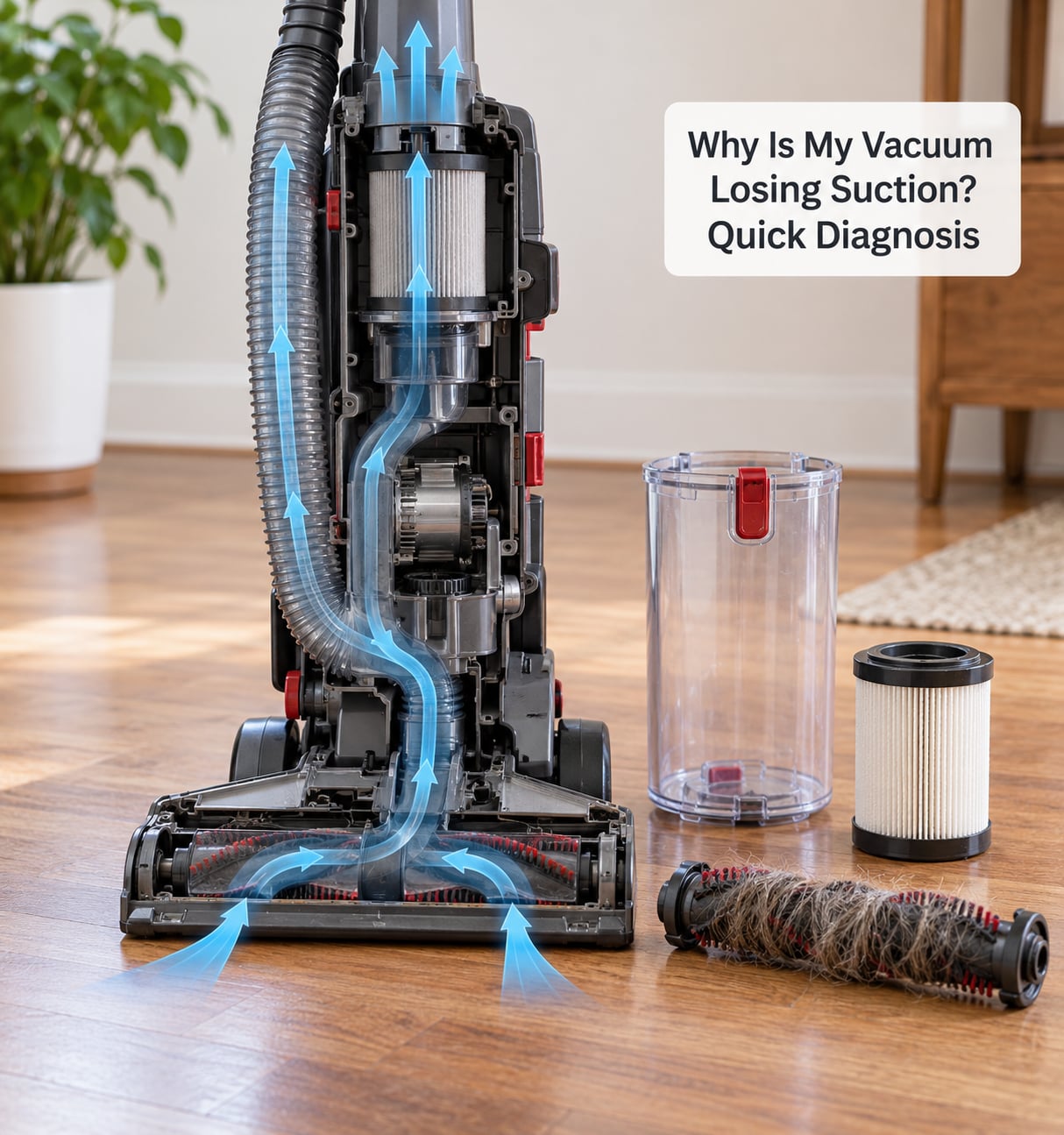
Start by matching your symptom to the likely cause. The table below covers the complaints that come up most, with the place to look first and how much of your evening it will cost you.
| Symptom | Most likely cause | Where to look | Difficulty |
|---|---|---|---|
| Weak on carpet only | Height setting or airflow gate not fully closed | Brush head lever, handle dial | Easy |
| Fine for two minutes, then fades | Overfilled bag or bin | Dust bag or canister | Easy |
| Loud roar, high pitch, motor straining | Filter packed with dust | Pre-motor and post-motor filters | Easy |
| Whistling or hissing sound | Air leak at a cuff, crack or lid | Hose ends, bin lid, wand joint | Easy |
| Strong at the hose, nothing at the floor head | Clog in the wand neck or floor head | Floor head intake channel | Moderate |
| Runs only a few seconds, then cuts out | Battery depleted or airflow sensor tripped | Battery, dock contacts, filter | Moderate |
| Spits crumbs back onto the carpet | Filter clogged so debris never reaches the bin | Filter housing | Easy |
| Brush stopped turning | Snapped belt or seized bearings | Baseplate under the brush roll | Moderate |
Before any of that, run the two-minute port test. Unplug the vacuum, pull the hose or wand off the machine, then power it on with your hand over the open port.
If the pull at the port is strong, the motor and filters are fine and your problem is in the hose, wand or floor head. If it feels weak, the restriction or the leak is inside the main unit, which narrows the search immediately. On cordless models, seat the filter back in and re-seat the bin before judging, because an unseated filter will fool the test.
What Causes a Vacuum to Lose Suction?
Suction is a pressure difference, and it only exists along a continuous sealed route. Restrict the route and the difference shrinks; break the route and the air simply takes the short way out. Both problems look identical from the floor: the machine gets loud and picks up less.
Full dustbin or bag
A bagged vacuum starts losing suction at around two-thirds full, well before it looks full, because the bag has to hold air as well as dirt. Bagless machines fare a little better but still choke once the bin packs down and the intake slots are covered.
Clogged filters
Filters are the most common single cause. Most machines have at least two: a pre-motor filter protecting the motor and a post-motor or HEPA exhaust filter. When either loads with dust, the motor is pushing against a wall. Hold the filter up to a light; if you cannot see clean daylight through it, it is time.
Blockages in the hose, wand or floor head
Socks, toy pieces and coins disappear into floor head necks without a sound. The common fast test is to drop a coin through the detached hose: if it does not come out the other end, that is your blockage. Hose bends and wand joints trap hair and dust even when nothing large went in.
Air leaks and broken seals
A cracked hose cuff, a bin lid that no longer seats, or a cracked intake gasket lets the motor breathe without pulling at the floor. Leaks announce themselves differently from clogs: you hear a whistle or hiss rather than a roar, and the suction feels weak even with the hose removed. A brush head set too high breaks the seal the same way, leaving the machine pulling from open air instead of the carpet.
Tangled brush roll or worn belt
Hair wraps around the ends of the brush roll and forms a tight band that stops the rotation. When the brush stops and the motor keeps running, you get a burning rubber smell. That is a belt or a brush problem, and it is not the same as a burning plastic smell from the motor itself.
Low battery and thermal cut-off on cordless models
A cordless vacuum at part charge runs the motor slower, and the weaker airflow triggers its sensors. Many also shut down after roughly 30 seconds of restricted airflow, which reads to owners as a dead machine rather than a protection feature.
Why is my vacuum losing suction right after you cleaned the filter?
Because the fix created a new problem. Four things do this reliably: the filter went back damp, it went back with detergent residue that sealed the fibres, it was reinstalled backwards so the rubber seal sat wrong, or the filter cage and gasket were not reseated. Any of them can leave you worse off than before, often with a musty smell alongside the weak suction. Let a washed filter sit a full 24 hours before it goes back in.
How to Fix Common Suction Problems Safely
Unplug the vacuum or remove the battery before you open anything. If the machine has picked up water or liquid, stop using it until a technician has looked at it; moisture reaches the motor and corrodes the windings and the electronics.
Work through the steps in order. Each one takes a couple of minutes, and stopping early is how people end up replacing a perfectly good machine.
- Empty the bag or bin. Take the container out and wipe the inside and the inlet slots. Check that the bin lid and gasket are seated properly afterwards.
- Clean the filters. Tap loose dust off outdoors, then wash only the ones your manual says are washable. Use cool water and no detergent if the manual says not to. Leave them 24 hours to dry fully.
- Look through the hose. Detach it and hold it to a light, or drop a coin through it. Push any blockage out from the far end with a blunt stick such as a broom handle or a plastic rod. Never use anything sharp, because a puncture turns a clog into a leak you cannot see.
- Clear the wand and floor head. Remove the soleplate, pull out hair and fluff from the neck and the suction holes, and check the intake channel behind the brush. A bent wire with a small hook at the end works well for compacted hair.
- Free the brush roll. Cut the hair band away with scissors along the ends and the axle rather than pulling it off; pulling is what damages bearings and end caps. Wipe the ends clean afterwards.
- Check the belt. With the brush removed, look for fraying, glazing or a broken belt. A rubbery smell means the belt, not the motor.
- Hunt for air leaks. With the machine running, run your hand along the hose, cuffs, wand joint and bin lid. Anywhere air escapes or whistles is the leak. Broken foam seals can often be reseated; cracked hose or collars usually need replacing.
- Check your settings. Return the height adjustment to its lowest sealed setting for carpet and close the airflow gate fully, or set suction to maximum in the app. Then run the vacuum empty for a minute to reset any sensor.
If the port test still feels weak after all eight, the machine itself is at fault rather than the attachments.
Why Does Suction Drop When the Vacuum Gets Hot?
Performance that fades as the machine warms up usually means restriction, not a dead motor. When the airway is choked, the motor works harder to move the same air, so it runs hotter. Many machines sense that and throttle down or cut out entirely as protection, which feels like the suction fading.
Corded machines have a related quirk: a long extension cord or a nearly spent cord drops the voltage at the motor, and the fan spins slower the longer you run. Cordless machines shut down after about 30 seconds if they decide airflow is too low, and the same logic makes some pulse on and off after a filter clean when the sensor is still reading the bin as full.
Normal overload protection is recoverable: clear the blockage or the filter, cool the machine for an hour, and try again. A fault that does not go away after cooling, with the filter clean and the bin empty, is a motor or electrical problem.
Why Does My Vacuum Have Good Suction but Leave Debris Behind?
Airflow and pickup are two different systems. Suction lifts the debris off the floor; the brush roll moves it into the path. When one fails, owners usually blame the other.
A worn brush roll with flattened or splayed bristles leaves lines of grit no matter how strong the pull is. Setting the head too high for the pile height lets the vacuum pull from the air above the carpet rather than sealing to it, so it feels powerful and cleans nothing. Over-suction at a gap in the nozzle or along the intake channel has the same effect.
Robot vacuums disguise this further. Dirty cliff sensors, a worn bin gasket, side brush tangles and an app suction mode left on low all read as lost suction, and many owners end up replacing a robot that only needed a wipe-down and a new filter.
When Should You Replace or Repair the Vacuum?
Stop using the machine and get it looked at if you notice a burning plastic or electrical smell, grinding or screeching from the motor, sparks near the brush or cord, or repeated shut-offs that survive a cool-down and a clean filter. Burning rubber smell from a stopped brush is a different story, and usually just a belt you can replace.
Beyond that, the split is between consumable wear and structural damage. Belts, filters, cords, brush rolls, hoses and wheels are meant to wear out; replacing them is normal maintenance. Cracked hose, a punctured cuff, a melted bin or a motor that will not hold speed is structural, and the cost of parts and labor starts to matter against what the machine is worth to you.
Check the warranty before buying any part, and check whether your model has a motor warranty longer than its parts warranty; several brands extend motor coverage when you buy the replacement filter or battery from them. If you are outside the warranty, weigh the repair against the machine’s age and how attached you are to it.
Well-maintained vacuums commonly run eight to ten years, cordless batteries nearer five to seven. Recurring clogs, repeated belt failures and grinding that returns within weeks are the pattern that says the machine is at the end of its useful life rather than the end of its warranty.
Frequently Asked Questions
Why is my vacuum losing suction after a few minutes?
A bag or bin that fills up during the run is the usual answer. Bagged machines start losing suction at around two-thirds full, and bagless bins pack down and cover the intake slots within minutes. A filter that only looks half clean can do the same thing by loading up on fine dust. Empty the container, hold the filter to a light, and run it again.
Can a dirty or clogged filter make a vacuum lose suction?
It is one of the most common causes. A loaded filter blocks the air path, so the motor pushes against resistance and the pressure at the floor head drops. Hold the filter up to a light; if light does not pass through it, clean it. Wash only filters your manual says are washable, and let them dry a full 24 hours before refitting.
Why does my vacuum sound weak but still turn on?
A running motor does not mean healthy airflow. A clogged filter, a blocked hose or a leak will all let the machine run while it moves less air than before. Listen for the difference: a roar points to a restriction, a whistle points to a leak. Do the port test with the hose removed to see whether the weakness is in the main unit or in the attachments.
Is it normal for a vacuum to stop when it gets hot?
On many machines, yes. A restricted airway makes the motor run hotter, and the machine throttles down or cuts out to protect itself. Cordless vacuums commonly shut down after roughly 30 seconds of low airflow. Cool it for an hour after clearing the blockage or filter. If it still stops with everything clean and empty, that is a fault worth having checked.
How often should I clean my vacuum filter?
Check it monthly with the machine off and unplugged, and clean it whenever you hold it up and cannot see light through it. Washable filters can usually be rinsed in cool water without detergent and left 24 hours to dry. Post-motor HEPA filters are often not washable at all, so check the manual before rinsing and replace those on their stated schedule instead.
When is it better to replace a vacuum instead of repairing it?
Replace it when the damage is structural rather than consumable: a cracked hose, a melted bin, a damaged cord or a motor that will not hold speed. Do not keep running a machine with a burning plastic or electrical smell, grinding, or sparks. If the same fault keeps coming back within weeks, or the machine is past eight to ten years, replacement usually costs less than another repair.
Conclusion
Unplug the vacuum and work in a fixed order: empty the bin or replace the bag, check the filter with a light, run the port test to split the problem between machine and attachments, then look down the hose and through the floor head neck. Most machines that feel dead are one of those four things.
If suction still fades when hot, treat the cut-off as a warning about restriction rather than the fault itself. And if a fresh filter somehow made things worse, suspect a damp refit, detergent residue or a backwards seal before you buy anything new.