Picking a campsite for beginners comes down to a short, ordered set of checks: make sure you are allowed to camp there, find ground that is level and drains away from your tent, stay a safe distance from water, look up for dead branches, and pick shelter from wind. Do those five things in that order and most bad nights disappear before they happen.
This guide walks through that process from the first search on a booking site to the moment you pull into a first-come, first-served loop. It takes about fifteen minutes to read and about five minutes to apply at the gate.
If you have never slept outside, the biggest mistake is overthinking it. You do not need a topographic map and forty reviews. You need a clear picture of what your trip actually requires, one campground that matches it, and a way to judge the ground when you get there.
Table of Contents
- What Should Beginners Look for in a Campsite?
- How to Pick a Campsite for Beginners
- Step 1: Write down what the trip actually requires
- Step 2: Shortlist three campgrounds, not thirty
- Step 3: Choose the campsite type
- Step 4: Read the campground page like a reviewer
- Step 5: Reserve, or plan your arrival
- Step 6: Walk the site before pitching
- Step 7: Reconfirm conditions the day before
- What Campsite Type Is Best for Your First Trip?
- How to Check Campsite Location and Access
- Should You Choose a Site With Utilities and Amenities?
- What Weather and Ground Conditions Should You Look For?
- How to Evaluate Campsite Safety Before Booking
- How Much Should Beginners Budget for a Campsite?
- What Questions Should You Ask Before Booking?
- Frequently Asked Questions
- How do I know if a campsite is suitable for beginners?
- What is the easiest type of campsite for a first camping trip?
- Should beginners choose a campsite with electricity and water?
- How far in advance should I reserve a campsite?
- What should I bring in addition to my tent and sleeping bag?
- How do I check whether a campsite is safe and accessible?
- Conclusion
What Should Beginners Look for in a Campsite?
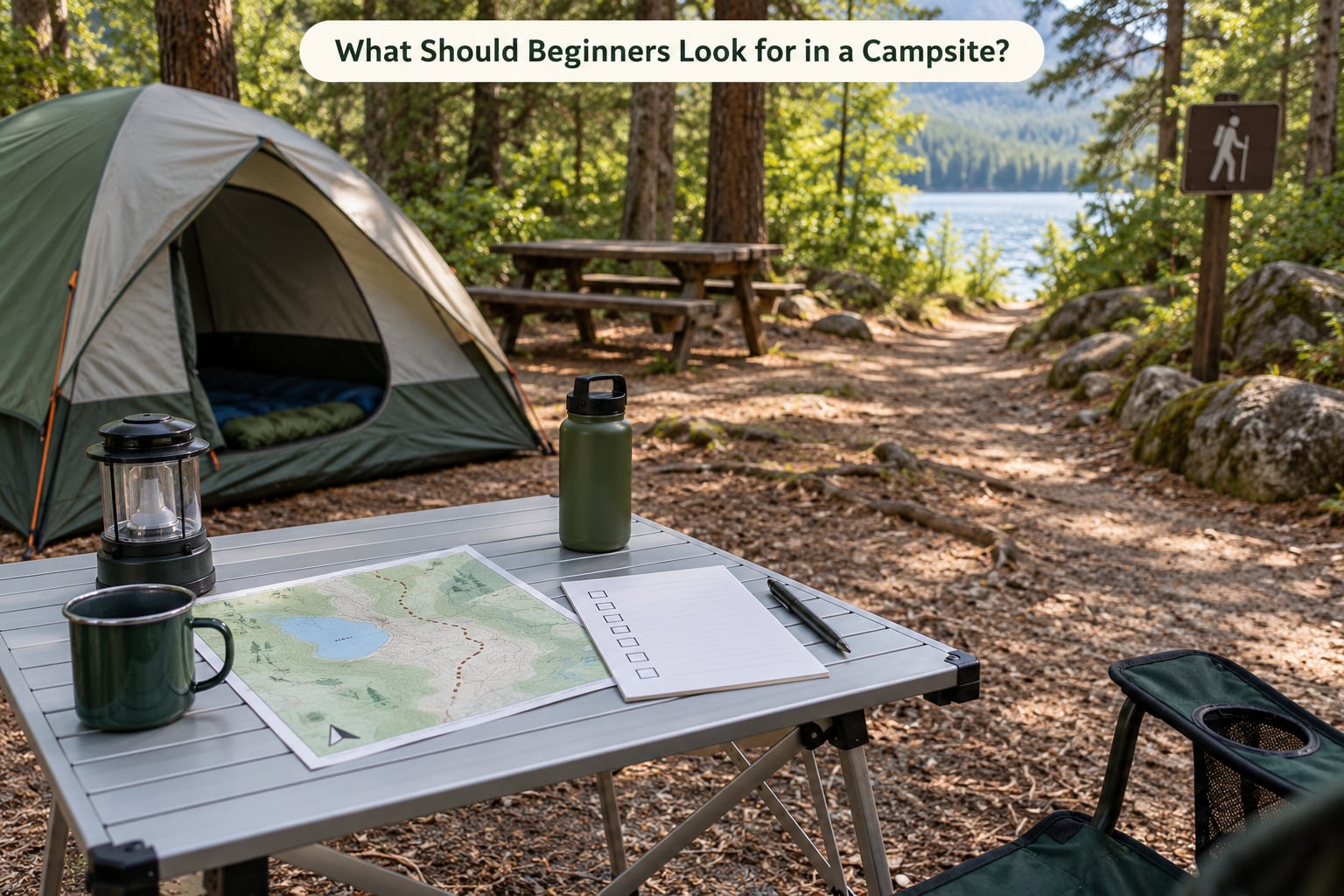
Some campsite features are requirements. Others are comforts you can live without. Beginners who cannot tell the two apart end up booking an expensive site for the wrong reason, or refusing a perfectly good one because it lacks a hot shower.
These are the features that actually decide whether a site works:
- Legal access. A designated site on land where camping is permitted. This is the one non-negotiable item.
- Level, durable ground. Flat enough to sleep on, firm enough to hold stakes, and sloped or positioned so water runs away from the tent rather than toward it.
- A safe distance from water. The Leave No Trace Center for Outdoor Ethics guidance is to camp, cook and dispose of waste at least 200 feet from lakes, rivers and streams. That is roughly 70 adult paces.
- Shelter overhead. Not a solid canopy, but enough tree or terrain to cut wind. Look up within a radius of about one tree height for dead branches, sometimes called widowmakers.
- Restrooms and drinking water. Not glamorous, but the single biggest quality-of-life difference for a first trip.
- Vehicle access that matches your rig. A site rated for a 40-foot trailer is useless if you drive a small car and the loop road is gravel.
Then there is the second column: showers, electricity, a campground store, Wi-Fi, a pool, extra-large pads. Those are conveniences. They are worth having when they solve a specific problem for your group, and worth ignoring otherwise.
How to Pick a Campsite for Beginners
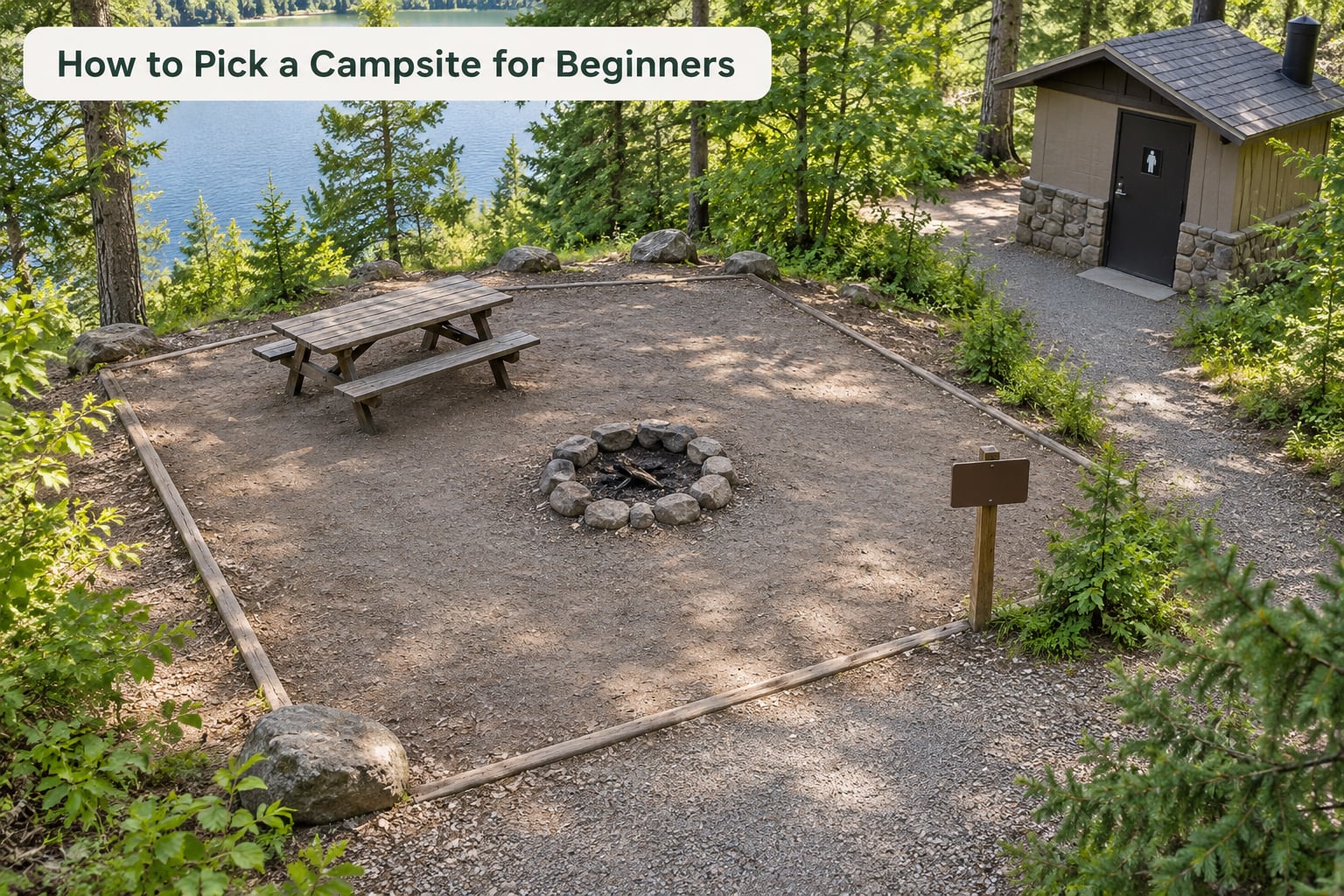
Here is the process in the order that saves the most time. Most people do it backwards, browsing pictures before deciding what they need.
Step 1: Write down what the trip actually requires
Before you open a single campground listing, note your dates, number of people, sleeping setup, vehicle type, tolerance for walking, and whether you are camping with kids, a dog, or someone who needs a restroom at midnight. Three nights of car camping with two kids has almost nothing in common with two nights in a tent on a hike-in site, and the sites that suit each are not comparable.
Step 2: Shortlist three campgrounds, not thirty
Search by driving distance first. A perfect site four hours away is a worse campsite than a good one forty minutes away, because you spend your entire first day driving. Filter for the features from the list above and you should be able to cut the field to three real candidates.
Step 3: Choose the campsite type
Decide whether you want a marked pad with a fire ring and a picnic table, a hike-in site, or a dispersed spot on national forest or Bureau of Land Management land. The next section covers which one fits a first trip.
Step 4: Read the campground page like a reviewer
Scroll past the hero photo. Look at the site map, the written description of each loop, and recent reviews where you search specifically for noise, bugs, cell signal and how close neighbouring sites sit. That last question comes up constantly and it is rarely answered in the official listing.
Step 5: Reserve, or plan your arrival
If the campground takes reservations, book the specific site rather than a whole campground, and check whether you can choose between loops. Busy loops near the bathroom and playground book out first, which tells you something about who else is camping there.
Step 6: Walk the site before pitching
At first-come, first-served campgrounds, arrive before sunset. Drive the loop slowly, park, and walk two or three candidate sites on foot before you commit. Standing water, low ground, overhead dead branches and neighbour noise are all obvious in person and invisible in a photo.
Step 7: Reconfirm conditions the day before
Check the National Weather Service forecast, the campground’s own alerts page, and any active fire restrictions. A clear forecast does not guarantee a safe site, but a forecast of heavy rain should make you ask where water will drain.
What Campsite Type Is Best for Your First Trip?
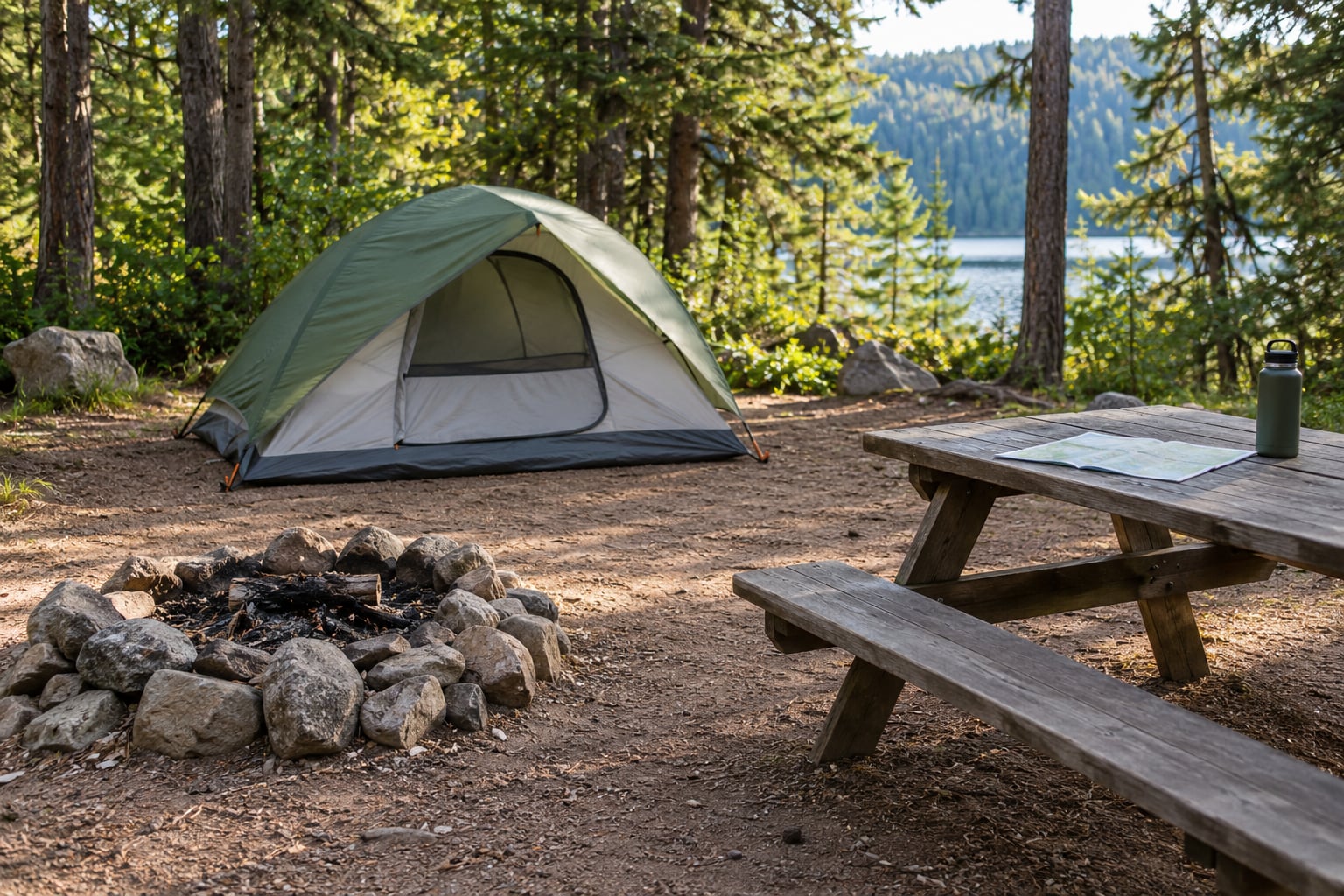
For a first trip, a developed campground is the right answer. Two or three nights at a campground with marked pads, restrooms, drinking water and a host on site will teach you far more than a weekend of dispersed camping in an unregulated spot.
| Site type | What you get | Suits a beginner? |
|---|---|---|
| Tent-only pad | Marked pad, fire ring, sometimes a water spigot, no vehicle hookups | Yes, the default choice |
| RV site with hookups | Wider pad, electric and water hookups, often a pedestal | Yes, if you need power for a fridge or medical device |
| Cabin or yurt | Enclosed shelter, beds, usually a private bathroom | Yes, and the lowest-risk first trip of all |
| Group site | One large pad or several pads under one booking | Only if you are travelling with a group |
| Walk-in or hike-in | A pad a short distance from parking, fewer services | Second trip, once you are comfortable carrying gear |
| Dispersed or backcountry | No pad, no facilities, no marked site | Not yet |
Dispersed camping means camping outside a designated site, usually on national forest or BLM land. It is beautiful and quiet, and it puts the whole burden on you: no site to inspect in advance, no restroom, no water, sometimes no legal access to the exact spot you had in mind. Rules vary by agency and can change with fire restrictions, so check with the land manager before you go.
Backcountry sites usually require a permit, and in many backcountry zones the permit specifies the zone rather than the exact pad, meaning you still choose your own site on arrival. That is a skill worth building on later, not a skill to test on a first trip.
How to Check Campsite Location and Access
Location is not just scenery. It decides how long your first and last hours take, whether you can bail out easily if the weather turns, and how many hours you spend in the car.
- Driving time, not mileage. Back roads at 25 mph make a 40-mile trip an hour and a half. Look at the map’s road type, not the straight-line distance.
- Entrance hours. Many campground gates lock at sunset for non-registered campers. Some host sites check you in late; some do not.
- Parking and turn-around. A loop with a tight corner or a low bridge can rule out a site entirely for a trailer or a truck.
- Distance from your real destinations. How far is the site from the trailhead, the lake, the town where you need groceries? Add 15 minutes each way for hauling gear.
- Cell service and emergency access. Look up coverage for the specific site before you go. Some remote campgrounds have no signal at all, which matters more if you are solo.
A good rule for a first trip: keep the campsite within an hour of a town with a grocery store and an urgent care, and the trip gets easier in ways you cannot predict in advance.
Should You Choose a Site With Utilities and Amenities?
Yes, for a first trip, and yes without apology. Full hookups and a flush restroom remove an enormous number of small frictions that have nothing to do with the fun part.
- Electricity means a warm tent on a cold night and a working phone charger. Check whether the pedestal supports your amperage and whether the site includes the connector or you need to bring one.
- Water hookups save you from hauling every gallon from a spigot. Confirm whether the water is potable and whether there is a separate non-potable spigot for washing.
- Sewer hookups only matter if you are in a large RV.
- Restrooms that are flush and indoors beat a vault toilet in the rain, particularly with kids.
- Showers matter more than most campers expect. A cold shower after a dusty day changes the mood of the entire evening.
- Dump stations matter only if you are towing.
- Wi-Fi and a campground store are conveniences, not criteria. Some campers love the store; others find it changes the feel of the trip entirely.
The trade-off is usually noise and crowding. Hooked-up RV sites cluster together, so you trade privacy for power, and you often land closer to a road or a generator. Read reviews for exactly this before you book.
What Weather and Ground Conditions Should You Look For?
Ground matters more than weather in how a night feels. A sloping site in mild wind beats a flat site in a gale every time.
- Drainage. Look for ground that tilts away from where the tent will sit. Low spots, swales and the inside of a bend in a road or trail are where water collects first.
- Durable surface. Bare rock, gravel, dry grass, pine needles and established dirt pitches well. Deep soft sand, thick mud, roots and duff under trees do not. The Leave No Trace principle of camping on durable surfaces exists partly because packed soil recovers slowly.
- Slope. Mild is fine. Steep ground means you are sliding downhill all night and your rain fly will channel water straight onto you.
- Flood and flash-flood risk. Camp well above stream banks and out of dry washes and canyon floors. A beautiful lakeside clearing is often all three of a cold sink, a bug magnet and inside a flood zone at once.
- Shade and sun. In summer, morning sun with afternoon shade is the comfortable pattern. In shoulder season, more sun is usually better than you expect.
- Wind exposure. A site behind a tree line or a rise loses points off your tent in a way an open field does not.
- Cold air. Cold dense air drains downhill and pools in depressions overnight. A hollow can sit noticeably colder than a spot twenty feet upslope.
Treat the forecast as one input rather than a guarantee. It tells you what the air will do, not where the water will run, and it will not tell you a dead branch is overhead.
How to Evaluate Campsite Safety Before Booking
Regulations differ by land management agency and change with the season. The US Forest Service, state park systems and the BLM each publish their own current rules, and a ranger at the gate is the final word on any site. Check the agency’s own site before you travel, and treat what you read here as a checklist rather than law.
- Hazard trees. Scan upward within about one tree height. Dead branches, split trunks and branches hung in other trees are the most common cause of campsite injuries.
- Fire restrictions. Many areas suspend campfires entirely during dry or windy conditions. A stage restriction means you may cook on a stove but have no fire ring use at all. Check the day you leave.
- Wildlife and food storage. Bear country requires a certified canister or a lock box, and the rules are specific about where you can store it. Keep food and scented items in the vehicle overnight where required.
- Insects. Standing water, wet grass and low ground are breeding grounds. If the ground around the site is damp and shaded, expect mosquitoes.
- Terrain. Cliffs, undercut banks, deadfall and steep drop-offs are reasons to walk on, not pitch beside.
- Neighbours. Look at how close the adjacent sites are and where their headlights will point. Privacy is a real selection criterion, and the top complaint in most camping forums.
- Medical access. Know where the nearest urgent care is and how long the drive takes. Note the campground address for dispatch.
One habit worth building on trip one: tell a person where you are going and when you expect back, and save your site location in your phone offline before you lose signal. It costs a minute and it is the single most common piece of advice in camping communities.
How Much Should Beginners Budget for a Campsite?
Campsite charges vary widely by region, season, site type and booking method, and the ranges you see online go stale fast. What moves a number up or down is more predictable than the number itself.
| Factor | How it moves the charge |
|---|---|
| Location | National parks, popular lake destinations and coastal areas sit at the top; rural county and forest campgrounds sit lower |
| Season | Peak summer weekends and holiday weeks cost the most; midweek and shoulder season cost the least |
| Site type | Walk-in and dispersed sites are cheapest; RV hookups, premium pads and cabins cost more |
| Occupancy | Some sites are priced per person rather than per site, so a full tent of six can cost more than two people at the same pad |
| Booking method | Reservations often carry a service charge; walk-up rates at the same campground can differ |
| Add-ons | Electricity, water, extra vehicles, pets and firewood are frequently billed separately |
These are typical patterns for US campgrounds, not quotes, and rates change regularly. Verify current fees and policies directly with the campground or the land manager before you budget around them. State parks usually run their own reservation system, while national forest and BLM sites go through Recreation.gov, so check the correct one for your destination.
What Questions Should You Ask Before Booking?
Most campgrounds publish their rules, but the practical details live in the replies. Send this list to the campground office, or check the FAQ page first and only ask what is missing.
- What is the maximum vehicle length and width that fits this site and on this loop?
- What are the actual site dimensions, and are they measured pad-to-pad?
- What time is check-in, and what happens if I arrive after the gate closes?
- Are pets allowed? Are there restrictions on size, breed or number?
- Is a campfire permitted, and is there a fire ring on the site?
- Are showers and restrooms seasonal, and are they open on the dates of my trip?
- What is the cancellation window and the refund policy?
- What are the quiet hours, and where do late arrivals typically park?
- Is there vehicle-length filtering on the reservation system, and can I pick a specific site or loop?
If the campground does not answer the two questions that matter most to you, site dimensions and late-arrival procedure, pick a different campground. Most of them answer quickly.
Frequently Asked Questions
How do I know if a campsite is suitable for beginners?
A site suits beginners when the basics are handled: it is a designated site where camping is permitted, the pad is level and drains away from the tent, you can park without blocking anyone, and restrooms and drinking water are close by. Check the map, the site description and recent reviews before you book, then walk the site on arrival. If you can pitch a tent, walk to the restroom and refill a water bottle without much trouble, it is a beginner site.
What is the easiest type of campsite for a first camping trip?
A tent-only pad at a developed campground is the easiest option for a first trip. You get a marked spot, often a fire ring and picnic table, plus restrooms, water spigots and a host on site. You can drive to it, unpack next to the car and leave if the weather is terrible. Cabins are even simpler if you would rather not sleep on the ground at all.
Should beginners choose a campsite with electricity and water?
For a first trip, yes. Electricity means a warm tent and a charged phone, and on-site water spigots save you hauling gallons from the car. Both make the first night easier and reduce the number of things that can go wrong before you have any idea what normal looks like. The trade-off is that hooked-up RV sites cluster together, so you usually give up some privacy and quiet. Read reviews for noise before booking.
How far in advance should I reserve a campsite?
Reserve as soon as your dates are fixed if the campground takes reservations, especially for summer weekends, holiday weeks and popular destinations where desirable sites sell out months ahead. Many campgrounds release rolling reservations on a schedule, so check when the next block of dates opens rather than assuming nothing is available. For first-come, first-served campgrounds, plan to arrive in the afternoon well before sunset so you can still assess the open sites in daylight.
What should I bring in addition to my tent and sleeping bag?
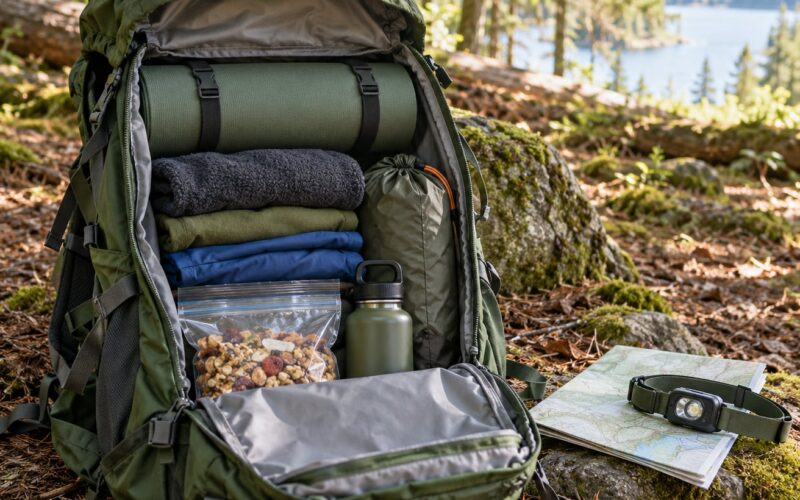
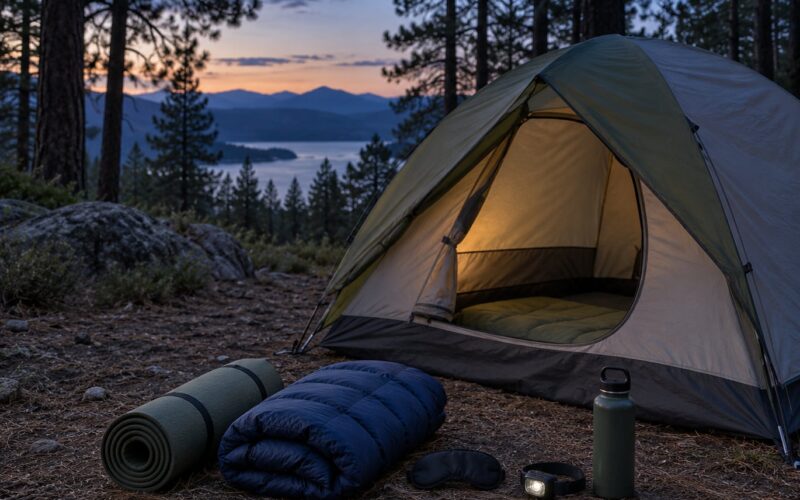
Bring a headlamp, a first-aid kit, a paper campground map or a downloaded offline map, a lighter or stove, a water container, and extra food than you think you need. For assessing a site specifically, a small hand trowel and a spare ground sheet are useful. Add a charged phone battery, a paper copy of your reservation, and insect repellent. If you are camping alone, share your itinerary and site location with someone at home.
How do I check whether a campsite is safe and accessible?
Read the campground page and recent reviews for fire restrictions, hazard tree notices, restroom condition and accessibility features, then confirm details with the office. Check National Weather Service forecasts and any active fire ban before leaving. On arrival, look up for dead branches within one tree height, stay at least 200 feet from water, and confirm your vehicle fits the loop. Rangers are the final authority on any individual site.
Conclusion
Start by writing down what your trip requires, then compare two or three campgrounds against that list rather than against a picture. Reserve early when the campground takes bookings, pick a site near the facilities for your first trip, and reconfirm the forecast and any fire restrictions before you leave.
When you arrive, give yourself daylight and ten unhurried minutes on foot. Legal access, level ground, clear sky and a safe distance from water will get you most of the way. Everything else is preference.