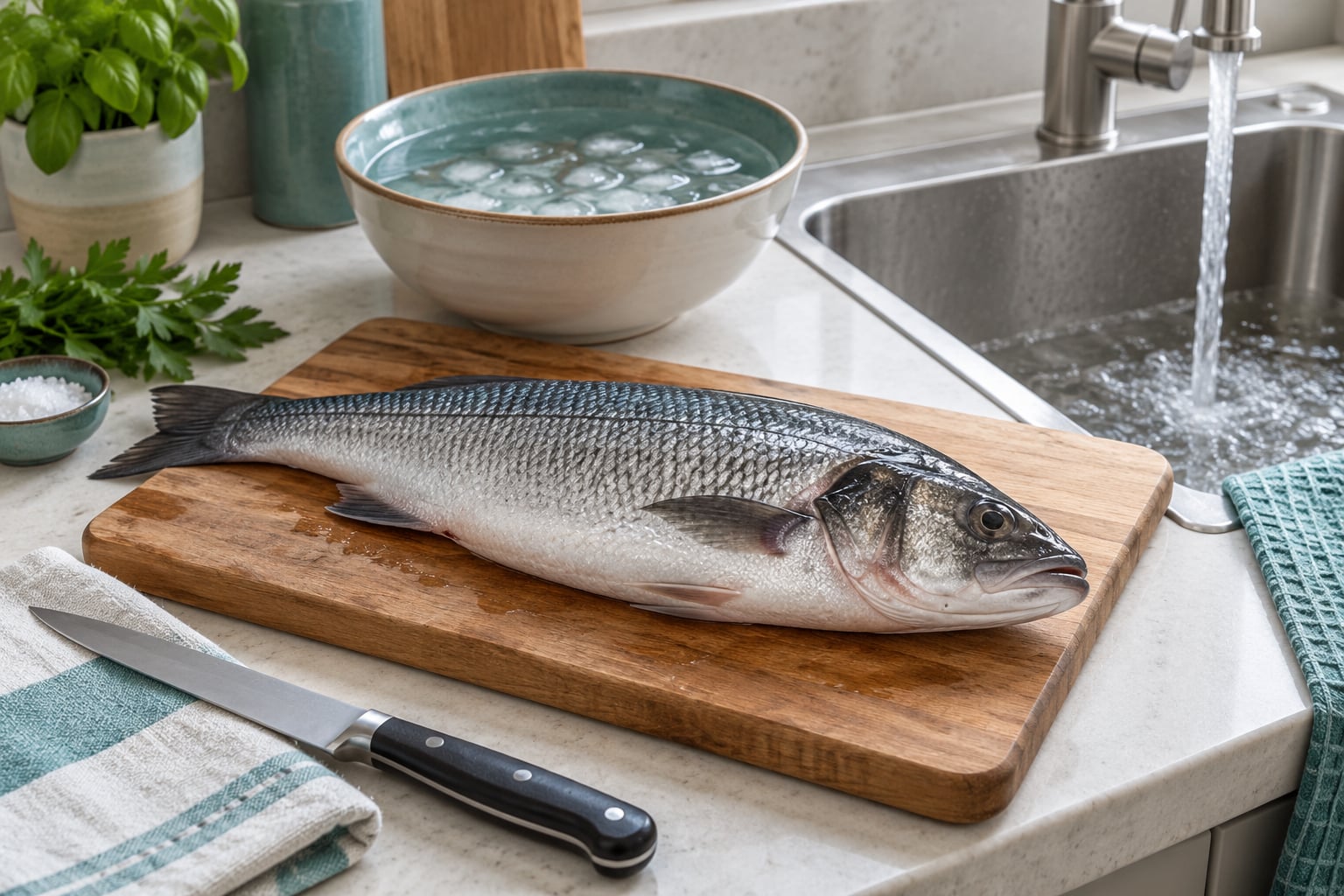
Cleaning a fish quickly is a matter of order, not speed: scale it before you make any cuts, trim the fins, gut it through the belly, then rinse with cold water and get it cold fast. With a sharp knife, a bowl of cold water and a sink full of running water, a whole fish goes from board to pan in about ten minutes.
Most of the delay people hit is not the cutting. It is scraping loose scales across the kitchen, then hunting for a peeler that is not there, then rinsing the blood line out of the cavity. Set the tools out first, do the messy work at the sink, and the rest is quick.
A note on freshness before we start: if the fish smells sour or ammonia-sharp, or has been warm for an unknown stretch, cleaning it will not make it safe to eat. Throw it out and start over with something fresher.
Table of Contents
- What You Need
- How to Clean a Fish Quickly: Step-by-Step
- 1. Set Up and Check the Fish
- 2. Remove the Head and Fins
- 3. Scale the Fish Quickly
- 4. Gut the Whole Fish
- 5. Rinse, Check and Dry
- 6. Store or Finish Prep
- Common Mistakes
- Frequently Asked Questions
- Should I wash fish with soap or baking soda before cooking it?
- Can I clean a frozen fish without letting it thaw first?
- How do I remove stubborn fish scales from the belly and fins?
- What is the black strip inside a whole fish, and should I remove it?
- How long can a cleaned whole fish stay in the refrigerator?
- Conclusion
What You Need

Rinse away the mess at the sink, not over the cutting board. Scales are light enough to travel across a kitchen, and they stick to countertops and floors for days.
- A sharp fillet knife or a flexible boning knife. Sharp matters far more than expensive. A dull blade crushes the flesh and slips.
- A sturdy cutting board, ideally one you keep only for fish and meat.
- A fish spatula, scaling device, or the back of a metal spoon for scraping scales off stubborn patches.
- A bowl of cold water for rinsing, plus a separate leakproof container for the discarded head, guts and fins.
- A clean towel or paper towels for patting the fish dry.
- Disposable gloves, optional but useful for cold, slippery fish with sharp fin spines.
- Something acidic such as lemon juice, lime or vinegar, and coarse salt, for scrubbing away odor before you cook.
Use two separate cutting boards if you cook for people who are fussy. Fish prepared on a board you later used for raw chicken is a fast route to cross-contamination, and it is easy to avoid.
Sharpen your knife before you start. Ten minutes on a honing rod beforehand beats fighting a dull edge on a wet, moving fish.
How to Clean a Fish Quickly: Step-by-Step
1. Set Up and Check the Fish
Look at the fish before you touch it. Clear eyes, firm flesh that springs back, gills that are bright red and cold, and a smell of clean ocean or nothing at all. Cloudy eyes and a sour or ammonia odor mean you should not be preparing it for eating.
Clear and dry the work surface, fill a bowl with cold water, and set your discard container next to the sink where you can reach it without walking away from the board. Lay the fish with its head pointing away from your non-dominant hand, so the knife travels in the safe direction.
Frozen fish can go from freezer to cold running water without thawing first. Hold it under the tap until the outer ice loosens, then work on it while it is still firm, or let it sit in the fridge until you can flex it.
2. Remove the Head and Fins
For a whole fish you plan to gut and roast, cut behind the gill plate and down through the backbone. That single cut removes the head and the gill plate together, which is where most of the odor lives.
Trim the dorsal fin, the anal fin and the tail with the knife or the fish spatula. Cut close to the body and angle the blade slightly away from your hand, because dorsal spines on bass, perch and catfish will puncture a fingertip without complaining first.
Drop every carcass piece straight into the discard container rather than leaving it on the counter. Keep the head if you want it for stock, where it is worth more than in the trash.
3. Scale the Fish Quickly
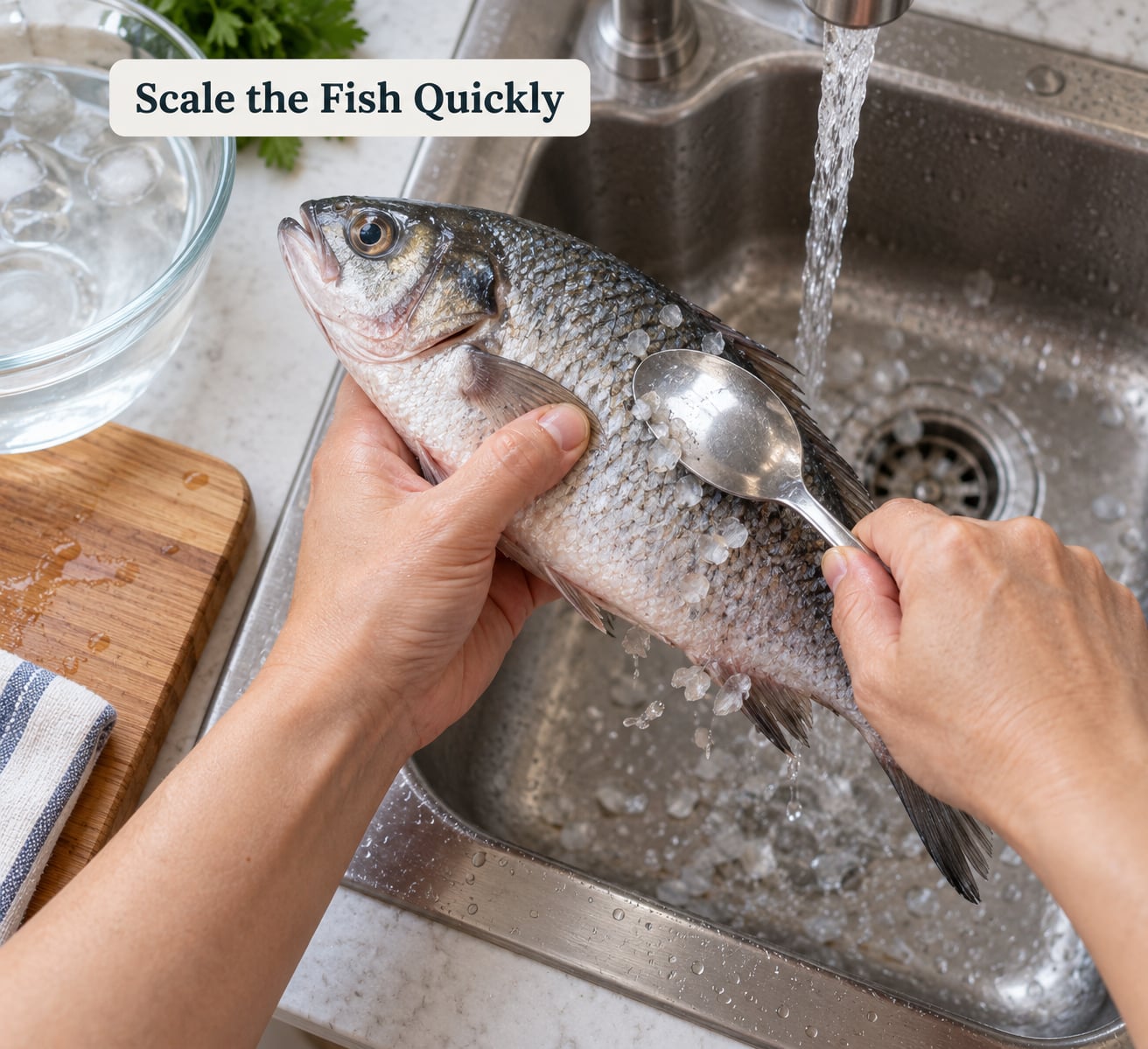
Do this before any other cut, because cut edges are harder to scale around later. Hold the fish firmly with one hand and scrape from the tail toward the head with short, firm strokes. Working toward the tail makes scales lift instead of drive themselves under the skin.
Scale over the sink, or submerge the fish in a filled sink and scale underwater. That contains the flakes almost completely, and it is the single fastest way to keep cleanup short.
For stubborn patches around the fins, jaw and belly, flip the tool over and use the back edge of the spoon or the corner of the blade, held shallow. Scrape until the skin looks uniformly matte rather than glittery, and check the belly line, where reflective scale patches hide.
Keep the blade shallow. Digging in to chase a patch is how you tear skin and take meat with it.
4. Gut the Whole Fish
Make a shallow cut from the vent, just ahead of the anal fin, forward toward the gills. Keep the blade angled slightly upward and shallow. The stomach sits on the other side of that cut, and the moment you break into it you are tearing organs instead of lifting them.
Reach in and pull out the viscera as one connected mass, attached membrane and all. Do not rip, since the gallbladder and the milky-sac contents are the fastest source of bitterness in a finished dish.
Look back into the cavity and check for anything you missed: roe, milky sac, loose organs. Along the backbone sits a dark, firm strip of blood line and kidney meat. Scrape it out with the knife edge or the back of the spoon. Some cooks leave it because it adds body to a stock, but on a fish you are grilling or frying it reads as muddy.
The belly should smell fresh and look clean when you are done. If it smells off, you either missed organs or the fish was not fresh to begin with.
5. Rinse, Check and Dry
Rinse the fish under cold running water, inside and out, then run your finger along the backbone, into the gill area and around the belly line to feel for anything gritty or sticky. Rinse the cutting board, the knife and the spatula at the same time. It costs ten seconds and it keeps the smell from moving around your kitchen.
Do not force water deep into the cavity with the tap pressure. A gentle stream, a light rinse with your cupped hand, or swishing the fish in the bowl of cold water does the job without pushing liquid into the flesh.
Never use soap, bleach, detergent or dish soap on fish you plan to eat. Those are for the sink after you are finished, not for the fish.
Pat the fish dry with a clean towel. Dry skin browns better, and a damp fish steams instead of searing.
6. Store or Finish Prep
Keep raw fish at or below 40°F, which is 4°C. A covered container set on a bed of ice in the coldest part of the fridge works well; ice packs in a cooler work just as well if you are not done cooking for a few hours.
The two-hour rule is the limit for perishable seafood at room temperature, and one hour when it is above 90°F, which is 32°C. A whole fish left on the counter through dinner is past that point even if it still smells okay.
For frozen storage, seal the fish in a freezer bag with as much air pressed out as you can, label it with the date, and lay it flat so it freezes evenly. A whole cleaned fish keeps well for three to six months in the freezer, and a fresh fillet one to three months.
If you are cooking straight away, skip all of that. Season it and get it into the pan. Cleaning changes none of the cooking rules: fish is done at 145°F internal, which is 63°C, measured at the thickest part.
Common Mistakes
- Using a dull knife. It crushes flesh, slips off skin and slows you down more than any other habit. Hone or sharpen before you start.
- Cutting toward your gripping hand. Lay the fish with the head away from you and let the blade travel away from your knuckles, not toward them.
- Scraping from head to tail. Scales sink in instead of lifting. Always go tail to head.
- Skipping the fin lines and belly. Scales hiding along the fin bases and the belly line are what leave you picking flakes out of the finished dish. Scrape those areas twice.
- Puncturing the stomach. Cut shallow from the vent forward. A sliced stomach means bitter fish and a sink full of organs.
- Leaving the blood line behind. The dark strip along the backbone turns bitter over heat. Scrape it, or accept that the fish is destined for stock.
- Rinsing with soap or warm water. Warm water cooks the surface and dulls the texture. Cold water only, and never any detergent on food.
- Reusing the unwashed board. Rinse the board, knife and spatula right after the fish. Odor and bacteria both ride on the surface.
- Storing in a leaking or uncovered container. A covered container on ice prevents contact with raw meat below it in the fridge and stops the smell from taking over the shelf.
- Delaying refrigeration. Once cleaned, get it under 40°F within the two-hour window. Gutting does not stop spoilage.
One habit makes the second cleanup faster than the first: do the entire job at the sink. Scaling, gutting and rinsing all happen in the same three feet of space, so there is nothing to carry, drip or trail across the kitchen.
For the smell on your hands and knife afterward, a squeeze of lemon or a wipe with a damp cloth and a drop of dish soap works. Scrub the board with coarse salt and a little lemon, then rinse.
Frequently Asked Questions
Should I wash fish with soap or baking soda before cooking it?
Never use soap, bleach or detergent on fish you plan to eat. Those belong to the sink and equipment, not the food. Baking soda is harmless in small amounts and a mild deodorizer, but cold running water and a squeeze of lemon do the same job without leaving anything to rinse off. Rinse under cold water, pat dry, and move on.
Can I clean a frozen fish without letting it thaw first?
Yes. Run the fish under cold water until the outer ice loosens, then scale and gut it while it is still firm enough to handle. Working semi-frozen reduces slippage. If you prefer a fully thawed fish, move it to the fridge for several hours rather than the counter, so the outside never sits in the danger zone while the middle thaws.
How do I remove stubborn fish scales from the belly and fins?
Use the back edge of a metal spoon or the corner of your knife, held almost flat against the skin. Work in short strokes from the tail toward the head, then circle the fin bases and the belly line where patches hide. Scaling the fish submerged in a filled sink keeps the loose flakes contained and makes this job much faster.
What is the black strip inside a whole fish, and should I remove it?
That dark strip along the backbone is the blood line and kidney meat. On a fish you are grilling or frying, scrape it out with the knife edge or the back of a spoon, since it can taste muddy over heat. Plenty of cooks leave it in when the fish is destined for a stock, where it adds body rather than bitterness.
How long can a cleaned whole fish stay in the refrigerator?
A cleaned whole fish keeps one to two days in the fridge at or below 40°F, which is 4°C, stored covered on a bed of ice in the coldest part of the fridge. For longer storage, seal it in a freezer bag with the air pressed out and freeze flat for three to six months. Never leave it at room temperature past two hours.
Conclusion
Start by getting a sharp knife, a board used only for fish and a bowl of cold water within reach, then inspect the fish before you touch it. Scale from tail to head at the sink, cut the head and fins, open the belly shallowly from the vent, pull the viscera and the blood line, and rinse everything under cold water.
That is the whole job. How to clean a fish quickly is really about sequence and setup: scale before you cut, gut before you fillet, and get the fish cold within the two-hour limit. Ten focused minutes and the rest of the cooking is easy.